

Quad Cities Marathon
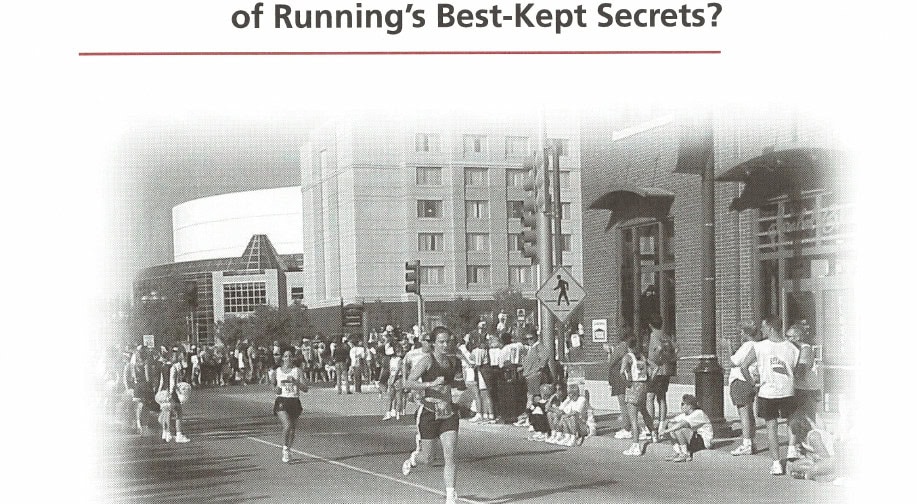
MAYBE THERE’S something to this Indian lore. As legend has it, the God of Water was traveling southward carving the Mississippi River when he was so distracted by the beauty between what is now Iowa and Illinois that he cast his glances sideways. These glances caused the river’s course to be altered forever, though just for a short while before resuming its southerly direction.
What settles now on that lone east-to-west flow, straddling the mighty Mississippi, are the Quad Cities: Rock Island, Moline, and East Moline on the Illinois side, and Davenport and Bettendorf on the Iowa side. (Please overlook that technically these should be called the Quint Cities—it’s sort of like the 11-team Big Ten Conference, surely a Midwestern phenomenon.) Linked by suspension, steel-arch, and swing bridges, the Quad Cities were primed for a marathon countdown: five cities connected by four bridges participating in three races across two states along one storied river.
| The Basics | |
|---|---|
| Quad Cities Marathon 920 15th Avenue East Moline, IL 61244 |
|
| PHONE: | 309/751-9800 |
| FAX: | 309/788/7898 |
| WEB SITE: | www.qcmarathon.org |
| RACE DIRECTOR: | Joe Moreno |
| YEAR RACE ESTABLISHED: | 1998 |
| SANCTION: | USATF |
| START TIME: | 7:30 a.m. for the marathon, relays, and 5K |
| COURSE RECORD HOLDERS | |
| Open men: | Bob Simmons, Iowa, 1999, 2:26:43 |
| Open women: | Christy Nielsen, Iowa, 1999, 2:56:31 |
| Masters men: | Steve Wilson, Indiana, 1999, 2:39:30 |
| Masters women: | Mary Burns-Prine, California, 1998, 2:59:55 |
| Five-person relay: | Endurance: Bryan Glass, Dan Fredericks, Tauwon Taylor, Ravi Bhave, Jacob Kaemmer, 1999, 2:20:44; 30-Something Babes: Barb Lauff, Sandy Guise, Theresa Grimes-Beck, Jodie John, Sheryl Luense, 1999, 3:01:00 |
| Two-person relay: | Open men: Steve Brenner, Ken Lauff, 2:38:05 Open women: Lauren Thompson, Dawn Brooks, 2:58:24 |
| PRIZE MONEY | Open division: 1st, $1,250; 2nd, $1,000; 3rd, $750; 4th, $600; 5th, $500; 6th, $400; 7th, $300; 8th, $200; 9th, $100; 10th, $50 Masters division: 1st, $250, 2nd, $100; 3rd, $50 |
| TIE-IN EVENTS: | Kids’ runs; two-person relay; five-person relay; 5K |
| NUMBER OF VOLUNTEERS: | 900 |
| MARATHON FINISHERS IN 1999: | 573 |
| MALE/FEMALE FINISHERS: | 73% male/27% female |
| COURSE MARKINGS: | Every mile |
| NUMBER OF MEDICAL STATIONS: | 5 |
| NUMBER OF WATER STATIONS: | 18 |
| FUTURE RACE DATES: | 09/24/00; 09/23/01; 09/22/02 |
| ENTRY COST FOR 2000: | $35 postmarked by Sept. 11; $40 through Sept. 23; $50 race day; 5-person relay: $100 postmarked by Sept. 11; $125 through Sept. 22; $150 on Sept. 23; 2-person relay: $40 postmarked by Sept. 11; $50 through Sept. 23 |
| AREA HOTELS: | The Quad Cities Convention & Visitors Bureau has initiated a Sports Accommodations Connection service, in which lodging arrangements can be made and special rates are available. Participating lodging include the host hotel, Isle of Capri (formerly Lady Luck), Bettendorf (800/724-5825); Radisson on John Deere Commons (309/764-1000); Jumer’s Castle Lodge, Bettendorf (319/359-7141); Holiday Inn, Davenport & Moline (319/391-1230); Plaza One Hotel, Rock Island (309/794-1212); Davenport Inn, Davenport (319/386-1940); Heartland Inn, Davenport & Bettendorf (319/355-6336); Signature Inn, Bettendorf (319/355-7575); Best Western, Moline (309/762-9191); Baymont Hotel & Suites (319/386-1600); Super 8, Davenport (319/388-9810). There is also a toll-free number to make reservations: 800/373-9609. |
| GETTING THERE: | The Quad Cities (Davenport and Bettendorf in Iowa and Moline, Rock Island, and East Moline in Illinois) are served by three interstate highways (I-80, I-74, and I-88) and several state highways. On I-80 east from Des Moines, Iowa, or I-80 west from Chicago, take I-280 to I-74. Take the I-74 exit north to downtown Moline, which is the last exit before reaching the Mississippi River. Quad Cities is 180 miles from Des Moines, 60 from Iowa City, 200 miles from Chicago, and 100 from Peoria, Illinois. The Quad Cities Airport at Moline is four exits (including the I-280 turnoff) from the downtown. A map is available at the Web site. |
A RUNNING NICHE
When race director Joe Moreno approached the Quad Cities Sports Commission three years ago with his vision of having a marathon become the organization’s signature event, he wasn’t looking for a way to put the Quad Cities on the national long-distance running map. He merely wanted to give the Sports Commission, and the Quad Cities, an opportunity to put on a quality event while filling a gap for area running enthusiasts.
Little did Moreno know that the completion of the first Quad Cities Marathon in 1998 helped carve the Quad Cities a national niche of their own. It took national running hero Frank Shorter, the 1972 U.S. Olympic marathon gold medalist and spokesman for the QC Marathon since its inception, to point it out: “There are very few cities that have both a major road race and a major marathon,” said Shorter, noting the Quad Cities’ midsummer Bix 7 road race that draws over 20,000 runners annually (including longtime spokespersons Bill Rodgers and Joan Benoit Samuelson, as well as Shorter himself on a few occasions). “Boston, Chicago, and New York have major marathons but no major road races. Los Angeles has a marathon but no major road race. Yet the Quad Cities now has both.”
Plus, by drawing 1,305 runners in its five-person relay, the Quad Cities Marathon received some bonus recognition, becoming the fifth largest relay in the nation, according to USA Track & Field. In 1999, Quad Cities expanded its running opportunities even more, adding a two-person relay. Though the two-person cut into the impressive, first-year five-person numbers a bit, having 290 and 1,030 runners, respectively, both Shorter and Moreno think that offering a 13.1-miler will serve the Quad Cities Marathon best in the long run.
“This will provide a unique opportunity,” Shorter said. “The niche is it being a developmental training run for marathon runners or first-time marathoners, introducing them to an actual marathon. It can be more of a regional race. Then, eventually, it will grow from a developmental run to the marathon they want to run.
“For those who run in Chicago (in October), this can be a nice complement. Maybe they run here in the relay and run here in the marathon the next year. That’s the hope.”
DREAM COME TRUE
Aware of the Bix 7 success, Moreno figured a marathon in the Quad Cities could catch on, but it had to be more than just a marathon.
“We want this to be for the entire family,” the race director said. That’s why organizers, including the Bix-operating Cornbelt Running Club, not only added the relays but also a 5K and three different kids’ runs.
“A year ago we were very nervous because we had an unknown quantity,” Moreno added. “But we’ve established ourselves very well.”
“We all wondered about a certain feeling of competition because of the Bix,” Shorter added, “but this is one of the few examples where people actually get along in this regard.”
PRERACE SPECIALTIES
Miss the symposium at the Health and Fitness Expo at the Lady Luck Convention Center on the eve of the race, and you’re really missing out. “This symposium is one of my favorites,” Shorter says. “They should take this show on the road.”
Shorter continued, “There was a 71-year-old runner, a first-timer, last year’s (women’s) champ, and me. We told of our attitudes and goals, but the way we expressed ourselves was the same. The feelings they had were the same as
Must See/Must Avoid
GO SEE IT
Casino riverboats. You have a choice of three: the entertainment-spiced Isle of Capri (formerly Lady Luck), the huge President in Davenport, and the former paddlewheeler Casino Rock Island. All are dockside. The buffets from the two on the Iowa side drew rave reviews from the 40,000 women bowlers who visited the Quad Cities during the Women’s International Bowling Congress national tournament two years back.
The Mark of the Quad Cities. The 10,000-seat arena has hosted the biggest entertainment and concert names, and some might even be around the QC Marathon date. Elton John played to a sold-out crowd eight days after the 1999 marathon. Later that same month came Tom Petty and the Heartbreakers, ZZ Top, and 98 Degrees. Call The Mark before you make your plans to visit the Quad Cities to see what’s available.
Deere World Headquarters. Product display exhibits for the Deere organization’s world headquarters are daily and free. Call 800/765-9588. Also, at the QC Marathon start/finish line is the John Deere Commons, a must-see for visitors offering another unique look at the world-famous farm-implement manufacturer. It includes a $7 million exhibition hall that pays tribute to the Deere heritage, agriculture, and farm-implement business.
Niabi Zoo. A hit with the kids, especially the elephant, Kathy Sha-Boom. Fall hours are noon to 5 p.m. weekdays and 9:30 a.m. to 5 p.m. weekends. There’s an admission fee, with children under 3 free.
Circa ’21 Dinner Playhouse. Marathoners will run past it during the Rock Island portion of the 26.2-miler. Located in the old Fort Theater, it has been producing Broadway musicals for the past 21 years.
Quad City Botanical Center. You’ll run past it, too. This new addition to Rock Island has a main attraction of a 6,444 square-foot indoor Tropical Sun Garden conservatory featuring a 14-foot waterfall, reflecting pools with Japanese Koi fish, hundreds of tropical plants and trees, and colorful flowers that change each season. Admission is $3.50 for adults, $1 for ages 8 to 17.
Putnam Museum. Very interesting stopping point. It includes a 3,000-year-old Egyptian mummy, life-sized polar bear in its Hall of Mammals, and a noteworthy history of the Quad Cities through the ages. It also has several seasonal special showcases. Admission is $4 for adults, $2 for ages 5 to 17.
Bettendorf Kids Museum. A hands-on museum with science and art exhibits. The kids should love it. Admission is $4/person.
AVOID IT
Don’t even think about doing something crazy on the I-74 bridge or Arsenal Island. Both are under the firm hand of our government.
mine; it’s just that mine were a little higher because of the Olympics.”
Shorter also gave a lengthy talk, including an informative question-and-answer session, at the Pasta Party, which featured carbs from Fazoli’s at $10 per ticket.
On the down side of the expo, attendance was sporadic (some say because mandatory packet pickup was not tied into it). And while there were 30 exhibition booths, according to two-time QC women’s runner-up Nancy Stanley of Lincoln, Nebraska, one necessity was missing. “It would have been nice to have some water there,” she mentioned. “They probably figured as runners we would bring our own, but some didn’t. I do recommend having refreshments at the expo.” Race organizers have vowed to make the expo more of a runner, and exhibitor, magnet in 2000 and beyond.
Course Attracts Flowery Adjectives
Shorter called the Arsenal Island portion of the QC course (miles 11 through 17) “serene.” Jeff Joyner, a dental student at the University of Iowa, took note of the course’s entertainment, calling it a spirit lifter. Daniel Dukoff of Bulgaria, the number two finisher in 1999, took note of the course’s beauty. “It’s very nice, very fast,” he said in his first visit.
And relay participants Marta and Steve Verschoore of Milan, Illinois, pointed to the course’s organization. “It’s nicely staffed,” said Steve. “From the relay transportation to the water stops to the medical tents and the end of exchanges, it was all very smooth,” Marta added. “They have buses going every 15 to 20 minutes. I had only a 10-minute wait to leave for my relay exchange point, and then when my relay leg was finished, five minutes later there was a bus and I was on my way back to the finish line to see my team come in. It was great.”
Like Shorter, Steve Verschoore also was taken by the Arsenal Island beauty. “The river, the golf course, the park, the old homes, I really enjoyed that part of the relay.”
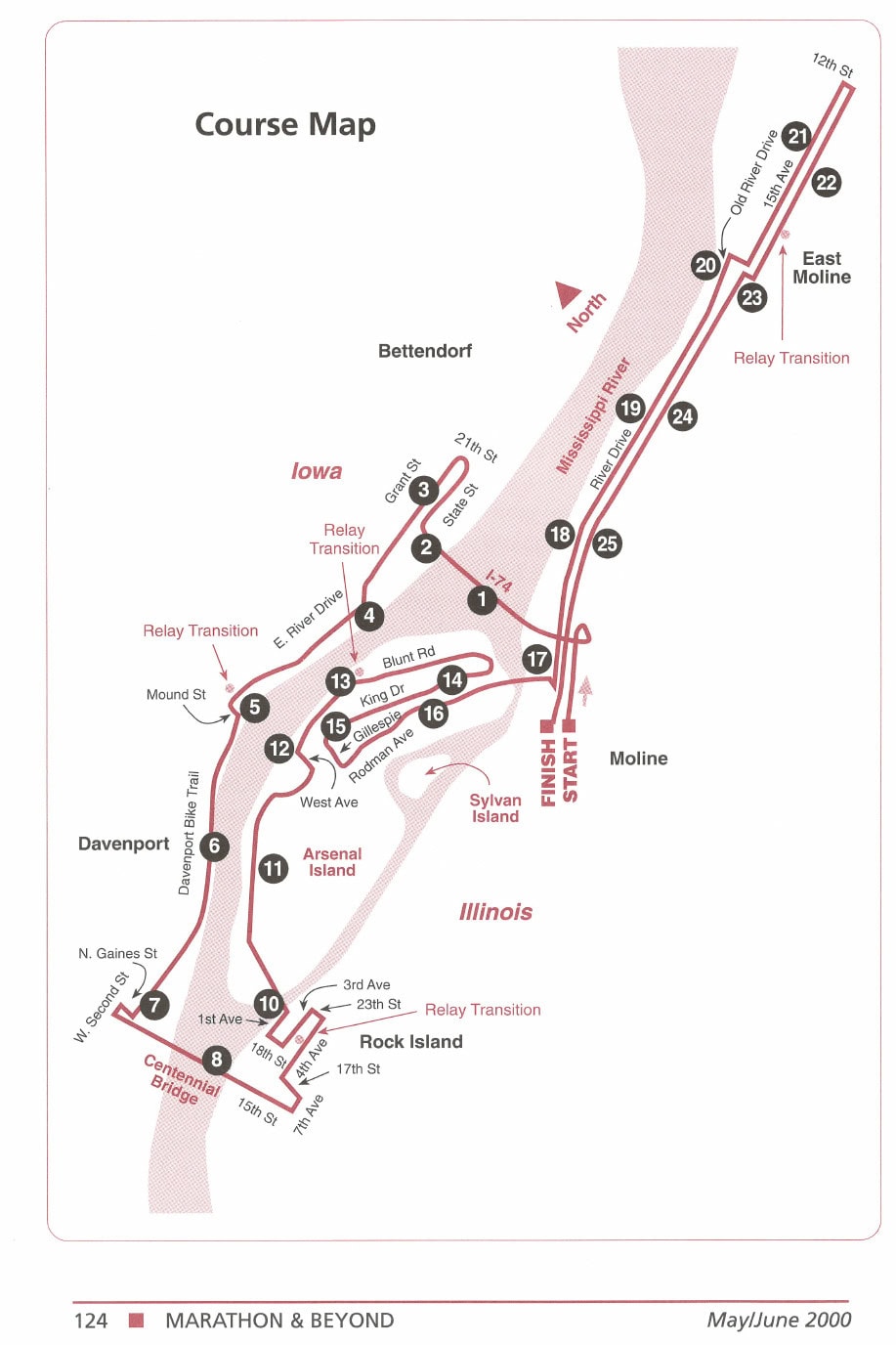
The course begins at the John Deere Commons, now a hotbed of activity on the Moline riverfront, highlighted by The Mark of the Quad Cities, a 10,000-seat arena that houses three minor-league professional sports teams: the Quad City Mallards in hockey, the Quad City Thunder in basketball, and the Quad City Steamwheelers, an arena football team. The Mark has been voted Arena of the Year in each of its four years of existence. With the 5Ks, one-fifth of the five-person teams, and half of the two-person teams joining the marathoner runners (1,282 in 1998 and 646 in 1999), it makes for quite a backdrop and an exhilarating start.
Though the first QC Marathon opened in unseasonably humid conditions, the temperatures were perfect a year later when the Sports Commission moved the event back a week to the last Sunday in September.
With the 5K runners heading straight on River Drive, the marathoners veer off after a half-mile onto the I-74 Bridge. This is the highlight of the first leg of the relays, with traffic blocked off for the east lane and snail’s-pace traffic remaining in the west lane of the Iowa-bound half of the suspension bridge. Travelers crossing the bridge at that time have become big marathon fans, and the runners certainly appreciate their moving encouragement.
Exiting off the bridge into Bettendorf, Iowa, the course heads right past the Isle of Capri Casino (formerly Lady Luck), one of three gambling riverboats that decorate the riverfront along the way. For all but 1+ miles of the next 6 miles, it’s all a cozy stroll along the Davenport, Iowa, riverfront, passing John O’Donnell Stadium—called the owner of the most scenic view in minor-league baseball—at mile 7.
Next to the stadium, and next up for the runners, is the Centennial Bridge. The arched structure is most beautiful at night when all lit up, but it provides an awesome view of the Mississippi by day, especially of the Government Bridge to the east. It has a swing to let barge traffic through.
After 2+ miles through Rock Island’s historic district—the best of the Quad Cities’ downtown areas with its entertainment and fare—it’s on to Arsenal Island, Shorter’s favorite stretch. The Olympic gold-medalist ran the third leg of a five-person relay the first year, and the first half of a two-person team in 1999, and it’s no surprise that both included this portion of the course. “I do love the Arsenal,” Shorter said. “It’s so pretty out there.”
At mile 17 comes the fourth bridge, which goes from the Island back to downtown Moline. It’s a tough portion of the course because you again see the Start/Finish line, but have to turn left and head toward East Moline and back for the final 9 miles.
Knowing that this out-and-back along the Illinois side of the river would be a tough portion to complete, Moreno came up with a unique addition. “It’s said that marathoners hit the wall at the 22nd mile. So, what we did was erect a huge wall at that mile post so that runners could literally run through it.” The wall is uniquely decorated, and runners can hear the encouragement of high-school cheerleaders as they run through it. In fact, of all the entertainment provided at more than every mile, it was the cheerleaders’ enthusiasm that drew the most positive comments from runners.
The course underwent a slight change between years one and two. Because a Davenport Riversance Festival had the rights to Mound Street in the Village of East Davenport, the QC Marathon had to continue on River Drive until meeting up with the Davenport Bike Trail just south of Mound Street. Despite the changes, the course remained certified by the USATF.
Runner’s High/Runner’s Low
Highs
- Fast flat course
- Eye-catching scenery of the Mississippi riverfront and Arsenal Island
- Over 40 bands and entertainment groups on the course
- Opportunity to run across an interstate bridge
- Opportunity (for men) to run on a government installation without a shirt
- Appealing T-shirt and flashy finisher’s medallion
- Possible chance to run with Frank Shorter (he has participated in the first two, but in 2000 has a conflict, as an Olympic commentator)
- Start and finish at The Mark of the Quad Cities arena, with plenty of parking
- Inclusion of relay participants offers a marathon-training avenue
- Good media coverage of event by two sister newspapers: The Dispatch (Moline, IL) and The Rock Island Argus
Lows
- Expo not well attended
- Wind off the river makes for a tough final four to five miles
- Fickle Mother Nature (warm temperatures the first year; a brisk wind the second year)
- Field closes early
Endorsements
“I don’t do too many repeats (of marathons),” masters runner Rudy Estrada of Milwaukee said, “but this is a great course and there’s great camaraderie. I come back to my favorite ones, and I think I’ll be back here. . . . I’ve run in 65 marathons, and Boston, of course, is my number one. But this one’s in my top five.”
For Nancy Stanley, a pair of runner-up finishes in her two years at the race may put Quad Cities on an even higher perch for her. “My plans are to be back,” she says. “It’s a great race. It’s six hours from my house, and right now I think it’s one of the best-kept secrets in running.”
As the word gets out, the Quad Cities Marathon numbers should increase. That, though, may take a while, as indicated by the drop in participants from 3,700 in the inaugural year to 2,628 in year two. But Moreno says the important thing is to establish a strong base, which he believes occurred in the follow-up race. Now he’ll be counting on more and more runners checking out the excellent Web site at www.qcmarathon.org or checking into what the Quad Cities has to offer.
Should runners take in the Quad Cities Marathon in the new millennium, they’ll undoubtedly appreciate the natural beauty the course offers, especially the nuances of and along the Mississippi River. It’s not every day runners get to run along scenery so beautiful as to distract the gods.
The Bottom Line
We have weighed various aspects of a marathon within a 1,000-point scoring grid. Besides the author of the article, a dozen runners at the race were randomly chosen to score the race for us. (QCM = Quad Cities Marathon) The results follow:
1. History/Tradition
Evaluate the race’s sense of history and tradition.
[Possible points: 30 QCM score: 20]
2. Entry Form
Is the race entry form clear, concise, attractive, complete, and easy to fill out?
[Possible points: 20 QCM score: 20]
3. Entry Cost
For most races, the entry fee covers between 30 and 50 percent of the cost of putting on the event. Rate the value of your dollar relative to this race.
[Possible points: 30 QCM score: 30]
4. Locale/Scenics
Is the race held in an area that is easy to get to and scenic, and offers adequate food and housing services and nonrace activities for family and friends?
[Possible points: 50 QCM score: 42]
5. Registration
Is registration well organized and efficient? Does it bog down unnecessarily?
[Possible points: 20 QCM score: 18]
6. Prerace Activities
Evaluate activities such as pasta feeds, parties, and so on, during the days before the race.
[Possible points: 50 QCM score: 40]
7. Expo
Does the expo offer a fair number and variety of booths relative to the race’s size? Are there quality exhibitors and good guest speakers?
[Possible points: 50 QCM score: 35]
8. Course
Take into consideration the following: degree of difficulty, certified, sanctioned, quality of road or trail surface, adequate mileage and directional markers, aid stations, medical coverage, race communications, accessibility to course for friends and family, typical weather, and so on.
[Possible points: 400 QCM score: 371]
9. Race Amenities
This category includes race T-shirt, finisher’s medal, finisher’s certificate, adequate and efficient finish area, ease of sweatbag retrieval, showers, postrace refreshments, awards ceremony, raffles, results postcard, results book, and so on.
[Possible points: 250 QCM score: 216]
10. Volunteers
Are the volunteers experienced and adequate in number?
[Possible points: 100 QCM score: 93]
Total Score for Quad Cities Marathon
885 points
This article originally appeared in Marathon & Beyond, Vol. 4, No. 3 (2000).
← Browse the full M&B ArchiveMore like this
1,000+ stories from 19 years of Marathon & Beyond
The complete archive of the legendary long-distance journal — digitized and free to read.
