

Recalling Steve Jones
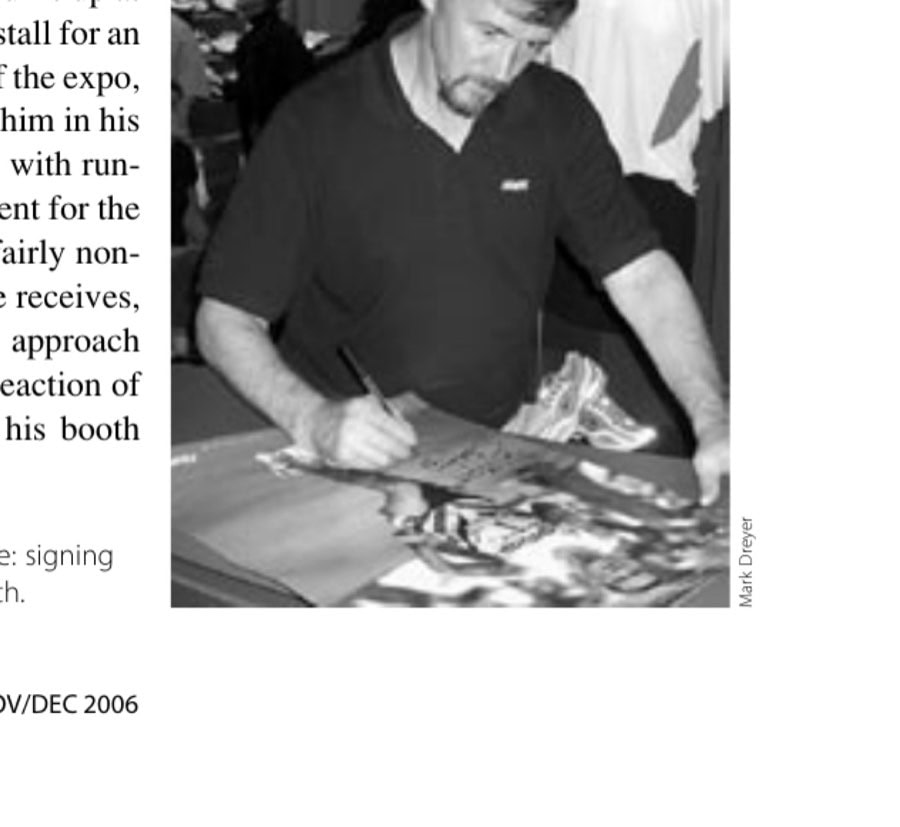
Mark Dreyer ▲ Steve Jones in his current role: signing posters at the Reebok expo booth.
Mark Dreyer
n northern Colorado, on the outskirts of Boulder, you will find an unassuming man of rare talent. He is a quiet man, whose slight build and medium height wouldn’t give you any clues as to his past, nor would his goatee beard. You would most likely find him painting, but you would rarely see him running. His soft Welsh accent may give you a hint though.
This man is Steve Jones, winner of the New York, Chicago, and London marathons and a former world record holder in the sport. These days he spends much of his time holding a paintbrush. “Not on canvas,” he hastens to add with a smile. “It’s mostly the insides and outsides of houses. That’s when I’m not going around the country attending marathon expos and races.” Jones has been affiliated with Reebok ever since he took up running more than 20 years ago and represents the company from coast to coast, typically appearing in the vast marathon expo halls where competitors can browse the latest running gear, sample new hydration drinks, or decide which of the many featured marathons around the world they plan to run next. Jones turns up at the clothing manufacturer’s stall for an hour or so during each day of the expo, signs some posters showing him in his glory days, poses for photos with runners, and offers encouragement for the upcoming races. He seems fairly nonchalant at all the attention he receives, happy to chat with all who approach him, but it’s clear from the reaction of the crowd gathered around his booth
watching archive footage of his many highlights that Jones is still recognized as one of the elite in his sport. And that should come as no surprise. In the fall of 1984, he burst onto the scene in such an extraordinary manner that his legacy was assured for years to come.
HIGH SCHOOL DROPOUT, SECOND-RATE RUNNER The son of a steelworker, Jones started running only after dropping out of high school at age 15, though he did it more to pass the time than anything else. As he says, with typically self-deprecating humor, he “couldn’t even make a B team.” Three years later, he became an aircraft technician with the Royal Air Force in Wales, and it was his employers whom he represented on the track when he first started to compete seriously.
He had some initial success in the 10,000 meters, and he also gained a thirdplace finish in the 1983 World Cross-Country Championships, but nothing that really indicated what was to come. He had tried his hand at the marathon in 1983 in Chicago, but his fortunes had gone from bad to worse. The day before the race, he sprained his foot in a warm-up jog; in the race itself, that same foot had landed in a pothole around the halfway mark, and he had been forced to drop out soon afterward. He was so disappointed at the time that he even tried to return a check for his race expenses. Suffice it to say that when he returned to Chicago the following year, still trying just to complete—let alone win—his first marathon, and a few months after finishing down in eighth place in the 10,000 meters at the Los Angeles Olympic Games, he was not exactly considered one of the leading contenders. What followed on October 21, 1984, was all the more astounding.
Lining up alongside current Olympic champion Carlos Lopes of Portugal and reigning world champion Rob de Castella of Australia, Jones hadn’t given himself much of a chance. He had even taken to changing his appearance, growing out his military haircut and cultivating a small beard. “I figured I couldn’t beat the other runners, so I figured I’d scare them,” he reasoned.
So Jones was as surprised as anyone when he managed to stay with the pack so comfortably. Going through 10 miles in 48:47, he asked that year’s Boston Marathon winner, Geoff Smith of England, if the times he was seeing and hearing around the course were correct. “I couldn’t believe we’d run that quick.”
One by one, the pack was whittled down. Defending champion Joseph Nzau of Kenya became ill and dropped out. Another Kenyan, Gabriel Kamau, had fallen by a water table after tripping up on Smith. Lopes had lost a shoe early on and had struggled to catch the leaders again. Having never made it past 16 miles in competition before, Jones was entering new territory, and still he felt better than expected. “There were no big ghosts going to jump on me, or gremlins. There was no Wall.”
Without a coach since the Olympics, Jones had sought advice from anyone who would give it. Fellow Briton and friend Charlie Spedding, fresh from Olympic bronze in the marathon, had told him, “If you feel like going, don’t. And if you feel like going again, don’t.”
MAKING HIS MOVE, ALL ALONE
▲
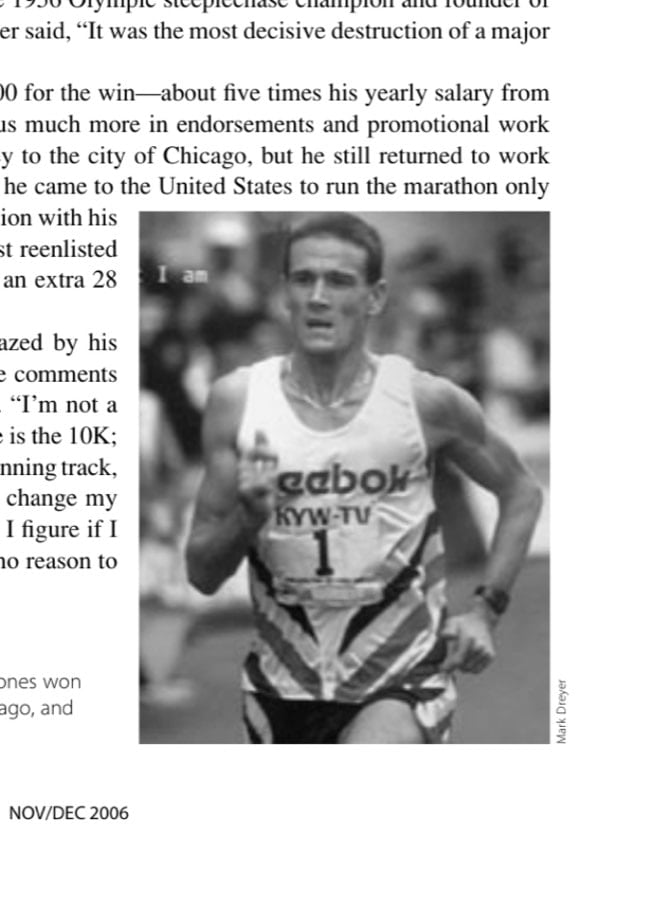
Back in his prime, Steve Jones won marathons in New York, Chicago, and London.
Mark Dreyer
But approaching the 20-mile mark, Jones finally made his move. “I took off and the pack didn’t come along. I was very surprised.” Jones covered the five miles between 19 and 24 miles in 23:46, destroying the rest of the field in the process.
With just over a mile to go, someone in the crowd shouted out that he had a chance for the record. Jones thought at first that he meant a course record, but with less than 200 yards to go, he saw the finish clock still in the 2:07s, and he knew he was on for a world record. Even so, he thought he was running out of time. “I felt the clock was going faster than I was.”
He crossed the line, arms raised, in 2:08:05, eight seconds quicker than Alberto Salazar’s mark set in New York three years previously and 1:39 under the course record. Chris Brasher, the 1956 Olympic steeplechase champion and founder of the London Marathon, later said, “It was the most decisive destruction of a major field I’ve ever seen.” Jones received $35,000 for the win—about five times his yearly salary from the Royal Air Force—plus much more in endorsements and promotional work and even received the key to the city of Chicago, but he still returned to work later that week. After all, he came to the United States to run the marathon only as a way of taking a vacation with his wife, Annette. Having just reenlisted with the military, he had an extra 28 days of leave to use up.
If the world was amazed by his performance, his postrace comments were just as bewildering. “I’m not a marathon runner. My race is the 10K; but I could get an injury running track, and then I might have to change my mind and run marathons. I figure if I can run and win, there’s no reason to run them.”
It was a philosophy he promptly dropped. He won the London Marathon the following year in a course record 2:08:16, which stood for 12 years, and he always returns to the UK for the race every April. He still has family in Wales, as does his wife. But he can usually be found in New York come the first weekend in November.
Part of that is due to his Reebok commitments, but it is clearly not a chore for him to return each year and shoot the breeze. Were it not for the stall he stands behind and the autographs he signs, he could pass for any one of the thousands of people milling around him, all soaking up the atmosphere and running their races in their heads. He comes across as unassuming, almost shy, but underneath there is undoubtedly a level of confidence that cannot just have been the product of several big race wins. It is clear that deep down, and despite all his modesty, he has always had a belief in his own ability and a determination to see that his potential is fulfilled. “
The main memory of my race here in 1988,” he recalls, “was that I was very, very confident. I waited and waited before making my move, long after the halfway point. I knew that any of the others would have to run an exceptional race to beat me.”
Having started at a measured pace, Jones caught the leaders around halfway, and made his most significant move coming off the Queensboro Bridge into Manhattan after around 16 miles. Though the race was over long before, Jones still maintained that he acknowledged as much only during the final 385 yards. “I turned around and couldn’t see anybody. You try to keep the pressure on yourself, try to keep the feeling that somebody is chasing you down.”
AN IMPROVEMENT ON ALBERTO’S TIME His winning time was 2:08:20, seven seconds faster than Salazar’s 1981 mark, which was run over a course that was later discovered to be 43 yards short. Ireland’s John Treacy, the third-place finisher, compared Jones’s 2:08 as equivalent to a 2:06 in Rotterdam, referring to the then-world record of 2:06:50, set in Rotterdam earlier that year by Belayneh Dinsamo of Ethiopia. Again that modesty. “I think John was just trying to flatter me,” Jones said.
The emphatic victory at New York helped him to overcome the dual disappointments of not making the British marathon team for the Seoul Olympics coupled with his most recent performance, ninth place in Boston earlier that year, which was his worst finish to date. And he didn’t mind proving his critics wrong, either. “I’d been written off by so many people before the race, but in the end I won by over three minutes, so it was hardly a fluke.”
So, after competing in many top races, which ranks as his favorite? “Chicago is a great race, so is Boston. New York is not just a race, though, it’s an event.
It’s the grandfather of mass participation, and it’s also the reason why London got started,” he explains. “Former Olympic champion Chris Brasher came over from the UK in 1979 to run New York and thought to himself, ‘Why can’t we do this back home?’” Two years later Brasher had organized the first London Marathon. “But all the races are impossible to rank, as the fields change year by year. You just don’t know where the fast runners will go. It could be London and Amsterdam one year, Chicago and New York the next.”
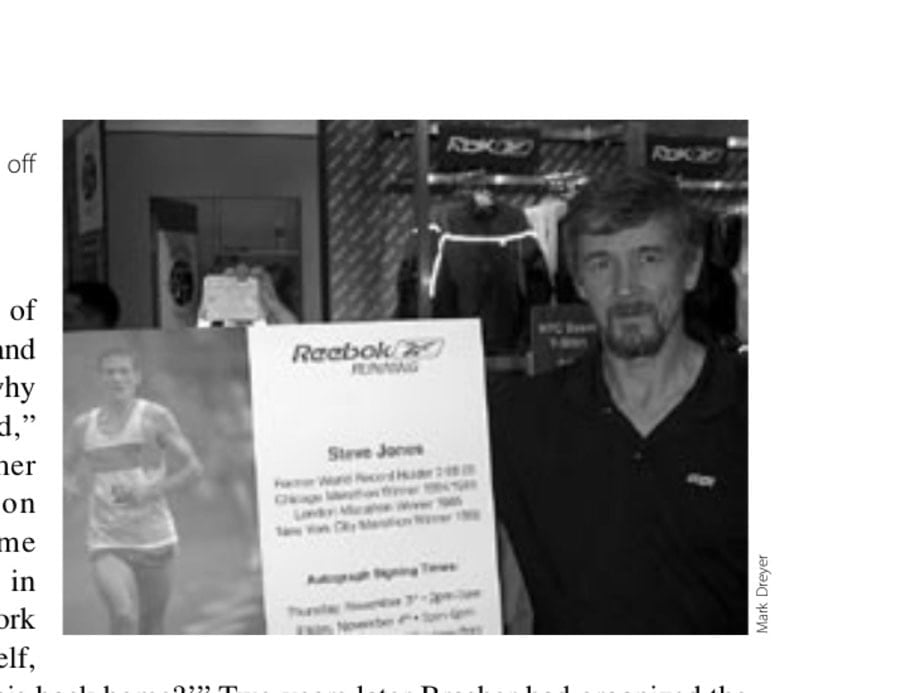
But as far as his own performances go, neither his New York win nor his victory in London ranks as his most satisfying achievement. More surprisingly, neither does his world record from 1984. Like any club runner, he measures himself against the clock and always signs his posters with a small “2:07:13” underneath his signature, his best-ever time, which he ran at Chicago in 1985 when he defended his title. It was one second slower than the world record at the time.
THE COMPETITION IS BEHIND HIM, BUT FAR FROM FORGOTTEN Many of those who meet him at the expos remember when he was at his peak during the ’80s; other, younger runners learn about him for the first time. But almost all are visibly moved watching the TV monitor as he crosses the line to win that first race in Chicago back in 1984. Jones takes the adulation in his stride now, but as increased crowd involvement over the years has changed the focus of the big races to participation, he, too, has left the competitive element behind. “
I really don’t run much at all these days—maybe twice a week at most, for 30 or 40 minutes,” he says. Compare that with the 115 miles he used to run every week, and it’s clear he’s very much retired, so much so that he couldn’t pick out even a few contenders for the year’s upcoming races. “I’ve no idea. I’m just not up with the sharp end of running anymore. My involvement now is with the people running at four and five hours, shepherding them round the course. It’s far more fun than I ever had when racing,” he adds, with just the merest hint of a smile.
Mark Dreyer
▲
Posing for the fans: Jones proudly showing off his achievements.
This article originally appeared in Marathon & Beyond, Vol. 10, No. 6 (2006).
← Browse the full M&B ArchiveMore like this
1,000+ stories from 19 years of Marathon & Beyond
The complete archive of the legendary long-distance journal — digitized and free to read.
