

Run From the Hill Stations
INTRODUCTION
Heat, dirt, pollution, busy streets, and overcrowded buses are the impression we all have of India. And it is true of some places on the plains. But what of the cool beauty of hill stations like Mussoorie, set high in the Himalayan foothills? These hill stations are remnants of British occupation of India and provide stunning views of the snowcapped tips of the world’s highest mountain range, and the red-roofed villages seated below them in green hillsides are truly picturesque.
Australian marathoner Peter Lane took the opportunity to discover some of the history and beauties of this region while living in Mussoorie for six months. In this second article, he runs from the Mussoorie hill station to Rajpur and Dehra Dun in the Doon Valley, a mainly downhill distance of 35K. His daughter, Joanne Lane, reports. * * * Out of the eerie morning monsoon mist comes Australian marathoner Peter Lane. Visibility is poor, and he is alert for traffic. He narrowly avoids running into a cow that emerges suddenly out of the hazy whiteness. It had been picking through some rubbish, and its soft bell had not penetrated the thick air to give any warning.
A coolie (employed to carry things), heavily laden with boxes, appears almost ghostlike in the fog like a soul damned to wander in eternal penance. Then he is gone—swallowed up by the mist. It is early, and the sun has failed to break through yet again, leaving only a dull gray light. Peter’s clothes hang damp and limply from his body. The air is so thick with moisture they did not dry, although he hung them up three days ago.
This is monsoon. For three months, the heavens open and provide enough nourishment for India to last the rest of the year. Water sources replenish, fields become green, and everywhere spurts new life. Even inside the houses, new life begins as walls blacken with mold and beds remain clammy even though sleeping bodies try to dry the sheets all night.
▲
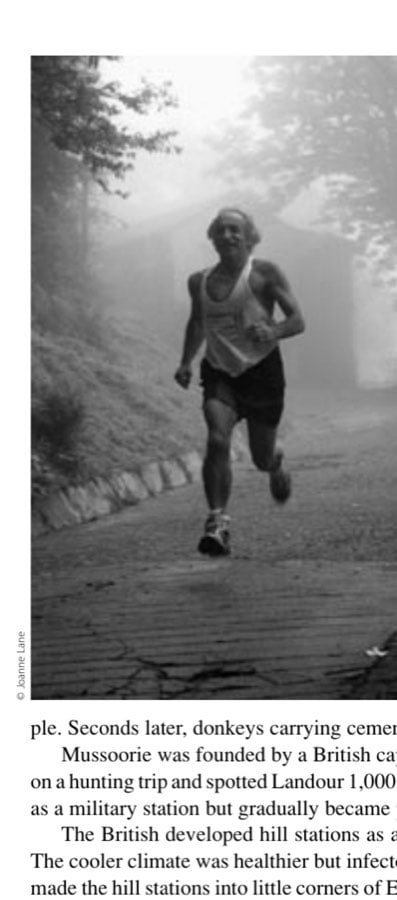
Peter Lane running through monsoon mist in Mussoorie.
In the high altitude of the Mussoorie hills, the monsoon strikes even harder. Peter runs from Sister’s Bazaar (8,000 feet) to Landour Bazaar, a drop of 1,000 feet that takes only 10 minutes.
© Joanne Lane
MONKEYS AND DOGS CONTROL THE MORNING India is still asleep as he makes his way through Landour. Families of marauding monkeys and packs of scavenging dogs fight over scraps of food from overflowing bins.
They control the bazaar in the early morning. He runs past them quickly, and the mist and silence surround him again. The silence is broken by a bell, rung by a Hindu devotee doing puja (prayer) outside the tem
ple. Seconds later, donkeys carrying cement clomp past, their bells jangling. Mussoorie was founded by a British captain named Young. In 1827, he went on a hunting trip and spotted Landour 1,000 feet above him. It was later developed
as a military station but gradually became part of the Mussoorie hill resort. The British developed hill stations as an escape from the heat of the plains. The cooler climate was healthier but infected foreigners with nostalgia, and they
made the hill stations into little corners of England with Elizabethan architecture, balls, theater, and endless dinner parties. Hill stations like Mussoorie are now holiday resorts for hordes of middle-class
Indian tourists who come in the hot season. Establishments catering to dancing, horse riding, theater, roller skating, and other sports were built for the new pleasure-seeking society, and now more than 100 hotels jostle for views across
the Dun Valley. Peter passes Mullingar Hotel, the first summer premises built in the Landour area, which once catered to British visitors. It is now a condemned, ramshackle building but is filled with hundreds of families and squatters. Prayer flags adorn
the shabby roofs and windows, and life there is a constant hubbub of activity with frolicking dogs and small children playing cricket. The Landour bazaar stretches from the top of Mullingar hill down past old Mr. Abinanden’s cloth shop and the post office to the Landour Clock Tower. This section is also the Indian bazaar where rent of houses is cheaper. The streets are dark and empty except for the monkeys, dogs, and rubbish-lined gutters, and Peter makes good progress. At the clock tower, he leaves the bazaar behind and passes the gates to the Indian private school Wynberg-Allen.
LOWER ALTITUDE, HIGHER HEAT
© Joanne Lane
As Peter runs farther down now past Barlowganj, another commercial center, the mist suddenly lifts and the early morning sun breaks through the clouds. From here the lush, green valley opens up before him down to the sweltering plains below. Already the temperature has changed with the drop in altitude. In the early days, the only access to Mussoorie was an 11K trek from Rajpur on horseback or dandi. In 1920, the first car arrived from Dehra Dun. The road rises from 640 meters (2,100 ft) to 2,005 meters (6,600 feet) within an hour and a half. The British developed the old motor road, and from Dehra Dun railway station it winds first through Rajpur, known for its many ashrams (religious
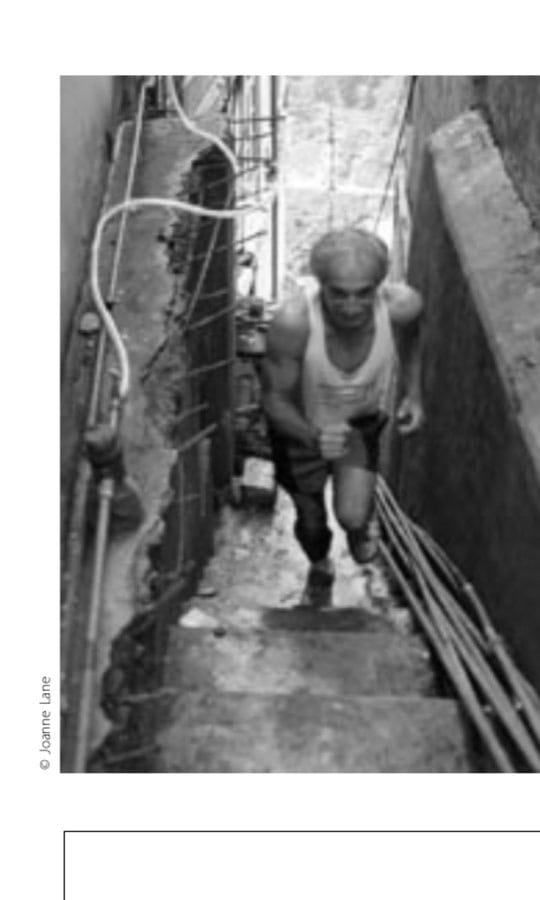
▲ Peter Lane running through the Mussoorie bazaar.
monasteries), then climbs by the terraced field of Bhatta and into the mountains where red-roofed houses cling to the wooded hills. Peter takes this road, as the new road is busy with traffic. Two hours after leaving Mussoorie, he reaches Rajpur. The road flattens and widens, and trees line the sides, providing a vast canopy of shade. Flapping Tibetan prayer flags from the homes of refugees greet him as he runs through the local bazaar. Here Peter sees a monument built for the 69 Rajpur sepoys (soldiers) who died in World War I. Out of respect, he stops for an emotional moment of thanks.
Rajpur Road is full of religious buildings: a Christian school for the blind, Bible colleges, Sikh and Hindu temples, as well as endless tea shops and vendors. An open sewer runs outside all these buildings. Hundreds of scooters, trucks, and bicycles whiz past him.
The local bus, however, is not so fast and ambles along, picking people up every few meters as they wave it down. It is so slow that Peter runs past it. Indian buses are always dilapidated and congested, and this one is no different. There is always room for someone else, and there are usually more people standing and hanging out the doors and off the roof than there are sitting.
He runs another hour amidst increasing heat before he enters the congested heart of Dehra Dun. It has now been three hours since he left Mussoorie, and he has covered 35K. The change in altitude becomes suddenly obvious, and the temperature is warm and sticky. Here there are even more scooters, bikes, belching trucks, rickshaws, and taxi rickshaws (banned in other parts of the country for their extremely high pollution).
A FUTILE JOB FOR THE TRAFFIC OFFICER Cows amble slowly across the busiest of streets avoiding the potholes, sewers, and traffic, seemingly deaf to the noise around them. A solitary policeman in a sea of traffic hopelessly tries to direct the flow with a pathetic whistle that can not be heard above the endless blare of horns.
People stop and stare as Peter runs sweating past the clock tower, the main landmark in Dehra Dun, and into the main bazaar. Some are more helpful, and when he stops for directions a man gives him sweets.
Dehra (camp) Dun (valley) is situated in a valley and is bounded by the Himalayas in the north, the Siwalik Hills in the south, the holy Ganges River in the east, and the Yamuna River in the west. On a clear day, Mussoorie is visible high above. Dehra Dun has become an academic and research center with the Forest Research Institute, Indian Military Academy, and many top schools are located in the area.
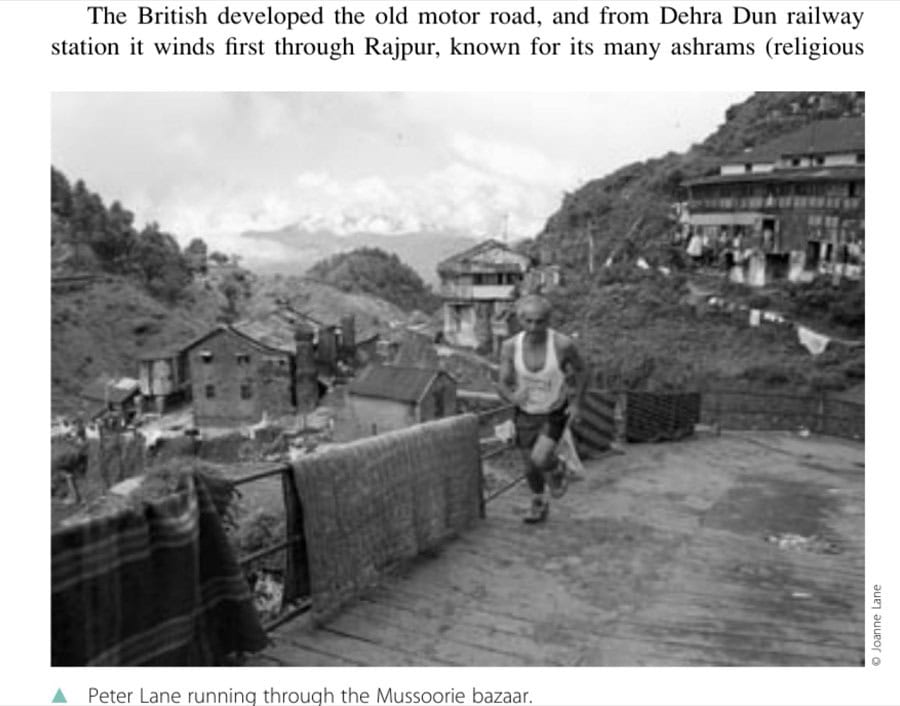
Peter asks for directions to the railway station in a small alley where people are setting up for the day’s market. It is early, but it is still a hive of activity. He runs
▲
Peter Lane running through the bazaar in Mussoorie up a narrow flight of stairs.
© Joanne Lane
past the Muslim quarters where meat is sold. Carcasses of water buffalo are strung up. Their smell is awful, and flies swarm around the offal (animal innards). Peter is hot and tired, and the extra effort he expends dodging rickshaws, cyclists, and cows in the narrow streets takes its toll. Early morning shoppers are impatient and leave him little room. At the far end of the bazaar, he nips across a whirlwind of traffic on the main road and finally runs into the railway station—the end of the line.
ad
Here again he is the center of attention. Indian railway stations are synonymous with confusion, noise, and chaos. At the gates to the station, a sea of red-shirted, dirty-turbaned coolies with railway armbands wait like vultures to swoop on passengers. They eye Peter suspiciously but leave him alone when they see he has no luggage for them to carry. The only thing he wants carried is himself!
A BLESSED BREAK FOR TEA Chai wallahs (tea sellers) line the platforms. Their hot brews leave a cloud of rising steam around their stoves. Peter heads to one of these stalls, stepping over sleeping bodies on the way. Chai in India is cheap at three rupees (46 rupees to $1 USD) per cup and very sweet. It is made by boiling the water with tea leaves, milk, and sugar all at once. The sweetness nourishes Peter and gives him enough energy to queue for an hour, with sweat pouring off him, for a bus ticket back to Mussoorie. The wait is worth it and he gets a seat, but even in India no one wants to sit next to a smelly, sweaty runner. From Dehra Dun, it is 1.5 hours to Mussoorie and a climb to 6,000 feet. Unfortunately the bus drops him at the opposite end of the bazaar, and to get home is another 40-minute, 1,000-foot climb. He runs back through the bazaar that is now brimming with tourists eating candy floss and kids with balloons. Others are amusing themselves on horseback or in the pinball parlors. This is the fashionable avenue, the Mall, which starts from the library and runs through the Kulri Bazaar. At night, the lights and signs transform the Mall into a tacky, cheap tourist paradise. He winds up past Jubilee Cinemas and Picture Palace—the best place to get a taxi. But there is no taxi-catching for Peter, and he continues the steep hike up Mullingar Hill. At least the temperature is cool, and he enters the guesthouse at 12:00 noon in time for lunch. With a round of applause from the residents, he sits down to a steaming plate of rice, vegetables, and chapatis (bread). That night the monsoon mists vanish again to reveal the lights of Haridwar and Rishikesh, holy cities built on the Ganges River, twinkling like some magical fairyland. Today’s 35K run has made Peter hungry for the final of his three runs: a pilgrimage run beside the Ganges, the religious lifeblood of the country, squirming and snaking along
the Dun Valley floor. He thought of running by the riverbanks thronged with sadhus (holy men) and pilgrims doing penance and pujas. He could already smell the incense offerings and bodies being cremated and hear the prayer cries to God.
Well, as they say in India, “Cul acha hai Sahib” (Tomorrow is good, sir.). The third and final part of this series will run in our next issue.
This article originally appeared in Marathon & Beyond, Vol. 10, No. 2 (2006).
← Browse the full M&B ArchiveMore like this
1,000+ stories from 19 years of Marathon & Beyond
The complete archive of the legendary long-distance journal — digitized and free to read.
