

Running Against My Nature
SOMETIMES YOU tear up the asphalt and sometimes it returns the favor. This day I found myself lightly stretching by the same track where my running first left me many, many years ago. I mused at the incredible coincidence of the whole thing, but I was now back on the track of the Sussex Avenue School, ready to get my vengeance. This was the same circle of 440 yards that laughed in the face of my agony over 30 years ago and turned my running to silence. I marveled at the fact that the same incident that first took my running away from me ultimately forced me to become the runner I am today. Please allow me to explain.
I was born a runner. For as far back as I can remember, I was always a runner. But I was not always the kind of runner I am now. In fact, the kind of runner I am today is most likely unnatural and against my nature because my nature was always to run short—and fast. When I was young, that’s the only kind of running I knew, and I was good at it. No other kind of running interested me. I used to run only to race, and I used to race only to win. And all my races were 100 yards or shorter until I abruptly stopped running at the very tender age of 11. I can honestly say I remember only a handful of times I ever lost a race.
Racing to win was the only reason I ran back in those days. The races were few and far between. I sometimes raced in gym class, occasionally I raced on a bet, and once a year I raced at the annual Butterworth Farms neighborhood picnic in Morristown, New Jersey. I never lost a race in Butterworth Farms, and I usually won my bets.
I was still living there when I was in the fifth grade, and I can vividly remember sitting in Mrs. Wilson’s classroom, most often just staring out the window and dreaming. Outside her classroom, I had a full view of the quarter-mile track quite clearly, but thinking back, I have no recollection of what subject Mrs. Wilson taught. My whole world took place outside her classroom, and that world included endless time just staring out the window, focusing on the track, envisioning myself running my 100-yard dashes and defeating anyone who dared step on the track with me. Yes, I was always a runner, but at the time I had no idea of the kind of runner I would become.
AN ADULT WHO RAN—AND RAN AND RAN
I recall now one day in particular, while I stared out that classroom window, a man way too old to be a student showed up at the track, stretched a little, and then did something amazing. He started running around and around the track, one lap after another, without even stopping at all. What struck me the most about him was how much he looked like my father and what I imagined myself to look like as an adult. In fact, if my father had not been away on a business trip, I might have thought it was he. But Dad was not a runner back then. Almost nobody was.
I remember thinking to myself how strange this man must have been. I couldn’t fathom the concept of running without having the instant gratification of kicking other people’s butts in the process. This kind of running did not make any sense to me at all. This guy must have been at least 40, and I remember thinking to myself that I would never waste my time doing something as ridiculous as running circles around a track. I would rather waste it looking out classroom windows, dreaming about my next 100-yard dash.
I was snapped out of my daydream as the bell rang, and I was off to gym class. We were running a 100-yard dash that day, and I was particularly eager to kiss the asphalt and kick some butt. As the class arrived on the field, the man saw he was being overtaken by a bunch of kids and yielded the right-of-way to us. He was sweating profusely and didn’t look like he had just completed anything enjoyable. I still marveled at how much he looked like my father. I just had to ask him why he did it. “Sir,” I asked, “why do you run around the track the way you do?”
He looked at me, and at first his jaw dropped as if he had just seen a ghost. But then he composed himself and his look changed. It was hard to explain, but he looked half as though he was caught totally off guard by the question and half as though he had been asked the question a hundred times before. He seemed very uncomfortable, as if he was processing much more than just my simple question. Before he answered, he extended his hand and introduced himself.
“Hi,” he said. “I’m Michael.”
I smiled. “Me, too.”
We shook hands and then I asked him again. “Michael,” I asked, “why do you run around the track the way you do?”
He thought for a minute and finally gave a simple reply. “Son,” he responded, “I could try to explain it to you, but I think you’re too young to understand right now. Some day, however, I think you’ll figure it out on your own.”
I had heard that answer many times but never in this context. The man toweled off and walked away as we overran the track.
ANOTHER WIN COMING UP
There were a few heats before mine, and I watched and waited. Finally, it was my turn. Mr. Geraldi, the gym teacher, had a cool little pistol that he used to start each heat. I lined up with my slower competitors and waited for the command.
“On your marks. Get set.” BANG!
I jumped out in front and could see hardly anyone, even through my peripheral vision. I was winning the dash—as usual. It was just like almost every other race I had ever run. But suddenly, my right leg felt like it pulled right out of its socket as I tumbled to the ground and the asphalt track had its way with me. I had no idea what had just happened, but I knew right away that I would never be the same runner again.
The pain was the worst I had ever felt in my life. As I was wheeled to the nurse’s office, I thought I was going to be sick. All I saw was spots, all I felt was throbbing in the buttocks region, and I swear that I was sure that my leg was going to need to be amputated. Although that ended up not being the case, it took months to come close to a full physical recovery. Unfortunately, the emotional scarring, just like the large lump that now remains at the epicenter of the injury, will remain forever.
After I tore my hamstring, I was the kind of runner who no longer ran. I guess that would have made me an ex-runner, but in my heart I know there is no such thing. An ex-runner is much like an ex-alcoholic. Even if one does not engage in the activity for years, a single taste can change the status from “ex” to once again “active.” I was scared to death of flat-out speed, as I never again wanted to endure that kind of pain and subsequent recovery. And I had no interest in running if I couldn’t run fast and win. So I played baseball and football and basketball but officially retired from running. At least for a while.
But baseball and football and basketball were all team sports, and, over time, the teams disbanded as the various team members went away to college or got jobs and started families. For a while I went from ex-runner to ex-jock as my own life changed, mostly for the worse. I clearly recall how, at the ripe old age of 26, after years of following a mostly downhill path in a figurative sense, I decided one day to change the course of my own personal nature. I wanted to learn to run just like that man I saw that day on the cursed track that took away my running.
I refer to it as “changing the course of my own personal nature” because my nature was to run short and fast. But those days were now behind me forever, just as my competition used to be. If I wanted to run now, my only option would be long and slow. I can’t even tell you why I wanted to give it a try, but it was probably because I was always a runner and a runner must figure out a way to run in any way he can.
I could vaguely remember reading about fast-twitch and slow-twitch muscle fibers in a book once, and knew right away that I had a large majority of the former. That’s why I had the explosive power and short-burst speed I had. I also recalled reading that, with training, fast-twitch muscle fibers could be converted to slow-twitch fibers, allowing a former sprinter to learn how to run longer.
So in the earliest days of spring 1982, I gave slow and long a try. I didn’t like it at all. I struggled at first to run a mile and was stuck behind that millstone for quite a while. It wasn’t fun, and I couldn’t do it every day because every time I did it my fast-twitch body rebelled. Each time I ran, I needed a couple of days to recover from a mile that took 10 minutes to run. Although I was young and I was lean, this kind of running was against my nature.
UP MILEAGE, UP
After about three months I had my runs up to three miles at about a nine-minute pace. It was still hard but I was making progress, and in the process I was changing my own personal nature. My body was gradually learning to run slowly. The twitches were getting slower, and I was becoming a different kind of runner. I might have been born to run, but I was slowly creating the runner I was to become.
I entered my first race near the end of June. I was probably ready for a 5K, but the 10K was the most popular distance in those days. So I entered, and I ran it. Sort of. True to form, I had to start walking just beyond the 3-mile mark. I half walked, half ran, and totally limped most of the final 3 miles, somehow managing to finish in a little under an hour. My feet were blistered and my legs were cramping. Even my biceps were sore. I was totally drained from head to toe. And I remembered trying to imagine what it would be like to be able to run another 20 miles on top of what I had just done, for the right of proclaiming that I was a marathon runner. I could not imagine ever having that right.
But I continued to train, extending my outer limits beyond where they had snugly fit before, and within a couple of months I could finally run a full 10K race without having to walk at all. Only a couple of months earlier, that had been against my nature, but now it was slowly becoming a part of my nature. I was evolving into the runner I was to become, and I was starting to actually like it. My twitches were getting more finely honed for long and slow all the time.
I started incrementally increasing my training distances and my race distances as my short and fast philosophies faded into distant memories. In September 1982, I ran my first 15K and on my birthday in October, as I turned 27, I ran my first half-marathon. A half year later, I accomplished what was once unthinkable as I crossed the finish line of the Long Island Marathon. The next day, I didn’t feel much worse than I had the day after my first 10K. I had changed my inner environment, and in doing so my outside world had changed as well.
Ever since then it has been my nature to be a long-distance runner. I know it is my nature because people don’t say, “There’s Michael. He runs.” They say, “There’s Michael, the runner.” It is only a subtle difference of semantics, but it carries a big difference in meaning. As of this writing, I have run several hundred races ranging from 5K to 30K, and I have also run 12 marathons. I am currently in training for lucky number 13.
The past few weeks, I have been traveling on business for my company. Travel does not always lend itself to good and productive marathon training, and sometimes strange things happen. This past week, when I spent a couple of days working just outside of Morristown, New Jersey, I found myself within a few miles of the asphalt track that had changed my life. Wouldn’t it be interesting, I thought, to return to the track that first took away my running and perhaps also forced me to later become the runner I am today.
YOU CAN GO HOME AGAIN
My first day in the area, I had a break during the day and I headed down to the Sussex Avenue School, perhaps to settle a score. My feelings were mixed as I stepped out of my car and to the fence beside the track, where I started lightly stretching. I wasn’t sure whether I was bitter, or mad, or just needed to make peace with the whole thing. But I do know that this was my first time back since my nature suddenly changed one day in gym class.
The former sprinter finished his stretching and took to the track. He started running around and around the track, one lap after another, without stopping at all. He ran lap after lap, thanking the heavens for the gift of long-distance running. As he continued to run lap after lap, a funny sensation gradually came over him. It didn’t feel quite like someone was staring at him but more like he was staring at himself from outside his body as he ran effortlessly, sweating lightly, breathing easily, and having the time of his life. Perhaps that elusive runner’s high had finally come to visit.
I was snapped out of my daydream as the bell rang, and within a few minutes the field was being overrun by a group of kids, perhaps fifth graders. They were led by a man with a starter’s pistol in his hand, and I knew it was time to yield the right-of-way. They were getting ready to run the 100-yard dash.
As I was walking off the track, now sweating profusely, I thought I heard someone talking to me from behind. “Sir,” the boy said, “I’ve been watching you running from Ms. Wilson’s classroom. I have a perfect view of the track through the window there. And I need to ask you something. Why do you run around the track the way you do?”
I turned to answer and was not prepared for what I saw. I could not hide my surprise, and my jaw dropped before I could answer. This kid looked exactly like me when I was in the fifth grade. I’m sure he saw my shock, but I didn’t want to seem to be a crazy old man. So I just extended my hand and said, “Hi. My name is Michael.”
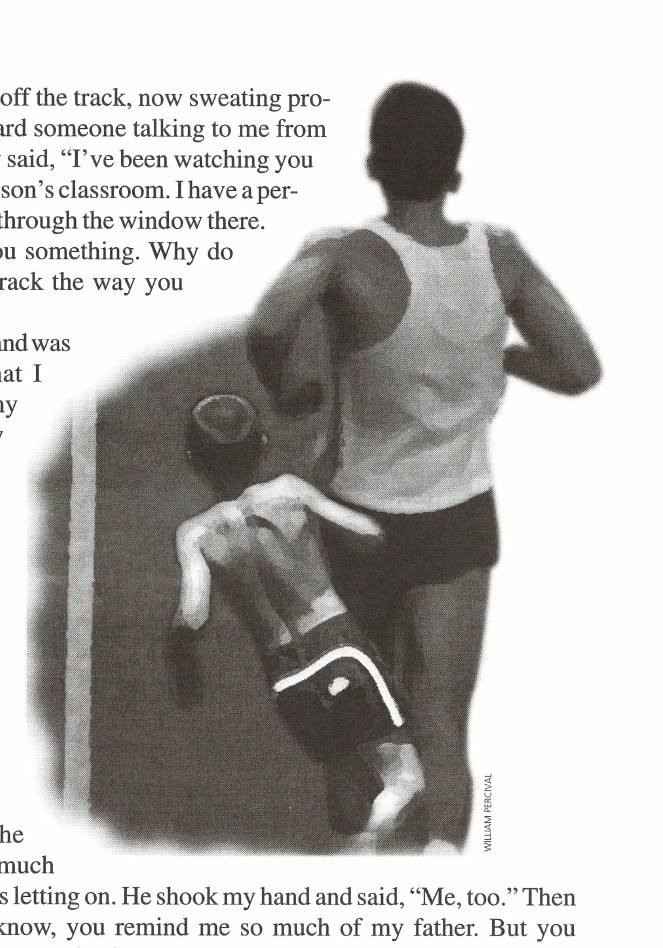
I could tell that he was also processing much more than what he was letting on. He shook my hand and said, “Me, too.” Then he continued. “You know, you remind me so much of my father. But you couldn’t be. He’s away on a business trip.”
We both stood in awkward silence for a couple of minutes, and then he repeated the question. “Michael,” he asked once again, “why do you run around the track the way you do?”
“Son,” I responded, after thinking long and hard, “I could try to explain it to you, but I think you’re too young to understand right now. Some day, however, I think you’ll figure it out on your own.”
I toweled off and walked away as the kids overran the track. I didn’t stay to see how Michael did in his heat.
JUNE 21, 2003 — Duluth, Minnesota
Grandma’s Marathon runs along the beautiful North Shore of Lake Superior and is considered by many as one of the fastest and most scenic marathon courses in the United States. Please join us for some of the finest hospitality in road racing!

This article originally appeared in Marathon & Beyond, Vol. 6, No. 6 (2002).
← Browse the full M&B Archive1,000+ stories from 19 years of Marathon & Beyond
The complete archive of the legendary long-distance journal — digitized and free to read.
