

Collecting on the Run
IT BEGAN with tobacco cards, of all things. Here I was, a guy who hated anything associated with cigarettes, fascinated by a pile of early-20th-century cards—distributed by a cigarette company—that an elderly gentleman had brought to the museum where I was working. Surprisingly, the full-color cards featured a variety of runners, along with short biographical sketches on the reverse side.
At the time, I knew that the sport of distance running had been around for a while, but the topic was never covered in any of my college history classes. I recalled that the Boston Marathon had been run for many years and that the marathon was the highlight of every Olympic Games. Aside from those two facts, about the only thing I could connect to the history of running was the New Balance Tracksters worn by a few old-timers running the roads in the early 1960s. I had a lot to learn.
As I began to read books on the subject, I learned that running for sport in the United States began as early as the 1820s and ’30s. Match races over varying distances, both on the roads and on measured tracks, attracted huge crowds and were accompanied by heavy betting. “Go-as-you-please” events, epitomized by the great indoor six-day races, were immensely popular with all strata of society in the 1880s. Amateurism began to take hold late in the century in response to what some thought the unsavory nature of these professional events and ultimately led to the formation of the modern Olympic Games.
Realizing that my escalating interest in running history offered yet another outlet for my affinity to collect stuff, I began to acquire running-related items, which in turn allowed me to learn more about the sport. The colorful Mecca cigarette cards, thankfully free of any tobacco odor, were easy finds at card shows, and it took little time to acquire the entire collection of runners. By attending these card shows, I established a network of dealers and other buyers who would search for more obscure cards. I soon had almost every card showing a distance runner, from the obscure Clarence DeMar “strip” card printed on cheap cardboard to the elegantly designed Allen and Ginter cards of the late 19th century showing pedestrians and long-distance runners that some collectors deem the most beautiful cards ever made.
Attending antique shows usually led to at least one purchase per show, but the typical response from dealers was a glazed look followed by a “Sorry, I don’t have anything.” But postcard dealers proved to be a good outlet for my desire to enlarge my collection. Although they were relatively scarce I was able, over the course of many years, to find numerous real-photo cards of track and cross-country meets and teams, Olympic marathon races, and cartoon scenes.
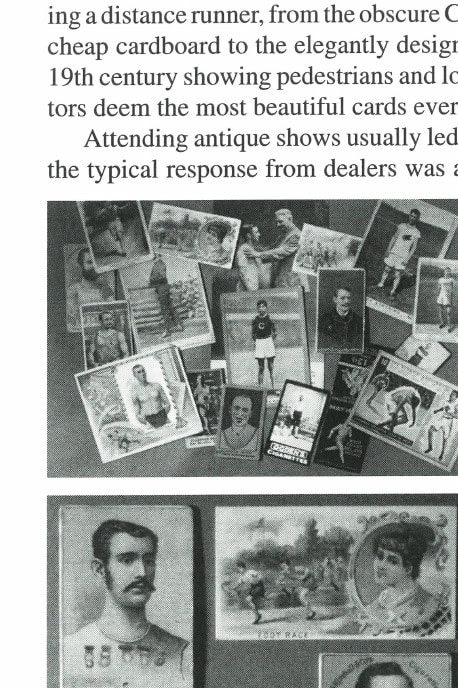
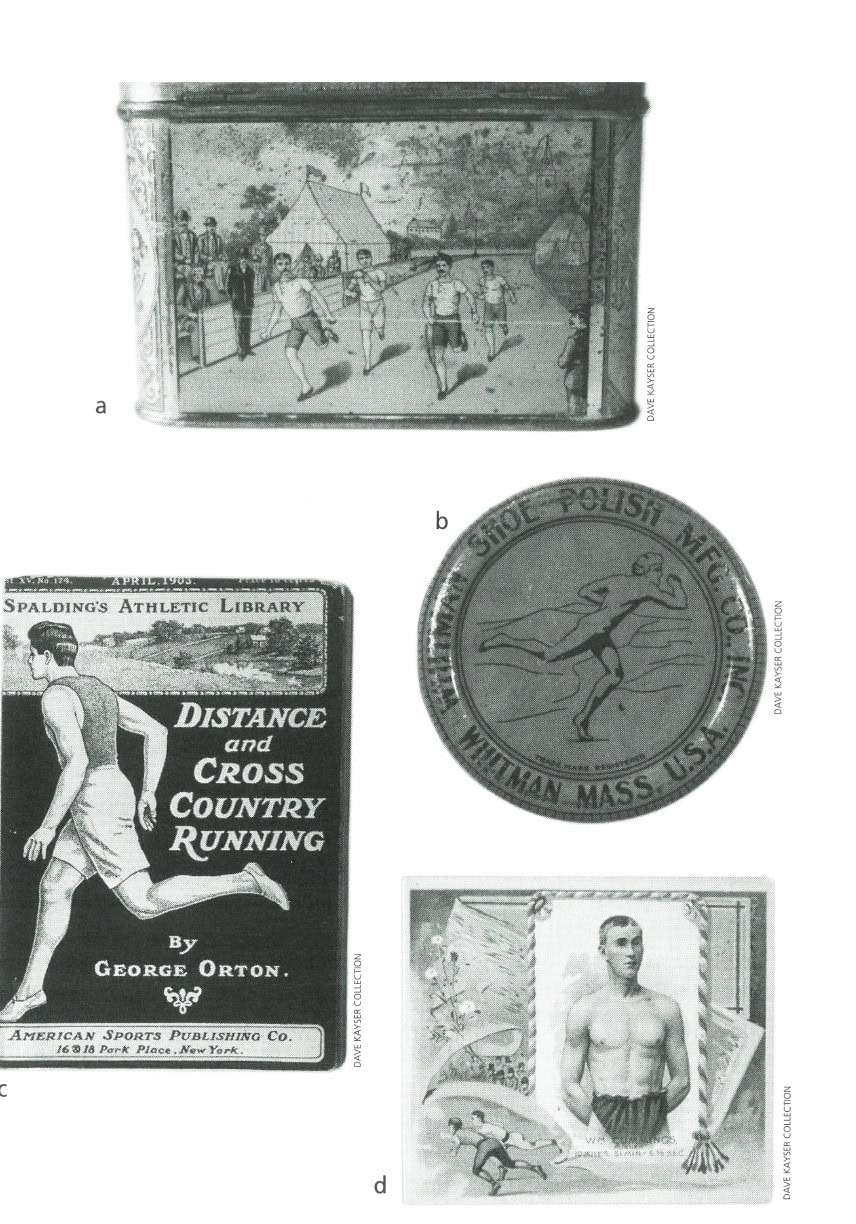
As I continued this search, I added a few fruit crate labels with a running theme, the most famous being the 1930s “Athlete” label showing the finish of a sprint race in the Los Angeles Coliseum. In the same advertising vein, I began to look for tin containers with marvelous images. Although not strictly historical documents, they do show the continued public interest in running. The most common tins are Marathon Oil containers with a running Indian and “Good in the Long Run” logo.
Boston Scores 100 on Collecting Prowess
Just a few blocks from the finish line of the Boston Marathon are the offices of the Boston Athletic Association, organizers of the event. Although the complex mainly serves as offices for the staff, the area is filled with exotica ranging from seats once used in the venerable Boston Garden to an aqua-interiored 1950s GE refrigerator in the staff break room. But for the running enthusiast, it’s the collection of memorabilia associated with past BAA activities that generates the most interest.
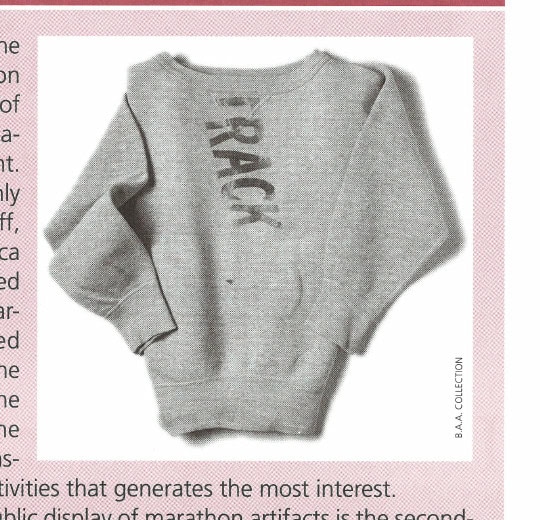
Included in the BAA’s public display of marathon artifacts is the second-place trophy from the inaugural race in 1897, the 1916 winner’s trophy that until recently was used as an ice bucket by a local racquetball club, scores of exquisitely designed competitors medals, contestants’ shoes dating from the 1930s, and the gray sweatshirt (see above) worn by Kathrine Switzer as she raced into immortality in the 1967 race.
According to Jack Fleming, the BAA’s media and promotions coordinator, the BAA also acts as a central repository for New England running- and track-related memorabilia. Scrapbooks, photos, race awards, film, and other material, if offered, are accepted for safekeeping until a New England running museum is established.
The turning point for this collecting activity came as the BAA was preparing for the 100th edition of the marathon in 1996. History was to play a large part in the celebration, and memorabilia were needed to interpret the proud history of the race. Material was gathered together from many locations, funds were set aside for acquiring artifacts, and an ambitious traveling exhibit program was set into place. The eight towns along the route had exhibits emphasizing their contributions to the race, ensuring that all the communities, not just Boston, were involved in the event. It was a huge success and guaranteed that the history of the race would never be forgotten.
The BAA’s collection continues to play a large part in keeping the Boston Marathon’s history in the limelight. Besides its office display, the BAA integrates memorabilia of the past into many current activities. Each year, marathon sponsor adidas highlights a particular aspect of race history in its expo space. Race publications routinely feature photos and awards from past events, and the Web site incorporates material from the collection so that the history of the event doesn’t become simply a moldering, dusty collection of yellowing paper and tarnished metal.—DK
Nike Is History
When Nike founder Phil Knight began selling shoes out of the trunk of his car at track meets in 1972 and Bill Bowerman was tinkering with shoes in the bowels of the Hayward Field stadium, little did they imagine that Nike would become a multibillion dollar company with offices, stores, and name recognition around the world. Fame and longevity ultimately led to an interesting past, and Nike’s colorful history is being well tended by an active preservation and collecting program that would be the envy of many museums.
Begun in 1986 with a couple of hundred items gathered together by the company’s public relations department for displays and special presentations, the Nike Archives program has evolved into a 19,000-item collection housed in a 10,000-square-foot climate-controlled facility staffed by records manager Kristi Kieffer and archivist Tina Lengacher. Included in the collection are items that any running collector would die for: handmade shoes for Steve Prefontaine and his 1972 Olympic Trials T-shirt, some of the first shoes Nike marketed in the early 1970s, drawings of the original swoosh, prototype shoes made by Bill Bowerman, photos from the early Nike days, and an original bench from the Hayward Field bleacher section.
The collection, which Lengacher estimates grows by about 3,000 pieces a year, is used for many purposes. Most obvious to the public are pieces appearing in Nike ads, ranging from Bowerman artifacts used to tout the line of shoes bearing his name to early Shox prototypes appearing in print ads last year. Requests for exhibit material are common, both within the company and by other institutions, and a variety of artifacts are used as background during special presentations put on by the company. “Behind the scenes” use includes shoes and apparel studied by designers for inspiration, new development, or reintroduction to customers enamored with the retro look, and patent disputes. Like any good curator, Lengacher keeps close tabs on the whereabouts of these artifacts using a computerized record-keeping system.
One of the more interesting aspects of her job is determining which items produced by the company today will be most essential to product designers, marketing gurus, and exhibit designers in the future. With hundreds of new products introduced annually, not everything can be saved because of both space and budget restrictions, making these decisions particularly important. As for that old Nike stuff squirreled away in offices, garages, and basements of longtime employees and athletes, Lengacher is like any other collector—she wants it! Give her a call (503/671-6453) if you’ve ever had the desire to be a benefactor of a top-notch museum collection.—DK
WHEN MEDALS WERE MEDALS
As I expected, I could frequently find medals, usually buried among military medallions or commemorative coins at antique shows. These items are perhaps our closest link to past events outside of newspaper reports. Besides establishing a direct connection to the event itself, they can also provide information on clothing styles, course landmarks, and results. Unlikely as it may seem, I once chanced upon an entire collection of medals that traced the accomplishments of a West Coast runner over a period of several years in the early 20th century.
Trophies are similar to medals in serving as a memento of certain events, though unfortunately for the not-so-rich running enthusiast, they are more expensive and desirable. Not only runners but also trophy, silver, and art collectors covet this type of collectible. Compared with the mass-produced awards of today, this type of item is a pleasure to own. Although possessing few myself, I delight in the fine engraving techniques, the upright pose of the striding figures, and in the case of a large 1927 mile trophy found in the back of a greeting card shop—don’t ask, I don’t know why either—the diminutive but sharp track spikes on the bottom of a raised foot.
Other interesting but more obscure items that filled my walls and drawers included an old board game titled “Game of Endurance Run,” trade cards with a running-related image that were distributed by businesses, event programs, almanacs that often include ads for shoes and apparel, and a shoe worn by a New England road runner in the 1930s whose lightness dispels the accepted image of race contestants plodding along the roads in shoes more suited for construction work.
Where can a person interested in collecting running mementos begin? When I began collecting, about the only method was to attend antique shows and visit antique shops and flea markets. A successful foray usually meant finding one or two items in a day, which meant little cost but a collection that grew slowly. Card shows are good if only to establish a network of dealers willing to look for running cards, and specialized postcard shows are held around the country. Rare-book dealers can find obscure titles and conduct a broad search for subject material. Once in a while it may be possible to find something in unrelated surroundings, such as a sports bar or an old sports-related retail store going out of business.
Today, as might be expected, all the action is on eBay, the e-commerce site with over 22 million registered users that offers everything from Beanie Babies to backhoes. On any given day, scores of running-related items can be found in the marathon, running, Olympic, and track and field categories. As in any other shopping experience, mundane items abound, such as a 1996 Honolulu Marathon T-shirt or a Sports Illustrated magazine with a famous runner on the cover. But to my amazement, things I never dreamed existed consistently come up for auction, such as the program for the 1930s transcontinental Bunion Derby, 19th-century go-as-you-please medals, and an obscure card from a collection that escaped the attention of even the most knowledgeable dealers. eBay has revolutionized collecting, making it easy to amass a collection of interesting items. At the same time, unfortunately, the thrill of the hunt is lacking when all you need is the patience to scroll down a list of auction offerings on a computer screen.
HIGH-END ITEMS
What hasn’t changed is the category’s affordability, allowing almost anyone to collect something, whether old photos or race medals. Certainly, some things are expensive, like the 19th-century Cross Country Run game board that brought $4,750 at a recent East Coast folk art auction or the early 1900s Boston Marathon participant medal that realized $130 in a December 2000 eBay auction.
But at the other end of the spectrum, a 1930s running instructional manual can be had for under $20 and a pair of old Nikes might be found for $20 to $35. Prices of medals vary widely. I’ve seen similar medals auctioned off on eBay for between $30 and $100, and books are the same way. Postcards can range between $2 and $20, though Olympic Games cards tend to be higher. I recently bought an 18-by-24-inch period photo of Clarence DeMar crossing the finish line at Boston for only $4. It was found hanging in a barn on Cape Cod, and I intend to set aside my curatorial concerns and maintain tradition by hanging it in a garden shed I intend to build someday.
Needless to say, patience is a virtue when bidding on, and losing, items, but if something becomes available that puts lust in your heart, whether at an antique show or on eBay, lay out the cash because you may never see it again.
Like most distance runners, collectors of running memorabilia are tenacious. Dr. Ed Kozloff, who lives in the Detroit area and is president of the Motor City Striders, has amassed an impressive collection of running memorabilia. Kozloff enjoyed reading about the sport but never considered collecting objects associated with his hobby until he attended a flea market in Washington, D.C., about 25 years ago. A coin dealer was offering medals from the Baltimore Cross Country Club, and Kozloff’s purchases at that flea market unleashed a passion. Besides assembling a library of 135 biographies of runners, he has gathered an array of photos, magazines, medals, Olympic memorabilia, merchandise bearing a “marathon” logo, and other odds and ends.
One of his most prized pieces once belonged to Edward Payson Weston, probably the world’s greatest pedestrian, who performed numerous feats of long-distance walking almost unimaginable today. The 1869 log now in Kozloff’s possession contains five pages of newspaper clippings on Weston’s quest to walk 5,000 miles in 100 days, along with daily notations of start and endpoints, towns he passed through, and daily observations. It is certainly a museum-quality piece, demanding the best of care. Kozloff continues to build his collection by scanning the eBay listings, along with the old-fashioned method of stopping at antique shops and shows while traveling around the country.
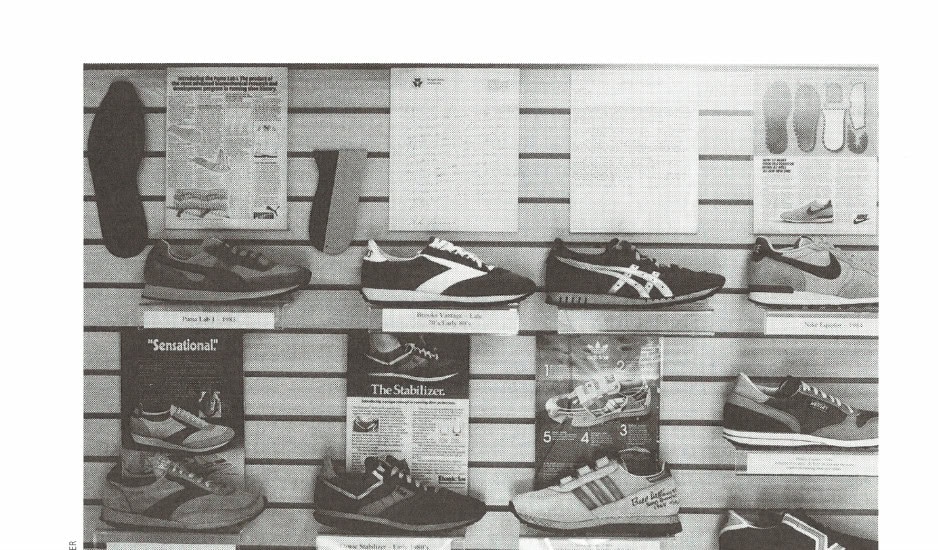
Another avid collector, especially of old running shoes, is Bob Roncker, proprietor of Bob Roncker’s Running Spot, Cincinnati’s premier running specialty store. Roncker has long been a collector of old shoes, and after acquiring the shoe collection of Ed Ayres, the founder of Running Times magazine, he decided it was time to properly display his collection.
In his newly enlarged emporium, one floor is dedicated to showing the progression of running shoes. Close to 300 pairs of shoes are on display, interspersed with explanatory labels, shoe company history, and contemporary magazine ads. Local running history, autographed memorabilia, Olympic material, old magazines, and apparel worn by notable runners are also on exhibit. Like any museum professional, Roncker hopes to educate and entertain his visitors by showing them how technical advances incorporated in the
A Legend’s Collection
What kind of race memorabilia does Bill Rodgers, one of the icons of distance running, save that will one day document one of the most illustrious running careers ever? A quick survey of his running store in Boston’s Faneuil Hall Marketplace gives some indications. Scattered among the merchandise are race trophies, posters, old shoes, and a letter written by Pre to Bill. At his home are some of his more valuable trophies, such as the silver platters he won at the New York City marathons. The really good stuff, such as his Boston Marathon medals, is kept secure in a bank safe-deposit box. Brother Charlie Rodgers relates that Bill is “not obsessed with documenting his accomplishments.” Bill once kept scrapbooks filled with newspaper clippings and photos but stored them in a damp basement where they became covered with mold and mildew. His Fukuoka trophies are stuck on a cluttered shelf in the office of his store. He recently returned a trophy that he won at the inaugural Tulsa Run to the race director, who is using it for promotions. Looking into the crystal ball, future collectors will find plenty of autographed pictures of Boston Billy but will have to be prepared to spend a bundle on other items related to this living legend.—DK
shoes contributed to the growth of the sport and how the sport has contributed to changes in society.
CARE AND FEEDING OF A COLLECTION
How do collectors care for their possessions to ensure their continued well-being? Common sense plays a big part. Exposing objects to light increases fading, so it’s helpful to keep light-sensitive photos, paper goods, textiles, and books in a dark storage area or at least away from windows. Mold and bugs are a constant threat, so that dark storage place shouldn’t be in a damp basement. Fluctuating temperature and humidity can cause the deterioration of almost any object, so a constant environment is ideal but often difficult to attain. Keeping objects in containers such as acid-free boxes helps to buffer or slow the rate of change, allowing the object to better adjust to the changing conditions. Keeping objects clean of dust and dirt is a must, and if they are displayed they should be in an area where they won’t be bumped or otherwise damaged.
A number of companies sell what are commonly called archival supplies designed to protect materials and increase their longevity. Two of the best-known firms are Light Impressions (800/828-6216, www.lightimpressionsdirect.com) and University Products (800/762-1165, www.universityproducts.com). Both of these firms offer boxes, binders, bags, albums, cleaning supplies, and frames that will increase the lifespan of precious acquisitions.
If you’re more inclined to saving contemporary running memorabilia instead of the old stuff, opportunities abound. Race expos offer a cornucopia of ephemera, ranging from shoe-shaped key rings produced by various footwear companies to posters, cards, magnets, race advertisements, and small souvenirs. Collecting the adidas “We’re Different” series of advertisements is similar to the many collections of “Got Milk?” ads, and the shoe surveys published by various running magazines are great research material. Recently produced running shoes may one day hold interest, though right now it appears that the great shoes of yesteryear, like the Nike LDV and the Brooks Villanova, have more cachet.
The future value of whatever you collect should be of little concern unless you are collecting only to supplement your retirement income. What’s most important is the enjoyment you receive from watching the collection grow and the memories associated with it. Happy collecting, but please don’t bid against me on an eBay auction.
This article originally appeared in Marathon & Beyond, Vol. 6, No. 6 (2002).
← Browse the full M&B ArchiveMore like this
1,000+ stories from 19 years of Marathon & Beyond
The complete archive of the legendary long-distance journal — digitized and free to read.
