

Running, Aging, And Human Potential
Creed for the Ancient Marathoner 1. Honor the run. Train enough, but not too much. Don’t rely on yesterday’s experience for today’s challenge. Be true to the task. Know that you are the torchbearer for those younger. You show them not
just what you can do but what they will be able to do. You show them their future. 2. Don’t be surprised. Train in the heat and in the cold. Know how to drink and eat. Know where each step is taking you.
3. Don’t take any extra weight along with you; be spare. 4. Be rested, be fresh, and arrive at the start ready for a full go. Know that each part of you is ready to go the full course. 5. Age is not an excuse. It is an advantage. Each of us has been up our
personal hill more often than the younger runners. We are older, we have experienced more, we have more to give—and we understand more. 6. Don’t make excuses. Don’t rely on someone else. You are in charge.
You alone can crest the rise, fight the fatigue, master the moment. 7. Although you are in charge of yourself, you are not alone. Your number increases. You run in the footsteps you have made—but also in the
paths of Emil, Frank, Johnny, Grete, Clarence, George, and others. You tie your shoes with their laces. You are one with the heroes and heroines. 8. Don’t compete with your yesterday. No one can defeat you. Be the
best that you can be this day. By being your best today, you will prepare for being your best tomorrow. 9. Listen to the wisdom of your body. It is older. It has been tested. It knows how. Pay respect and learn from its teachings.
10. Have fun, don’t take the run too seriously, be confident.
out that he was an imposter, a mere 94-year-old, and therefore never enshrined as the first centenarian marathoner. That honor still awaits. Also in my personal pantheon of older long-distance standouts is Helen Klein, whose career reaches near-miracle status. Helen, now 86, ran the 2008 Kaiser Permanente Napa Valley Marathon in 5:36. When 79, she ran 4:38, at 80 she ran
© David Hill
Courtesy of John Keston
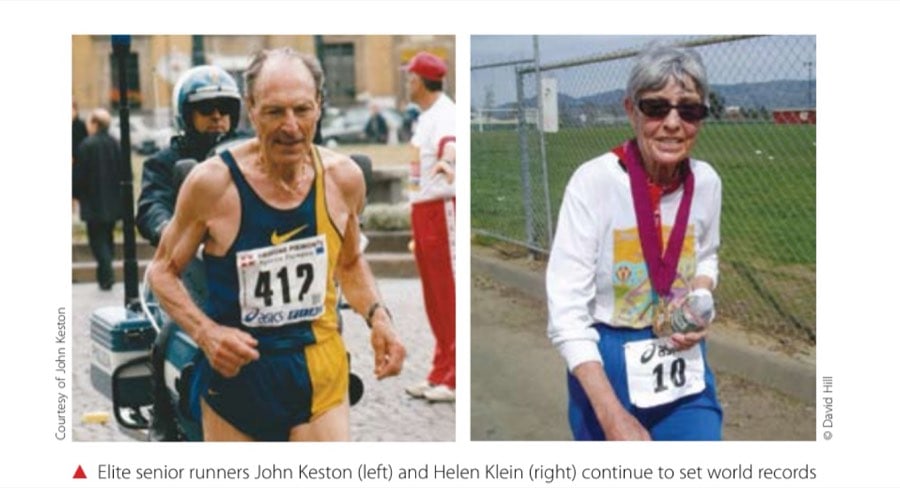
4:31, and at 81 she ran 4:45. At age 66, Helen ran five 100-mile mountain races in a span of four months, including the Western States 100-Mile trail run. For 25 years, my wife and I annually give prizes to the oldest finishers of this most
grueling of races. We figure that any youngster can run 100 miles, but 100 miles for a runner over 70 years of age is worthy of every acclaim and recognition. Other notable older runners are John Keston, who ran 3:00:58 at age 71; Ed
Benham, who ran a 4:17:51 marathon at age 84; and Mavis Lindgren, who sped to an 8:53:08 marathon finish at age 90. So my role as a practicing physician with a particular bent for older people has been enriched by my immersion into the marathon world. I ran the ING New
York City Marathon in 2008 in a blissful 8 hours and 10 minutes and loved every minute except for the start at the Verrazano Bridge, where a 41-mph headwind made me feel like molasses in a cold jar. But the wind abated, the sun shone
brightly, and I steadfastly made my way around the five boroughs, stopping to enjoy the Emmanuel Baptist Church Gospel choir (which urged me to join in), then a coffee break on First Avenue, and later a Vaseline search to take care of
chafed legs, since all the aid stations had long since closed and abandoned the still-struggling slow runners. I ran every step and was passed by innumerable faster walkers. I never wavered: my good training had me fully prepared mentally and physically. I was proud that
at age 78, I was able to keep it up for eight hours. I even passed a fellow straggler at Columbus Circle, giving him the double thumbs-up as I motored past.
▲ Elite senior runners John Keston (left) and Helen Klein (right) continue to set world records in their eighties.
The elders of the NYC Marathon At my current age, I was curious to see how my peers had fared in demonstrating human potential. The table below is a portrait of the New York City Marathon beginning in 1970, the date of the race’s origin. I’m very cheered by the fact that the number of runners over 70 is increasing. If we ancient duffers can show the rest of the world that you can keep going as you mature, perhaps the conclusion that they will draw is that they can do it, too.
The imperative message that all of this holds for the geriatrician, indeed for all doctors, is that as we age, the most important part in our body is not our heart or our lungs or our kidneys or even our brains—but our legs. As we keep them moving, the rest of the body pretty well takes care of itself.
No drug or any other maneuver offered to us by our annual $2.3 trillion medical-care system can make that claim, which is a reality that we neglect at our collective peril. And don’t forget Bortz’s Law, which holds: “It is never too late to start, but it is always too soon to stop.” NYC Marathon Age Results Year
Age group
1970 70-74
Men
Women
Ted Corbett (only runner over 50)
1978
70-74
6
0
1988
70-74
36
5
75-79
9
0
80-89
4
0
70-74
81
14
75-79
23
7
80-89
11
3
90-plus
1
0
1998
70-74
111
14
2008
75-79
28
6
80-89
10
3
90-plus
2
0
This article originally appeared in Marathon & Beyond, Vol. 13, No. 5 (2009).
← Browse the full M&B ArchiveMore like this
1,000+ stories from 19 years of Marathon & Beyond
The complete archive of the legendary long-distance journal — digitized and free to read.
