

Running Far, Far From Home
When you run a marathon in another country, you can expect the unexpected. With family on both sides of the Atlantic, the unexpected became the norm in my running life more than 25 years ago. A 10,000-mile round trip without a marathon on the itinerary is unthinkable.
Two that fit into our schedule during our most recent transatlantic trips were a flat point-to-point race from Kortrijk to Brugge in Belgium and a loop run around and over Mount Snowdon in Wales.
The home Web page for the Guldensporen Marathon in Belgium, which I discovered on MarathonGuide.com, described the course: Je loopt een vlak parcours, tussen duizenden toeschovwers, tot op het historiche Burgplein van Brugge. Sounded good to me. I tried to enter online but failed. I couldn’t read the entry form.
I did figure out that registration and packet pickup went on until 5:00 p.m. the day before the race. High anxiety was setting in when it took us until 4:15 that afternoon to drive from Germany to Brugge. We had no idea where the registration site was when we got there. The solution: park the car and get a taxi, quickly. We beat the deadline by 10 minutes. Entry fee was 25 euros, or about 30 American dollars. The race packet contained my number, 784; four safety pins; and a map of the finish area of the race—nothing more.
One of the people in the registration area told me that buses to the start would leave from the finish area at 6:30 a.m. Bus tickets cost 3 euros. “Need any more information?” she asked. I couldn’t think of anything.
A sporting complex for all tastes
The buses took us to a sports complex, similar to what you might find at a small American college or university. There was a gym with basketball courts, gymnastics mats, dressing rooms, showers, toilets, and a café where many of the runners went for coffee and—yikes—a smoke before the race. The complex also had a soccer field, a running track, and a nine-hole golf course.
As race time neared, I recalled the question that I had been asked the previous afternoon: “Need any more information?” I hadn’t asked whether there would be aid stations along the course. Maybe there wouldn’t be. It looked like every second runner was carrying a water bottle to the starting line. On top of that, it was already too warm for a marathon, and I quickly noticed another alarming fact. Family members or friends on bicycles accompanied many of the runners who weren’t carrying water bottles. Most every bicycle had a basket loaded with food, water, and other drinks. I decided to start out conservatively and then slow down if necessary.
My pessimism evaporated five kilometers into the race. The sky clouded over and it began to get cooler. We came to a group of men handing out large, wet sponges and then the first water station. Sponge-and-water stations were spaced every five kilometers thereafter, with electrolyte drinks added after 20 kilometers.
The course ran along a two-lane concrete road through fields of corn, potatoes, and cabbage; pastures of grazing, white Charolais cattle; and several small farm villages. For 99.9 percent of the route, the course was absolutely dead-level flat. As we ran past the brick homes and storefronts in each village, I measured the lines of bricks against the sidewalks, looking for any change in elevation. There was none. The sidewalks followed the same line of bricks from one side of each building to the other, from one end of town to the other. The elevation didn’t change by as much as an inch.
At about 10 kilometers, we ran up and over a bridge across a canal. The ascent to the top of the bridge took less than 20 seconds. Ten kilometers later, we went over a railway bridge, this time spending maybe 20 or 30 seconds going up. Later, there was the only genuine hill on the whole course, surely less than 100 feet high.
Crowds lined the sidewalks in every village. In two, uniformed bands played as we passed by. In a third, we were serenaded by a duo playing an accordion and a drum. In one village, we passed a café or bar with a big sign, obviously the name of the place, which said “Fagot.” What in the world did that mean in whatever language was spoken there, French or Flemish, the two official languages of Belgium? (I later learned that the word means bundle of sticks.)
It’s curious that different languages are spoken in different parts of such a tiny country. Belgium is smaller than some counties in American states. If we had run 10K in the opposite direction at the start of this marathon, we would have crossed the border into France. If we had run 10K past the finish, we would have been in the North Sea. If we had veered off 20 degrees at the finish and continued 10K, we would have been in Holland.
As always, when I run in a new and strange place, I was on the lookout for roadkill. All I saw this time was one dead rat and one dead hedgehog, a small European version of the porcupine.
No split times were given during the race, but there were markers every kilometer. That made calculating pace easy: first 10K in 49-something, second the same, and third in about 52. After that, I didn’t care—it was survival time.
In love with kilometers
I learned two important things during the race. First, the kilometer is a beautiful measurement when you reach the latter stages of a marathon. Mile markers are too far apart when you’re counting down after 20 or 22 miles. Kilometer markers come along more frequently. A kilometer is the equivalent of less than two and a half times around a track, a distance much easier to deal with mentally than a full mile.
Second, I found that the maxim “You are what you eat” has some truth to it. Our time in Belgium was too short and Belgian cooking too interesting to even consider settling for a plate of pasta the night before the race. I found a restaurant with a little chalkboard out front advertising “Rabbit Grandmother’s Way.” I couldn’t pass that up. The rabbit, smothered in a gravy of wine, mushrooms, onions, and a little more wine for good measure, was delicious. As with most restaurant meals in Belgium, it came with a platter of French fries. It remained to be seen whether I would run like a rabbit the next morning.
Through 40 kilometers, I ran like a 64-year-old rabbit, on pace for my fastest time in three years. However, over the final two kilometers, I trudged along more like Grandma if she had been wearing the boots that Grandpa wore when he mucked out the barn.
I didn’t hear my name called when the trophies were handed out after the last finisher came in. Later, when I searched the Web for results, I couldn’t even tell if there were age groups.
What is the polar opposite of flat?
No marathon ever intimidated me quite like the Snowdonia Marathon in a remote corner of northwest Wales. Still, I felt compelled to run it simply because it was there and we were there, simultaneously.
Two newspapers described it as “one of the most grueling road races in Europe.” The course description that came with my entry confirmation said we would circle Mount Snowdon, the highest peak in Wales (although a mere 3,560 feet). There would be 1,200 feet of uphills and 1,000 feet of downhills in the first 21.5 miles. Then, before a flat finish, we would make a 700-foot climb followed immediately by a 900-foot drop.
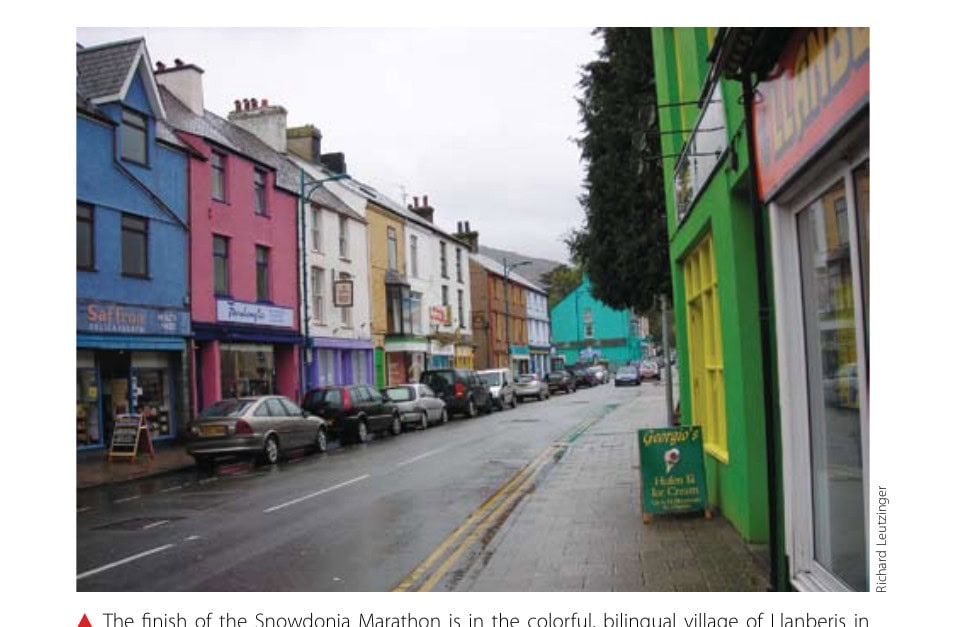
To get to the race, I traveled all morning by car, train, and bus from my mother-in-law’s home, also in Wales, to the village of Llanberis. I got to my hotel minutes before the start of a brief but fierce rainstorm.
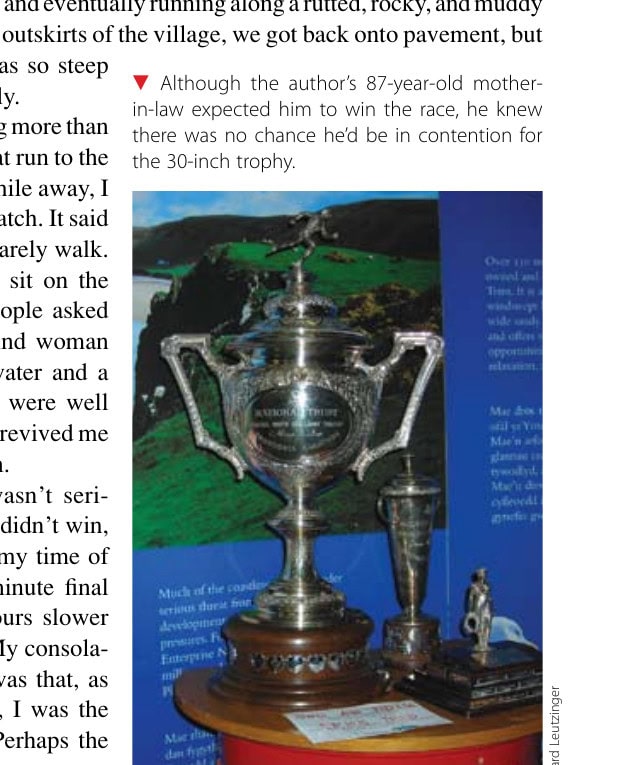
After it passed, I walked to the community center to pick up my T-shirt and chip, take a quick tour of the expo, and admire the gigantic, silver perpetual winner’s trophy, which stood 30 inches high and 18 inches wide. Tomorrow it would be mine, if I could fulfill the expectations of my 87-year-old mother-in-law, which of course I knew I couldn’t. With most of the afternoon to kill, I walked to the railway station where a narrow-gauge train departs to take tourists to Snowdon’s summit. A printed sign said: “Sorry, the rail service has been suspended due to high winds on the mountain.” Another said: “WEATHER NOTICE: misty on the mountain at present.” Typical British understatement.
Although the race would finish in Llanberis, the 1,500-plus runners would start from Nant Peris, a mile or two up the road. We were warned to allow plenty of time to walk there as shuttle rides were limited.
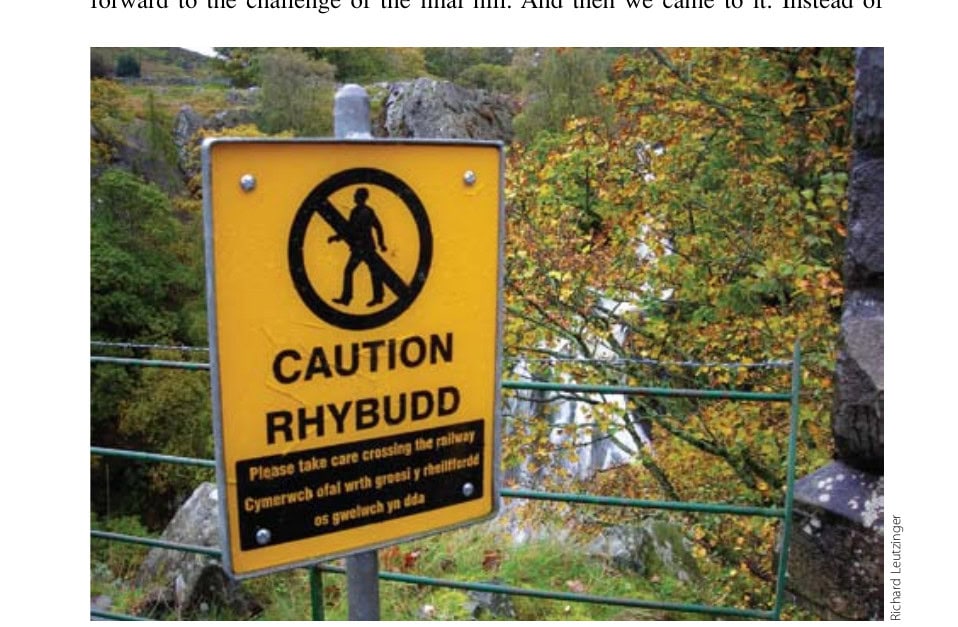
Llanberis is a bilingual village of 2,000 on the edge of Snowdonia National Park. English is its second language. Spoken Welsh has a nice, almost musical lilt to it, but you wonder why when seeing it written. Eleni, am I tro cyntal, byddwm yn defnyddo amseru digidol. Translation: This year, for the first time, we will be using digital timing.
Trying a local lamb specialty
Wanting to immerse myself as deeply as possible into the culture of Wales, where sheep outnumber people two to one, I ordered a midafternoon lunch of “minted lamb burger and wedges” in a little mom-and-daughter café. The wedges were unpeeled potato wedges, fried, I think, in lamb fat—something to avoid in the future.
I carboloaded that evening on a baked potato smothered with baked beans and apple pie with custard at Caffi Pete’s Eats, a totally funky restaurant packed with an assortment of runners, hikers, and climbers. The walls of Pete’s Eats were covered with photos of climbers hanging off sheer cliffs, runners struggling up steep hills, and hang gliders soaring above pristine valleys. Selections on the free jukebox ranged from Brubeck to Tchaikovsky. The place was on the verge of exploding with energy. I hoped that I could carry some of it to the race the next day.
Sunrise came an hour early on Sunday. What the British call summer time had ended at 2 A.M. My anxiety had vanished during the night, as had the rain and wind. Conditions were marathon perfect. I passed part of the morning before the 9:30 race start reading the race program. I smiled at the names of the clubs of some of the runners: Calder Valley Fell Runners, Vegetarian Cycling Athletic Club, Epsom Oddballs Running Club, Brandon Fern Hoppers, Goyt Valley Striders, and Dorking & Mole Valley Athletic Club.
Full of nervous energy, I joined the majority of runners on a 30-minute stroll, much of it uphill, to the start. Staging and start were on a gravel spur road at the bottom of a steep hillside, next to a sign warning in two languages: Danger, falling rocks. As we waited for the starter’s air horn to sound, I overheard a man ask the elderly woman runner in front of me: “How many will this be for you?” “Three hundred fourteen,” she answered.
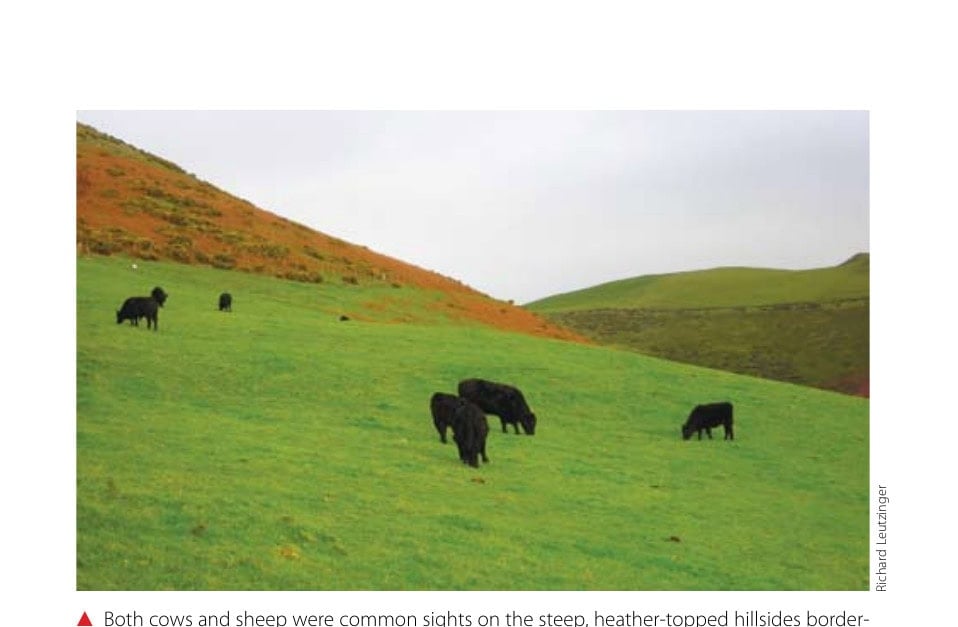
The course followed the advertised terrain but with a diversity of scenery I didn’t expect. Before the end of the first four-mile 800-foot ascent, I had lost count of the waterfalls we had passed. By 15 miles, I had lost count of the lakes we had run by. In addition to groves of oak and beech, there were rhododendrons as big as apple trees, whole fields of heather and gorse.
Every man-made structure along the way was made of gray stone—houses, bridges, even the walls between fields of grazing sheep. Every house was topped with a slate roof. Small crowds came out to see us through each village, including one called Rhyd Ddu, urging us along with low-key “well dones” and an occasional “brilliant.” Official aid stations offered water and a watered-down electrolyte drink. Two unofficial tables served cups of tea and fruitcake.
I passed the half-marathon marker in two hours flat and was still holding that pace comfortably at 20 miles. Describing this as “grueling” was a joke. I looked forward to the challenge of the final hill. And then we came to it. Instead of following the low shoulder around the mountain as we had up to that point, we were now about to go straight up one side of it. The road narrowed from two lanes to one, then became a paved footpath and finally a mud-and-stone trail. At one point, I counted 16 people ahead of me, all of them walking. We all walked for close to five minutes, jogged along a plateau in the trail, and then walked some more when the trail took another steep upturn.
Redefining what “grueling” means
“Grueling” had become an apt description by the time we reached the summit and looked down at the slate rooftops of Llanberis below. The steepness of the descent is best recollected now when I stand still, look at a spot on the floor 24 inches in front of my toes, and think, we had to drop 900 feet at that angle to reach the finish. We started the descent at about 23 or 24 miles— first making our way carefully between rocks and slogging through mud, then slipping and skidding across a wet grass pasture, and eventually running along a rutted, rocky, and muddy tractor trail. On the upper outskirts of the village, we got back onto pavement, but at one point even that was so steep that we had to walk briefly.
And then, with nothing more than a gradual downhill and flat run to the finish, little more than a mile away, I bonked. I looked at my watch. It said 4:05. Suddenly, I could barely walk. I stopped three times to sit on the ground. Half a dozen people asked me if I was OK. One kind woman brought me a glass of water and a banana, even though we were well past the last aid station. It revived me enough that I could finish.
My mother-in-law wasn’t seriously disappointed that I didn’t win, but I didn’t tell her that my time of 4:28 (with about a 20-minute final mile) was nearly two hours slower than the winner’s 2:39. My consolation in both marathons was that, as far as I could determine, I was the first American finisher. Perhaps the only one.
This article originally appeared in Marathon & Beyond, Vol. 13, No. 1 (2009).
← Browse the full M&B ArchiveMore like this
1,000+ stories from 19 years of Marathon & Beyond
The complete archive of the legendary long-distance journal — digitized and free to read.
