

Running Fast For the Long Run
In the October 2003 issue of Runner’s World, Amby Burfoot included a profile of my training in his article “Boost Your Endurance.” I received numerous queries from runners who were intrigued with my low-mileage, high-intensity training regimen, asking for details. Why do I train that way? Why does it work for me, relatively speaking, and for whom might it be a reasonable training approach? Let me explain, but some personal history first.
My competitive running began 40 years ago in junior high school and continued through high school and college, primarily as a means for basketball conditioning. There were occasional races, but the training was neither consistent nor sustained for any meaningful length of time. After my competitive basketball playing came to an end, I needed a replacement sport. Road racing has filled that role for the past 30 years. My first race was a 10K, my second a 20K, and my third a marathon.
I was never tempted to go farther, but I was curious to see whether I could go faster. Like most marathoners, I quickly focused on qualifying for Boston, which then required a sub-3:00 finishing time. Soon after I qualified and ran Boston for the first time in 1978, the qualifying time dropped to sub-2:50.
Using a Runner’s World marathon training program, my older brother, Don, who had never run a marathon, and I began following the six-days-per-week training program that totaled a weekly 55 miles of training: three five-mile runs, two 10-mile runs, and a 20-mile run.
In 1979, at the Marine Corps Marathon, we succeeded in running under the new Boston standard when we were at the ages of 29 and 32.
LESS MILEAGE, SIMILAR RESULTS We continued running sub-2:50 marathons throughout our 30s and 40s. As we approached the age of 40, we gradually reduced our weekly mileage to approximately 45 miles per week, but we added sessions of cross-training. After we were 40, those 45-mile weeks became 40-mile weeks and later 35mile weeks on four days of running. However, the total amount of aerobic training
stayed constant as the cross-training increased. Don, who owns a 2:40:50 PR, ran sub-2:50 at age 48, and I ran a personal best—2:44:50—at 41. My running came to a halt for two years when I underwent back surgery after the 1995 Boston Marathon. When I returned to running two years later, I followed a principle of not running consecutive days and only three days per week. Because Don and I train together, he gradually adopted the same training regimen. At age 50, however, he was still running under three hours for the marathon. Three years after surgery, I was able to train enough to return to marathoning.
For the past 25 years, Don and I have consistently earned age-group awards in local and regional races. In other words, our performance relative to others of our age has stayed constant. Those of you familiar with age-graded tables used by the World Masters Association /QQ: World Association of Veteran Athletes? XQQ/ may be interested to know that our performance-level percentages have been virtually identical for distances from 5K to the marathon over a span of 25 years.
Why have we been able to maintain our performance quality while reducing our total running mileage? I will offer some reasons. First, we have maintained a high level of intensity for those three runs. Our weekly running includes (1) a track workout that incorporates interval training totaling three to four miles of fast running, (2) a run of five to six miles at marathon pace or a tempo run of three miles embedded in a five- to six-mile run, and (3) a long run of 15 to 20 miles at only 15 to 30 seconds slower than marathon pace. Ours was an approach that we later learned was strongly supported by Jack Daniels’s research as presented in his Daniels’ Running Formula.
Second, we have maintained a cross-training regimen on at least three of the nonrunning days. These workouts have varied among bicycling, swimming, rowing, and tennis. We also train with weights two to three days per week.
Third, we have maintained the same body weight. Our year-round training and attention to good nutritional habits have been constant.
ONE SIZE DOESN’T NECESSARILY FIT ALL Fourth, it may be that we are well-suited physiologically to a high-intensity, lowvolume training program. Some runners—most likely those with a high percentage of slow-twitch muscle fibers—respond well to high-mileage training. Based on our successes in other sports—in particular, basketball and track events including distances from 220 to 880 yards and the long and high jumps—I would speculate that we have a fairly even mixture of slow- and fast-twitch fibers that respond well to the lower-mileage approach.
To be sure, I am not advocating our method of training for everyone, nor am I claiming that it is even the best method of training for us. It is a training regimen
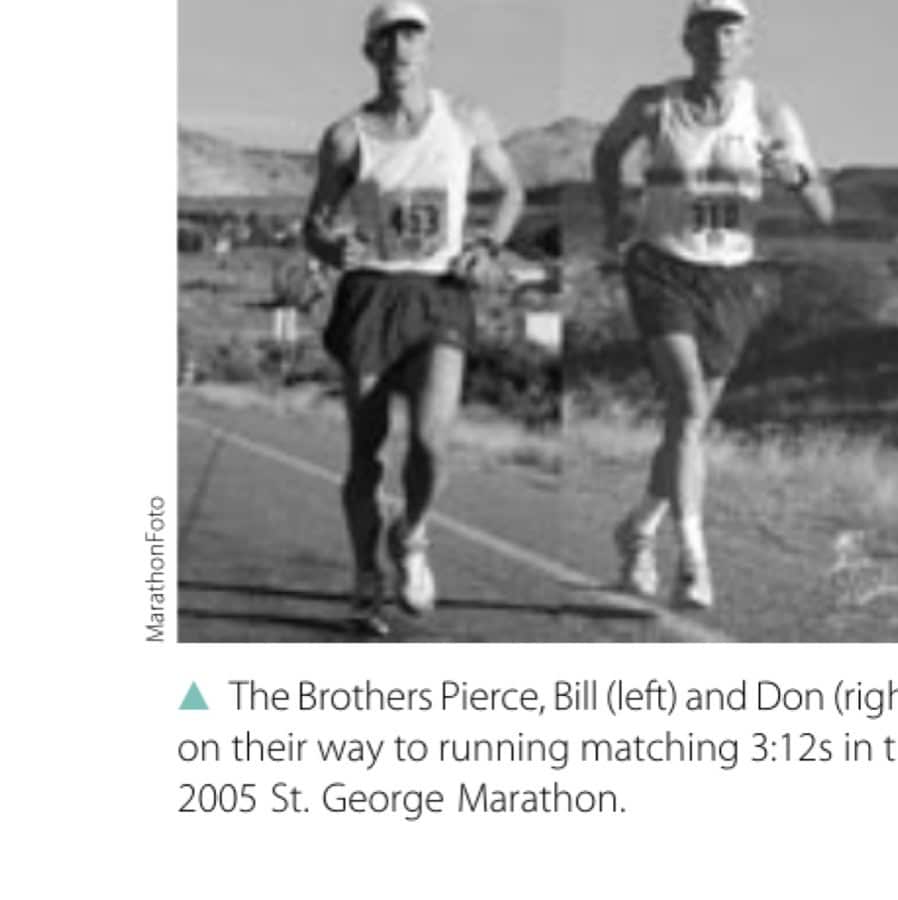
MarathonFoto
that has enabled us to maintain a high level of fitness and a comparable performance standard over three decades of running. The advantages of the three-runsper-week training regimen are that it keeps running fresh, reduces the likelihood of overuse injuries, and provides sufficient recovery to have faster training runs
than if you were running more often. At Furman University, where both of us are employed, the Furman Institute of Running and Scientific Training recently conducted a study to determine the effects of a three-quality-runs-per-week training regimen on running performance.
It was hypothesized that by adhering to training paces and distances determined by each subject’s fitness level, runners in the study would have an improvement for one or more of the following running performance variables: maximal oxy
gen consumption, lactate threshold, running economy, and running velocity at maximal oxygen consumption. As a group, the subjects showed improvement over the 16 weeks of training on all of the four variables related to running performance. Improvements of 7.9 .
percent and 4.4 percent in running velocity at peak VO2 and lactate threshold, respectively, for the 22 subjects are a strong endorsement for the three-qualityruns-per-week training program. Because the subjects were experienced runners and racers, their improvement confirms that training with a purpose in a structured
program can lead to improvement, even for the runner who has been training regularly. The three-quality-runs-per-week model gives runners a means for achieving a high level of fitness with only three or four hours per week devoted to running.
This “optimal results from a minimum of training” model gives the recreational runner a means for staying healthy and competitive while still having time to participate in other recreational activities.
The three sessions per week of high-quality running still provide the recreational runner with the fitness benefits of high-intensity training and the stimulation, both physiological and psychological, associated with hard ef
forts. We hope that by running fast, we will be running long for the long run. Author’s note: The Furman Institute of Running and Scientific Training (FIRST) was the subject of an August 2005 Runner’s World article that described ▲
The Brothers Pierce, Bill (left) and Don (right), on their way to running matching 3:12s in the the results of a “three-days-perweek” marathon training study. 2005 St. George Marathon.
This article originally appeared in Marathon & Beyond, Vol. 10, No. 1 (2006).
← Browse the full M&B ArchiveMore like this
1,000+ stories from 19 years of Marathon & Beyond
The complete archive of the legendary long-distance journal — digitized and free to read.
