

Running Luddite
It reigns supreme as the most important and historic stretch of macadam in all of road racing, according to Bill Rodgers, who won the world’s greatest race four times in six years. Full of lore and dreams, broken and fulfilled, Heartbreak Hill looms at mile 20 of the Boston Marathon. As I bounced over its crest and shifted gears to descend the “Haunted Mile” into Cleveland Circle in the 2007 Boston, I heard a voice out of sync with fans and runners: a familiar style of voice, one that we’ve all heard while standing in line at the grocery store or the airport. A fellow runner was talking on a cell phone—loudly, of course. Unbelievable.
As I hurried through that fabled stretch of the world’s most historic marathon, I told myself, “This moron is talking on a cell phone. A &#@$% cell phone!” Then I remembered that old definition of stress: “when the mind overrides the body’s overwhelming desire to choke the living (daylights) out of some idiot who desperately deserves it.”
Well, I wasn’t going to kill him. I just wanted to throw his phone in the gutter at the bottom of Cleveland Circle, where Rodgers’s store was located many years ago, just as a tribute to what road racing once was, before the dark times of cell phones, iPods, heart rate monitors, and stopwatches with GPS devices that can tell you which blade of grass you are currently stepping on at 50 degrees east longitude, 38 degrees north latitude.
One of my old running buddies often took great pleasure in teasing me about being a “slave to the watch,” and that was just a regular old chronograph about 15 years ago. By today’s standards, I could be considered a running Luddite. You can call me that, but unless one of us is on fire, don’t call me while we are working out.
Tyranny! Tyranny! Ye of the silicon teat Running the shores of White Rock Lake in Dallas, Boston’s Charles River, or any popular running trail the last few years, it’s obvious the phenomenon is approach86 l MARATHON & BEYOND l March/April 2012
© Michael Hughes
ing ubiquitous status. Would-be athletes are trading in the pleasures of running for the tyranny of electronics. If you didn’t guess already, I’ll confirm for the record that I am an old-school runner from the 1970s. A wonderful aspect of our sport back then was that, despite being a solitary pursuit, there was an almost tangible camaraderie among athletes dreaming of being the next Sebastian Coe, Francie Larrieu Smith, Frank Shorter, or Grete Waitz. Lifelong friendships forged with other runners belied a fierce competitiveness that was reflected in race results in the ’70s and ’80s.
Even on a local race level, the difference between then and now is stunning. For example, I regularly ran 34-minute (or faster) 10Ks and 16-minute 5Ks in Dallas and Fort Worth-area races. These days, that is often good enough for the overall title with no one else even close. Back in my glory days, I grabbed a bunch of age-group awards but rarely finished in the top 20.
And all of this high-level running was accomplished without the aid of heart rate monitors, iPods, GPS watches, or cell phones. Imagine that. Too many times in recent years, out of habit, I’ve pulled alongside fellow runners on the trail or in a race just to socialize for a moment, then realized they were completely oblivious to me and the rest of the world. You see, I’m not on their iPod playlist, they’re engrossed in checking their heart rate, and, oh, wait a sec, they have to take this call. “Blah, blah, blah. Blah, blah. Yak, yak, yak, yak, yak.”
Heaven help us all. Wasn’t this supposed to be the Communications Age? Let’s call it the Age of Making Simple Things Complicated. How did we get here, and more important, what do we do about it? And what in the name of Clarence DeMar ever happened to just living in the moment? I love what a very famous walker once wrote: “Simplify, simplify.” His name was Henry David Thoreau, and his writings still resonate in our needlessly complicated world.
Taking them on, one by one by . . . So let’s make a short, simple list of the culprits that pull people away from the pure joys of running. Cell phones: First, a confession. There are rare times I carry a cell phone while running, for safety reasons, and I recommend this to anyone who feels the need. But I’ve never actually used it during a workout. I prefer to focus on the task at hand and live in the moment, whether it’s my daily run or the Boston Marathon.
What I see at White Rock Lake and other parks are runners, cyclists, and walkers jibber jabbing with a caller about the Cowboys game, the weather, the price of tea in China, and so forth. This leads me to ask, “Who the heck are you talking to 24/7/365? Do you really have to talk to someone every waking moment of the day?”
Again, carrying a phone for safety is great, but it gets drowned out quickly when you’re blasting your favorite ’80s tunes on your iPod. MP3 players, iPods, and such: I still remember five-time Olympian Francie Larrieu Smith talking to my marathon training group in 1992 about the dangers of wearing headphones while running. Whether it’s day or night, male or female runner, the hazards can’t be overstated. Francie bluntly asked, “What are you going to do when someone grabs you from behind? You are not going to hear them coming, and it will be too late.”
This comment comes from one of the greatest female athletes ever, a woman who could certainly outrun an attacker if she had a warning. But, as Francie noted, no warning means no defense. Heart rate monitors: The same pal who once teased me about being a “slave to the watch” also has explained to me how, used properly, heart rate monitors can enhance the training of runners and other athletes.
Dang hypocrite. Seriously, I agree. But the overuse of these devices can be as detrimental to training as an overuse injury, particularly for marathoners. Even with factors such as age and fitness being equal, the charts listing maximum heart rates and target heart rates are educated estimates, at best. If you’re having a breakthrough speed workout or race, are you going to hold back because your HRM registered 170 beats per minute?
© Michael Hughes
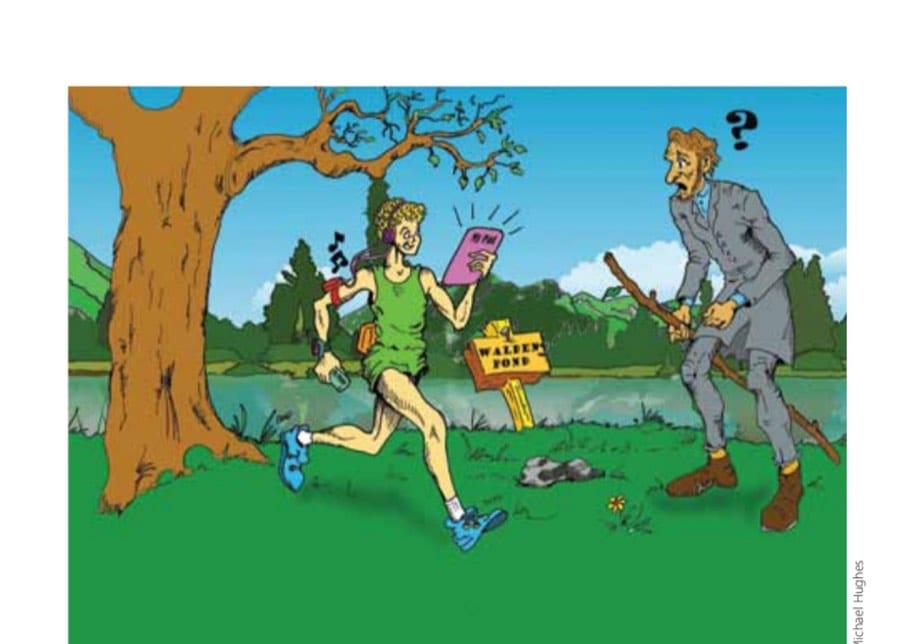
That is kind of like the guy who, once a week, runs 12 times 400 meters in 75 seconds because, well, that’s what he does every week. This limiting mind-set is a guarantee of limited race performance. Why not hit the trails or the roads and run those same 75 seconds with the pedal to the metal? You won’t know exactly how far each repeat is, but odds are you may surprise yourself by reaching new levels. No matter what the monitor says, you’re either running your hardest or you are not.
Run as fast as you can on that day Kenyan running great Ben Moturi, who dominated Texas distance running in the 1970s and ’80s, once explained the folly of clock-watching and time goals to me. After he ran the White Rock Half Marathon in 1:12, Ben, in his early 50s by then, was relaxing after the race. When I asked him if that was his time goal, he looked at me very strangely, then smiled. “I never set a time goal,” he explained in his gentle East African accent. Pointing at his feet, he added, “If you do that, it is like you are running with a clock on your shoes. Then you are watching that clock instead of racing.”
Moturi’s “let it all hang out” strategy worked well for him over the years. He won dozens of races from the 5K to the marathon and placed 10th at the 1982 Boston Marathon, the “Duel in the Sun” won by Alberto Salazar.
As I said, either you are running your hardest or you are not, a statement so simple that Thoreau would have loved it. This is where the digital people miss the whole point of running. They make a very primal activity a complicated thing. The Dallas Morning News published an article about GPS devices and iPods, written by Leslie Garcia. “One recent morning, on what was supposed to be a slow workout day, the monitor registered my heart rate in the 160s after only half a mile (give or take 0.01 mile),” she writes. “I almost turned around and walked home, even knowing that the monitor had a bit of a glitch.”
Garcia then admits, “Thus, I have a certain amount of envy and admiration for people who don’t particularly care what their heart rate is. Or whether this run is 0.35 miles longer than the last.” As I’ve discovered in 36 years (and approximately 93,000 miles) of running, it all kind of evens out over the years. I probably overestimate one run by 400 or 800 meters a few days after I underestimate another course.
Notice I said “course,” not treadmill, the next evil contraption to discuss. Treadmills: Aside from the fact most of these devices become very expensive clothes hangers, the treadmill troglodytes are running right past a wealth of memories. Just in the last several months at Dallas’ Norbuck Park and the White Rock area, I’ve seen bobcats, coyotes, snakes, opossums, raccoons, skunks, and armadillos.
Over the years, I’ve run 10-mile workouts in 112-degree heat, which was even worse than I imagined. I’ve cruised through tempo workouts on stunningly beautiful days when God graced us with a 62-degree, partly cloudy template. Just as memorable were the wind-chill runs of 20 below zero and the South Carolina hailstorm that blindsided me back in 1978.
Visiting my cousins in Camden, a scenic little rural hamlet, I went out for a run on their 2.7-mile “block.” About five miles later, I realized there was some miscommunication. I was hopelessly lost on very lonely country roads, and it was getting dark. Then the lightning and rain started rolling in, making my 15-yearold body move a whole lot quicker. The rain came harder, the lightning put on a blinding show, and I got scared.
Running like a bat out of hell, I vividly recall crossing railroad tracks just as I was thinking this can’t possibly get any worse.
Hail! Hail! The gang’s not here It did, in the form of hail—good, solid, marble-sized hail that hurt like hell. It felt like a thousand bees stinging my skin. And I ran faster than I’ve ever run before or since. (I’m sure a GPS watch would have confirmed this!)
I finally came upon a gas station my cousin and I had been at the day before. The stunned attendants graciously offered their phone as they stared at me like I was a madman or an alien, maybe both. My cousin picked me up a half hour later, and I slugged him in the shoulder and explained to him the importance of communication. (His “block” was actually a triangle.) We laughed our asses off all night long.
And I will have a story to tell for the rest of my life. What stories will the iPod generation tell people? That they were talking on their cell phones on Heartbreak Hill? That they would have made more running friends if they could have heard anyone talking to them? That their heart rate in Boston was three beats per minute faster than it was at the New York City Marathon?
Out of the hundreds of races I’ve competed in from the mile to the marathon, I remember few of my times and places, although I can look them up in my oldfashioned, handwritten running log. What I will take with me are the people and the experiences, one reason I mention Ben Moturi and Francie Larrieu Smith. I will never forget the months I had the honor and pleasure of training with these champions during my freshman year at North Texas State University: the hot August intervals on the golf course, the early-morning “steady state” runs through the farm roads of then-rural Denton County, always watching in admiration as Ben pulled away from us like a man on fire.
Then getting to know the high-quality people they are, something many runners don’t have time for in the Age of Electronica. My list of running friends and experiences could fill up megabytes of memory.
My heart rate quickens as I write this, but this running lifestyle can’t be measured with an instrument. It’s in my heart and in my head. Simplify, my friends, simplify.

This article originally appeared in Marathon & Beyond, Vol. 16, No. 2 (2012).
← Browse the full M&B ArchiveMore like this
1,000+ stories from 19 years of Marathon & Beyond
The complete archive of the legendary long-distance journal — digitized and free to read.
