

Running With Purpose
On July 8, 2010, I had the opportunity to speak with elite ultrarunner Lisa Smith-Batchen. Lisa recently finished a project called Running Hope to America. Joined by her crew and long-time friend Sister Mary Beth Lloyd, Lisa set out to run 50 miles in each of the 50 states in 62 days to raise money for charity. At one point in the run, she got injured and completed her journey across the United States with a broken foot. Lisa is 50 years old and lives with her husband, Jay, and her two adopted daughters, Annabella, 8, and Gabriella, 5, in Driggs, Idaho. Lisa, how are you recovering? My body is recovering quite well. My foot has to remain in a cast. But, eventually, it will heal. I think where I am having trouble recovering is that I’m on a letdown, like a downturn. It’s that sinking-in feeling of, “Oh, my God, we’ve actually done this.” We’ve actually done it. It went by so fast that I never had time to think about it while I was doing it. You and Sister Mary Beth have, for some time now, been advocates of “running for a purpose”—that is, running for a cause other than for personal glory. How important was that concept to the mission of Running Hope to America? It was incredibly important. I have been good friends with Sister Mary Beth for 28 years now. She has been the mission director for many years of Religious Teachers Filippini. She has a book out called AIDS Orphans Rising. For many years, we have focused on raising money for orphans in the world, where both parents have died of AIDS. There are about 700 AIDS orphans that we take care of all the time, year-round. But there are also 57,000 AIDS orphans in America alone this year. And that’s just from AIDS. People have a tendency to think that AIDS isn’t that big of a deal anymore, but it is a huge deal. Six cents can feed a child in most countries. Six pennies. A nickel and a penny. Can you believe
that? And that feeds one child for a day. So think about a dollar. One dollar truly makes a difference. Our hope is to get the word out there that $1 will make a difference. We want to raise $1 million. If 1 million people donate just $1, we’ve got $1 million. That doesn’t seem so tough, does it? How long did it take you to organize this project? It only became an idea last August. It hasn’t even been a year that the idea even came together. The fact that we’re already finished with it is still absolutely remarkable to me. It’s a miracle, really. There were a lot of people who doubted you from the inception of the project and said that the whole thing just couldn’t be done. What was it like to hear those kinds of criticisms so early on? It was tough because some of it was from people that I highly respected in the sport. They saw the schedule and said, “How are you going to do this? It’s nuts!” But I think some of us gain power when others tell us, “You can’t” or “You won’t.” I just kept saying, “I am going to do this. If I don’t do it now, it’s never going to happen.” Also, I knew that if God really wanted us to do it, He was going to help us. It’s funny because it just worked. Everything fell together. Was there ever a moment when you questioned the feasibility of it all and said to yourself, “Maybe they’re right. Maybe it can’t be done?”
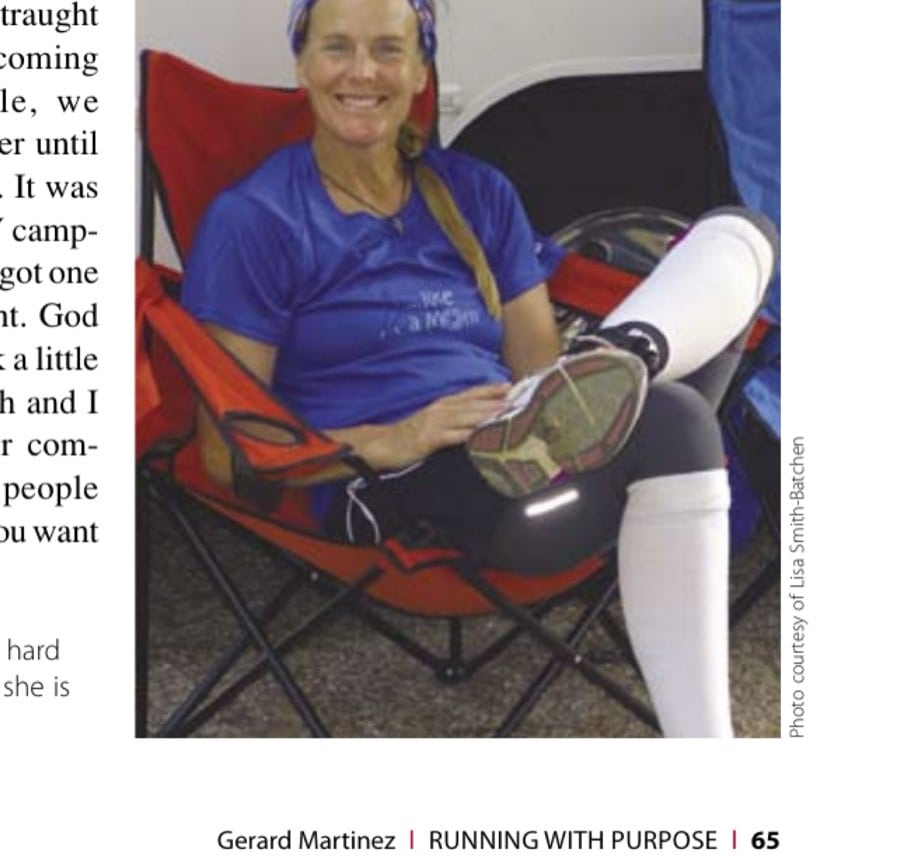
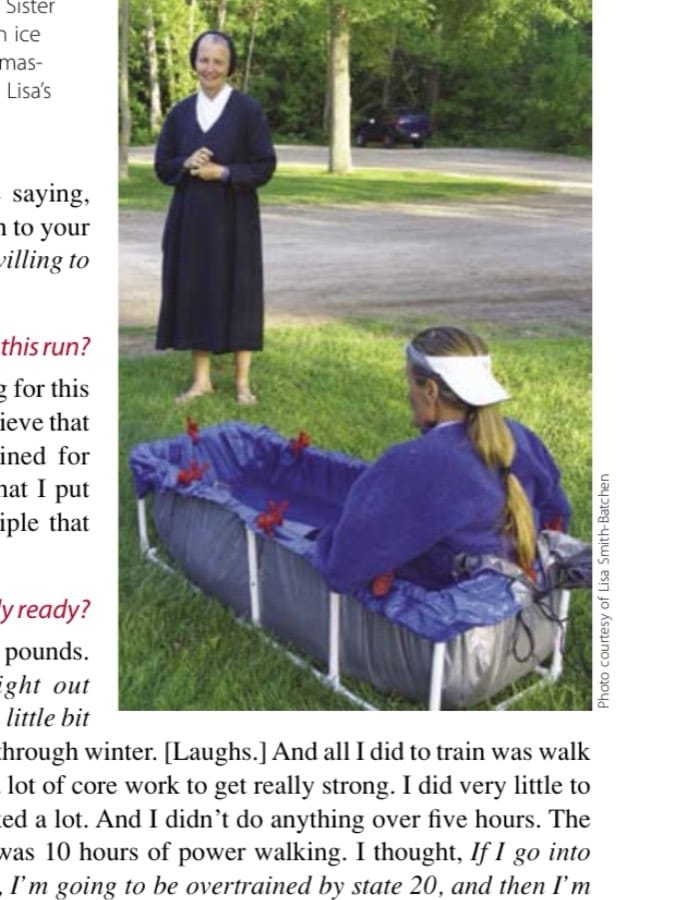
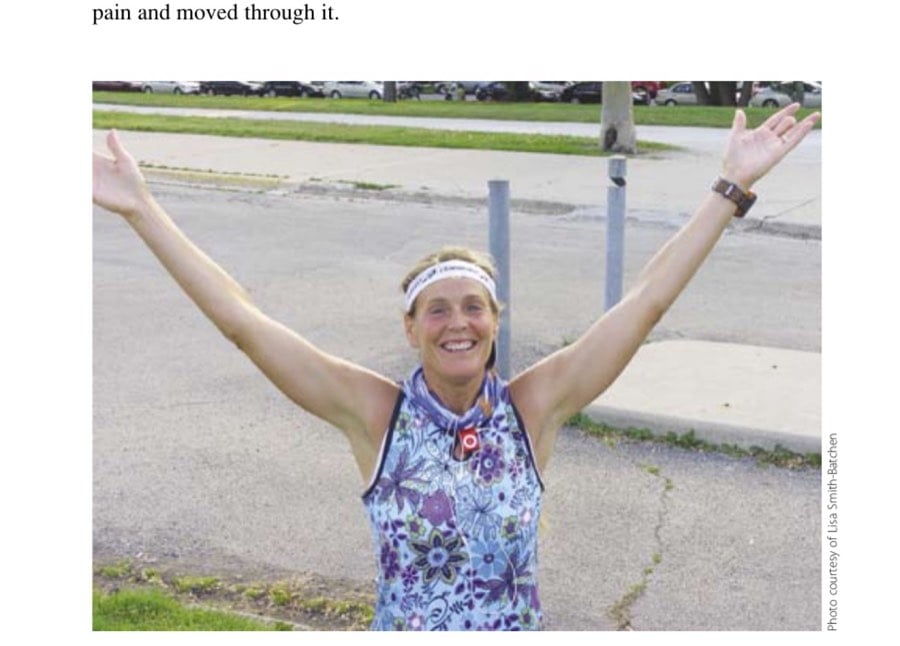
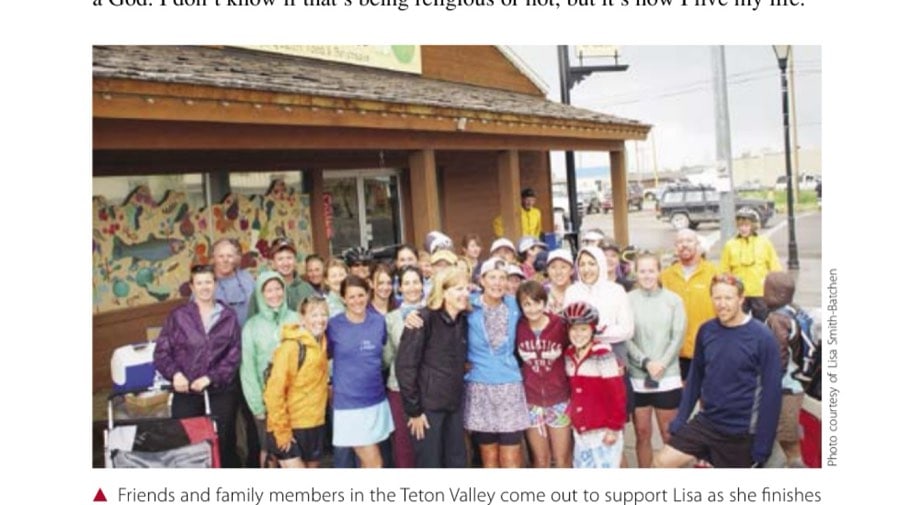
Photo courtesy of Lisa Smith-Batchen
Never. I never, ever said, “Let’s throw in the towel.” There was a time when I was distraught because nothing was coming together. For example, we didn’t get the RV camper until two days before we left. It was amazing! We had no RV camper! [Laughs.] We finally got one for a very good discount. God was just making us work a little harder. Sister Mary Beth and I never faltered from our commitment. When other people criticize you, of course you want
▲
Lisa rests her legs after a hard day’s run. Despite the pain, she is all smiles.
▲
Under the watchful eye of Sister Mary Beth Lloyd, Lisa takes an ice bath. These baths, as well as massages, played a crucial role in Lisa’s run through America.
to listen to what they’re saying, but you also want to listen to your heart. How hard are you willing to work to make it happen? I’ve actually been training for this my whole life. I really believe that everything I’ve ever trained for came down to this and that I put into practice every principle that I’ve ever learned. How did you get your body ready? I actually gained about 10 pounds. I thought, I’ll lose weight out there, so let me start out a little bit heavier. So I ate my way through winter. [Laughs.] And all I did to train was walk three days a week. I did a lot of core work to get really strong. I did very little to no running. I power walked a lot. And I didn’t do anything over five hours. The longest week I ever did was 10 hours of power walking. I thought, If I go into this thing really in shape, I’m going to be overtrained by state 20, and then I’m going to get injured. So I took on the philosophy of going into it in shape but not in great shape, strong but not endurance-level strong. My friend Marshall Ulrich said it would take about 10 states. He said, “After about 10 states, you should be in a rhythm.” Did it take 10 states as Marshall predicted? No. Oh, my God! It was brutal! By day 10, I was calling Marshall, going, “It’s not happening!” By day 11, it didn’t happen. Day 12, day 13. But, when I woke up on day 14, it was like everything had clicked. Nothing was sore anymore. My body was accepting everything I was doing to it. I started to feel fit. By state 20, I felt like I was flying. I felt so in shape. How many calories a day were you consuming? About 5,000 to 6,000 calories a day.
Photo courtesy of Lisa Smith-Batchen
How long did you train for this run?
What were you eating? I really wanted to hold true to my own nutrition principles, and I did that for the first six states. At first, I didn’t want to eat a lot of sugar. I was eating protein, and I would eat a lot of avocados, tomatoes, and fruits. But after six states, I had lost 8 pounds already and was really tired. I realized I couldn’t keep it up. I had to make some changes. The minute I ate a doughnut and drank a milkshake, my energy came back. It was incredible. I did stick to the high protein and all of the other things I was eating. But, truth be told, the refined sugar and those kinds of calories really did help me in the end. How did you manage all that pain? Some ultrarunners talk about how they love pain. What is your philosophy on pain?
Photo courtesy of Lisa Smith-Batchen
Well, I wouldn’t say that I love the pain. I accepted the pain. I was so tired; I couldn’t get comfortable; my legs ached. I didn’t want to take drugs. I took a total of, I think, 14 Tylenol the entire time. I never took Advil or Aleve. I really wanted to protect my kidneys and liver. As for the sleep deprivation, it was torture. I had to go places that I hadn’t been before. But it’s all a mental thing. I accepted the pain and moved through it.
▲ The sweet glory of success! Lisa celebrates finishing yet another 50 miles.
▲
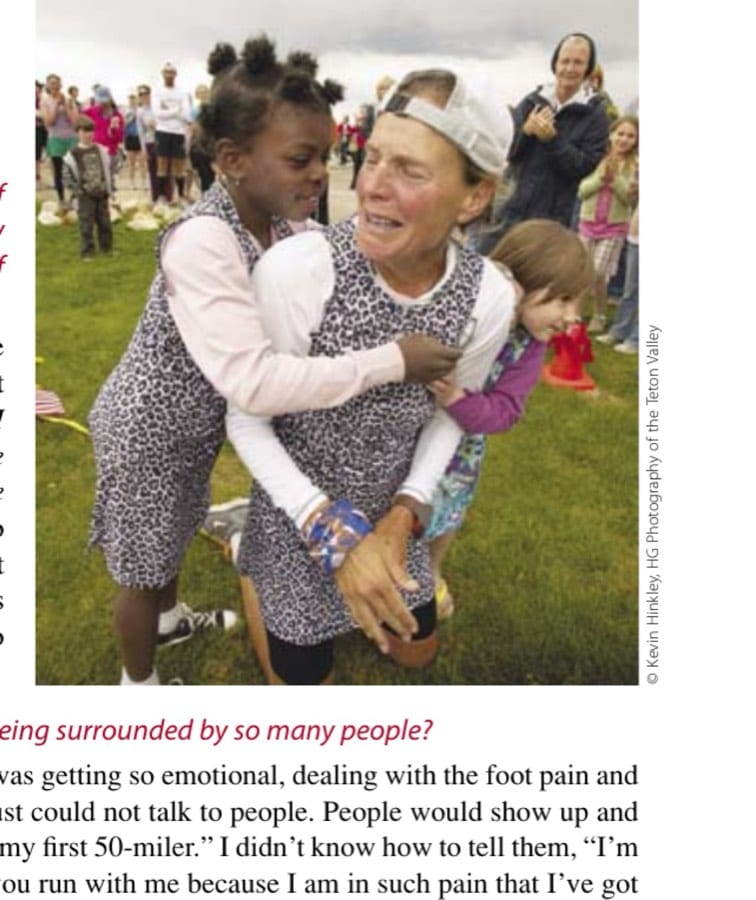
Lisa is embraced by her daughters as she crosses the final finish line on her journey through America.
I loved having people with me for 50 miles. It was awesome. I thought, I can’t believe these people came out to run with little old me. I didn’t expect so many people to show up. It was so kind and generous of them to come. It was so great and inspiring. Was it ever a challenge being surrounded by so many people? Yes. By state 28 or 30, I was getting so emotional, dealing with the foot pain and the sleep deprivation. I just could not talk to people. People would show up and say, “Hey, I’m here to do my first 50-miler.” I didn’t know how to tell them, “I’m sorry, but I cannot have you run with me because I am in such pain that I’ve got to think about myself.” I’m just not that kind of person. And my crew was telling me, “We invited these people. We can’t turn them away.” But then the foot pain got really bad. I had to get into a box and say, “This is my box; don’t get inside my box; don’t come near my box.” All I could think about was putting one foot in front of the other. It was almost like a trance, a meditative state. I had to be selfish because my only goal was to hold to my commitment. How did you break your foot? It was a pothole. A really small pothole. I was running in Texas and talking to this beautiful group of people and all of a sudden, my foot rolled over. When I got back to the RV camper, we iced the foot and elevated it. Did you ever think to stop running? Never. Two doctors looked at the foot and said, “Well, you know, you should probably stop.” I knew I was not going to stop running. So I got an ankle brace and started wearing that. I kept icing it and elevating it. Sister Mary Beth prayed
© Kevin Hinkley, HG Photography of the Teton Valley
You got to meet a lot of people. Talk about how that affected the spirit of the run.
over it. But the pain was tremendous. It felt like Kathy Bates just hit my foot with a baseball bat, like in that movie. [Misery.] But I never faltered. I always knew I could finish. Even if Kathy Bates had broken both my feet, I would have absolutely continued! How did your family support you through the project? My family has always supported me. It’s remarkable. During my run, it was still very important for [my husband, Jay, and me] to keep our kids in their stable environment, going to school and their ballet lessons. Grandma was here to help us. Jay did an absolutely remarkable job. He is my number one supporter. We’ve always supported each other. He knew all along that I wanted to run across America, so when we sat down and I showed him all the plans, he said, “What can I do to get this to work for you?” My parents and siblings have always supported me, too. Every one of them was there for me along the way. My mom was at the finish line. My oldest brother was on my crew. I am so fortunate to have them. I saw that incredible photo of you at the finish line in Idaho. Your family is by your side and you are on your knees crying, your face turned up to the sky, hands folded in front of you in prayer. Your expression is almost indescribable. What was going through your mind at that moment? It makes me cry to even think about it. We lost a friend here [in the Grand Tetons] on February 26 in an avalanche. His name was Wray Landon. Five days before I finished, I was scrolling through my phone, and I had like 3,000 e-mails. But there was this one with the subject line reading, “When the going gets tough towards the finish . . . ” It was from Wray’s mother. Inside, the message read, “When the going gets tough towards the finish, as it will, Wray will lift you up and help you towards the finish line.” So eight miles to the finish, my foot was killing me. My orthopedist had already looked at it and said, “Oh, man! Lisa, when you see the finish, run like hell because it might just blow. Just give it all you can.” It was thundering and lightning. It hadn’t done that all day. It was unbelievable how loud it was. Sister Mary Beth said to me, “God is bringing us home with a bang, Lisa! He’s throwing bowling balls down on the ground!” It was like a beautiful celebration. Of course, everybody else was freaked out. I had all these people running with me. All of a sudden—I’m not kidding you—60 mile-perhour tail winds picked me up and threw me four miles into Victor, Idaho, which is where the next stop was and where a whole bunch of people were waiting for me. I’m telling you, my left foot, the broken one, was not hitting the ground. I looked up at the sky and I could feel Wray’s presence. His presence was bigger than the sky. It was huge, like the wind. When I got to Victor, I kept saying, “It was Wray.” Of course, nobody knew what I was talking about. God did. All of a sudden, I started running. We had four miles left to go. Everybody was with
me. The sky started trembling. The storm was raging. I finished at a place called the Spud Drive-In. Hundreds of people came out. Communities showed up honking horns. There were fire engines and bells ringing. I couldn’t believe this finish line party they had thrown for us. Then the skies opened up; they separated. And the only place the sun was shining was right over the finish. I was speechless. I was so thankful, so overjoyed, and I kept thinking, God, we did it! My kids were there and my family was there. So many people I love were there. I’m still left with the most joyful heart. I have never felt more loved than I feel now. It was never about me. Never. It was always about following the call. I feel that God had been telling me, “This is what you’re supposed to do, Lisa.” I want to tell you that you are one of the most truly religious people that I know. [Laughs.] No, I mean that in the best possible way. The work you do for other people is truly inspiring, as is your unrelenting faith in God.
Photo courtesy of Lisa Smith-Batchen
I wouldn’t say that I am religious. I don’t go around preaching Catholicism at all. Sister Mary Beth once told me that “becoming a Catholic just makes you a better Christian. But you don’t have to be a high and mighty Christian, walking around preaching Catholicism.” The important thing is that you just believe in something. Have faith. Just go out and be a good person. Do good things. I just live by my faith. I do believe in God. What I saw during my run proved to me there is a God. I don’t know if that’s being religious or not, but it’s how I live my life.
▲ Friends and family members in the Teton Valley come out to support Lisa as she finishes running 2,500 miles through the United States.
Why call the project Running Hope to America? Our goal is to spread hope and raise money and awareness. There are so many people suffering and struggling in the world. We want to help them all, AIDS orphans included. We want to give them hope. You know, hope is a big word. People who have hope live incredibly differently than people who don’t. Orphans came out to see us on our run, and homeless people were cheering for us. It was awesome! You have to have hope. If you don’t have hope, you won’t succeed. In the end, our entire mission was successful because we were able to touch so many people. That’s what life is all about, right? Helping people. Now that the run is over, is your mission to help these kids finished? The run was just part of the journey. Now the journey continues. The awareness continues. We get to tell our story. The money is not going to be raised by next week. I think it’s going to take maybe a year, but it’s coming in more and more all the time. Now that we’ve actually completed the project, people are donating more. It’s wonderful. What comes next? Where does Lisa Smith-Batchen go from here? You know, that is actually a big chapter of the book I’m going to write. Where do I go from here? Where does someone go when they’ve been an athlete in this sport that’s consumed them for so long and now it’s over and gone? I’m never going to get any faster. I really don’t think I’m going to run any farther. So I don’t see a point in continuing to race. Why spend money and time doing that when I have two children to raise? But I do know that I will do another journey or another adventure to continue raising money for children, probably something with Ray Zahab and Marshall Ulrich. I’m definitely going to write a book. I want to start doing some guest speaking; I want to tell our story, the story of Running Hope to America—how we did it, why we did it. I want to tell others that if they believe, they can do anything.
Postscript After undergoing major foot surgery and spending over nine months in a walking boot and a cast, Lisa finally began training on May 1, 2011 for her 10th Badwater crossing. She had not run a single step since that final day in Idaho. Her orthopedic doctor says that her foot is “as good as new.” Getting back into the groove of running is a slow and painful process, but Lisa tells me she is just grateful to be able to run again. “I will be racing for last place,” she says. She feels that completing Badwater will be the end of Run Hope for her. However, the charitable initiative continues on for those who choose to follow Lisa’s good example.
This article originally appeared in Marathon & Beyond, Vol. 15, No. 4 (2011).
← Browse the full M&B ArchiveMore like this
1,000+ stories from 19 years of Marathon & Beyond
The complete archive of the legendary long-distance journal — digitized and free to read.
