

Rush To New Orleans
At times, you have to decide what your priorities are. I had been tracking the open spots in the entry list for the Milwaukee Lakefront Marathon for most of the summer; I’d run a relay with my wife at the Paavo Nurmi Marathon in Hurley, Wisconsin; and I’d been boosting my overall mileage. By the end of August, I had decided on my priorities and I’d registered for the Milwaukee race. But things were not to be as simple as I’d made them out in my mind and according to my plans. That weekend, Labor Day, while I was listening to the weather reports concerning another storm in the Gulf, my carefully laid plans would be blown into tatters. No big deal, I thought at first; the Gulf has hurricanes, and we have snowstorms. But relatively speaking, we’re both so used to riding them out, that hurricane or snowstorm, it’s just another day.
Then the unacceptable happened. News came fast; the New Orleans Saints wouldn’t be able to play any home football games this year! Total devastation had hit New Orleans and the Gulf States. Well, I convinced myself, you just have to set your priorities. In my part of the world, all was well; my name was on the list of runners accepted into the Lakefront Marathon, and I was ready to notch one more 26.2-miler on my belt.
But in church that Sunday, Bob Breneman brought up the problem of the hurricane, and in response, a special offering was made to help folks affected by the disaster. But we had no idea what the most effective use of the money would be. A brainstorming session followed the regular service. We knew the problems in the Gulf were serious, but we still didn’t have any idea of the extent of the problem.
A relief plan was put together; one of our congregation members is from Alabama, and his friends there told of a church that did good relief work. From our Christ Congregational Church of Rio, Wisconsin, to the Church of the Nazarene in Monroeville, Alabama, a relief effort was put together.
Our relief plan was a go, but it had a long way to go before it could actually be called a “plan.” We had no idea what we were doing, which, it would turn out,
was just like FEMA. On Wednesday, we borrowed a trailer from the Assembly of God Church of Rio, packed it full of supplies, and additionally packed a pickup lent to us and driven by Delbert Curtis. We set our priorities, which were to do Something—and to do it sooner rather than later. We now had a plan! I went along as a driver, navigator, and financier—using my charge card to get 5 percent rebates on gas purchases; I would get repaid for the gas less the discount. We wouldn’t have to worry about carrying cash, and our gas fund would go just a little further.
I have driven to running events all over the country, and my wife and I make a habit of finding nice campgrounds we can check into rather than using motels. I also collect maps, so with an atlas and a bundle of individual state maps, I would do most of the navigating. Delbert is retired from a job with the county; he used to drive a snow plow, so he is used to extended drives, although they usually didn’t require navigating. Jason Howie would go along and be left in Monroeville to work until we came to pick him up. We were lucky to find three people who could leave town on short notice. I made peace with myself that my running would be seriously curtailed while we took part in our delivering-the-goods mission; I might have to run the upcoming marathon by relying on the training runs my poor legs had been doing over the past decade or so—sort of like muscle memory.
THE BEST TYPE OF INSURANCE The trailer was packed on Wednesday. Louise Camp, church secretary, was there in the parking lot as we were finishing up. Louise had her list to check off with us to make sure we were ready, and she got to the end of it, finally: “Do you have Triple-A?” She obviously wanted us to be ready for any eventuality.
I said, “No, but we have G.O.D.” Louise paused for a second; then we all laughed, and suddenly that became our slogan for the mission. It would come up several times along the way: G.O.D., but no Triple-A!
Thursday morning, the 15th of September, we left Rio. Donations had been gathered on short notice by Christ Congregational Church of Rio and North Scott Baptist Church of Pardeeville, and gas money that would complement my credit card was contributed.
First stop was for gas at the Illinois border. My charge card wouldn’t work at the pump. We had a problem! But we had G.O.D., so it didn’t remain a problem for long. The card worked just fine on a different pump.
Delbert did most of the driving. I think if we had a snow plow, he would have felt right at home. We passed Peoria, where I have mixed memories of going to a race and getting locked into a campground at the state park. Park didn’t open until eight, same time as the start of the race. Not to be deterred, my wife, Deb, and I just decided to run the distance at the park and go to the finish line later.
▲
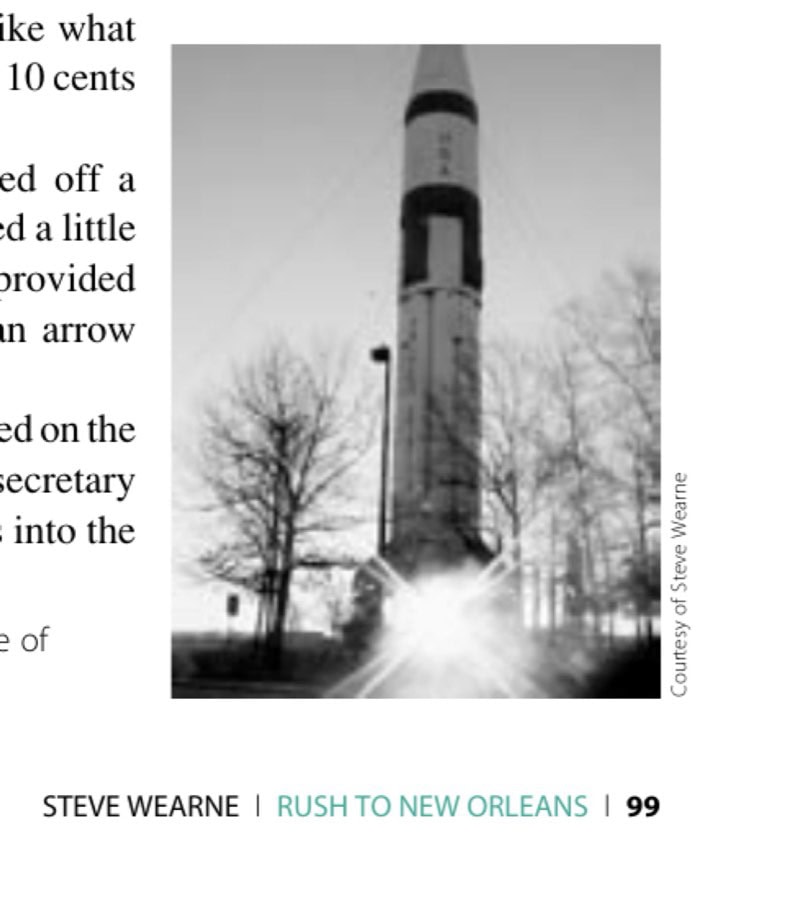
The sun at dawn gives the rocket a source of power for liftoff.
Courtesy of Steve Wearne
At Bloomington, we turned east, getting to Indianapolis just after 1:00 P.M. I once ran a half-marathon here, a big event. I have the picture as I crossed the bricks at the Indy 500 track. It was the largest race I had been in up to that time.
When the starting gun sent the runners off on their way, they filled the streets of Indianapolis. It was difficult to pass other runners in the crowded conditions until we reached the Indy track. Because it had a wide roadway I pulled out to the side and accelerated on the straight. The curve was banked so steep we had to stay down on the infield. This event really gave us a feel for another kind of race. The light traffic in Indy helped Delbert and me avoid passing difficulties.
When we reached Louisville, there was an accident, and traffic was backed up for miles. Since we had G.O.D. with us, however, the accident was in the northbound lane and the southbound lane in which we were driving had a clear road. On our first day we made it to Athens, Alabama. When I ran the marathon in Birmingham, I had stopped at the first rest area early in the morning. A rocket is on display at the rest area. I took a picture of the rocket while the sun was coming up that morning. With careful framing, it looked like the rocket was blasting off.
The Birmingham Marathon was memorable because I had picked a state park to camp in and the lights were on all night. I had no idea of the time and was late for the start. You can imagine getting to the start as the mats are being picked up and asking, “Which way did they go?” I had to run several miles just to catch the last runners. It was at that race that I met Jerry Dunn, the race director and marathon-running maniac and the husband of Elaine Doll-Dunn, from South Dakota. Elaine is the race director of Leading Ladies’ Marathon. Race directing obviously runs in the family.
We noted that a lot of military vehicles were on the road, and there were about 10 trucks parked around our exit. The soldiers looked bored, making us wonder, how effective is their presence? A few trees were down in this area, but the damage was scattered, something like what a tornado would do. Gas prices dropped 10 cents a gallon just off the interstate.
I had a map of Monroeville printed off a computer. It helped, but we really needed a little better guidance. As if on cue, G.O.D. provided a sign: Church of the Nazarene, and an arrow pointing to the right.
We rolled into the parking lot, knocked on the door, and introduced ourselves to the secretary at the church office, and she directed us into the
dining room. “Go in there and eat,” she ordered. We obeyed. Eating had not been one of the top priorities on our list.
FILLING OUR PERSONAL FUEL TANKS Pastor Freddie Lindsey soon joined us. Freddie took a plate of food, but he was interrupted about four times by the ringing of his cell phone. I was about ready to help him clean his plate but opted for another piece of cake. Good food, typical church style, in this case heavy with homemade Southern dishes. Shortly after lunch, the cooks would start tomorrow’s meals. This church was experienced at pitching in and helping out—displaced people from the Florida hurricanes of 2004 were still living in the area.
Freddie told me about his group. It provided everything evacuees would need—food, clothes, bedding—and even helped secure medical attention. When the hurricane victims left their homes, they left everything behind, including in many instances their drug prescriptions. Freddie was frustrated because the people were desperate, trying to get government assistance in the form of cash cards good for $600 and up, but were standing in long lines outside Red Cross centers while the weather was very hot and humid. The Red Cross had sent its local chapter 200 cash cards. The problem was that there were over 1,000 evacuees wanting those 200 cards.
Freddie said, “The backbone of America is being tested, and it is cracking.” I replied, “The backbone of the American government is being tested, and it has cracked severely; the backbone of the American people is being tested, and it is being strengthened.” He needed a little encouragement.
All the government and media focus was on New Orleans, but other parts of the Gulf States had been hit just as hard—some even harder. In Mobile, there were 50,000 people without homes. But the focus was still on New Orleans, as if it was the only place touched by the hurricane. So people hereabouts stand in line in 98degree heat, waiting for the fulfillment of government promises, maybe another 200 cash cards, and then wait for the next day. Don’t lose your place in line!
Freddie showed us his supply center where we were to unload. Passing the Red Cross center, we saw one guy feeding a very small child in the front seat of a minivan, holding the bottle for the baby. All the doors were open to let in what little breeze was available. The inside of the van looked like a disaster area. I
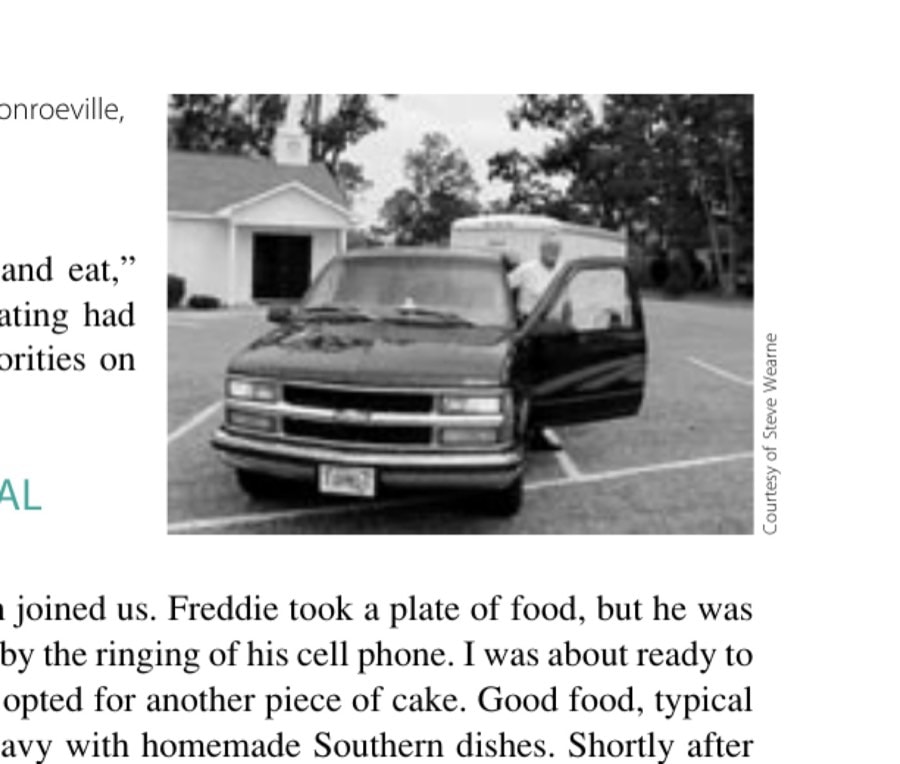
Courtesy of Steve Wearne
▲
Delbert Curtis on arrival in Monroeville, Alabama.
wondered how my car would look after I’d lived in it for two weeks. The family probably had been faithful taxpayers a month before but now lived full-time in a minivan. Freddie mentioned to Delbert a desperate need for food in Pearl River, Louisiana. Next thing I overhear is Delbert saying we were going that way. “Right on the way back to Wisconsin.” I had been navigator for most of the trip, and I could tell I would have to talk to Delbert about the concept of the shortest distance between two points and other such details. On a trip to the Mississippi Marathon near Jackson, Deb and I had camped near Pearl River, so I thought I knew where we were headed: roughly midstate, 100 miles north of the coast, but this was the town of Pearl River where the river flows into Louisiana.
So Delbert comes over to me and says, “We are going that way home, aren’t we? We can deliver supplies for them. Can’t we? That won’t add any distance!” I said, “Sure, we wanted to go there anyway. That’s right on the way home to Wisconsin. Direct route!” I wondered to myself how Delbert would get along with a GPS. He’d probably burn out the poor thing’s memory the first time he punched in some coordinates. At first, we were going to follow a semi the next morning, but after a little more consideration we told Freddie we would leave tonight. No time like the present; strike while the iron’s hot, that kind of thing. Our plan had a life of its own—planned by G.O.D., not Triple-A.
Delbert and I had “sense of direction” arguments for the whole trip. Delbert would say he wanted to go right to look for gas, then left, and I would say I wanted to go west first, then east, which was the same thing. We would make a turn, pass a couple of businesses, and drive into just the place we were looking for without ever having been in that location before.
Our trailer and the pickup were reloaded. Freddie offered us showers. We certainly needed showers but we declined the invitation. After all, we were on a mission. Delbert and I made a pact not to inhale real deep near each other and left for Pearl River. We had our priorities, and they were miraculously delivered to both of us at the same time. We were actually getting into sync. When I said we should go to Hattiesburg, get a motel, and then go on to Pearl River secure in the knowledge that we would have a place to return to, Delbert said that was just what he was thinking.
About 4:00 P.M., Delbert and I were headed for Mississippi. We left Jason to work in the warehouse; he was set to stay for a week, a month, whatever. Pearl River is just over the Mississippi border in Louisiana, near the junction of Interstate 10 and Interstate 12. Trees were down all along the highway. Construction vehicles, loggers, and trucks with trailers much like ours filled the highway as we drove west. I remembered how back home in the wake of major storms I’d done some of my best running; you pretty much had the roads to yourself and
you had the added challenge of dodging obstacles in your path. We stopped in Hattiesburg and according to plan got a motel room so we would have a place to sleep that night. But our plan hit a snag! Where was G.O.D.? We pulled into a motel in Hattiesburg and were told it was booked full until November. We both said we would try another one. I pointed across the road and said to head over there, but the traffic pattern was confusing and we ended up in a turn lane. I told Delbert to just go with the flow; something steered us away from that motel, and on the other side of the interstate we missed the turn for another motel, then stopped at a light long enough to get oriented. We turned right to another pair of motels and pulled into the one that was easier to enter with a trailer attached and went inside. We asked about a room, and there was one. Our G.O.D. plan was working.
NO MORE ROOMS AT THE INN While we were registering, a man walked in and was told there was no room at the inn. Wow! We got the last room. Delbert explained to the people at the check in about our G.O.D., which seemed to be working real well.
They told him we were luckier than we thought: someone had canceled just 20 minutes earlier. If we had come here first instead of the other motel, it would have been full. If we had stopped at any other motel before coming here, that guy behind us would have had the room. We had G.O.D. on our side and G.O.D. was running on all eight cylinders!
At our destination church in Pearl River, we met another army of volunteers, people who were working to distribute supplies to evacuees. The volunteers informed us of a greater need in Slidell, Louisiana. They asked us to drive there to unload. Sure. It was right on the way. Just ask Delbert.
Pastor Thomas Allen corrected my pronunciation of Monroeville. My northern accent just didn’t agree with his southern ears. Then he gave us directions to Slidell. In spite of everthing he’d been going through, he was in good humor; his office was his home. His bedding was kicked to the side of the room until he needed it later that night.
I joined Delbert in the dining room, and we had a nice visit with the volunteers. One of them was from Illinois. He had come here with a friend. His friend had to go home, but he chose to stay. He didn’t really know why he came, but he was glad he did. We told him he might have some G.O.D. about him, just like us.
Slidell is real close to Lake Pontchartrain and the ocean. Debris lined the streets. We drove over downed power lines. The streets were lined with damaged buildings. Some traffic lights were replaced by stop signs; other traffic lights were just dark and unmarked. They probably ran out of stop signs.
We visited and pumped the volunteers for additional information. Seemed like they had a lot of bread, yes, but they had received a truckload that day, and now it
fit on one table; it was being distributed that fast. Lots of canned goods but no can openers. Send can openers! Lots of food. Yes, but it would all be gone in two days max. Could use more canned meat. Personal rescue packages lined the wall, but they go fast, too. A personal rescue package is a large baggie containing toothpaste, towel, toothbrush, and personal care products for one person. They are made up and boxed by the Church of the Nazarene, then sent to places that need them. Considering what some of the evacuees were going through it was great to know we had a motel room waiting for us. Thanks, G.O.D.!
Our trip home was kind of anticlimactic. Our rare disagreement came when Delbert talked about making it most of the way home on Saturday and finishing on Sunday. I said, “What are we supposed to do, get a room in Rockford? Drive the last hundred miles the next day?” Delbert didn’t need much encouragement to keep driving. Delbert saw it my way, and we made it back to Rio at midnight, completing our 2,500-mile loop in 67 hours.
Three churches joined together to send supplies to three churches in the Katrina zone. Needs were being met more efficiently than the Red Cross and FEMA could manage.
RETURN TO THE KATRINA ZONE! After returning to Rio, we consulted on the next step. The need for more supplies was still there. But I had a marathon to run. But then, you have your priorities! Delbert couldn’t make another trip as he had health matters to attend to. So we needed a different vehicle, trailer, and drivers. It was harvest time in Wisconsin. Potatoes were donated from a farm near Plover. Apples came from the Ski High Apple Orchard near Baraboo. More apples and potatoes were donated locally. Contributions of recently canned vegetables came from packing plants. Two sofas, toys, olive oil, stuffed animals. The need for transportation was brought up in church. One member mentioned he had a friend who he thought could help, and I got a call from Paul Maier later that Sunday.
Paul had a large diesel pickup used for construction and a choice of caps for the back; we decided on the camper and enclosed trailer. Paul’s children are home-schooled, so they joined us, and we talked about our plans. When I offered Paul my vehicle to use while we drove south, he claimed
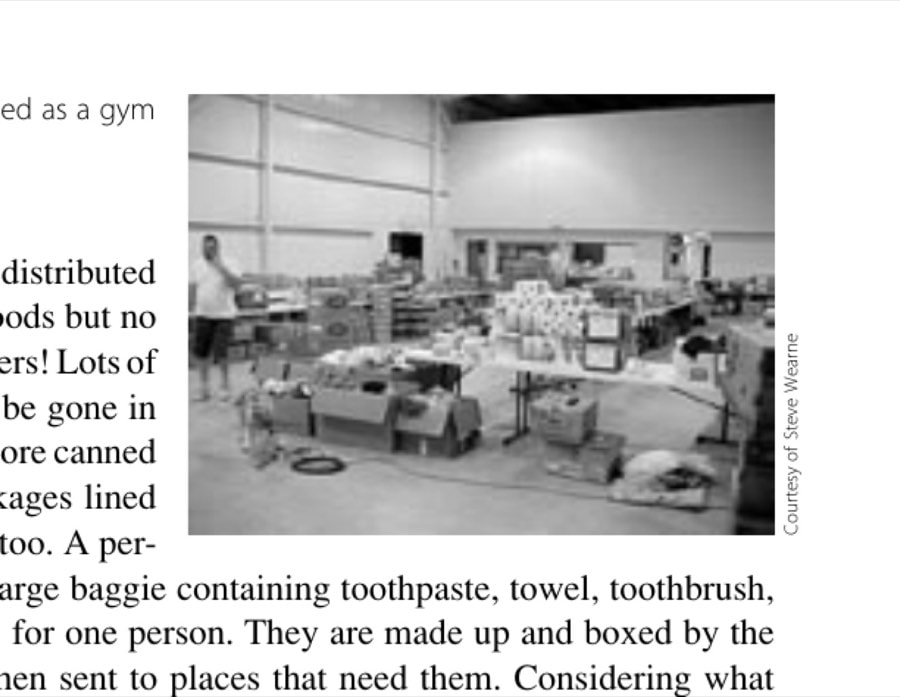
Courtesy of Steve Wearne
▲
Warehouse that was intended as a gym in Slidell.
he thought he was going along. And bringing with him his two sons, Jonathon and Benjamin; they were good workers and could unload at the other end. His offer was quickly accepted. You’re probably wondering by this time where the running comes in—besides nostalgically looking out of a truck window at places along the way where I happened to run races. Well, as time drew near, there was still the matter of the Milwaukee Lakefront Marathon to consider. I had, after all, managed to get registered at the last minute, and here it was being run the very next morning. You’ve got to have your priorities! And for this fall, I apparently had priorities in spades.
Taking a short break from my rescue mission(s), Deb and I went to the expo in Milwaukee. We met the race director, Kristine Hinrichs, as she noticed my Paavo shirt and made a comment about how low key that marathon was. (It starts in a town of about 100 people.) Kristine had run Paavo. We left the expo to find a campsite for the night. We camped at Long Lake in Kettle Moraine State Forest. It’s home to the Kettle Moraine 100-miler, so there’s your “beyond” part of the story. We hiked a trail that night and drove to Grafton for the start of the marathon on Sunday morning.
The marathon went surprisingly well, considering the kind of training I hadn’t gotten due to my travels to the hurricane zone. Deb dropped me off at the high school, and then was able to meet me along the way several times. I ran with and talked to Roy Pirrung, catching him at about two miles and staying ahead until just over halfway through the marathon. Roy is kind of a local at distance runs in Wisconsin. He lives in Sheboygan; he often passes me in the second half of a marathon. He has something of a weight advantage and might train a little more than I do, occasionally running my entire monthly mileage in one day! Roy ran Paavo also, and we talked for a short distance about that race and about writing for Marathon & Beyond, where Roy has had several stories published.
My training had been going well for this marathon; weekly mileage for the year was up to 23. Time for my half of the relay at Hurley had been 93 minutes. Then Katrina hit. Priorities changed. Mileage dropped to 56 miles in three weeks. OK, big drop; I’ve gotta be honest: I haven’t been training. At halfway through the marathon, I was about done. The second half took almost two hours; the full marathon took three and a half hours, which, for me, is two degrees past sluggish. Immediately after the finish, I had to get back to Rio. A trip loomed! Yet another shift in the ever-shifting priorities!
But the plans had changed a bit. Benjamin and Jonathon needed to be back on Wednesday for a class. We would have to go a little faster than planned. The trailer was full, and a couch needed to be squeezed in. When the trailer was ready, there was no way to lift the hitch so it could be attached to the pickup. There was too much weight in the front of the trailer, so we unpacked it, repacked, and then
adjusted it again before leaving Rio. It continued to give us trouble; we repacked two more times in Wisconsin. Finally we were able to get the pickup and trailer up to 70 miles per hour. Paul drove until midnight; I took over in Indiana.
CHANGES MADE BETWEEN THE TWO TRIPS About 5:00 A.M., I was fighting to stay awake. Paul took over the driving. Diesel was now 50 cents more than gas, and with our load we were using a lot of diesel. We pushed on, and I told Paul about the changes since the first trip. The soldiers were gone, power lines held down by fallen trees had been cut, and more vehicles like ours with relief organizations’ signs were in evidence.
Then there were the FEMA vehicles. You would see a bunch of identical trailers traveling the highway. After a few convoys, they were easy to pick out. They were on their way to New Orleans to be parked!
The church was still serving the homeless, but the Red Cross shelter had been closed down even though homeless people still lived in the area. I was glad to have a couple of young kids, Ben and Jon, along for the unloading. Jason had fit in well with the volunteer work. Jason is an artist, and at the end of the day he would do artwork. His artwork drew an audience. He was leaving a picture of a rescue truck being protected by angels in the middle of a storm. Freddie’s express! Freddie told us about a group of Mexican workers that had been brought into town on a school bus and dropped off with no money and only the clothes they wore. They came in later that night, and Freddie told us all the clothes they were wearing came from the warehouse. Only one in their group spoke English.
We also met Jackie, a Red Cross worker, very effective. Freddie said she was his contact to get things done. Jackie knew her way around the red tape. One person came into the Red Cross with a fraudulent address, and Jackie could hardly believe when he came back to the same center a second time. She explained in detail the amount of prison time and fine that were possible.
This time we showered before leaving. The boys had to be back, and there was no way we could go to Louisiana this time, so we turned north and made it home on Tuesday night just 48 hours after leaving. It was time well spent. We’d been on a mission from G.O.D.
This article originally appeared in Marathon & Beyond, Vol. 11, No. 6 (2007).
← Browse the full M&B ArchiveMore like this
1,000+ stories from 19 years of Marathon & Beyond
The complete archive of the legendary long-distance journal — digitized and free to read.
