

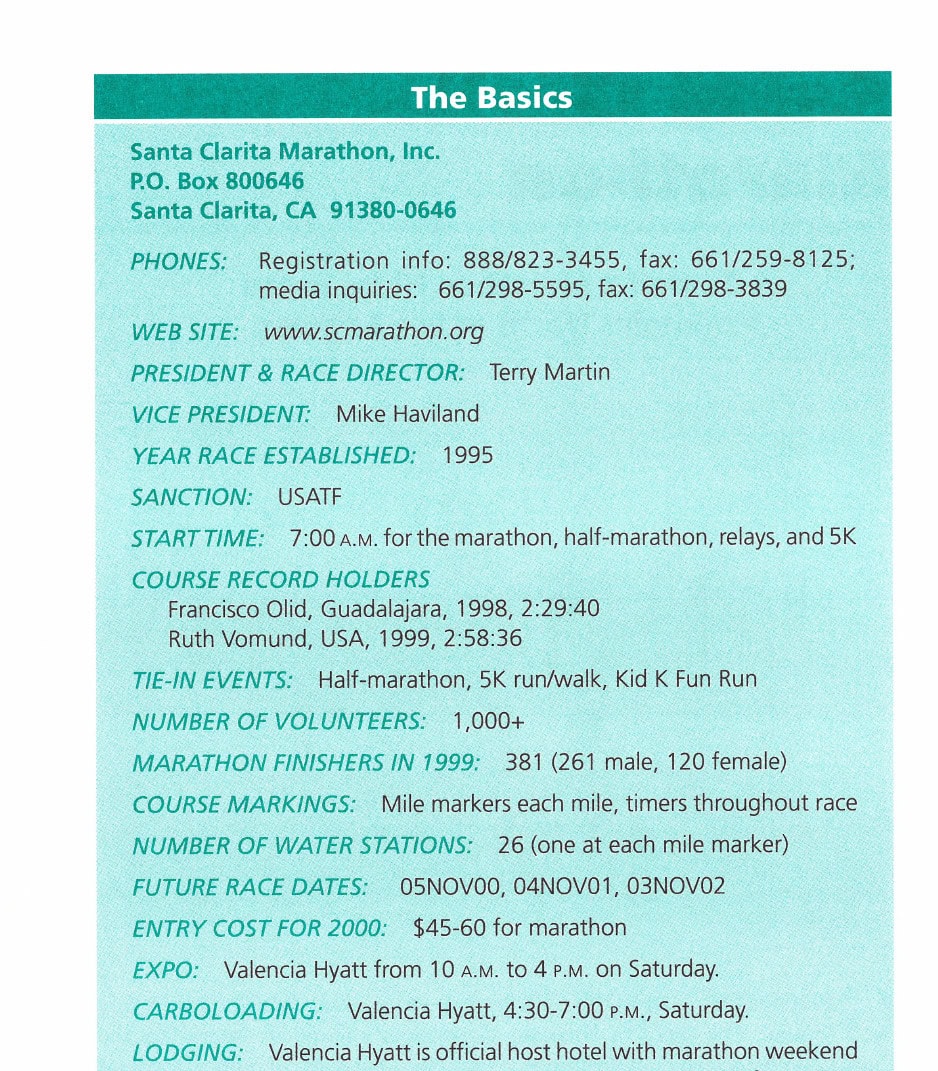
Santa Clarita Marathon
GEOGRAPHY INFLUENCES history more often than the other way around. The proof of Nicolaus Copernicus’s heretical theory that the Earth was not the center of the universe upset the applecarts of both history and religion. Columbus’s misreading of geography had a profound influence on the history of the six centuries since.
Although the Santa Clarita Valley is located within the borders of Los Angeles County, just 30 miles from the Parker Building in downtown LA, it’s a rare Los Angelino who can direct a stranger to the valley’s location. And for many who live in the Santa Clarita Valley, that’s just fine by them.
The Gousha/Chek-Chart roadmap of Los Angeles doesn’t even list Santa Clarita Valley or the four very distinct towns located there (Valencia, Saugus, Newhall, and Canyon Country), even though the intersection of I-5 and Highway 14/Antelope Valley Freeway (Santa Clarita’s intersection to the world and the site of Six Flags Magic Mountain Theme Park) is included.
Santa Clarita’s obscurity is not a result of nothing ever happening there. The valley boasts the first documented discovery of gold in California (in 1842, six years before the discovery in Coloma, 350 miles to the north, which set off the Gold Rush of 1849), the world’s oldest existing oil refinery, California’s first commercial oil field, the third longest railroad tunnel in the world (completed in 1876), one of the last great train robberies in the United States, the second oldest schoolhouse in Los Angeles County, and the second-worst disaster in California history (after the 1906 San Francisco earthquake), which occurred in the canyon above Saugus when the St. Francis Dam collapsed in 1928.
The Santa Clarita Valley’s cloak is the Western Traverse Ranges, a series of mountains that separates the Los Angeles Valley from California’s huge Central Valley interior. The mountains run east-west, while I-5 (one of the most heavily traveled commercial highways in the country) runs against the grain in a north/south configuration, which means travelers climb up and over the range but seldom have occasion to pull off the highway and explore what’s available in the valleys off to either side. Santa Clarita Valley, although low in the southern edge of the mountains and geographically close to LA, is still hidden from casual view by mountains.
Add to all this that the valley is buffered on the north and east by Angeles National Park and on the northwest by Los Padres National Forest, and you’ve got a little pocket of peace hidden away from the rat race world of Southern California.
THE DEVELOPERS STRIKE
It isn’t that LA is completely blind to the Santa Clarita Valley. There are a few developers aware of its enticing proximity to downtown LA; and then there are the longtime residents who work diligently to keep development slow enough for projects to be thought through. In 1986, the Santa Clarita Valley Historical Society (founded in 1975) organized its members to form a human barricade around the Mitchell Ranch in Sulphur Springs (an adobe ruin and a Victorian farm house) against the onrush of the bulldozers. As the bulldozers approached, they roused a swarm of bees in the old house, which delayed the destruction long enough for the Society to negotiate with the property owners to remove the old adobe ruin brick by brick to relocate it at Heritage Junction Historic Park, where the Society has relocated more than a half-dozen historic houses, the Saugus Train Station, and an historic locomotive. The park is next to the William S. Hart Regional Park, a shrine to the famed early silent movie cowboy star.
Bulldozers are still a common sight on the landscape (and should probably be designated the official valley’s symbol), as the valley (especially Valencia, the town nearest Six Flags Magic Mountain) gradually transforms itself from the typical early-California hodgepodge of housing styles and commercial development to a very well-planned community—with emphasis on community.
Although commercial and real estate development is progressing at a blistering rate, and a multilane expressway (Magic Mountain Parkway) leads from I-5 into town, local runners and pedestrians aren’t faced with the inevitable battle with automotive mayhem as they are in most of Los Angeles, where in their infinite wisdom city planners made a point of not building sidewalks because nobody uses their feet to get anywhere. In Valencia, the planned community is so well-thought-out that pedestrian overpasses and paseos (neighborhood greenery walkways leading to overpasses) make it possible for residents to get where they are going on foot or bike while never having to wait for a traffic signal or worry about being run over by an automobile.
Such pedestrian amenities have helped encourage the Santa Clarita Runners Club to become a very tightly knit, incredibly active addition to the community. The connection between the community and the local running club became even more entwined after the club launched the Santa Clarita Marathon in 1995. For several years the club put on the race with the approval of the local communities, but eventually the Santa Clarita Valley saw the race as something it very much wanted to get behind. The race was passed from the club to the valley, became an incorporated nonprofit organization, and is now run by a committee of club members and civic leaders. The combination has proven valuable on two fronts: the local communities are very much behind the race both financially and philosophically. The race is both well financed and well organized. It is publicized in all year-long calendars published and promoted by the valley, and the town goes all out over race weekend with banners hanging from literally every streetlight that can be climbed. Santa Clarita Runners Club member Terry Martin is president of the marathon and race director, while Mike Haviland, a hardcore runner himself, is vice president and represents the community. The two form an enviable one-two punch, while the running club members are involved on every level.
NO BIG-CITY RACE
The race isn’t big by big-city standards, and that’s fine with the race committee. They don’t want to grow too fast; because of the very intimate nature of their course, they have their eyes on limiting entrant numbers so
The Santa Clarita Valley, the catch-all term for the four towns (Valencia, Newhall, Saugus, Canyon Country) on the east side of I-5 from Six Flags Magic Mountain, constitutes a relatively benign (when you consider how close it is to downtown LA) and upscale enclave where each of the four towns maintains a unique personality, while the whole valley faces a complete makeover as a planned community, which has begun at I-5 (at Valencia) and is moving east at an ambitious pace. The large four-color promotional brochure describes the valley this way: “With nearly 170,000 residents and 45,000 jobs, the Santa Clarita Valley features state-acclaimed schools and colleges, a regional shopping mall, superb hospital and health care, indoor and outdoor recreation, cultural activities and entertainment, and thriving industrial parks and commerce centers.” There is so much going on at the moment that a visit this year will likely be quite different from a visit next year, when additional aspects of the valley’s reincarnation will be in place. The valley is ranked yearly by the FBI as one of the safest areas in the United States.
GO SEE IT
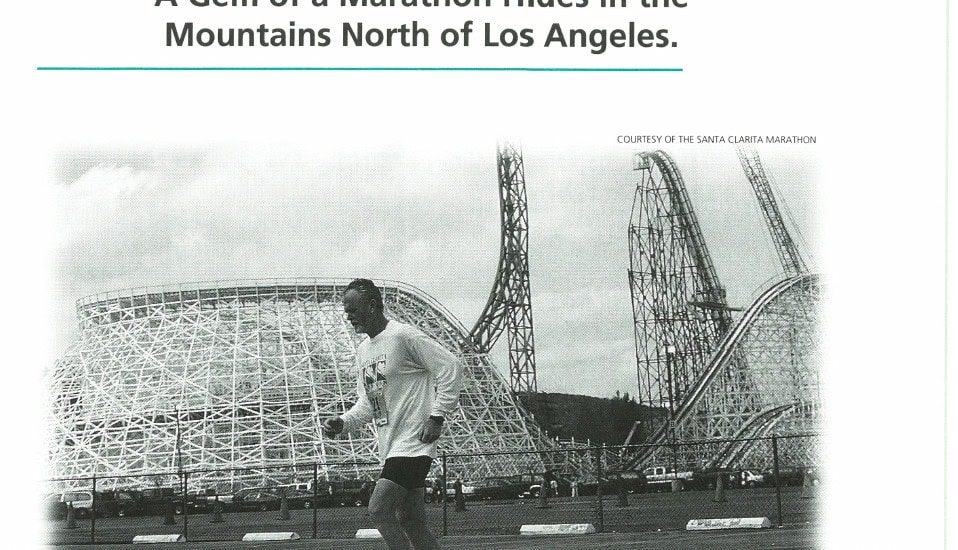
Six Flags Magic Mountain. Folks in the Santa Clarita Valley claim that the amusement park (where the specialty is rollercoasters, both traditional and ultramodern, including the world’s only 100+ mph coaster, Superman, the Escape) has by far overshadowed their communities. Fortunately, Magic Mountain was built on the west side of I-5, about as formidable a dividing line as you can get, so that the park’s popularity and style doesn’t really interfere with Santa Clarita’s efforts to reinvent itself as a pedestrian-friendly planned community. The park features 10 themed areas, and the Hurricane Harbor features a multitude of water-based rides and activities for those summer days when Southern California gets extra warm. 661/255-4100.
Heritage Junction Historic Park, at 24101 San Fernando Rd., Newhall, 661/254-1275, is a lot more laid back than Six Flags. This historic park is the site where the Santa Clarita Historical Society has been rescuing the area’s history by literally picking up and moving historic buildings before the bite of the demolition crew can get to them. The park is being reconstructed as a little town tied to its railroad roots. The Saugus Train Station, Mitchell Adobe, Newhall Ranch House, and the Pardee House have been set side-by-side along a rail line where the Mogul Engine #1629 (a 75-ton steam engine built in New York in 1900) is the centerpiece. Up behind the station area are four more “saved” structures set together to form a turn-of-the-century Main Street: Kingsbury House, the Little Red School House, Ramona Chapel, and Edison House. The Historic Society also has a very active Web site loaded with up-to-date features on the valley’s past: www.scvnet.com/scvhs.
William S. Hart Park and Museum, 661/254-4584, adjoins the Heritage Junction Historic Park, and is an opportunity to step back in time to the authentic Old West. Hart, one of the premiere silent film cowboy stars, purchased the land that is now the park in 1921 and built a 22-room mansion on the land, which today is the museum housing his collection of Western art, Native American artifacts, and early Hollywood memorabilia. The park is set up like a little Western town. There are also adjacent picnic areas, walking paths, and regularly scheduled historic presentations; look for a small herd of bison given as a gift from the Walt Disney Studios in 1962. Call ahead to check on park hours, as the hours change depending on the season; there is no admission charge. Check the park’s Web site: www.hartmuseum.org.
Valencia Town Center. The center, located between Magic Mountain Parkway and Valencia Blvd., as soon as you enter town from I-5, is not your typical mall but an authentic attempt by planners to build a user-friendly and community-integrated town hub. There is plenty of room to walk (and lots of walking/bike access to literally every corner of the center), lots of pleasant little corners to sit and relax, and plenty of pedestrian/bike overpasses to avoid having to cross a busy thoroughfare. Unlike many malls, where a runner or walker chances death and dismemberment by traffic, you’ll find plenty of generous sidewalks. There are also residences worked into the plan—people can actually live in the midst of the Town Center and easily walk to shops without the shops overwhelming the semisecluded living areas. You can buy a good book, walk three dozen steps, get a good cup of coffee, and walk another dozen steps to a secluded bench to read and sip. Many of the town’s offices and departments are being integrated into the Town Center, including the police and the tourism bureau. See www.santa-clarita.com. The center is an excellent place for a stroll to vent some of the built-up nervousness the day before the race.
Castaic Lake Recreation Area. This 9,000-acre outdoor park is delightful and a real plus to the area. There are nice jogging paths and lots of space for picnics and relaxing. The only drawback is the filling-vibrating whine of jet-skis. 661/257-4050.
Melody Ranch is at the intersection of Oak Creek and Placerita Canyon Road. Originally a Western town built by Ernie Hickson, who disassembled and brought in buildings from real Western towns in Nevada, the 110-acre ranch was used as a movie lot (town scenes from Stagecoach and High Noon were filmed there), but most of the town burned in August 1962 while owned by singing cowboy Gene Autry. The final 10 acres were sold by Autry in 1990 to Renaud and Andre Veluzat, who restored much of the ranch to its former glory. 661/259-0837.
AVOID IT
Nothing comes to mind. If you find an area that’s even remotely threatening, please let us know!
THE CLUB
Santa Clarita Runners Club
661/294-0821
Current membership: 175–200 runners
Organized runs:
Tuesdays: 6:15 P.M., track, College of the Canyons.
Thursdays: 6:00 P.M., trail runs in summer, footpaths and streets in winter.
Saturday: 7:00 A.M., 5-, 7-, 8-, 9-, or 10-mile runs, followed by coffee at Starbucks.
as not to stress the course, the volunteers, or the infrastructure. The 1999 marathon had only 475 marathon entrants, while the half-marathon had 794, which allowed the two races to start together. If the race grows much more, separate starts five minutes apart may be necessary to allow the field to spread out before reaching some of the more intimate bike paths along which the course runs. (More about the course later.)
Every race event, if it is to survive, must develop a personality and style. Santa Clarita’s is an amusing schizophrenia aggravated by the remaking of Valencia. The race committee and the race itself is very downhome, intimate, friendly, and welcoming, all against a backdrop of 21st century user-friendly redevelopment on a large scale. The new race headquarters hotel is the Hyatt Valencia, a mere two years old and shiny as a newly minted silver dollar. Yet at the Business, Sports and Fitness Expo held in the hotel’s grand ballroom, the sponsoring running club hands out big stick pretzels to runners who drop by their canopied booth. The expo fills the ballroom only because things are spread out; the expo could easily double and still fill the same space. Community involvement is evident in the unusual number of local businesses that exhibit.
The accompanying pasta feed—an all-you-can-eat bash for $12—is in a hall adjoining the expo at the Hyatt. For 1999, local running legend Gary Tuttle was the guest speaker; he held the audience spellbound by initially admitting that he doesn’t think he was much of a marathoner (even though he placed second at Boston in 1985), then proceeded to run the audience through each of his dozen or so marathons as though he’d just run them last week.
The fact that there is so much redevelopment in Valencia makes the organizational side of the race both a joy and an incredible contrast. Runners board buses at the back parking lot of the Valencia Town Center, a massive shopping center. There is sufficient parking available to accommodate a midsized town. The buses are lined up as though they are cars on a train; runners get onboard and are whisked to the starting area. The finish line is within 120 yards of the bus loading area, so when you’ve completed the race, your car is within a short leg-massaging walk from the finish chute. Even closer is the awards area, food fair, and music. A pancake breakfast begins at 7:45 A.M. for family members and friends waiting at the finish area. The Good Time Jazz Band begins playing at 8:00. And there’s a kids’ 1K race nearby at 8:30, which for 1999 had nearly 600 youngsters sprinting to all shades and sizes of glory.
A UNIQUE START AREA
In contrast to the ultranew finish area, the start area is about as ugly as they come. The former home of John Lang, the valley’s second resident, the site was once known as Lang Station, where two railroads met on September 5, 1876. (Think of a smaller version of the famed meeting of the Union Pacific and Central Pacific at Promontory Point, Utah, in 1869.) Unfortunately, Lang Station burned down in the late 1960s, and the site became a sand and gravel yard. The assembly area for runners is the construction yard of the AE Schmidt Company. Sounds pretty grim until you’re delivered there in darkness (for a 7:00 A.M. start) and find that the race committee has erected a huge canopy set off with icicle lights dropping from the roof edge, with an interior filled with folding chairs, gas heaters, and—a dozen steps away—water, coffee, bagels, orange slices, and a long line of plastic restrooms.
Once dawn begins to break, you clearly perceive that you’re in a construction yard, but the efforts of the committee make it a bearable place to stay for the half-hour or so you’re stuck there. One thing that could be done to improve this corner of the race would be to drive a squad of running club members out a week beforehand to clean up the trash and debris that gets blown into the surrounding terrain.
The start itself is a few hundred yards away on a two-lane underpass. The race uses the Championship Chip, and the cacophony of bleats and beeps as hundreds of runners surge across the start is a bizarre contrast to the remote, quiet start area.
Runners will not confuse the course scenery with the redwoods of the Avenue of the Giants, the majestic coast of Big Sur, or the sleeping wine vines of Napa. The first 10 miles follow Soledad Canyon, the bottom of which is a dry riverbed typical of Southern California before the rains come. On the plus side, the running surface is good, the profile is overall gentle downhill, and some of the sections that run along the paralleling bike trail verge on serene. This is also the segment of the course where, should
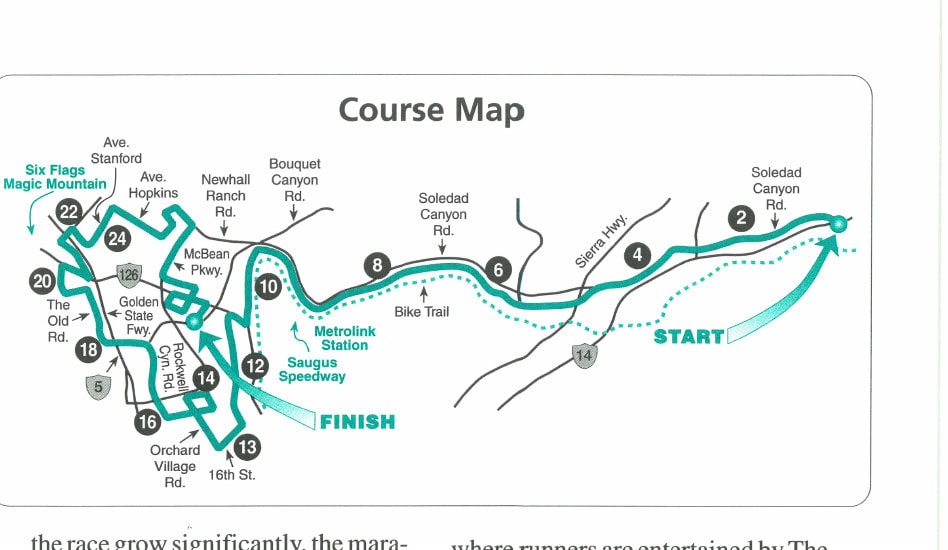
the race grow significantly, the marathon and half-marathon starts will need to be staggered since entrances and exits from the bike path narrow like a clogged artery. If you get behind a group of running friends pacing each other, passing becomes a distinct challenge.
The aid stations are upbeat, and at this point runners are still sociable and attentive enough to appreciate the enthusiasm of many of the excited and welcoming youngsters handing out water and sports drinks. You see many high-fives and hear squeals of laughter as young girl volunteers get water splashed on them as runners jockey for an offered cup.
SOME VARIETY
The course isn’t all monotonous dried riverbed. At mile nine, it runs through the Metrolink rail station (the mass transit connection to downtown LA that currently runs six days a week), where runners are entertained by The Skinny Little Twits, an LA band that does a terrific riff on middle-of-the-road rock acts like the Doobie Brothers and the Eagles.
A little farther along, the course passes the legendary Saugus Speedway, now closed to auto-racing thrills due to earthquake damage but open every weekend as a massive flea market. It’s much too early for “new legs for old,” but the site offers a colorful patchwork distraction.
As runners near mile 11, the course splits dramatically. Runners are shunted downhill onto the trails along the riverbed, half-marathoners streaking directly to the finish area, while the marathoners take a very sharp right turn to run along the riverbed toward a section of the course that is almost impossible to describe. Many turns are involved, and the course becomes difficult to follow as it (mercifully) takes advantage of the new pedestrian-friendly aspects of Valencia by sending them through charming little neighborhoods, all serviced by the ever-present paseos, making it unnecessary to cross busy streets.
At mile 15 the course begins to climb a bit for two miles as it winds its way toward the Six Flags amusement park west of I-5. It then loops through several of Six Flags’s parking lots before heading back toward Valencia Town Center. Miles 22 to 25 are slightly uphill, followed by a level-to-downhill final mile to the finish line on Citrus Road.
Disc jockeys ply their “art” at miles 17, 21, 22, 23, and 24, which helps distract the glycogen-depleted runner from the blues.
By the time the marathoners reach the finish line, they’re able to use the little walk from the finish line to the festivities areas as a cool down. The festivities area, which had been serving pancakes first thing in the morning, transitions over to a nice lunch (featuring Mexican food in 1999) provided by Trader Joe’s, while bands play mellow music. If you drove to the bus pickup area first thing in the morning, you’re now within a softball throw of your car.
If your fun meter has still not quite redlined, check your registration bag for a 30-percent discount coupon into Six Flags. The park offers just what you need on a postmarathon queasy stomach: rollercoasters. A marathon in the morning and an afternoon spent riding rollercoasters? You need do nothing more in life to prove your stomach-of-steel honors.
Runner’s High/Runner’s Low
HIGHS
- Very good race organization
- Exemplary community support
- Well-organized bus transport to start
- Well-organized and entertaining finish area
- Excellent pasta dinner speaker
- Enthusiastic aid stations
- Excellent host hotel facilities and events
- Varied scenery along course
- Disc jockeys at miles 17, 21, 22, 23, and 24 help distract glycogen-depleted runners
- Very good tie-in races
- Involvement of local running club
- Good cooperation between CHP and Sheriff’s Dept.
LOWS
- Grim start area once sun rises
- Bike path sections occasionally narrow dramatically
- Very limited local newspaper coverage on race day
- Start seven minutes late
The Bottom Line
We have weighed various aspects of a marathon within a 1,000-point scoring grid. Besides the author of the article, a dozen runners at the race were randomly chosen to score the race for us (SCM = Santa Clarita Marathon). The results follow:
1. HISTORY/TRADITION
Evaluate the race’s sense of history and tradition.
[Possible points: 30 SCM score: 15]
2. ENTRY FORM
Is the race entry form clear, concise, attractive, complete, and easy to fill out?
[Possible points: 20 SCM score: 18]
3. ENTRY COST
For most races, the entry fee covers between 30 and 50 percent of the cost of putting on the event. Rate the value of your dollar relative to this race.
[Possible points: 30 SCM score: 30]
4. LOCALE/SCENICS
Is the race held in an area that is easy to get to and scenic, and offers adequate food and housing services and nonrace activities for family and friends?
[Possible points: 50 SCM score: 47]
5. REGISTRATION
Is registration well organized and efficient? Does it bog down unnecessarily?
[Possible points: 20 SCM score: 20]
6. PRERACE ACTIVITIES
Evaluate activities such as pasta feeds, parties, and so on, during the days before the race.
[Possible points: 50 SCM score: 45]
7. EXPO
Does the expo offer a fair number and variety of booths relative to the race’s size? Are there quality exhibitors and good guest speakers?
[Possible points: 50 SCM score: 31]
8. COURSE
Take into consideration the following: degree of difficulty, certified, sanctioned, quality of road or trail surface, adequate mileage and directional markers, aid stations, medical coverage, race communications, accessibility to course for friends and family, typical weather, and so on.
[Possible points: 400 SCM score: 330]
9. RACE AMENITIES
This category includes race T-shirt, finisher’s medal, finisher’s certificate, adequate and efficient finish area, ease of sweatbag retrieval, showers, postrace refreshments, awards ceremony, raffles, results postcard, results book, and so on.
[Possible points: 250 SCM score: 235]
10. VOLUNTEERS
Are the volunteers experienced and adequate in number?
[Possible points: 100 SCM score: 95]
TOTAL SCORE FOR SANTA CLARITA MARATHON
866 points
This article originally appeared in Marathon & Beyond, Vol. 4, No. 4 (2000).
← Browse the full M&B ArchiveMore like this
1,000+ stories from 19 years of Marathon & Beyond
The complete archive of the legendary long-distance journal — digitized and free to read.
