

My Most Unforgettable Marathon
TAMPA BAY, FLORIDA, December 10, 2000—The decision to write this article occurred while I was sitting on a plane next to an obese woman during a long, agonizing flight to Phoenix. Sitting in a middle seat with no other open seats on the plane caused me to search for anything that could take my mind off the fact that all five of my senses and my personal space were being violated. This was to be a marathon of a flight. . . .
A couple of years ago, during the Florida Gulf Beaches Marathon in St. Petersburg, Florida, Andy Mathews explained his three-tier goal system to me. Andy is one of the wonderful running friends I met when I joined a local running group, the Tampa Bay Runners. His quest was to attain an “ultimate goal” of a Boston Marathon qualifying time. My job was to pace him the last six miles and along the way to tell him every stupid joke I knew.
Although Andy did not reach his ultimate goal that day, he did achieve one of his other goals, which he called “the acceptable goal.” Not very much later, during the Grandma’s Marathon, he did manage to achieve his ultimate goal of 3:15.
I don’t think I realized how the seed that Andy planted affected me until just recently. I was cleaning out my car and found an old Tampa Bay Runners newsletter (Treadwell, April 2000) containing an article that Andy wrote on his three-tiered goal system. The article was titled “3 Goals Are Better than 1.” It was then that I realized that Andy had unknowingly become one of my running mentors. I went out to help him run the Florida Gulf Beaches Marathon, but it was I who had benefited.
After completing my first marathon, Disney 2000, I decided it was time to see how much faster I could run one. So what time should I choose as a goal? Andy’s three-tiered goal system came to mind. So, like Andy, I went with the idea of a Boston qualifying time as my “ultimate goal.” Since I’m older than Andy, and likely to be for a long time, I would need to break 3:25. Tier two (the “challenging goal”) would be to break 3:30, a very fine time for a guy my age. And tier three (“acceptable goal”) would be breaking 3:35, which would still knock 10 minutes off my PR.
PICKING AND CHOOSING
It was now time to pick the marathon in which all this would happen. So many marathons, so many choices, and so many people running marathons. As I contemplated all things marathoning, I asked myself whether I could answer the question of why so many people were taking on the marathon as a personal aerobic challenge. I think I know why. I think we become a bit of a superhero to ourselves. I know that sometimes when I’m out having a tough training run and am experiencing a hard time getting through it, one thought alone moves me to a new and higher level.
The fact that I have already completed a marathon gives my self-esteem enough of a boost that I shoot up a notch and things go better.
To have trained hard enough that I could run a marathon at a pace that I could previously achieve only in a five- or six-mile race gives me superhero status to my way of thinking. If I could do that, I probably can do just about anything I set my mind to.
I decided on the Hops Marathon by Tampa Bay. I felt that running in my hometown would remove several potentially negative factors that are usually present when traveling to a destination.
My early objectives were to eliminate any factor that might split my focus. Additionally, the Hops course is flat, and since it was the first year the marathon would be run, I anticipated that the course would not be overly crowded so that I was assured I would be able to get into the field. So Hops it was. I sat at my computer that day, with ice on my knees, and registered online.
Without being totally conscious of my actions, I began to take steps to reinforce my objective. I had been doing track workouts under coach Dror Vaknin, who coaches a group called “Progressive Team in Training,” a sort of post-grad Team in Training group hoping to improve upon their original escapades in marathoning. I decided to make it formal with Coach Vaknin so I wrote out a check for his coaching services, and in the memo field of my check to him, I scrawled “3:25.” My training schedule was in place toward my ultimate goal. I closely followed the training program and in fact added a rather unusual practice run, something called the Chicago Marathon.
At Chicago I found that, with the stress of a time goal removed, the external joy rolls in. Running against the clock has its own joys, but they are usually internal. I reveled in the fact that it was not all that long ago that the very idea of running, and finishing, a marathon seemed like a huge challenge. Now here I was at Chicago, running 26.2 miles while wallowing in the cheers of spectators, casually gulping down the water and Gatorade, and reveling in what was, by Florida standards, perfect weather for running long.
I had a wonderful time thanking the volunteers and talking inspirationally to the other runners who were there using Chicago as a stepping-stone to Hops.
At the finish I was ecstatic. Incredibly, over the next day or two I experienced no soreness or fatigue. Running a full marathon as part of a training program toward running a fast marathon is not standard practice, but for me it was a huge confidence builder, in that I had reassured myself that I could cover the distance; now all I had to do was to cover it faster. I felt that I could do that at Hops if I could restrain myself from expending so much energy on talking to everyone I encountered along the course, as I had done at Chicago.
POSITIVE REINFORCEMENT
Back in Tampa now, and it’s the day before my target marathon. At the expo, I asked my new best friend, world record holder Khalid Khannouchi, to sign my Hops poster with his name and the prediction that I would break 3:25. He went even further: he put a smiley face after his signature and said that I could run it and come in smiling too. (How could I even think of hanging up the poster if I didn’t perform as the champ had predicted?) In addition, I bumped into Bob Foster, a fellow Tampa Bay Runner, who was scheduled to work the finish area; he told me he would be looking for me and that I had better not be late.
On the day of the race, I was unusually calm. It was as though my instinct had kicked in, and it was advising me not to waste my energies on anything other than the upcoming trial.
Because it was a small marathon in my hometown, I knew many of the other runners. It was both soothing and satisfying to see so many runners I had trained with. This social setting, combined with my buddy Andy’s taking me out at the 7:45 to 7:50 pace I needed, put me in a great mood. The miles just began to tick off effortlessly.
Near mile 10, though, I began to feel some discomfort in one of my knees. I had the darkest thought of the whole day that if this pain increased, I was done. Thankfully, it did not persist. It must have known that this was going to be my day and it had best behave itself.
As with most days in Tampa, the weather was warm and many of the runners around me complained about the heat. I tried not to listen to them and was unaffected. I hydrated perfectly and had no problems with the heat.
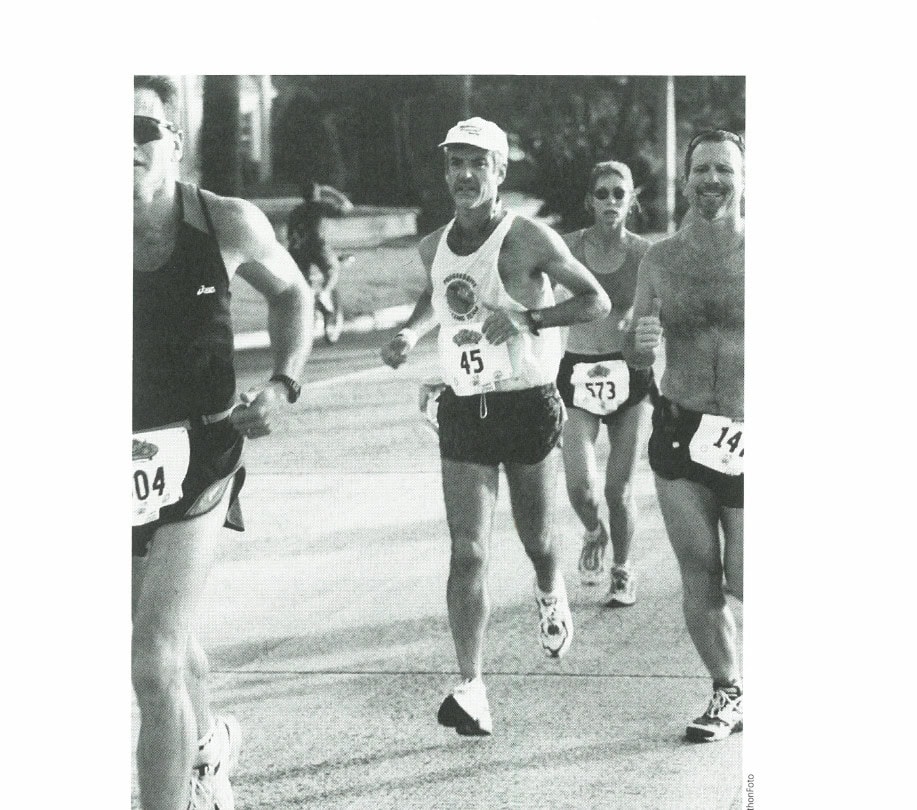
At mile 15 my mentor and pacer, Andy, informed me he was not feeling well and he needed to drop back. Before he let me go, though, he did two things that had a big effect. First, he told me to take smaller strides with quicker leg turnover for 20 seconds or so at each mile, as this would keep me from becoming fatigued. The other thing he did was to ask one of the other runners who was at our pace to look after me. This assistance never really materialized but the thought was magical to me because it provided me with the joy of his friendship and compassion.
These positive influences made a huge difference in getting me through my race test. The other influence was my own determination not to let Andy down after all the help he had been to me.
Instead of worrying about being alone on the course, I set a goal for myself: to be at 23 miles at the three-hour mark. That would give me the luxury, if one
can call it that, of needing to run in the final miles at a mere eight minutes per mile.
By this point, the field had narrowed and we had left the shady roads that had provided some protection from the merciless sun.
As I reached each mile marker, I thought of what Andy had told me to do: take those quick, short steps. I did as Andy suggested, running alongside other runners going at my pace so that I wouldn’t undo my pace during the gear shifts. It got to the point that I was actually looking forward to this drill; it was a welcome change to what was becoming the tiresome motion of running.
MAKING ADJUSTMENTS
I suppose it was a combination of the heat, the lack of other runners near me, and a decided lack of spectators that undermined my pace. By the time I reached 23 miles, I was 90 seconds behind schedule. Some quick math, which I somehow managed to do at that point, confirmed that now an eight-minute pace was not going to get the job done if I still wanted to meet my Ultimate Goal. However, I was all over the Challenging Goal.
It’s strange, but this was the very first time I thought about this second-tier goal, and the thought quickly did an exit-stage-left as I said to myself, “You can run faster or you’ll have to do this whole thing over again.” Immediately, another thought came to me. “You may never again feel as good as you do now at mile 23.”
Those two thoughts made my legs turn over as if they were automatic, changing over to a new gear.
Another thought that helped me get through this was realizing that I had only a 5K left to run and I didn’t have to run it as fast as a 5K race. With those thoughts in place, the final three miles didn’t seem like an eternity.
Down deep I knew I was going to be able to do it. I concentrated on just maintaining my pace.
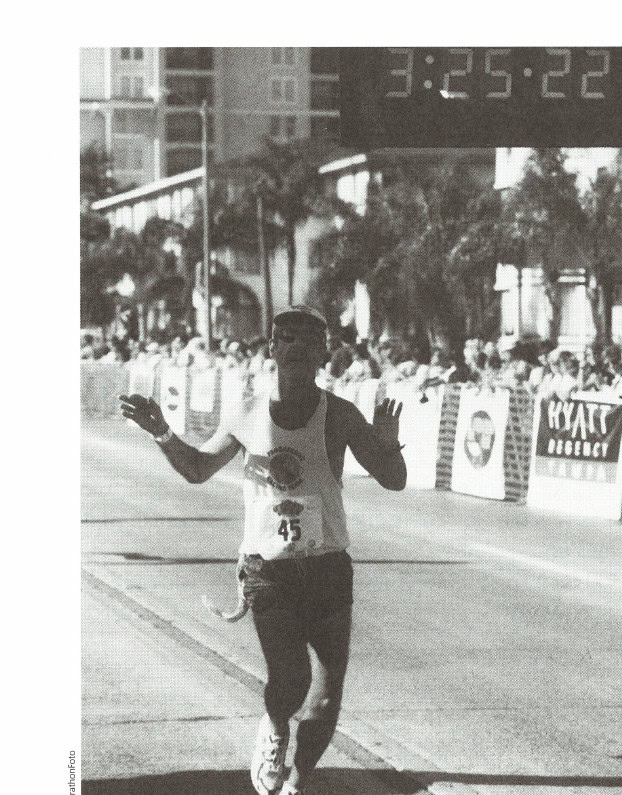
With roughly three-fourths of a mile to go, one of my training buddies was on the sidelines. He jumped out of the crowd and started running with me, telling me that I could do it. I was amazed again that I actually had some kick left as I approached the finish. I pushed it with what I had left and ran under the finish banner in 3:25:22. As Andy said later, I had plenty of time to spare: one whole second per mile!
Across the finish line, I was surrounded by my Tampa Bay Runner friends: Bob, Candi-O, and Jim. The three of them took real good care of me. The feeling of euphoria was heightened for me because these people who were working the finish line were not only friends but also fellow runners, so they could empathize with my feeling of achievement.
Just a short time later, another friend informed me that Marianne, my girlfriend, had finished and her only worry seemed to be whether I had met my goal. That selflessness is what Marianne is all about. She continues to be a valuable messenger to me about the deeper aspects of human existence; sometimes I find that I’m not sure what she is saying about the more profound side of our life on this earth, but her meanings manage to shine through even when I’m uncertain of their nuances.
The rest of the day was equally magical, and, surprisingly, the body from which I had demanded so much continued to hold up so that I could enjoy and absorb all the postrace activities. Everywhere I went my friends and colleagues made me feel like a hero. Inside, I began to realize that it was, indeed, a very special accomplishment, but it was also humbling because it pointed out to me how much more I had to learn.
* * *
Well, the finish line of this very uncomfortable flight to Phoenix is near, and today it excites me almost as much as successfully crossing a race finish line. Being pressed sideways into your seat by another intruding body doesn’t do much to make life at 35,000 feet tolerable, but it did have its “up” side in that it forced me to refocus my energies to turn out this story; otherwise, I might never have gotten around to writing it.
Now all I have to do is attempt to get an upgrade on the return flight so that I have some space in which I can work on my business forecasts. I should learn more from Marianne about how to see the positive side to every life experience. She has the right idea.
And What I Learned From It
The day after the marathon, I was on the phone with a client. After I told him of my achievement, his response was interesting. “If you put that kind of work and focus into your clients and prospects, you’d be a millionaire.” I think he may be right. What I’ve learned is that whether it’s a marathon or an airline flight from hell, the correct mental focus can and will help you prevail in unleashing your inner strength.
Additionally, it becomes obvious that training for and running a marathon will better arm a person for life’s little everyday battles, like the one that nearly flowed over into my lap on that airline flight.
These pages contain advertisements for the following races:
- Mardi Gras Marathon – New Orleans, Louisiana, February 16, 2003. Marathon · Half Marathon · 5K. Course highlights: French Quarter, Esplanade Ave., City Park, Uptown New Orleans, Garden District, Audubon Park, Prytania Street, Bayou St. John, Canal Street. Phone: 504.454.8687. www.mardigrasmarathon.com
- HP Houston Marathon and EP 13.1 Miler – Sunday, January 19, 2003. New Start Time 7:00 am, New Time Limit 6 hours. Ranked among top 25 U.S. Marathons: Fastest Winter Marathon, Second Fastest Marathon Overall, Third Best Organized Marathon, Fourth Best Crowd Supported Marathon (Ultimate Guide to Marathons). www.hphoustonmarathon.com, 713-957-3453
- 25th Annual Running – Napa Valley Marathon – March 2, 2003. RRCA National Championships. www.napa-marathon.com
This article originally appeared in Marathon & Beyond, Vol. 6, No. 5 (2002).
← Browse the full M&B ArchiveMore like this
1,000+ stories from 19 years of Marathon & Beyond
The complete archive of the legendary long-distance journal — digitized and free to read.
