

Small Towns, Big-Time Races
Most of Europe may have lagged behind other areas of the world as ultrarunning, once known as pedestrianism, suddenly gained momentum elsewhere in the world. The sport originated in England in the 18th century, and it seemed to revive in the 1970s. This was especially true in the English-speaking countries and primarily in Great Britain, Australia, and the United States.
What had been a major sport a century earlier gained a foothold in those countries and made it appealing again, although for different reasons. In the old days, the sport attracted major players willing to go the distance, not so much as a matter of sport, but rather to make money like other professional athletes.
Races were staged in large arenas, drawing spectators and those willing to wager a few pounds or dollars betting on their favorite athlete. So promoters took full advantage of large cities, where they would be somewhat guaranteed to fill the house on race day or race week in many cases.
One of the most popular pedestrian events was the six-day go-as-you-please race. Not only did it afford promoters the chance to gather an audience, it allowed them to do it for nearly a week. As the week went along, the crowds generally would grow in anticipation of what would happen near the finish.
A lot has changed since those days. Many of the major races in the United States are run on trails, hence no paying spectators, and in many cases, no spectators at all. Promoting an event becomes less of an exercise in drawing spectators and more of one in drawing participants.
TAKING A CHANCE ON 48 HOURS In 1985, in a small town in southwestern France, a man with a vision changed all that.
Jean-Gilles Boussiquet proposed to the mayor, in the city of Helene, a 48-hour race. Many thought it was a crazy idea. The mayor, Jean-Guy Branger, on the other hand, followed Boussiquet’s suggestion and found the support to make it a reality.
Today, that race, now held in the small town of Surgeres, is the top 48-hour race in the world. These two pioneers were aware that to make the event a success would take more than they alone could manage.
They enlisted the expertise of Michel Landret, head of sports for Surgeres, and Charly Garreaud, a rugby coach in Surgeres at the time. Both of these choices proved to be fruitful, as both men dedicated themselves to the event.
Unlike many races of the day being staged at tracks around the world, this group of Frenchmen brought back the idea of promoting races to a larger audience. Their idea of a track race was to bring together the best multiday runners in the world, with the largest audience possible, and to bring them all together for a purpose as well.
Over the years, more than two decades now, the “48 Heures pedestres de Surgeres” has exceeded all their expectations. This small town, an agricultural center, embraced the event from the onset. With a population of around 6,000, Surgeres and the surrounding communities turn out each year for more than just the race. Although the race is the focal point, many other activities take place over the course of two days.
Bringing in daily crowds of several thousand was not an easy task. The organizers closed down the inside and outside perimeter of the track to keep spectators from interfering with runners. By building two bridges, one on each side of the track, they allowed spectators to move over the track while the runners continued to compete below.
By doing so, they not only eliminated a potential safety issue, but they created a captive audience for the activities that were planned inside the oval. Running for hours and hours, for some, can be boring; watching runners run around the same oval for any length of time must surely be boring.
At any given time, spectators might be able to view an acrobatic company performing, magicians, a karate exhibition, an equestrian show, and many other activities. A large tent serves as a dining hall and kitchen before and after the race. During the race, a band occupies the dining hall, and an assortment of bands from polka to rock and roll entertains all.
The planned activities in the track’s center were created not only for the spectators but for the participants as well.
THE PROFITS KEEP IT GOING
Roy Pirrung
The profit from sales of food and beverages continues to fund the 48-hour event, supporting all facets of the race including travel and prize money for the runners. The event is considered to be the 48-hour world championship, and this venue, a 301.59-meter certified dirt track, has seen numerous world and national records broken in open and masters categories.
The very forgiving surface allows the multiday runners relief from pounding on pavement for two days of steady running. However, because of the soft surface, runners end up creating dust and subsequently eating that dust.
Unique to the event are the accommodations provided for each contestant. Known as “caravans” in French, small camper trailers lent by local residents are posted with a sign bearing the name and country of the athlete using it. They line the curve at one end of the track, and here each runner and crew take up residence for two days.
This area is also where the mess tent/music hall is located and where runners are allowed to have their handlers run alongside to provide for their needs. Surprisingly for a race so famous, lap counters are still part of the event; the organizers have not given way to electronic timing, unlike many other races.
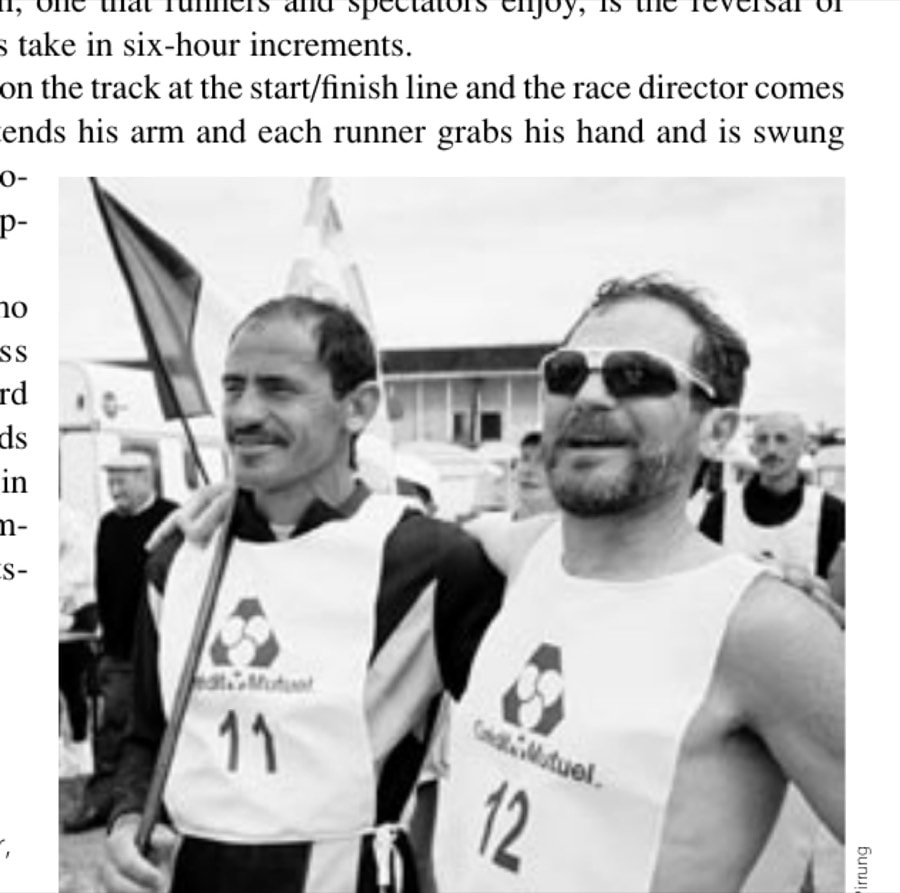
▲ Seigi Arita of Japan (left) finished second and the author (right) third with 378K and 376K, respectively, in the 48-Hour Championships in Surgeres, France in 2000.
The interaction between runners and their lap counters can be humorous and confrontational at times. Over the course of their shift as lap counters, the volunteers sometimes fall into conversation with others nearby and miss the runner, who is responsible for seeing he is recorded.
Some runners treat this lapse in concentration very seriously and begin to verbally abuse the counter, in their own language, and usually it is one the counter does not comprehend. Other runners simply approach the timing area and make the counter aware that they have completed the lap and would like it recorded.
A tradition similar to our prerace pasta dinners is not optional for runners in this race—it is mandatory. The dinner begins promptly at noon, on the day of the race. A time for reporting to the track, scheduled for 3:30 P.M., is reserved for introductions. All of the athletes’ names are called, and then a portion of their country’s national anthem is played.
The schedule set up by organizers is strictly adhered to and includes a time to check in, provide the race director with a medical release, and pick up your caravan keys. Another tradition, one that runners and spectators enjoy, is the reversal of direction the runners take in six-hour increments. A cone is placed on the track at the start/finish line and the race director comes out to assist. He extends his arm and each runner grabs his hand and is swung around the cone, propelling him in the opposite direction.
As the runners who have reversed pass those coming toward the cone, each extends a hand to the other in high-five fashion symbolizing their sportsmanship.
Roy Pirrung
▲
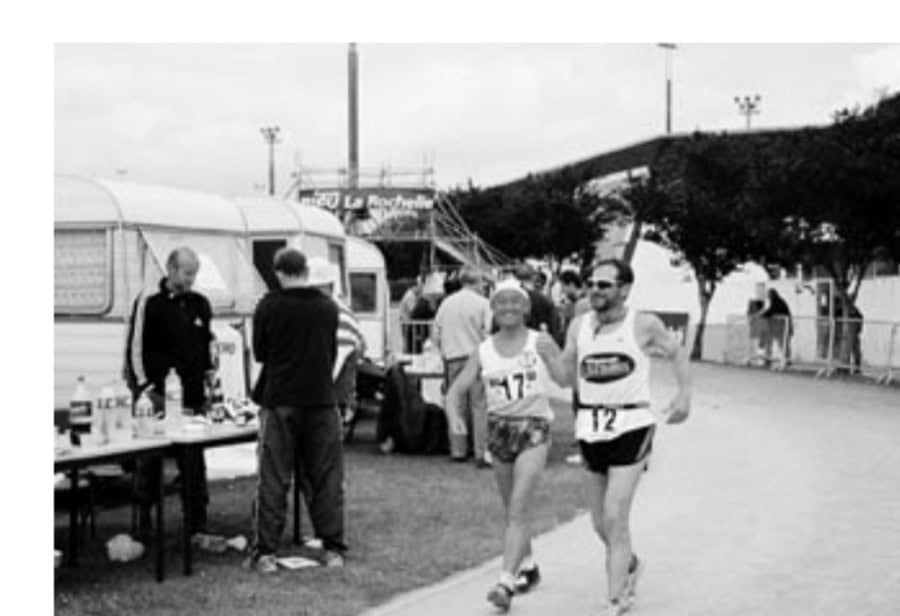
Greece’s Yiannis Kouros, the overall winner, with the author, who placed second, in the 2002 event.
Following the race, runners have about an hour to get cleaned up and return for an awards ceremony. The stage that has been used during the race to entertain the spectators and divert the attention of the runners’ effort now comes into play.
Dignitaries take the limelight, and in typical dignitary fashion, they seemingly go on forever with their speeches before the top three male and female runners are introduced and receive their awards.
Along with the top three, many other runners receive awards and gifts from the local sponsors. A small duffel bag is provided each year to cart the goods home. In 2005, a French film crew produced a DVD of the race and some of its participants, including an English version. For information contact moana. productions@wanadoo.fr. The film focused on several runners from Europe, Asia, and the United States and featured their thoughts of the race in France and their philosophies on ultrarunning in general.
THE ENTIRE TOWN TAKES PART Another small town, this one in Austria, may have borrowed some of the features of the French 48-hour. Worschach, in the Austrian Alps, with 700 inhabitants, recruits nearly 500 for its 24-hour event. Held each July, it is also a fund-raiser for local charities.
In the days preceding the race, which served as the 24-hour International Association of Ultrarunners (IAU) World Challenge in 2005, the presence of international teams fired the locals with enthusiasm.
The main street was active with workmen erecting fencing, bridges, and stages. Similar to Surgeres, runners were separated from spectators on this onekilometer road loop. The day prior to the race, a parade of athletes in their team uniforms marched up the main street, now closed to all traffic.
As each country was announced, runners climbed the steps leading to the stage-bridge combination and were introduced while their images were cast on a large screen set up across from the numerous establishments serving food and beer along the main street.
A pasta dinner followed introductions, and then teams headed for their respective quarters. Some chose local hostelries with their alpine views and quaint quarters, while others took advantage of housing offered by the organizers in an agriculture college dormitory.
The day can get long and attention spans can slack off for lap counters. None of that here, as each counter had double duty.
Given a block of wood with a strap attached, the counters slipped one hand through the strap and slapped the side of the semitrailer where they were perched and became instant cheerleaders. At times, especially when lots of runners approached, the counters would get into a rhythm sounding much like war drums, and the runners going by would get pumped by the noise.
When runners became tired, this noise could either pick them up or annoy them, as the sound could be deafening. Each team was given a small hut similar to one used by street vendors and likened to an ice-fishing shanty by northerners on the U.S. team. The hut had a fold-down front that could be used as a table to serve food and drinks to team members.
This little hut also served as a place to store gear and for the crew to avoid the sun during the day and the cold and rain during the night. During the heat of the day, sponges soaked in ice-cold mountain water were handed to appreciative participants every lap.
The main stage overlooked the small restaurants that were transformed during the race to outdoor eating establishments. Diners could eat, drink beer, and cheer for their local favorites or international favorites from just a few feet away. At midnight, a special fireworks display with a mountain backdrop took place, briefly taking the minds of the runners elsewhere.
Innovation by both of these small communities has helped them reach the big time in the world of running and also provided their communities with successful events, enjoyed by thousands and benefiting many thousands more.
Roy Pirrung
▲
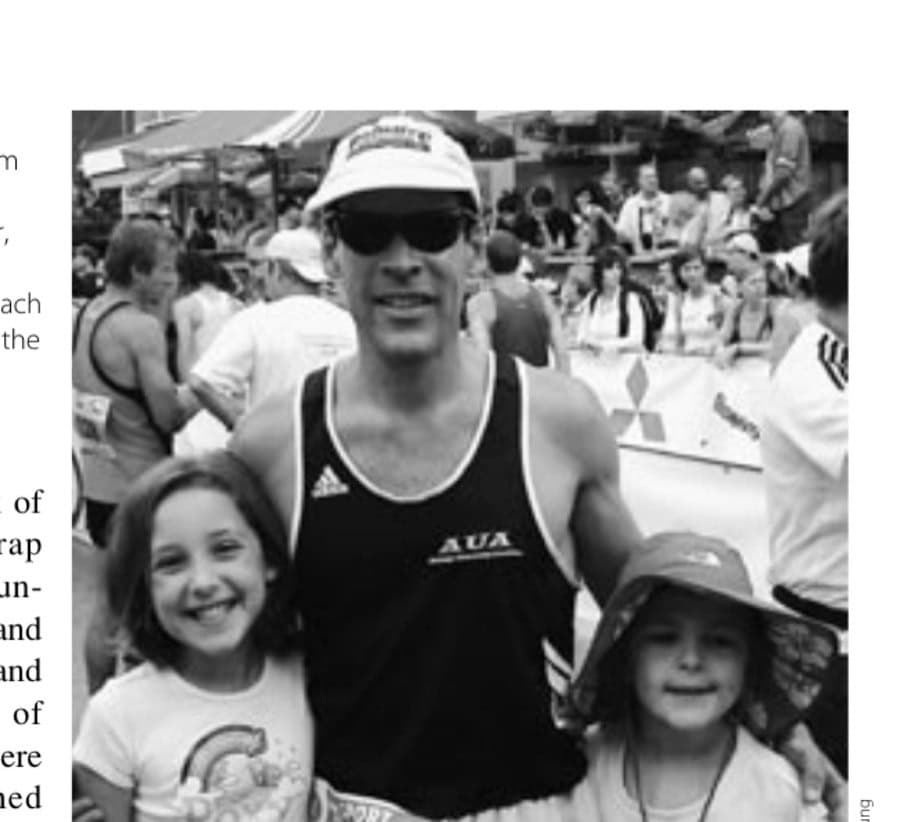
Dean Karnazes, 24-hour national team member, with crew members—daughter, Alexandria, and son, Nicholas—in Worschach in 2005, just prior to the start.
This article originally appeared in Marathon & Beyond, Vol. 11, No. 3 (2007).
← Browse the full M&B ArchiveMore like this
1,000+ stories from 19 years of Marathon & Beyond
The complete archive of the legendary long-distance journal — digitized and free to read.
