

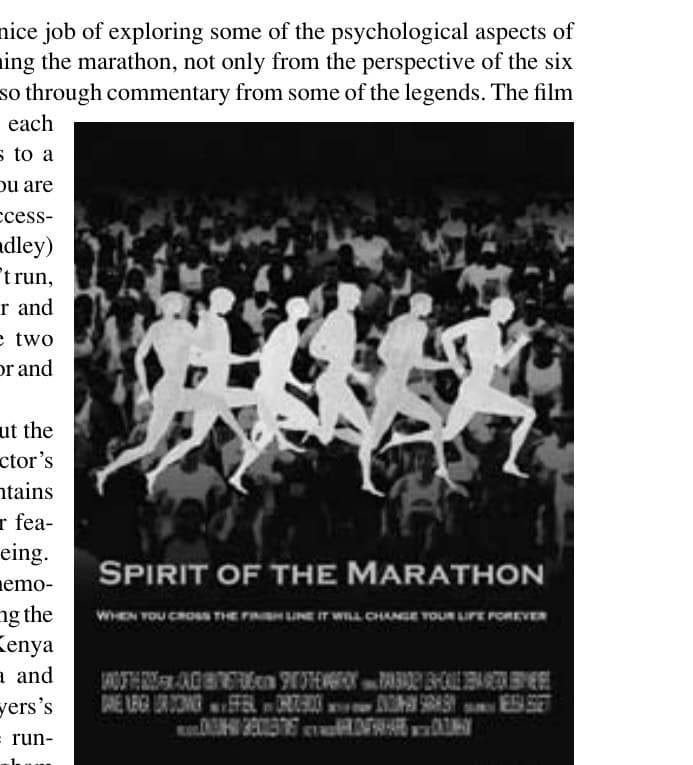
Spirit of the Marathon is a must-see movie for past, present, and future marathoners. At times inspirational, at times a wonderful historical perspective of the marathon, at times a trip down memory lane with some recent marathon champions, the movie is well done.
Many movies have featured running (more than you would think—check out www.runningmovies.com), but this nonfiction film explores in a special way the highs and lows of preparing for, running, and finishing the marathon.
The movie’s Web site, www.marathonmovie.com, provides the following background information (in typical enhanced-publicity mode):
“Four years in the making, Spirit of the Marathon is the collaborative effort of three-time Academy Award winner Mark Jonathan Harris, Telly Award winner and marathon runner Jon Dunham, and producer/marathoner Gwendolen Twist. Spirit of the Marathon is the first ever nonfiction feature film to capture the drama and essence of the famed 26.2-mile running event. Filmed on four continents, the movie brings together a diverse cast of amateur athletes and marathon luminaries.
“As six unique stories unfold, each runner prepares for and ultimately faces the challenge of the Chicago Marathon. More than a sports movie, Spirit of the Marathon is an inspirational journey of perseverance and personal triumph, a spectacle that will be embraced by runners and nonrunners alike.
“Filmed on four continents and in five countries, the film features legends such as Dick Beardsley, Paula Radcliffe, Bill Rodgers, and Grete Waitz.” The movie’s Web site also has a great deal of background information on the athletes featured in the film as well as some of the legends, who include the above stars as well as Frank Shorter, Amby Burfoot, Alberto Salazar, Katherine Switzer, and Joan Benoit Samuelson (among others). Film footage also has great material from the 1896 Olympics, the famous 1908 race with Dorando Pietri and Johnny Hayes, as well as footage of Emil Zatopek and Abebe Bikila.
One of the key features of the film that makes it so entertaining is the blend of elite marathoners (Deena Kastor, 2004 bronze medalist in Athens; and Daniel Njenga of Kenya, two seconds and two thirds at Chicago), regular marathoners (Ryan Bradley, trying to qualify for Boston; and Jerry Meyers, a highlight of the film and, at 65-plus years of age, a four-time marathoner) and two newbies, first-timers to the marathon distance, Leah Caille and Lori O’Connor. The film does a wonderful job of traveling with all of these runners on their journeys over six months leading up to and including the 2005 Chicago Marathon.
The scenery is impressive, from Mammoth Lakes, California (Deena Kastor) to Kenya (Daniel Njenga) to Chicago and its lakefront and diverse neighborhoods. For those who know (and love) Chicago, including the tens of thousands who have run its marathon, and especially those who did it in 2005, Spirit of the Marathon is sure to bring many wonderful memories flooding back. Watching the camera pan back on the thousands of runners at the starting line and seeing the runners as they finish, you can’t help but cheer for each runner and run vicariously through each participant.
The movie does a nice job of exploring some of the psychological aspects of preparing for and running the marathon, not only from the perspective of the six runners featured but also through commentary from some of the legends. The film footage also explores each of the runners’ stories to a sufficient extent that you are rooting for all to be successful. Alas, one (Ryan Bradley) got injured and couldn’t run, but his wife took over and ran the race, and the two wound up qualifying for and running Boston.
Be sure to check out the bonus features and director’s cut on the DVD. It contains extra scenes and other features that are worth seeing.
There were many memorable moments, including the precious little boy in Kenya watching the camera and jogging a bit, Jerry Meyers’s great quote about the runner’s high, John Bingham (the Penguin) talking about running a marathon, and Deena Kastor’s cooking. Runners will walk away with different moments as highlights. Be sure also to watch the movie credits. The end of the credits provides marathon finish times, ranging from close to two hours to over six hours, for all of those who helped to create the movie. The list of the participants and their finish times is rather distinguished!
Although the movie is quite enjoyable, you can quibble with some things. Certain aspects of the runners’ lives were not explored enough. For example, Njenga was working in Tokyo, and all of a sudden, he was training and based back in Kenya. Bradley got injured and his wife “took over,” but what was her perspective in all this? Since he could not exercise because of his injury, what were some of his coping mechanisms? Why was Leah Caille crying so much during the marathon? Were they tears of joy (seemingly), frustration at possible injuries, or a display of her mental toughness to finish the race regardless of the cost? There was also not enough closure to the movie. Yes, there were a few sentences about what happened next for each of the six runners (new goals, for example), but a more extensive interview with each would have been great. How did Njenga feel about coming in third once again after training so hard to win? How did Leah and Lori feel about finishing their first marathon? Would either of them run another marathon? It was also hard to decipher the finishing times for the nonelite runners (except for Jerry and his daughter; the clock was clearly visible as they crossed the finish line).
Although there were aspects of the film we thought could have been improved, overall it was very well done and worth two hours of your time. Our final evaluation is to give Spirit of the Marathon 3 1/2 running shoes out of four. The DVD is scheduled to be available this fall. Check out www.marathonmovie.com for details.
This article originally appeared in Marathon & Beyond, Vol. 12, No. 5 (2008).
← Browse the full M&B ArchiveMore like this
1,000+ stories from 19 years of Marathon & Beyond
The complete archive of the legendary long-distance journal — digitized and free to read.
