

Steamtown Marathon
The Basics
| The Steamtown Marathon P.O. Box 20126 Scranton, PA 18502 |
| PHONES: 1-800/22-WELCOME; 570/963-6363 |
| FAX: 570/963-6852 |
| WEB SITE: www.visitnepa.org |
| RACE DIRECTOR: William F. King |
| YEAR RACE ESTABLISHED: 1996 |
| SANCTION: USATF |
| START TIME: 8:00 A.M. |
Course Record Holders
| Open men: | Bob Schwelm, Haverford, PA, 1998, 2:20:59 |
| Open women: | Charlene Lyford, Greene, NY, 1998, 2:44:01 |
| Masters men: | Terry McCluskey, Brookfield, OH, 1997, 2:31:35 |
| Masters women: | Marilyn Huot, St. Lambert, Quebec, 1998, 3:14:31 |
| PRIZE MONEY | $15,000 total purse |
| TIE-IN EVENTS: | Kid’s Run; Wheelchairs can race the full marathon |
| NUMBER OF VOLUNTEERS: | 2,600 |
| MARATHON FINISHERS IN 1998: | 1,662 |
| MALE/FEMALE FINISHERS: | 74% male; 26% female |
| COURSE MARKINGS: | Every mile |
| NUMBER OF MEDICAL STATIONS: | 13 |
| NUMBER OF WATER STATIONS: | 13 |
| FUTURE RACE DATES: | 10OCT99, 08OCT00, 07OCT01. |
| ENTRY COST FOR 1999: | $40 until 13SEP99, $50 after 13SEP99 |
AREA HOTELS: Northeast Pennsylvania Convention & Visitors Bureau reserves blocks of hotel rooms for marathoners. Some discount rates and late checkouts are available. Call 800/22-WELCOME for lodging assistance. Marathon sponsor “Around the World Travel” will also be pleased to provide lodging or travel assistance (570/383-0544). Make reservations early—early October is the height of fall foliage tourist season.
GETTING THERE: Scranton is served by many major northeastern Pennsylvania highways. I-81 runs just east of downtown, and the Northeast Extension of the Pennsylvania Turnpike (I-476) offers three exits to serve the city. Scranton is 77 miles north of Allentown, 122 miles northeast of Harrisburg, and 127 miles north of Philadelphia. The Wilkes-Barre Scranton International Airport at Avoca is four short exits off I-81 from downtown Scranton.
Millions of dollars were poured into the city to revitalize it. They didn’t merely repaint the city, they reinvented it. The dollars added the Mall at Steamtown, the National Historic Steamtown site, the Scranton iron furnace site, a Cultural Center, and downtown movie theaters. The Radisson at Lackawanna Station Hotel, The Courtyard by Marriott, and the Comfort Suites opened up hundreds of rooms for visitors who want either to tour the deeply historic city or to see where their money is being spent when they send their kids to college in Scranton. There are three colleges in or near downtown Scranton: Lackawanna Junior College, Marywood University, and the University of Scranton.
The city’s three hospitals include the Community Medical Center, the Moses Taylor Hospital, and Mercy Hospital, within walking distance of each other. As for churches, you’ll find St. Peter’s Cathedral, Temple Israel, St. Mary’s Church/Center, St. John’s Lutheran Church, St. Luke’s Episcopal, Elm Park United Methodist Church, and the Covenant Presbyterian Church. There’s also a Catholic Youth Center and a Jewish Community Center.
If sports or the arts are to your liking, just up the hill on the far side of Interstate-81 sits Montage Mountain Ski Resort with its Performing Arts Center. The Glenmaura National Golf Club is a short 9-iron shot from Lackawanna County Stadium, home of the Red Barons, a Philadelphia Phillies AAA team.
What a change since Harry Chapin rode the bus.
The More Things Change . . .
Want more visitors and more excitement downtown on a lovely fall weekend? Why not add a top-drawer marathon? This is exactly what the running fathers of Scranton decided to do.
The first Steamtown Marathon in 1996 had 517 starters, with 462 finishing the mostly downhill course. The winning time was a nearly pedestrian 2:31:13. A year later 904 runners started way out in the countryside and ran into downtown, with 806 finishing, and a winning time of 2:22:33. On October 11, 1998, 2,066 runners toed the starting line near Forest City High School, with 1,663 completing the course. Bob Schwelm of Havertown, Pennsylvania, set a course record of 2:20:59.
Why the tremendous jump in numbers over the very short three-year history of the race?
Begin with race director Bill King and his assistant director Jim Cummings. Throw in expo coordinators Therese Neary and Jim Moran. Mix in police chief Tom Dubas, who handles course traffic control, and J.R. Rupp of the Northeast Pennsylvania Convention & Visitors Bureau, who helps organize the entire event. Stir in over 2,600 volunteers, all with smiles on their faces for each and every runner. The recipe adds up to much more than a successful marathon. You have a community happening.
When was the last time you went to a race and complained that there were “too many people pushing water at me”? One runner from nearby Pottsville summed it up best: “The people of northeastern Pennsylvania should be proud of the job they did. The support during the race from the [nearby] towns was also great. I just hope they keep it small. It felt very personal, not like you’re just a number.”
Jim and Bill and the rest of the organizers took the best of all the marathon events they ran or visited and added their own blend of Pennsylvania hospitality. It truly shows. What other marathon features more than one volunteer per entry?
Sunday, Sunday! Raceday, Raceday!
Raceday buses begin pulling out of downtown Scranton at 5:30 A.M. Every five minutes another canary-yellow school bus pulls away from the Lackawanna County Court House steps carrying 48 to 52 sleepy-eyed runners exactly 26 miles 385 yards away.
The bus ride out of Scranton covers very little of the course, so it’s a waste of energy to try to construct the course from what you’re seeing through the bus window. Better to sneak in a nap if you can.
The first spot you finally touch the course is in Carbondale, which we’ll say more about later. Following a left turn in Carbondale onto Route 171, the first sensation that greets sleepy-eyed bus riders is a slight bit of pressure on the back of the thighs and calves and the sensation of a large hand pushing them further back into the bus seat. In a sort of optical illusion, looking out the window does not reveal the ascension of a huge hill, but the pressure on the body indicates a definite climb.
The ride through Fell Township, Vandling, and into Forest City features its share of uphills and down, but the real grasp of the descent in store for the runners comes when the bus turns left to grind up the hill to the Forest City High School.
Forest City High School, its parking lot filled with Port-a-Squats and its gym permeating with the smell of BenGay and other exotic muscle-rejuvenating concoctions, might remind you of the Hopkinton gym in the early 1980s. Darn near everyone knows darn near everyone else. If you don’t know someone, you do know someone who will introduce you to the someone you don’t know.
Must See/Must Avoid
Northeastern Pennsylvania, like many previously depressed American regions, has risen, phoenix-like. Once the center for King Coal, the bottom fell out of the market in the 1950s, and the region stagnated.
Over the decades, however, the Scranton/Wilkes-Barre area has revived itself—fortunately, without damaging the uniqueness of the surrounding towns in the process. Unlike many urban areas, however, Scranton hasn’t “progressed” to the point that it offers much in the way of danger to visitors. In fact, for a big-city dweller, the Scranton/Wilkes-Barre area may seem terminally laid back—and maybe a little too friendly for some seasoned travelers. So be it.
Go See It
Steamtown National Historic Site. One of the world’s largest collections of steam locomotives and related memorabilia. A roundhouse, museum, theater, educational bookstore, and steam locomotive excursions. Open from 9 to 5. No entrance fee. Train rides from $5 to $10.
Fall Foliage. Early October is a wonderful time to be in northeastern Pennsylvania. Leaf colors will take your breath away. If you’ve never experienced “fall foliage,” you’re missing one of the great natural wonders of the world—and it’s all free.
The Tribune and The Scranton Times. The Saturday Times includes a pull-out map of the course with all the towns highlighted with population, points of interest along the race route, the time the leaders should be through town, and the best places to watch the race. It also lists the entrants alphabetically. The Monday Tribune has complete race results, loads of photos, and for $3 the Saturday, Sunday, and Monday editions will fall into your mailbox a week or so after the race.
Lackawanna Coal Mine Tour. Coal was once king in northeastern Pennsylvania. Tour a real coal mine 300 feet below the surface to get a firsthand view of the hard and dangerous life of the coal miner.
Anthracite Heritage Museum. Learn how industry and immigration shaped northeastern Pennsylvania in this combination of vivid images and videos. The museum features a store, library, and archives used by local historians.
Everhart Museum. Open since 1908 at the Nay Aug Park, this museum features, on a rotating basis, arts and natural history, including a bird gallery, dinosaur hall, fossils, rocks and minerals, mammals, American folk art, 19th- and 20th-century art, and art of the Orient, Africa, and Oceanic societies.
Camaraderie abounds, and there are enough facilities that no local flowerbeds were used as urinals.
AT THE START
After casually lining up for the start, the runners take off and are greeted first by a slight downhill as they turn onto Dundraff Street. The course is level for a few blocks before taking another right onto Main Street (aka Route 171), where the steep descent begins. The initial blaze of downhill speed and the concentrating on watching your footing virtually guarantees that the vast majority of the runners completely miss the Coal Miners’ Memorial on Main Street.
Mile 2 appears in nearby Vandling, a small town which next year will be celebrating its centennial. They anticipate putting on quite a celebration and hope to share it with the runners.
As runners enter Fell Township, they are still enjoying a downhill race. Fell Township is known as the manufacturing center for visors and eyewear for both military and commercial use. The course crosses a viaduct and then begins an arch-shaped climb before descending into the main business district of Simpson.
The course levels off as it flows into the township and city of Carbondale, a city you’ll not forget after passing through on race day. The parking meters along Main Street are festooned with balloons, and rows of spectators line each side of the street. In the middle of town, at City Hall, the local high school band and cheerleaders perform for every runner who passes in front of them. As runners exit the town at mile 8 on the way to Mayfield, each of them is personally thanked for running through town.
Mayfield, population 1,862 (less than the race field), houses the National Institute of Environmental Renewal. The course here is flat or slightly downhill until leaving town, where runners encounter their first incline. They tend to welcome the change of topography as the shift between battered and slightly overused muscles is switched to those so far untried. The incline continues into Jermyn, the birthplace of first aid training, and the halfway point of the run.
BEWARE: WORLD’S LARGEST POTHOLE
Next up is the town of Archbald. Its claim to fame? The world’s largest pothole. That’s right: pothole. Left by the last glacial era, the hole was discovered back in 1884. It couldn’t have taken much to discover it, as this pothole is darn big. Near by is Pothole State Park. The fall foliage dazzles as runners wind their way through this wooded area of the course. At this point the course is flat, in spite of skirting the famed and feared pothole.
Mile 17 moves into Blakely, the scenic highlight of the course. Here you’re forced for a half-mile to give up the civilized footing of asphalt for the beautiful, flat, tree-lined trail running along a meandering brook.
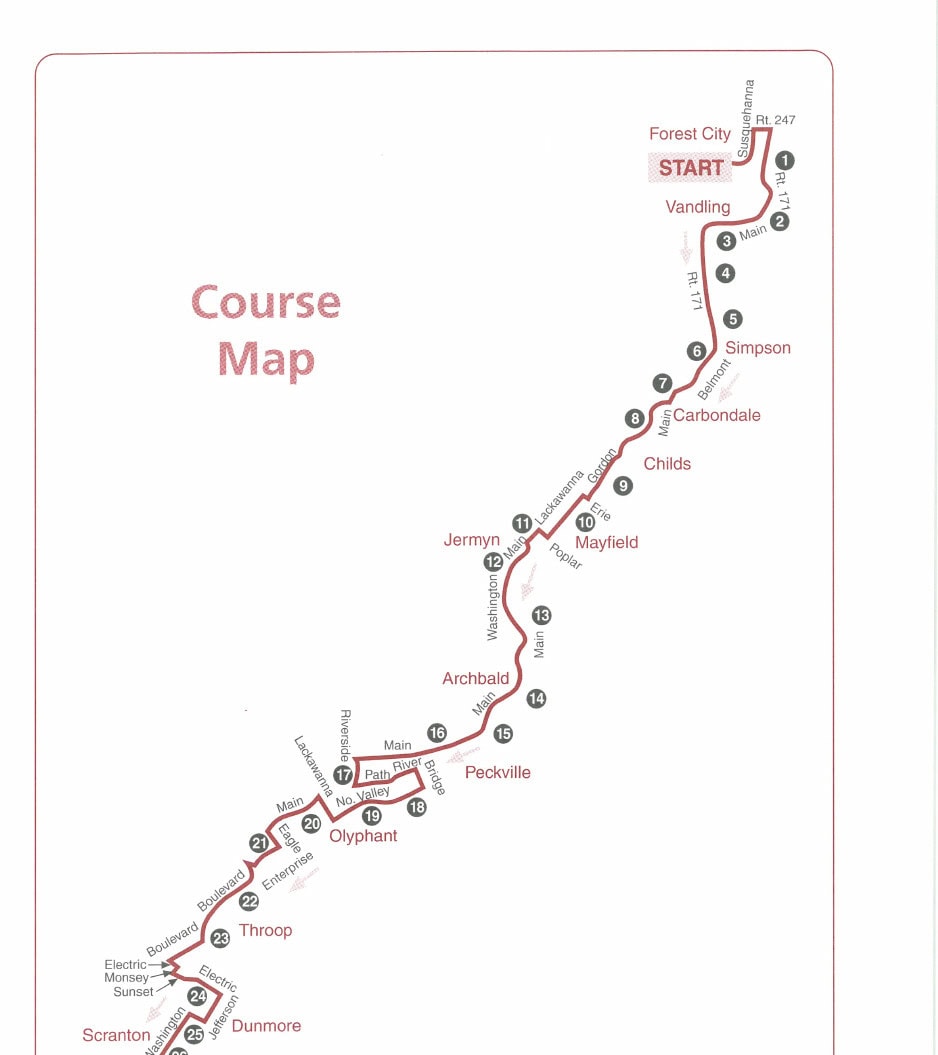
Next up is Jessup, followed by Olyphant. Both are flat and lead runners very near to the 20-mile mark. Jessup, home to 4,619 hard-working folks, is noted for the Lackawanna County Railroad Bridge, while Olyphant lays claim to a business district known for its bridal shops. Do not wear a Will You Marry Me? sign in Olyphant unless you’re serious.
Dickson City, home of the Viewmont Mall, comes next. On a clear day, from this point runners receive a tantalizing view of their goal: downtown Scranton. Unfortunately, Dunmore imposes itself first. Though it totals less than a mile of the course, the Dunmore uphill is the course’s toughest. Veteran runners describe the grind up Electric Street as “a killer.” Coming at the 24-mile mark, a hill is never welcome, and this particular hill is less welcome than most. But take heart. At the top of the hill the course again flattens and is followed by a gradual downhill to the finish at the Lackawanna County Courthouse on North Washington Avenue.
The crowds here are very deep, lining both sides of the street. The reception rivals any marathon you’ve run. Race personnel are very visible, giving high-fives to those they recognize as well as to those they don’t. The excitement on the faces of the runners and the volunteers makes this a course well run from both sides of the slate.
| Runner’s High | Runner’s Low |
|---|---|
| Fast downhill course | Really sore legs the next week from all the major downhills |
| Outstanding race stuff and finisher’s medallion | Small expo with poor speaker system |
| Super support from all towns along the course | “Too many people pushing water at you” |
| Wonderful organization; no stone left unturned | |
| Extra-friendly and helpful volunteers and race officials |
GOT MAPS IF YOU WANT ‘EM
Once your application for the race has been received, you’ll be sent a package containing everything you need to know about the Steamtown Marathon. Nothing is left uncovered. A map is included to help you reach the Saturday (11 A.M. to 6:00 P.M.) expo held in the atrium of Fleet Pennsylvania Services at Montage Mountain, a few miles from downtown Scranton. The pasta party, held from 4:30 to 8:30, is at the Ski Lodge at Montage Mountain. It helps to have a car for the trip from the expo to the pasta party, but the drive’s not long.
A second map covers downtown Scranton. All free parking lots are marked, and all points of interest for you and your family are highlighted.
A third map clearly marks both the mile markers from Forest City to Scranton and the parallel roads that run with the course. It’s easy for a family to drive to various points along the course to cheer on their runner and still get to the finish in time to see him or her cross the line. If you have questions or need more details, the information/trouble booth at the expo should have the answers.
OTHER FRILLS
Thirteen water and aid stations are on the course, each manned (or womanned) by some of the most delightful people you’ll ever meet. The long-sleeve race T-shirts are outstanding. Wear one in a crowd of runners, and Steamtown stands out. The engraved finisher medals are also top-notch. You’ll be proud to display yours in your home or office. Finally, be sure to pick up an official race poster drawn in pencil and acrylics by local artist Marijo DePaloa. The poster depicts racers cheered on by fans on Main Street with fall foliage splendor in the background. The course is shown on the border of the poster, along with scenes from the area. Some runners grumble about the $10 cost (been to Boston lately?), but one look at the artwork convinces most people to buy the poster, frame it, and hang it up next to their finisher medal.
If a fall marathon is in this year’s plans and you’re too late for the Marine Corps (which you are, since it filled in March), call now for the Steamtown experience. Great course, 955-foot drop in elevation, only one major hill, and most important, a perfect example of Northeastern Pennsylvania’s outstanding hospitality served up by 2,600 happy volunteers. Just be sure to keep an eye out for that freewheeling semi carrying 30,000 pounds of bananas.
The Bottom Line
We have weighed various aspects of a marathon within a 1,000-point scoring grid. Besides the author of the article, a dozen runners at the race were randomly chosen to score the race for us. (SM = Steamtown Marathon.) The results follow:
1. HISTORY/TRADITION
Evaluate the race’s sense of history and tradition.
[Possible points: 30 SM score: 22]
2. ENTRY FORM
Is the race entry form clear, concise, attractive, complete, and easy to fill out?
[Possible points: 20 SM score: 19]
3. Entry Cost
For most races, the entry fee covers between 30 and 50 percent of the cost of putting on the event. Rate the value of your dollar relative to this race.
[Possible points: 30 SM score: 28]
4. Locale/Scenics
Is the race held in an area that is easy to get to and scenic, offers adequate food and housing services and nonrace activities for family and friends?
[Possible points: 50 SM score: 44]
5. Registration
Is registration well organized and efficient? Does it bog down unnecessarily?
[Possible points: 20 SM score: 20]
6. Prerace Activities
Evaluate activities such as pasta feeds, parties, and so on, during the days before the race.
[Possible points: 50 SM score: 46]
7. Expo
Does the expo offer a fair number and variety of booths relative to the race’s size? Are there quality exhibitors and good guest speakers?
[Possible points: 50 SM score: 31]
8. Course
Take into consideration the following: degree of difficulty, certified, sanctioned, quality of road or trail surface, adequate mileage and directional markers, aid stations, medical coverage, race communications, accessibility to course for friends and family, typical weather, and so on.
[Possible points: 400 SM score: 371]
9. Race Amenities
This category includes race T-shirt, finisher’s medal, finisher’s certificate, adequate and efficient finish area, ease of sweatbag retrieval, showers, postrace refreshments, awards ceremony, raffles, results postcard, results book, and so on.
[Possible points: 250 SM score: 212]
10. Volunteers
Are the volunteers experienced and adequate in number?
[Possible points: 100 SM score: 99]
Total Score for Steamtown Marathon
892 points (out of 1,000)
T HE CITY of Scranton, Pennsylvania, and its many surrounding communities do a fantastic job with the Steamtown Marathon. In three years it’s grown from 500 to more than 2,000 registrants, and the organization and the support are as good as any I’ve enjoyed anywhere, including legendary Boston. For a train lover like myself, the T-shirt featuring a steam locomotive gives the race a permanent place on my calendar.
Although I had plenty of advance notice that I was going to run 26.2 miles on October 11, I didn’t do nearly enough training. I ran a couple of half-marathons in the six weeks before Steamtown, but I didn’t get in enough long runs. So, when I arrived in Scranton, I was hoping to run a good race, but hope and some years of experience in the bank was about all I had going for me.
On Saturday night, I fueled up on Chinese food and hoped that my body would remember how to run farther than 13 miles. I sensed that I wouldn’t be setting a PR the next morning, but I still hoped to find a way to run reasonably well.
The scene on Sunday morning was one of great joy. The people of Forest City, where the point-to-point race begins, made everyone feel like an honored guest, and it was easy to be nervous and thrilled as more than 2,000 of us got ready to run. A television helicopter circled overhead, and the excitement grew. Then the cannon went off and the journey began.
As the hordes headed out of Forest City, I sensed that I was in for a long day. I just didn’t feel smooth. Every step required a great effort, but I hoped to find my stride after a few miles.
When I hit the first mile in 9:23, I attributed my time to the crush of runners on the narrow streets. When I got my split at mile 2, I was out of excuses, and I knew that it was going to be a struggle.
I was right on that. I didn’t feel bad, but I didn’t feel good. If I had been out on a training run, I would have cut it short. My legs felt sluggish, and my stomach didn’t feel right. Fortunately, I had plenty of company and plenty of support. Volunteers and fans were plentiful—many of the volunteers were high school cross-country runners loaded with empathy for marathoners. They gave me encouragement and water, but by the eight-mile mark I had abandoned hope of a good time, which would have been anything under 3:25. Instead of worrying about my time, I tried to focus on the fantastic experience of running a marathon.
Even though my shoes weren’t throwing sparks, I was participating in one of life’s great celebrations. Nowhere was heard a discouraging word, and my pace still put me ahead of a lot of people. High school bands played and spectators said nice things. For a few hours, I was a hero. I could tell by all the people who were cheering for me.
As the miles passed, my splits grew progressively slower, and I played mind games with myself, games with steadily decreasing expectations. If I can hold this pace for the last 16, I can still get under 3:30 . . . if I can hold this pace for the next 12, I can still get under 3:35 . . . if I can just hold together enough to finish, I’ll be very grateful. You know how it goes. Many times I tried to pick up the pace, but my body told me I was already going as fast as I could go that day.
I never had to walk any extended distances, but I did stroll through some water stops. I reached 23 in 3:10, and Becky joined me there and posed the obvious question, “Where have you been? I’ve been expecting you.” I explained that I was doing my best, but my best wasn’t too good that day.
As we ran, she chatted, and I grunted occasionally. She talked about some people and a cat she had met while she was waiting. I just wanted to be finished, and I wasn’t in the mood for bubbly conversations. Still, I was glad for her presence. I couldn’t let up with her there, and she boosted my ego by saying that my marathon shuffle was a good workout pace for her. I needed a good chuckle at that point.
Somewhere past 24 I encountered the worst hill on the course. I put my head down and watched my feet as I shuffled up the long and winding road. I was feeling seriously sorry for myself, but at the top of the hill was the sight that put a rough marathon into its proper perspective.
On top of that hill in Dunmore is the children’s home that receives the proceeds from the race. Children in wheelchairs were sitting there; some of them appeared to have some serious disabilities. I figured that most of them would never be able to run a marathon at any pace, and their presence brought a lump to my throat and water to my eyes.
Seeing those kids reminded me that simply having the ability to run a marathon is a special gift. Slow or fast, it’s something that very few people have the physical and mental ability to do. I consider myself fortunate to be a part of that special group. So I got a little choked up and ran on. My body was aching, but I knew that my time was at hand. My tiny troubles would end in a few minutes.
My right foot was blistered, and at 25 the course threw another annoying hill at me. I didn’t like it, but I shuffled on, slow but determined. It hadn’t been my best marathon, but I knew the finish would be the same reward as it is when I run well.
Finally, I crested the last hill and saw the finish line, down a modest grade. An arch of balloons awaited me, and a surge of adrenaline powered me as hundreds of gracious strangers rooted me on. I can’t say that I sprinted to the finish, but I did cross with dignity in that I was still running.
My time was 3:40:42, and I staggered in the finish chute. A dozen different emotions ran together, and my eyes watered again. “Thank you, Jesus,” I whispered to myself as a kind volunteer wrapped two foil blankets around me.
Then all that I wanted was a comfortable place to sit down. I found a park bench and curled up beneath my silver blankets, too exhausted to be either happy or dejected. Becky found me and gasped when she saw the salt caked on my face. I told her it was normal for me to look that way.
I wasn’t thrilled with my time, but I was pleased with my effort. I had gone as hard as I possibly could that day. I’d have preferred to run much faster, but I’d finished a marathon, and that knowledge soon had me smiling.
My effort recertified me as a marathoner. I’ve run at least one every year since 1980, and I don’t believe that I can live on yesterday’s glories. I feel a need to run at least one marathon a year to maintain my membership in this exclusive club, so reaching the finish line kept my membership current.
Within an hour of finishing, I was in a hot tub at the Scranton YMCA, thinking of what I’ll do to make my next marathon much better, and happy in the knowledge that I am a marathoner. Whether it takes a 2:06:05 or 3:40:42, it’s still a significant achievement to run 26.2.
When I saw the results, I realized I had actually run reasonably well that day. Graded on a curve, I’d have earned a B, and more than 1,000 people would have been happy to trade times with me. More than 1,000 of the 1,600+ finishers were behind me, and I guess that the race must have produced a lot of DNFs.
So, yeah, I’d have liked to run faster, but I’m happy to have run at any speed. On 364 days in 1998, I was just a regular guy, but on October 11 I achieved something significant. On October 11, I pushed myself out of life’s comfort zone. On October 11, I was a hero—and I remembered a valuable lesson about the marathon: speed is nice, but it isn’t necessary for a great marathon experience. In fact, I think it’s fair to say that every marathon is a great marathon. And I know it’s accurate to say that it’s better to have marathoned and struggled than not to have marathoned at all.
Below, listed alphabetically, are other marathons profiled in Marathon & Beyond, the volume and issue number in which each race’s profile appeared, and the overall score each race received.
| Calgary Marathon (vol. 3, issue 2): | 876 points |
| Edmonton Marathon (vol. 2, issue 2): | 814 points |
| Fox Cities Marathon (vol. 3, issue 4): | 865 points |
| Governor’s Cup Ghost Town Marathon (vol. 2, issue 1): | 795 points |
| Grandma’s Marathon (vol. 3, issue 1): | 968 points |
| Honolulu Marathon (vol. 2, issue 4): | 906 points |
| Humboldt Redwoods Marathon (vol. 2, issue 3): | 809 points |
| Las Vegas International Marathon (vol. 1, issue 5): | 789 points |
| Philadelphia Marathon (vol. 1, issue 4): | 838 points |
| Pittsburgh Marathon (vol. 1, issue 6): | 904 points |
| Portland Marathon (vol. 3, issue 3): | 943 points |
| San Francisco Marathon (vol. 1, issue 2): | 804 points |
| Shamrock Sportsfest Marathon (vol. 2, issue 6): | 866 points |
| Sutter Home Napa Valley Marathon (vol. 2, issue 5): | 913 points |
| Vancouver International Marathon (vol. 1, issue 1): | 823 points |
| Wineglass Marathon (vol. 1, issue 3): | 839 points |
This article originally appeared in Marathon & Beyond, Vol. 3, No. 5 (1999).
← Browse the full M&B ArchiveMore like this
1,000+ stories from 19 years of Marathon & Beyond
The complete archive of the legendary long-distance journal — digitized and free to read.
