

Stopped Worrying About The Race
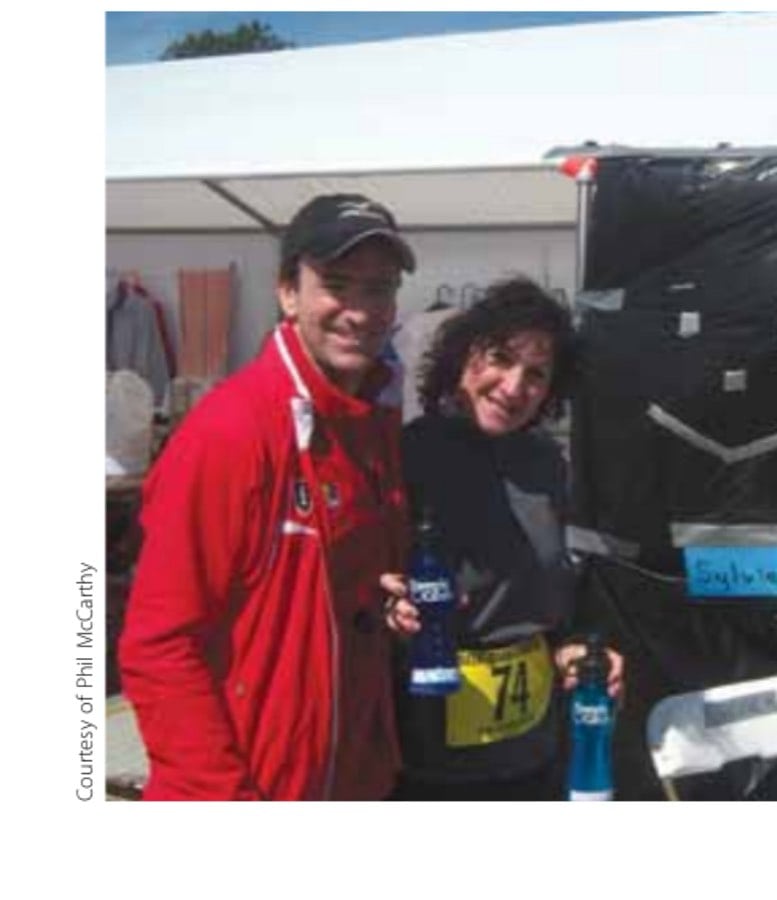
The author with Canadian runner Sylvie Boisvert before the start of the race.
▲
Courtesy of Phil McCarthy
Numbers of all kinds were running through my head before the start of the Sri Chinmoy Self-Transcendence Six-Day Race, which started April 21, 2013, in Flushing Meadows Corona Park, Queens. I had high hopes for
big mileage totals, so those numbers were in my head as well as my expected mileage per day, minutes per mile, hours I’d have to sleep, and more. But before the end of the race, none of those numbers really mattered at all, and the most
important number was the huge number of friends who came out to crew for me, bring me food, or cheer me on. So right off the bat I want to thank those people. Unfortunately, it would consume most of the article to list everyone who had a hand in this.
I had a lot of reasons to feel good going into this race. Physically I felt good and well trained and well rested; this would by far be my longest race, my previous longest being a 48-hour race, but I
seemed to do better the longer the race; this would be a reunion of sorts of the 2007 24-Hour world championship team at Drummondville, Canada, where I had my first real breakout race, with teammates Alex Swenson and
John Geesler both running as well as Canadian Sylvie Boisvert, who won the open race in Drummondville and even the race director in Drummondville, Michel Gouin.
With Mike Arnstein’s help, I got off to a good fast start, just as I was expecting, running 70 miles in the first 12 hours. But I realized that that pace was not sustainable, and my plans would have to be adjusted somewhat, even sleeping the first night, which I didn’t plan to do. By nighttime I was on my own, and it was tough mentally, knowing how far I still had to go. It was then that I really questioned the wisdom of entering the race. But I got in about 45 minutes of sleep, from 1:45-2:30 a.m., and I managed to finish the day with 120 miles. On Monday afternoon, Mike and Oz Pearlman came running by, literally, to give their encouragement and to check up on me and to leave little notes among all my things, even in my tent.
The handler who knew it all Monday night, Shaun Leonardo came to crew for me, and although not a runner himself, he is a lifelong athlete and was an incredible handler, knowing just what I needed, even helping me into the medical tent for some early blister work, Achilles work, and massage. After just two hours’ sleep I was up again and on the road.
By Tuesday I was developing a routine of eating, drinking, sleeping, going to the bathroom, chatting with the other runners, and worrying less about mileage. I seemed to run best from 6:00 a.m. to 6:00 p.m. We were fed good full meals at 6:00 a.m., noon, and 6:00 p.m., and I usually loaded up a tray and walked with it and usually felt a burst of energy after the calorie intake. By darkness, I usually slowed down some and would do a cool-down lap or two before going to sleep, which on nights three to five was about 11:00-3:00. The one thing that surprised me was that I had a very hard time getting to sleep after the first couple of nights. But I would lie there and get whatever rest I could.
By Tuesday and Wednesday the help I received became quite overwhelming—in a good way. By Wednesday I think I was gaining a reputation for having a lot of groupies come by—at least that’s what I kept hearing. It was pretty amazing, and I hardly knew how to wrap my mind around it. But that’s how I had my revelation. Before the race I had asked for advice from Trishul Cherns and Dave Luljak as well as from Martin Fryer and John Geesler during the race, and the one thing they all said was to just keep moving forward and not worry about the mileage but just let yourself get into the “flow” of the race.
I kind of knew what they meant, but I resisted the part about not worrying about mileage, and it wasn’t until Thursday night that I really felt what they meant. I had a visit from a very good friend, but my conversation with him kind of jolted me out of the world I was in and brought in some negative outside attitudes. Otto Lam arrived about the same time, and his enthusiasm jolted me a little as well, since I was in a pretty calm and relaxed state by that time. I actually felt the need to calm him down, saying nothing is that urgent. Then I was talking with him, trying
Courtesy of Phil McCarthy
▲
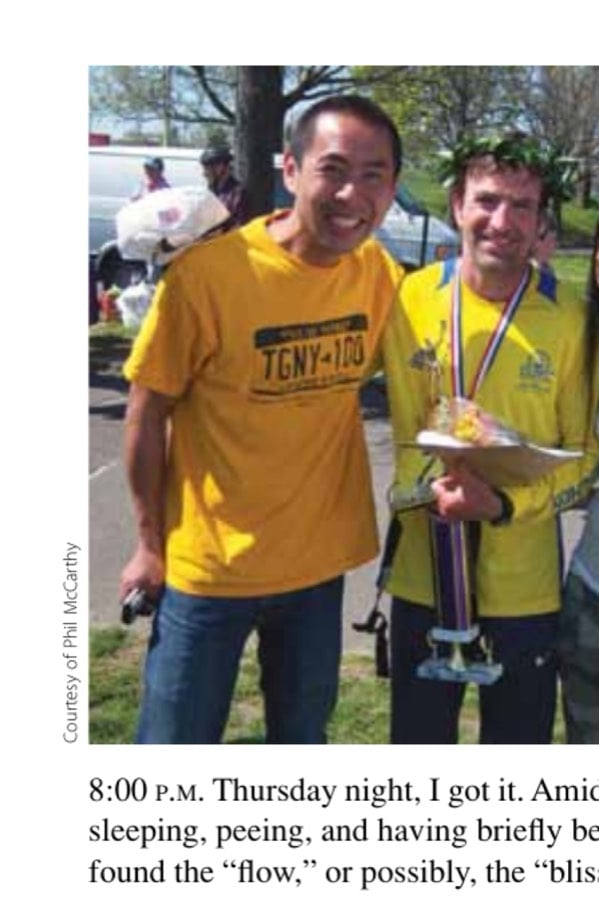
The author’s crew, Otto Lam and Elaine Acosta, who took care of his every need during the race.
to make sure he was going to be OK with enough food and rest, and he kept saying, “Don’t worry about me. Just focus.” I told him, “Focus is not the right word. I’m just here, and this is what I’m doing. And now I
get it.” And at about 8:00 p.m. Thursday night, I got it. Amid the repetitive routine of eating, drinking, sleeping, peeing, and having briefly been jolted out of it, I suddenly realized I’d found the “flow,” or possibly, the “bliss,” and I understood the joy of what I was
doing. As darkness began to fall, I passed people walking, and I realized it was the same joy whether you’re running or walking, and all of us were sharing the same experience. I had been in a conversation with Nirbhasa Magee, an Irish runner who was
competing in the 10-day race that was being run simultaneously. He is a very sweet and enthusiastic young guy and he mentioned how everything around us—the Long Island Expressway, the lake, the kids, the motorcyclists popping wheelies,
the seagulls pulling worms out of the ground at dawn—was our environment, our theater, that we were moving through. So Thursday night turned into Friday, and Friday noon I felt a big rush of energy from four sources: (1) the sun (and the weather was really beautiful pretty much
the whole time; no rain, only occasionally some strong winds); (2) my handler Otto; (3) lunch; and (4) the knowledge that I had only 24 hours to go.
Going with the long surge Now, with my legs relatively strong, my feet feeling trashed but mostly numb, and newfound energy, I began a long surge that took me from 391 miles at noon to 400 miles shortly after 2:00 p.m. and beyond. I did the calculations and determined that if I kept the same pace (a little better than 4.5 mph), I could just reach 109 for the last day and 500 for the race!
It’s not a fast pace, and it felt comfortable, but as time went on it felt more and more like a sprint. Otto crewed me like a champ, having everything I needed ready for me. But by a little after 7:00 p.m., the wind came up off the lake, and I realized the foolishness of the task, and I fell into a walk. I thought: I want to enjoy the last day rather than push myself for an arbitrary goal. All I had to do was keep moving and I would win the men’s race with a good total, and I would get much more out of the experience.
The most magical moment of the race came early Saturday morning, about 3:00 a.m. There had been musicians playing during the race—electric guitar/drums, saxophone, acoustic guitar. Saturday morning an electric guitarist was playing Eastern-style riffs on the plaza by the lake at the concession-stand building, amid the still night sky under a full moon, accompanied by a low electric drone. The absolute peace of the moment was broken only by my own traveling around the course.
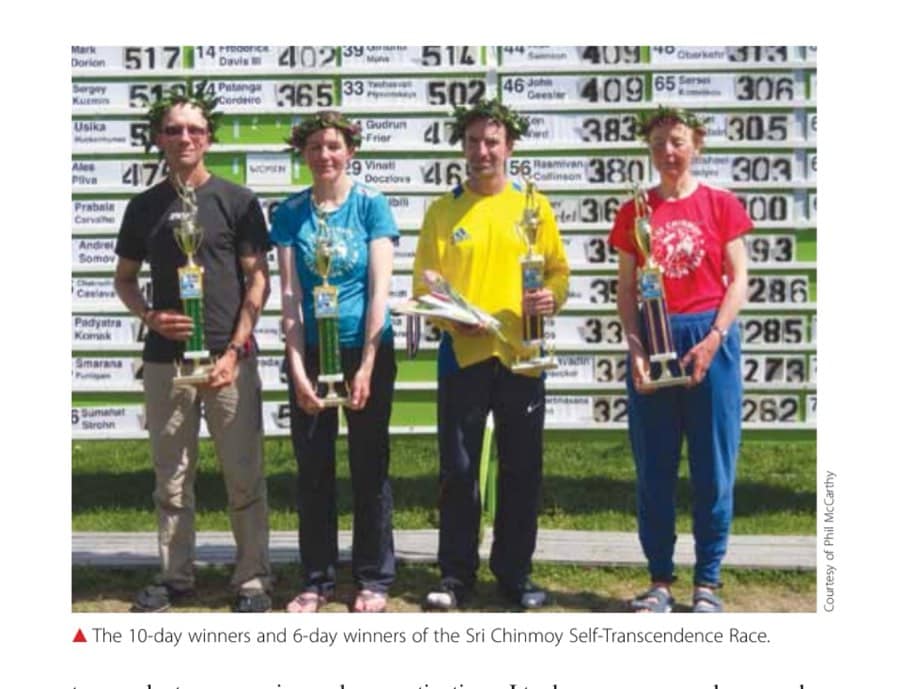
So after several more hours of forward motion, the race was coming to a close. In the end, I won the six-day race with 462 miles, and the great Dipali Cunningham won the women’s six-day race for the 16th straight year. Martin Fryer, my Australian friend, won the men’s 10-day, and Kaneenika Janakova of Slovakia won the women’s 10-day.
I was very proud to have finally met Dipali and had the chance to talk with her periodically during the race, and she very kindly gave me words of encouragement. My proudest moment came at the finish when she came over to congratulate me and told me how I helped pull her through the last day. She is truly one of the alltime greatest ultrarunners in the world and yet one of the most gentle and humble.
Early in the race John Geesler told me that he hoped that he, Alex Swenson, and I would finish one-two-three, and we did, with Alex and John both finishing with 409 miles (Alex took the second spot by reaching the distance first).
Several days after the event, I began to understand how it fit into my running career and my life. Over the previous year, after some bad races, I began
Courtesy of Phil McCarthy
▲
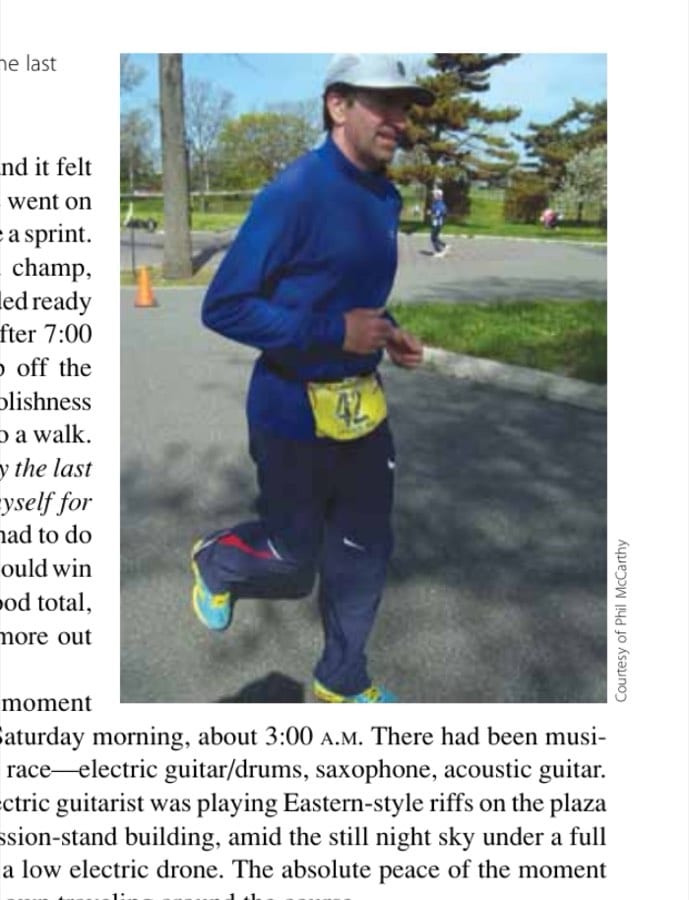
The author running on the last day.
Courtesy of Phil McCarthy
▲ The 10-day winners and 6-day winners of the Sri Chinmoy Self-Transcendence Race.
to reevaluate my running and my motivations. I took a more personal approach, a more philosophical approach, trying to understand how this fit into my own personal fulfillment rather than how this fit into the local or national or world scene or trying to prove to people what I could do.
Support is everything I realized that I had a lot of supporters who wanted me to do well, but I thought I could be a better, positive influence by taking this approach. This article really only touched the surface of the events and my thoughts on the race and the lessons I learned and the people I met. Some things will have to remain my own personal experience.
The “part II” in the title refers to the Febapple 50-mile race in February 2013, which was part I. There I finished a tough race much slower than expected but with as much satisfaction as if I had won and maybe more, because it was a victory in its own way. The Self-Transcendence Six-Day Race was a victory as well because I rediscovered the joy of running, of dissipating stress, of coexistence, of relaxation, of smiling and laughing, of showing a positive image, of learning gratitude.
This article originally appeared in Marathon & Beyond, Vol. 19, No. 4 (2015).
← Browse the full M&B ArchiveMore like this
1,000+ stories from 19 years of Marathon & Beyond
The complete archive of the legendary long-distance journal — digitized and free to read.
