

Tales From The Rogue Valley Runners
The stories I hear range from treks on the Camino de Santiago, a centuriesold pilgrimage route through Europe, to adventures on the Pacific Crest Trail extending from Mexico to Canada. Some are anticipating their first 5K while others are training for Badwater, a 135-mile ultramarathon from Death Valley to Mount Whitney, California.
No one knows quite like a runner what it’s like to get out there on the road, track, or trail as a habit of thought and as a lifestyle. It’s an evolution, after all, one I see daily in the store where I work as I perform gait analyses and fit customers for shoes. I work at Rogue Valley Runners, a running store in Ashland, Oregon, whose owner has won Western States twice.
Some who come in are beginners, and others have been doing it their whole lives, but the connection I see among all of them is that they love what they do. Their enthusiasm is infectious, and their adventures are grand.
People are full of questions: What do you think about barefoot running? How should I train for my first marathon? How often should I switch out my old shoes? What about injuries? How much time should I take off? What do you recommend for plantar fasciitis? New shoes? Inserts? Or a good podiatrist?
It seems almost like a return to childhood, this enthusiasm and this willingness to learn—and, conversely, when injury strikes, the desire to get right back on board after the boat has capsized is unlike any other drive. I’ve felt the same way in my own athletic pursuits, a burning desire to learn and to, therefore, be better. What is this magical realm that seems to bring adults back to the whims of childhood?
The desire to dream. Whether attempting a first 5K, a first marathon, or a first ultra, there is uncharted territory to be explored, an undiscovered country to be found, the thrilling “what if” of the never attempted to be revealed.
In the beginning
Courtesy of Holly Hight
I didn’t start off as a runner, and I was never as inspired before my days logging the miles. I didn’t think we would wind up back in Ashland, Oregon, the place where my husband, Blaine, and I had met and where we had gone to college, the small town we had left looking for bigger adventures in bigger places.
But we had come full circle, from Washington, DC, to Portland and two highstress jobs, then back to Ashland, with its tight-knit community, artsy atmosphere, and slower pace. It’ll be a good place to raise our son, we told ourselves.
I didn’t expect to find even bigger adventures, with a whole community of vibrant and ambitious personalities, epic journeys taking place quietly in the hills above Ashland on the trails that snaked among fir, pine, and hickory trees, all the way from Lithia Park to Mount Ashland’s peak. While we were gone, our little college town had become a hub for ultramarathon running.
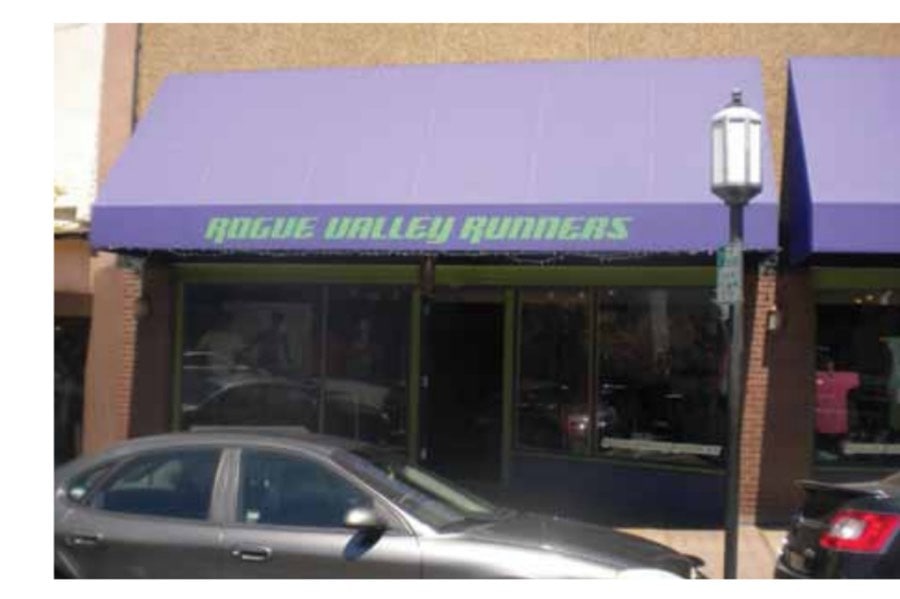
But I didn’t yet know about Ashland’s ultra community until I tried to get a job. I had seen the running store in the plaza as I had driven by it, a purple awning with green letters, Rogue Valley Runners, above the door. I went in and saw a beautifully organized store with a warm ambiance in a historic building. It was laid with dark wood flooring, and the shoe wall was brick, giving it a nearly rustic feel. On the walls were huge pictures taken in Utah, Colorado, and Patagonia of runners in dramatic places, on adventures they would never forget. It was inspiring enough for me to want to work there.
▲ My portal to the ultrarunning community.
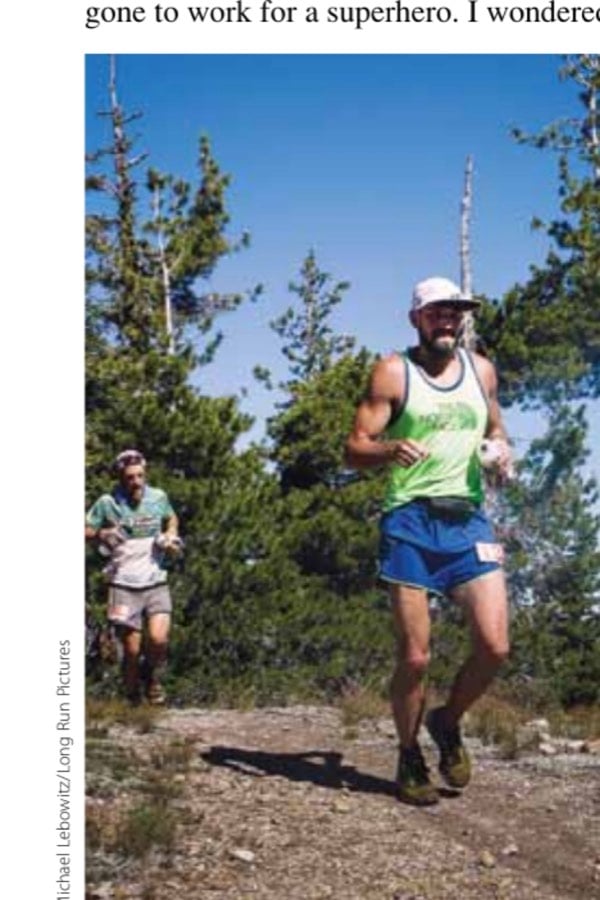
Hal Koerner, owner of Rogue Valley Runners and two-time Western States champion, is also the race director of Ashland’s ultra-challenging 100-miler, Pine to Palm. ▲
© Michael Lebowitz/Long Run Pictures
I dropped off a resume and hoped for the best. “Hal’s always looking,” an employee told me, “especially in the summer, when we’re busy.” I took a card. Hal Koerner, two-time Western States champion, was the owner.
Nearly six months later, I received an e-mail; Hal wanted to meet with me, as he was looking to hire. We met over coffee. I had been nervous before the interview, but Hal immediately put me at ease with a warm welcome and an easy,
laid-back demeanor belying a highly competitive athletic resume. I was a runner but had never done anything longer than a marathon and wasn’t sure just what ultrarunning was. I was about to find out.
The first thing I noticed were the two bronze Western States Cougar Trophies along with those from the Hardrock 100, two gold-plated pans celebrating victories over a 100-mile course with an average elevation of 11,186 feet.
I tried to imagine what it might be like to run 100 miles, four marathons back to back, on hilly terrain, and at altitude. I had done one marathon on a relatively flat course and thought 26.2 miles was the climber’s equivalent of scaling K2.
I imagined K2 multiplied by four; the thought made me wonder if I hadn’t gone to work for a superhero. I wondered what running such epic races was like and thought about how finishing can be taken for
granted. Many are used to shorter races and think more in terms of time than whether they will finish. But finishing some races, regardless of time, can be accomplishments in themselves. Inspiration in a 100-miler has to have
as much stamina as an ultramarathoner’s legs or heart. “I would say my most inspired moments are dur-
ing the times when running is hardest, when I wake up at 5:45 in the a.m. and have to put on my shoes to make the run happen before work, school, or whatever else it is I have to do,” commented Ryan Ghelfi, the 2012 Siskiyou Outback 50-mile champion. “Training to run a great race is easy when all the stars are aligned, but what I think really makes the runner are those times when running sucks but you have to do it anyway because you know what it is that you really want.”
At a recent visit to a cross-country camp, my mantra was: if running does one thing, it’s always asking How bad do you want it? If you love it, you will want it bad, whether it’s one mile or 100. Running is an ancient passion, but only recently has technology come around to the examination of how we’re able to pair each runner’s unique biomechanics and foot shape with the ideal shoe. “
I would say some of the most amazing technology right now [deals] with material science, textile manufacturing, and the ability to customize upper fit to individual foot profiles,” Hal said. “Looking at how hybrid materials are being applied now as compared to the past has allowed companies to increase support while minimizing weight and increasing comfort.”
The gait analysis When we fit customers for shoes, we determine whether they pronate by watching them on a treadmill. Pronation is the body’s way of absorbing shock. When this happens, the foot rolls in as it approaches toe-off. What we look for is how the calcaneus (or heel bone) lines up with the Achilles tendon. If it’s not straight up and down and the foot angles in, the person overpronates, which may increase the risk of injury. “
We aren’t looking at dual density as the de facto standard for pronation control anymore,” Hal said. “There are a lot of amazing and revolutionary things going on in the industry right now. The minimal movement really started a new way of thinking, albeit a drastic one that the companies all chased after, but now we are seeing a gradual move to the center that is going to benefit more people in the long run and really improve running comfort, efficiency, and protection.”
Shin splints and medial ankle or knee pain can be common sites of pain stemming from overpronation. The right fit helps to minimize the chances of injury and make the experience of running more enjoyable. “It’s a very exciting time to be selling shoes and running,” Hal added.
In addition to owning and managing Rogue Valley Runners, Hal is also a race director for three trail runs. One is a 100-miler called Pine to Palm and another, Lithia Loop, which takes place in the hills above Ashland every November, is a marathon. The third, Tar ’n’ Trail, is a shorter, albeit tough, six-mile race on switchbacks overlooking the valley.
“It’s a labor of love,” Hal said of his races and regarding Pine to Palm: “I love the distance, the ultrarunning community, and my region. The race has allowed me to bring all those things together and, although at times it is a very stressful venture, being at the finish line reinforces why I do it.”
Pine to Palm, September 15-16 Blaine and I were assigned to Wagner Butte from 2:00 to 7:00 a.m., mile 80 and one of the larger aid stations on the course. We joined a few other volunteers, and under the bright lights of Coleman lanterns, we flipped grilled cheese sandwiches and cooked chicken noodle and vegetable soup. There were also potato chips, cookies, and candy bars, salty and sweet incentives to keep going. One of the biggest hits of the night was the coffee we had brought up, piping hot and hair-curlingly strong. We passed steaming cups to the tired runners coming in and immediately saw their faces brighten.
Volunteers filled water bottles and CamelBaks and poured paper cups full of GU Brew, water, 7UP, and Coca-Cola. There were chairs and blankets, too. Some people slept for a few minutes, but others grabbed a quick bite and were on the trail again. Some seemed on a high, motivated and gung-ho to get started again for that final 20-mile push, while others were exhausted and discouraged.
From one runner: “You go through a lot of ups and downs. Right now I’m in the basement.” Some pulled off shoes caked with dust and socks stiff with dirt to reveal blisters the size of quarters, while others leaned back in a chair, eyes shut against the dark, complaining of severe nausea. Daniel Newberry, the lead volunteer and coordinator at Wagner Butte, attended to blisters with a first-aid kit, and others offered 7UP to those who were queasy.
It’s an ordeal, I realized, like a birth. I tried to imagine what it might be like to run four marathons back to back on terrain that yielded a 20,000-foot elevation gain and another 20,000-foot loss with three huge climbs to 7,000 feet, what it might be like to stagger out of a chair, barely able to walk, 80 percent of the way home, with 20 miles more to go. And I couldn’t. “
I think I might do this next year,” Blaine said, undaunted. “We could do it together.” “How about I pace you the last 20,” I said—the 20 that might just seem impossible. The 20 when you’ll need someone who is lucid and not as discouraged as you are. Many of the runners had pacers that last fifth. For some, it’s necessary. They need someone helping them, someone talking them through it. I thought again of a birth. I had heard stories. People hallucinated on this course.
I walked up the road from the aid station, and it was inky black. At 3:00 a.m. there was nothing except the crunch of gravel under my feet and a rash of stars
above. It occurred to me how creepy this might be for someone without a pacer, alone on the trail, with miles to the next person ahead or behind. One hundred miles seems like forever in the dark. Then, from around the bend, a light was bobbing. “Runner!” I heard Daniel call. As the runner approached, Daniel asked for his bib number, and there was the familiar refrain from one volunteer as the bedraggled man came in: “What do you need? We’ve got grilled cheese sandwiches, chicken noodle soup, cookies, M&Ms . . .” “
Grilled cheese sounds great,” I heard him say. I dashed over to a plate piled high with sandwiches and handed one to him. He ate ravishingly, having found a chair, a blanket pulled to his chin. So this is ultrarunning, I thought suddenly, that ambiguous thing I knew of vaguely when I had walked into Rogue Valley Runners asking for a job. This was the ultimate test of the human body, mind, and spirit, will in the flesh, grilled cheese and a steaming cup of coffee fueling the determination to go on.
Next year, this could be Blaine, I thought. Maybe we really could do this together. Gradually, it began to get light, twilight revealing a yawning expanse of forested ranges leading toward the coast. Pink light fell on faraway pine stands and I felt a blitz of joy. I could understand the desire to do something extraordinary, not only to run 100 miles on terrain
© Michael Lebowitz/Long Run Pictures
▲
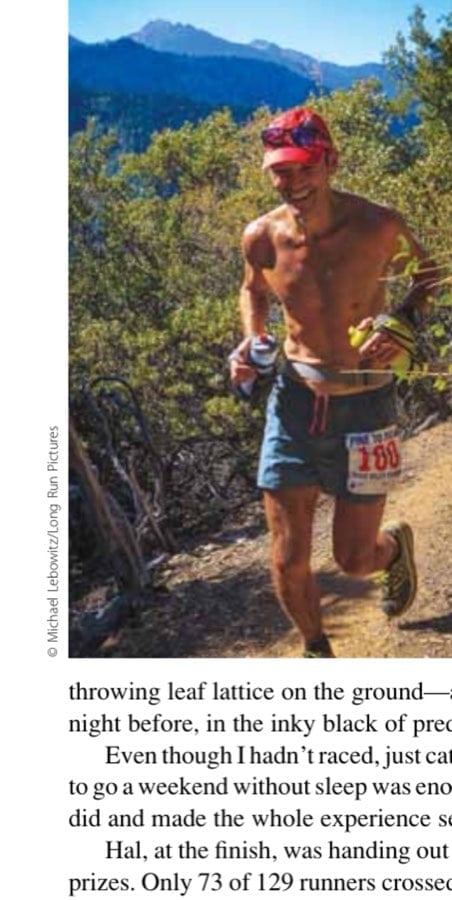
Light at the end of the tunnel at Pine to Palm: a smile on the trail makes anything seem surmountable.
that rose and fell thousands of feet but to do so in a place where one row of mountains stood formidably against another and another. No wonder athletes desire to pit their spirits against it. To do so is the
ultimate challenge and a supreme accomplishment. The finish line was in a familiar place, near the tennis courts in Lithia Park. After a three-hour nap, Blaine and I made our way to a shady spot with a good view
of the line. We watched as runners came in, 33-plus hours after the start of their races. Exhaustion mixed with elation was the order of the day. The sun was bright overhead, throwing leaf lattice on the ground—a far cry from where all of us had been the
night before, in the inky black of predawn. Even though I hadn’t raced, just catching a glimpse of the doggedness required to go a weekend without sleep was enough for me to appreciate what these athletes
did and made the whole experience seem a little surreal. Hal, at the finish, was handing out awards as people hobbled up to claim their prizes. Only 73 of 129 runners crossed the line in time, beating a 34-hour cut-off. “
This was our third year, and although I never thought we would amass the numbers we have at this event, it has also made me realize just how much ultra trail running has changed over the past 15 years,” Hal said later. “We have a very
diverse field, and that has thrust me into an even more important role as a race director.” No longer was “ultrarunning” a vague term to me. I had seen it, met it, face to face. If I didn’t run it, I would pace it, and if I didn’t pace it, I would volunteer
next year. This I knew. This new adventure has inspired me, yet again, to dream, to step into that magical realm that brings adults mysteriously and miraculously back to the whims of childhood. It did for Blaine: “I have a year to train,” he said. “I’ll do my first three miles tomorrow.”
Twenty-Six Point Two BY DOUG JORDAN
The gun goes off, and so do you. The air is filled with cheers! Now begins adventure true, A memory for years.
You carry on because you must. To stop would court defeat, In spite of legs that cannot thrust And feet sunk in concrete.
The first few miles you feel so grand – Did I go out too fast? More likely it’s the training planned, The payoff come at last.
Plod on to twenty-four point eight; Pre-London, you’d be through. But distance grew by king’s dictate: Still one point four to do.
Next thing you know, you’re halfway there, But trouble you can’t cheat; All was fine, then you’re aware Of blisters on your feet.
There’s little difference now between Your legs and leaden weight, And even though it can’t be seen, To suffer is your fate.
The next mile marker is sixteen; Fatigue begins to grow. You’re clearly now beyond routine, But the pain is still “sotto.”
Your gaze upon the finish fixed, Thank God, the pain is done. Triumph and exhaustion mixed – When next begins such fun?
The distance cannot be defied, So breach the wall or quit. Get past twenty, or be denied, And then be forced to sit.
This article originally appeared in Marathon & Beyond, Vol. 17, No. 5 (2013).
← Browse the full M&B ArchiveMore like this
1,000+ stories from 19 years of Marathon & Beyond
The complete archive of the legendary long-distance journal — digitized and free to read.
