

The 1968 Olympic Marathon Trials
Over the years, as I have returned to run again the marathons of my youth, I find myself feeling more and more out of place, a dodo of sorts from a bygone era. Looking around at my fellow runners eagerly awaiting the starter’s gun, seeing their color-coordinated outfits, hydration packs, and those ubiquitous packets of GU, I feel strangely old. I find myself longing for the simple camaraderie of those who just love to run long distances. But there was another time, a time when I didn’t feel old, when, as I toed a starting line one August afternoon in 1968, I knew I was in the presence of greatness. I had no business being there, really. I was undertrained, inexperienced, a real novice—as they say, “a rank amateur.” Even now I find what I did that summer a little hard to believe.
You might say that I have been enamored with the mystique of the marathon ever since my third-grade teacher, Mrs. Coffey, read us a story about a Boston Marathon runner who was asked to become a courier for a dangerous wartime mission in an attempt to save his unit trapped behind enemy lines.
In school I was pretty much a chubby, nonathletic kid. Running hurt. I had no interest in running—that is, until I watched the 1964 Tokyo Olympics on the black-and-white TV set in our living room. Something about the track events inexplicably inspired me. Maybe it was watching Billy Mills win the 10,000 meters. I don’t know, but a few days later I was impulsively signing up for our high school’s cross-country team. I was in 11th grade. Little did I know then that four years later I would be in Alamosa, Colorado, actually toeing the line with one of the very runners I had watched on TV, waiting to take part in the very first U.S. Olympic Marathon Trials.
Between my sophomore and junior years at Penn State, I decided to take a summer job working for the Philmont Scout Ranch in Cimarron, New Mexico, as a program counselor. I was assigned to French Henry Camp in the northern part of the ranch, where my job was to teach the area’s gold-mining history to scout groups hiking through on their way to summit Baldy Mountain. I was a geology
major and the grandson of an underground zinc/lead miner, so it was the perfect job. I lived with three other guys in an abandoned miner’s cabin at 9,600 feet. When my cabin mates learned of my interest in running, they informed me that Bill Lamb, director of nearby Miranda Camp, was getting a group together to represent Philmont in the upcoming Pikes Peak Marathon later that summer. Right then and there I knew that I had to meet this Bill Lamb and become a part of that group. When Bill and I finally did get to sit down and talk running, he showed me the information he had brought with him from his home in Sepulveda, California. This included a new upstart running magazine called Distance Running News (DRN), later to become Runner’s World, various issues of Track & Field News, and an interesting running-shoe catalog from a newly formed company in Santa Monica, California, called Blue Ribbon Sports, later to become Nike. I promptly wrote off for my own BRS catalog and DRN subscription.
Setting things right Initially that summer, my training, if you could call it that, consisted of working all day, eating supper, and then after cleaning up the dishes going out for short one- to two-mile runs just before dark, always on a full stomach. Occasionally I would be able to get in a slightly longer run on days off. All my running was done on old abandoned mining roads high up in the mountains. By early July, I had developed a rather painful knee. I could hardly run at all without limping. For several weeks I was forced to just walk. As the knee problem, most likely patellar tendinitis, slowly improved, I attempted to resume more normal running. On July 19, my Blue Ribbon Sports catalog arrived. I eagerly thumbed through it, being most impressed with the shoes made by a company I had never heard of before, adidas. At the time I was running in a worn-out pair of Spaulding cross-country flats that were on the verge of falling apart, maybe the source of my knee problem. Bill, however, owned a pair of great-looking shoes called Olympiades that were made by this adidas company. I was sold. I didn’t exactly like the black stripes on Bill’s shoes, but the catalog offered another adidas model called the “Italia.” It was made from soft kangaroo leather and had the three adidas-trademark stripes in green. The shoes even came with green soles. I immediately mailed off my order to Santa Monica, not knowing if the shoes would get to me in time or if they would even fit. Anyway, the shoes did arrive in time, literally two days before the Pikes Peak Marathon, and they did fit. Regrettably, though, I never had time to properly break them in before the race.
In late July, before my new shoes arrived, I got this crazy idea that I needed to do a really, really long run before Pikes Peak to see if I was up to the challenge of completing a full marathon. I mapped out a 23-mile trail run over the northern section of the Philmont. Then, seven days before Pikes Peak, I set out
in my taped-together cross-country flats to run the entire route, having no access to any known water source. This was long before the days of CamelBaks or Ultimate Direction hydration packs. By the time I made it back to our cabin at the end of the day, the sole of one of my shoes had ripped loose. I had completely worn through my white adhesive-tape patch job! Six days later, two carloads of runners from Philmont were headed north to Manitou Springs. I was about to run in my very first marathon.
Early Sunday morning, August 4, we gathered at the Manitou Springs police headquarters to check in and get our bib numbers. There was a problem with one of our runner’s registration paperwork, and we ended up getting delayed. By the time we drove up to the starting line in front of the Cog Railway Depot, the race had already begun. Car doors flew open and we headed off up the mountain, having no idea who any of the other runners were in the race. I didn’t learn until years later, while searching through Matt Carpenter’s wonderful database, that three of the Pikes Peak runners that day had come up from the Alamosa Olympic training program specifically to run in the race, just two weeks before they were planning to compete in the Alamosa Marathon trials. One of the three was none other than 1968 Boston Marathon winner Amby Burfoot!
Plans for Alamosa I’m not sure if it was before or after Pikes Peak that Bill and I got the idea to drive up to Alamosa for the Olympic Marathon Trials. Bill had read about the event in one of his spring issues of Track & Field News. We knew that we had already missed the official deadline for entering but thought it would be fun to just watch the race and maybe photograph some of America’s best marathoners in action. And, just in case, we brought along our running gear anyway.
On Saturday, August 17, the day before the Trials, we made the scenic drive north from Cimarron to Alamosa, stopping briefly at the Great Sand Dunes National Park to drop off a fellow Philmont staff member who was planning to summit Blanca Peak the next day. We then headed west toward Alamosa. Coming into town, we noticed some people on the street who looked like runners. We stopped and asked them where we could go to find out about registering for the marathon. They directed us to Plachy Hall on the campus of Adams State College. (This happened to be a newly constructed athletic field house, built in 1965 for $1.6 million, and named for one of ASC’s most honored presidents, Fred Plachy.) We were able to locate Joe Vigil, one of the codirectors for the marathon trials. Coach Vigil took one look at us, and after we told him what we wanted, he practically laughed in our face and said, “If you were marathon runners you would have known about the registration deadline.” In a way he was right, but we still pleaded that our only available source was April’s Track & Field News,
which said that the race was open to anyone. Coach Vigil went on to say, “It’s impossible for you to get into the race now. I’ve been planning for this race for the last four years, and no late entries are going to screw it up. The only way you could possibly get in is to clear it with the Olympic Committee.” He then informed us that the Olympic Committee would not be arriving in Alamosa until Sunday, the day of the race, so we left and went back into town rather dejected. Little did we know that another last-minute runner was attempting to enter the race the same day that we were, an unknown collegiate runner from Yale by the name of Frank Shorter!
Having plenty of time on our hands that evening we decided to take in a movie, The Odd Couple. We bought our tickets and went inside. The movie hadn’t started yet, and seeing all the people around us wearing their running shoes was driving us up the walls with jealousy. These guys were going to run Sunday, and we weren’t. Finally I broke down and told Bill that I wanted to go back out to the car and get my adidas Italias. So we left the movie theater, got our running shoes out of the trunk of Bill’s car, and changed into them right there on Main Street. Then we went back in and enjoyed the movie, feeling a little more a part of everything that was happening around us. After the movie Bill and I drove back to the ASC campus where we spent the night in our sleeping bags on the floor of a dormitory lounge.
Prior to the Alamosa trials, the U.S. Olympic Committee had held six regional qualifying marathon trials. The winners of these six races plus the next 14 overall fastest finishing times were offered an all-expense-paid opportunity to train in Alamosa for the month leading up to the Trials. The runners ended up being housed in an ASC dorm. In fact, it was one of those runners who suggested that we camp out in the lounge for the night, as we had made no other arrangements for a place to stay while in Alamosa. I remember thinking to myself at the time that I had never seen so many people in one place walking around in “track shoes.”
Help from a real Buddy Sunday morning, after cleaning up, we went downtown to a restaurant for breakfast and then immediately headed back to Plachy Hall for our second attempt at getting into the race. Fortunately for us, this time we were allowed to speak with Buddy Edelen, the other codirector for the Trials. At the time I had no idea who Buddy was other than that he had been on the 1964 U.S. Olympic team and had been the first American marathoner to finish in Tokyo that year. What a contrast Buddy was to Coach Vigil. The day before, Coach Vigil was as intimidating as a Marine Corps drill sergeant. Buddy, on the other hand, was warm, welcoming, and friendly. You could immediately sense that he was very sympathetic and genuinely wanted to help us out. It wasn’t until reading through some old newspaper
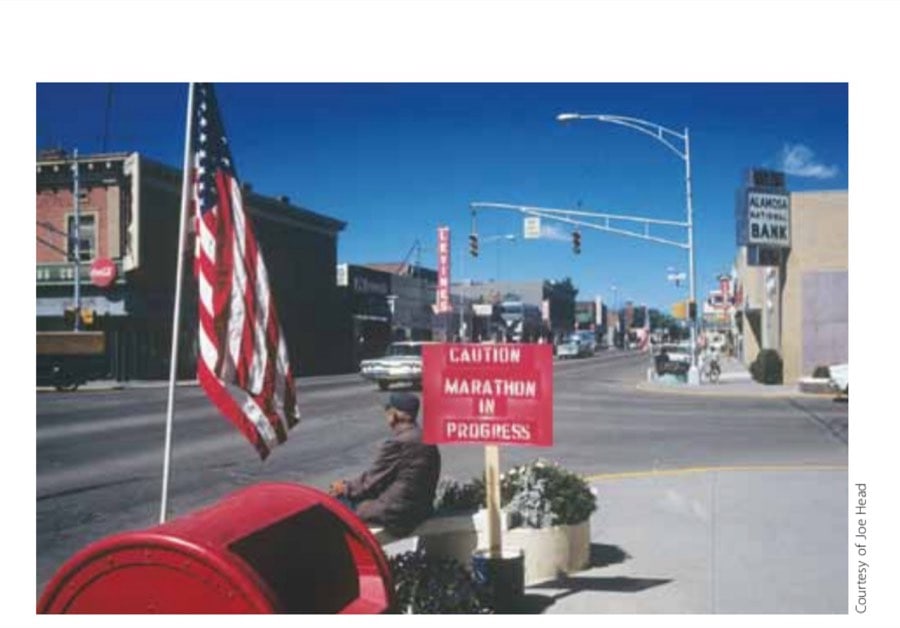
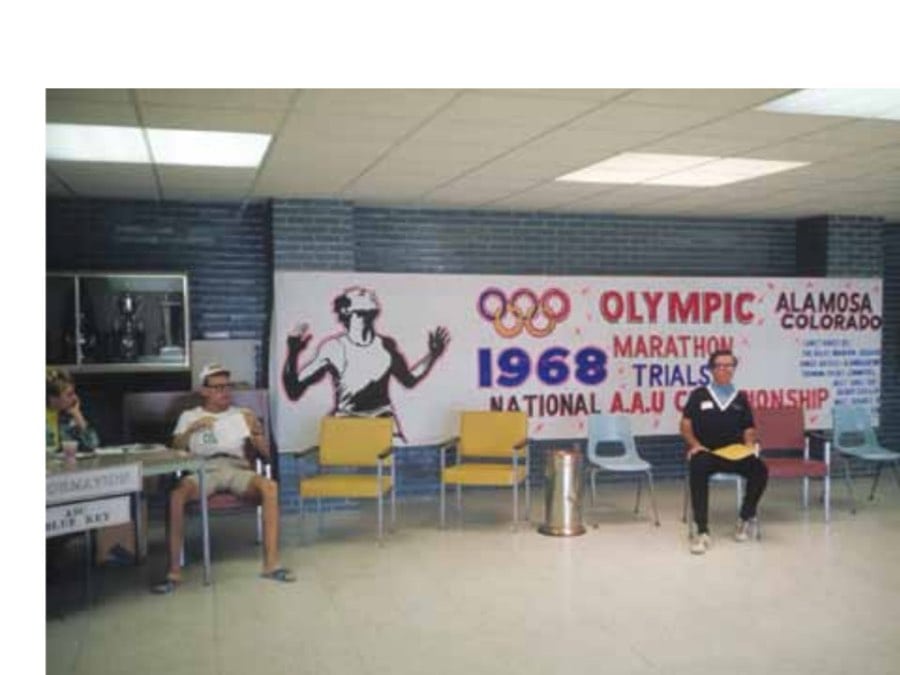
Courtesy of Joe Head
clippings years later that I caught a glimpse of Buddy’s heart toward runners. In an article discussing the second annual Alamosa Olympic Training Project Committee Marathon held September 3, 1967, it mentioned that “Buddy Edelen announced that entries will be accepted right up to the last moment, which is envisioned to be September 3, 9:00 a.m.” The race, by the way, started at 10:00 a.m. that day!
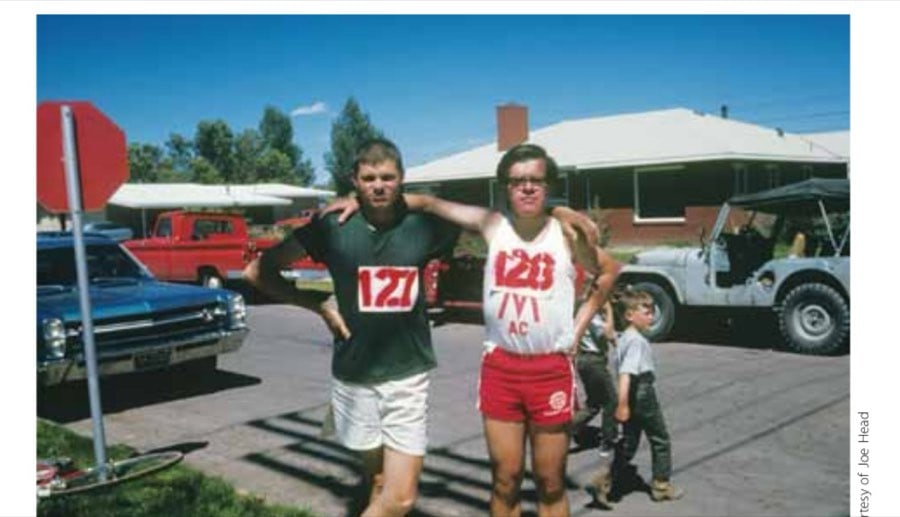
Buddy told us to get physicals (I basically remember just being weighed) and bib numbers and then wait for final clearance. The doctors and registration people turned out to be just as friendly as Buddy. A Japanese student helping with registration showed us around the field house. Everywhere there were pictures on the walls of Jim Ryun and other running greats being put through high-altitude exercise-physiology experiments. Then we waited, and waited, and waited. I never remember ever being told that we had been given final clearance. I do remember that Bill and I eventually drove over to where the race was to start and needed to park several blocks away. We asked a pretty girl who was one of the spectators nearby to snap our picture. Bill looked like a runner, wearing his Mill Valley Athletic Club singlet and shorts. I looked more like your local jogger. Our bib numbers were stenciled in red on large pieces of white oilcloth. My number was 127, Bill’s 128. Newspaper articles published before race day mention 130 registered runners. Apparently, we were given the bib numbers of previously registered runners who never showed up.
Anyway, we then walked over to the starting line at the corner of First Street and Richardson Avenue. I’ve always had a thing about starting lines, maybe a
▲ Joe Head (127) and Bill Lamb (128) shortly before the start of the race.
philosophy. Everyone’s a little nervous, checking each other out. I remember reading once that when Abebe Bikila ran in the 1960 Rome Olympics marathon, he did not know any of his competitors. His coach had to tell him to be on the lookout for the runner wearing bib number 26, Rhadi ben Abdesselam of Morocco, as he was expected to be Bikila’s main competition. Rhadi, for some reason, that day decided to wear his white track and field event bib with the number 185 on it instead of the usual black marathon bib. Bikila ran the last 14 miles in a duel with the very runner he was looking for, yet without knowing it. In a sense I was a little like Abebe Bikila that day. I really didn’t know any of the runners milling around the starting line. Because of the few Track & Field News issues I had read over the summer as a result of my friendship with Bill, I did at least recognize George Young when a car pulled up and dropped him off at the starting line. He was lean and muscular with a flattop haircut that made you think he was in the military. And I realized at one point that I was standing right next to Bob Deines, wearing his black Occidental College running outfit.
At home among the giants of the sport What I didn’t know at the time was that I was also standing around with the likes of Olympic gold medalist Billy Mills, John “The Younger” Kelley, 1968 Boston Marathon winner Amby Burfoot, future Olympic Marathon gold medalist Frank Shorter, and famed writer-to-be Hal Higdon, all of us waiting for the start of the very first Olympic Marathon Trials. I did sense, though, that I was in the presence of greatness and was thrilled to be a part of it.
Yet with all this I still couldn’t believe that I was actually in the race until the gun sounded. Then I knew that Bill and I were guaranteed the T-shirts given to each entrant. Apparently, two of the final no-show runners who had previously registered never claimed their shirts. We got them instead. They weren’t your typical finisher’s shirt, just a gray short-sleeve T-shirt with red lettering that read: “Alamosa 1968 Olympic Development-Training Site.”
While we waited for the start of the race, I found myself looking around to see what other runners were wearing. I remember seeing that a number of runners had on Pumas, the shoe George Young won the marathon in, and adidas. There was the occasional New Balance Trackster, which looked more like a dress shoe for Pat Boone than a running shoe, and then there were the popular blue-and-white Onitsuka Tiger Marathon flats (Kenny Moore took second place wearing these). Of the 130 officially registered runners, postrace news articles mention that 113 runners actually started that day, with only 63 finishing the race.
It may be hard to believe, but the race started with a parade leading off in front of the runners. When the starting gun finally did sound, I immediately became aware of the international pace as guys went flying by me. Before the race, Bill
and I had decided that our goal would be to simply finish in under four hours. Bill reminded me that that meant needing to average only a little over nine minutes a mile. Well, when the announcer called out our first mile split, my time was around 6:45! Needless to say, by mile 12 I was burned out and walking.
Unlike me, Ron Daws, who placed third in the Trials, did not let himself get caught up in the excitement of the moment. Years later he would write, “One of the earliest lessons I learned was the value of even pace . . . Before the 1968 Olympic Marathon Trials at high altitude, everyone discussed even-paced running. Through a special workout, I made sure I knew pace and kept my head when the race was on while everyone else either took off like it was the 1848 Gold Rush or dawdled so during the early stages that catching up felt like the gun lap of a mile.” To keep from running too fast at the start, Ron had devised a workout routine during his time in Alamosa where he would run the first mile of the course 10 times, at race pace. He would run this over and over until each time he was within one or two seconds of his 5:45 goal pace.
Race-day weather was somewhat warm and windy, with the high reaching almost 74 degrees and winds averaging around 13 miles per hour. The temperature at the Alamosa airport when the race began at 3:00 p.m. was 59 degrees with winds out of the southwest at 8 mph. By the time the top three finishers were coming in, the temperature had risen to 68 degrees and the wind had picked up and was out of the south at 17 mph. Skies were clear with visibility at 50 miles. Blanca Peak, rising 14,345 feet to the northeast, was clearly visible 27 miles away.
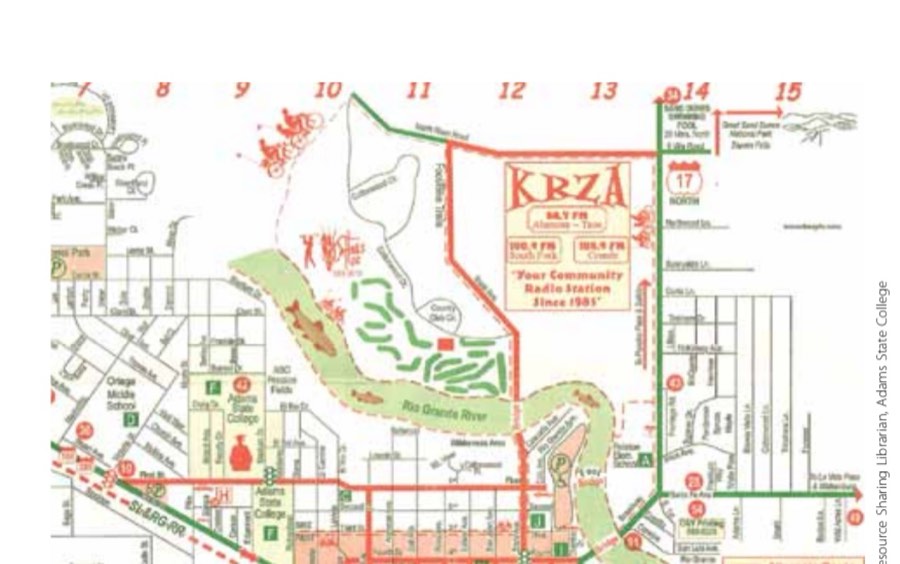
Regarding the course The marathon course consisted of five 5.2-mile loops followed by a short run back onto the campus of Adams State College. The finish line was on Stadium Drive near the tennis courts and Plachy Hall. It was most likely identical to the marathon course used for the “1st Alamosa International Marathon” (August 8, 1966) and the “2nd Annual AOTPC Marathon” (September 3, 1967). A newspaper article describing the 1967 event mentions that “race official Buddy Edelen had authenticated the course.” Buddy’s son, Brent, would say in a phone conversation years later that he thought it was his dad who had laid out the original course used for the 1968 Olympic Marathon Trials. The course was almost perfectly flat. Ron Daws described the San Luis Valley topography as “the same as an ironing board.” There was, however, one “hill”—a bridge, really, over the Rio Grande River. The Colorado Department of Transportation officially lists it as bridge O-13-B. Built in 1966, it crested at an elevation of 7,550.89 feet, 11 to 12 feet above the normally flat roadbed, producing a small hill with 4- to 5-degree slopes on either side. By the time you were finishing your fifth loop, it seemed like a veritable mountain.
Courtesy of Mary Walsh, Resource Sharing Librarian, Adams State College
▲ Current Alamosa street map.
From the starting line we ran down the northern side of Alamosa along First Street and then turned left and headed north out of town on State Street. This took us over our first bridge, a flat truss bridge that crossed the Rio Grande near the nine-hole Alamosa County Golf Course, now the 18-hole Cattails Golf Club. In his book The Self-Made Olympian, Ron Daws mentions remembering the giant sprinklers feeding the golf course and the swarms of mosquitoes over the road. I don’t remember any of that. Of course, there was a lot that didn’t really stand out to me as I ran loop after loop out in the middle of nowhere. State Street came to a dead end at the North River Road. There we turned right and headed east until we reached the intersection of Colorado State Highway 17. Here we turned right again and headed south, into the wind, back into town. Basically, the only spectators you encountered during the race were the ones in Alamosa that you would get to see briefly once every five miles. Otherwise you were by yourself. I don’t remember seeing any buildings once out of town, just flat, dry agricultural land. There were two aid stations located about 2.5 miles apart, with friendly volunteers offering encouragement. And making the racecourse possibly a little safer was a paved foot/bike trail that paralleled the roads, making up the major portion of the racecourse. Runners were directed onto this bike path whenever present. As
Courtesy of Joe Head
▲ One of the signs used to create a safe running lane along the north side of Main Street.
we rounded our first 5.2-mile loop, a loudspeaker blared out our name and team, which for me was PSU (Penn State). I remember at the time what a boost that was to my ego. At the same time you got to wave to the marathon queen, ASC graduate student Chris Pallett of Hyattsville, Maryland, and her court, Ellen Moranville of Arvada, Colorado, and Marian Morris, of Alamosa, and in return receive a lot of encouraging smiles from some lovely college girls. Yes, this was not your typical marathon. I don’t think I’ve run in another marathon that included a royal court chosen ahead of time especially for the occasion.
Gatorade? What’s that? Before the start of the race, it was announced that runners could begin making use of the aid stations after completing the first five-mile loop. Along with water sponges, three different drinks would be available: water, iced tea, and for the very first time in a USOC-sanctioned event, Gatorade. First developed at the University of Florida in the fall of 1965, Gatorade had only recently become available to the general public when the Stokely-Van Camp Corporation took over commercial production in 1967. Its use was met with mixed reactions by the runners who had just been introduced to it a few days before. Ron Daws tried it 20 miles into his last long training run before the race. He commented that “the drink proved palatable and refreshing” but was concerned about it seeming “too thick.” During the marathon, without any forethought, he ended up drinking it
every third aid station and tolerating it quite well. Another runner, Bill Gookin, however, was not so fortunate. He had tried Gatorade for the first time the night before the Trials and then decided to drink it at the first aid station, 5.2 miles into the race. He got sick and ran the next two loops “bent over double” with stomach cramps, eventually finishing 30th in 2:58. Later, using his background as a biochemist, he analyzed Gatorade and then went on to formulate his own product, which he initially called “Gookinaid.” Later he changed the name to the more familiar “E.R.G.” (Electrolyte Replacement with Glucose). These days Gookin’s formulation is known as “Hydralyte.” Somehow, I don’t think Gatorade is worried about losing its share of the replacement-drink market to this spinoff product any time soon.
Initially my buddy Bill and I ran together until it became obvious to me that I could not keep up. I encouraged him to go on ahead and then settled into a more realistic pace. By this time we were into our third loop. Most of the time I ran simply staring at the pavement just in front of my feet, oblivious of my surroundings, unaware of the competitive battles being waged around me. There really wasn’t much to look at anyway. I could always tell, though, by how loudly a runner’s feet were hitting the pavement behind me if I was simply being passed by another slow runner or if I was being lapped. There’s nothing quite like being lapped during a marathon, knowing that the guy passing you is over five miles ahead of you in the race. I got lapped by a lot of famous runners that day! As previously mentioned, somewhere around the 12- to 13-mile mark, I had to start walking. I had taken off much too fast at the beginning of the race and had rather thoroughly depleted my glycogen stores. I remember walking for miles until just outside of Alamosa and then out of pride starting to run again until I could get through town.
Eventually, I was able to settle back into a slow jog for the remainder of the marathon. It never occurred to me to quit, or to want to drop out of the race. Near the end of my last loop, I caught sight of a discarded white painter’s cap lying alongside the road. I picked it up and put it on. I had noticed at the beginning of the race how many of the runners were wearing these. In fact, in the classic Valley Courier news photo taken by sports editor Larry Lopez, you see seven runners rounding the corner after completing their second 5.2-mile loop. Five of the seven are wearing white painter’s caps and four can be seen wearing those ever-popular blue-and-white Tiger Marathon flats! The sun was setting, and it was almost dark when I finally crossed the finish line, 4 hours and 40 minutes after starting. There were no cheering crowds to meet me, no one to give me an official time, only my running buddy, Bill Lamb, who had thoughtfully grabbed my Nikon camera ahead of time so that he could take my picture as I finished. At the time, I assumed that I was the very last runner to come in. Years later I would learn that there was at least one other runner who finished after me, a William Daughtry of Los Angeles.
![William Clark-led group shown beginning their third 5.2-mile loop. Left to right: Capt. William Clark, USMC, [hidden behind him is Frank Shorter whose one leg can be seen], unknown runner, Amby Burfoot (85), George Husuark (51) of Montebello, California, and Tom Heinonen (42) of Minneapolis.](https://marathonhandbook.com/wp-content/uploads/906909_fig4.jpg "The 1968 Olympic Marathon Trials 15")
© Larry Lopez, Valley Courier
▲ William Clark-led group shown beginning their third 5.2-mile loop. Left to right: Capt. William Clark, USMC, [hidden behind him is Frank Shorter whose one leg can be seen], unknown runner, Amby Burfoot (85), George Husuark (51) of Montebello, California, and Tom Heinonen (42) of Minneapolis.
On his drive out to Colorado, he had had car trouble and had been scalded by hot radiator fluid. He decided to run the race despite his burns. He crossed the finish line at 9:10 p.m. during the awards ceremony.
After the running is over It was 7:40 p.m. by the time I finished. The awards banquet was to start at 8:00 p.m. After researchers had recorded my postrace weight, I quickly showered and headed over to the ASC cafeteria with Bill. It was quite a heady experience, sitting there at the long tables with other runners, listening to all the proceedings. What I remember most though was being somewhat taken aback by news that the race winner, George Young, was actually thinking of not running the marathon in Mexico City. In my naivete, I could not understand why he wouldn’t want to, having just come in first in the Trials. (In addition to winning an Olympic bronze medal in the steeplechase, George did go on to run the marathon, finishing 16th.)
Courtesy of Joe Head
▲ My running buddy, Bill Lamb (right), in the Plachy Field House foyer waiting for me to shower up before the awards banquet. The runner on the left is Tom Heinonen, who went on to become head women’s cross-country and track coach at the University of Oregon.
And I remember thinking it strange that one of the three finalists, Kenny Moore, did not even stick around long enough to be recognized at the awards banquet. Bill and I rather unceremoniously left Alamosa later that evening for the long drive back to Cimarron in the dark. All in all, it had been an experience to remember. It’s not every day that you can say you finished a marathon with a DNF list that included the likes of Billy Mills, John “The Younger” Kelley, Amby Burfoot, Frank Shorter, and Hal Higdon! I could not have imagined a more memorable way to end my summer on the Philmont Scout Ranch staff.
Afterword Regrettably, like most runners I suppose, I rarely, if ever, have given any thought to all the behind-the-scenes effort that goes into putting on the race that I’ve entered. This was certainly true that day in Alamosa. However, the first Olympic Marathon Trials were unique. As I have spent time researching this race that I ran in so many years ago, I have discovered a human side to the event that I was completely unaware of. Everything started, so to speak, as a direct result of local Alamosa attorney Whitford Myers’s insomnia. Apparently unable to sleep one night, Whit Myers started reading through his March 1964 issue of Amateur
Athlete, an AAU publication. It had been only five months since the October 1963 meeting in Baden-Baden, West Germany, where the International Olympic Committee decided to award Mexico City the 1968 Summer Olympic Games. One particular article, “Indisposition after Running” by Dr. Ernst Jokl, caught Myers’s eye. In a caption under one of the article’s illustrations he read, “However, it is essential for athletes residing at sea level to train at altitudes of 7,000 feet or above for at least three months prior to competitions held at such elevations, e.g., for ski races at Aspen, Colorado, or for the track, rowing, swimming, and cycling events scheduled for the 1968 Olympic Games in Mexico City.” Two or three weeks later, Myers met with other Alamosa businessmen at the San Luis Valley Judo Club to discuss Jokl’s article. Their brainstorming resulted in the creation of the Alamosa Olympic Training Project Committee (AOTPC). They then presented their ideas for the AOTPC to the faculty and president of Adams State College for approval.
Thus began a local effort that would extend over the next four years to bring an Olympic training program to Alamosa. Next, help was sought at the state level. In February 1965, Colorado Governor John A. Love signed a bill creating a “1968 Olympic Training Commission,” carrying with it an appropriation of $16,658, the goal being to bolster a drive to induce the U.S. Olympic team to train at Adams State College before the 1968 games in Mexico City.
That same month, Alamosa hosted an AOTPC “Kick Off” banquet at Adams State College in an effort to attract donations and volunteers. One week later, Alamosa’s local paper, the Valley Courier, announced that Leonard “Buddy” Edelen, “America’s best hope for bringing home the first Olympic Marathon win since 1908,” had enrolled at Adams State College as a graduate student in education and psychology and would begin his studies in the fall. Edelen was coming to ASC at the recommendation of his coach, Fred Wilt, a former Olympian himself, specifically to train at high altitude for a year “to see how tough it was and how necessary it is if you hope to do well at Mexico City.”
About this same time, ASC alumnus Joe Vigil (1953, 1959) joined the ASC coaching staff. (He would go on to coach at ASC for 29 years and have 19 national championship cross-country teams, the first coming just three years after the 1968 Olympic Marathon Trials.)
The summer after the IOC’s announcement to hold the 1968 Summer Olympic Games in Mexico City, exercise physiology researcher Dr. Bruno Balke and Jack Daniels, a silver and bronze Olympic medalist in the modern pentathlon, conducted high-altitude research in northern New Mexico. Reflecting back on this years later, Dr. Daniels wrote, “As soon as the Mexico City Olympics were announced, Balke went to the U.S. Olympic Committee and in his not-so-politically-correct style said to them, ‘We shouldn’t be coming to you asking for support to do research at altitude; you should be coming to us to offer financial support for our research.’
Needless to say, we received no support but we went to Red River, New Mexico, for our first study.” Alamosa ended up becoming one of the first sites for extensive tests on highaltitude performance when Dr. John Faulkner of the University of Michigan, in August 1965, spent nearly a month there. In 1966 Dr. Elsworth Buskirk of the Penn State Noll Laboratory for Human Performance became involved in cooperative high-altitude research studies in Alamosa along with Faulkner and Balke. Dr. Balke headed up this collaborative effort. When Jack Daniels transferred to the University of Wisconsin in 1967 to continue his doctoral studies under Dr. Balke, he spent the summer in Alamosa conducting high-altitude physiology experiments on elite runners: Jim Ryun, Conrad Nightingale, Chris McCubbins, and Tom Von Ruden. Daniels was later named an altitude consultant to the U.S. Olympic Track and Field team. He ended up doing his doctoral-dissertation research on 26 of the Olympic Trials subjects during their training in the summer of 1968. Dr. Daniels said years later that there was “no doubt in my mind that Balke was the main factor in trying to get things organized in terms of research, but I am pretty certain I did more altitude research than any other Americans.” It was Daniels who spoke out in favor of Alamosa being chosen as an Olympic training site, stating in Track & Field News that it was the “most like Mexico City” regarding climate of the six places he had done testing in so far.
ad
All this was going on at a time when there was much confusion regarding the effects of altitude on performing athletes. Jack Daniels tried unsuccessfully to get the powers at USA Track & Field to hold races at altitude, not just have athletes train at altitude. And then there was the IOC putting out its “Circular Letters” informing countries that Olympic teams were not allowed to train at altitude for more than six weeks in the year leading up to the Games. And no more than four of those weeks could be in the three months just before the opening ceremonies. All this was presented in the interest of “good sportsmanship” and “to achieve fairness as far as possible between competitors . . .” However, no such restrictions were put on athletes “who usually live or train at such heights . . .” The summer of 1968 was also a time of racial tension, especially sensed at Echo Summit’s “ethereal” track and field location. It is interesting to note that after the black-power salute protest in Mexico City by American sprinters Tommie Smith and John Carlos, it would be marathoners Ron Daws and Kenny Moore, along with Olympic race walker Tom Dooley, who would help stack the sacks of hate mail that began arriving the very next day. The late John J. Kelley, in recalling his own experience at the Alamosa Trials, mentions that Coach Joe Vigil was “basically operating on no budget.” When Kelley came down for the Trials, he brought with him an envelope containing several hundred dollars from a hometown fund-raiser on his behalf. Kelley noted that in those days runners worried about losing their Olympic eligibility over anything that might suggest professional payment. He therefore handed the envelope over to Coach Vigil, who in turn used the money to buy prizes for the winners. Finally, if there is one person who should be most identified with the 1968 Alamosa Olympic Marathon Trials, it should be the late Buddy Edelen. The Trials would probably never have been held in Alamosa were it not for him, yet his name is all but forgotten among today’s marathon runners. Buddy was the first American to break 30:00 minutes for the 10,000-meter run, he was the first American to break 2:20 for the marathon, and he was the first American in nearly 40 years to hold the world record for the marathon. Hal Higdon, who introduced Buddy to his first road race (the Holiday 10, along Chicago’s lakefront), would describe Buddy as “America’s best marathoner during the years between Clarence DeMar and Frank Shorter.” Buddy came to Alamosa planning to train for the 1968 Olympic Marathon Trials, not help organize them. When persisting sciatica ended any hope of that, he willingly stepped into that often thankless role of a race promoter and director, and was genuinely happy to see others getting to run in his race. I can only imagine how he must have felt the day of the Trials, seeing the rest of us line up to start the race, knowing that we were standing where he wished he could be.
My road to Alamosa will in a way always begin and end with Buddy Edelen.
This article originally appeared in Marathon & Beyond, Vol. 19, No. 6 (2015).
← Browse the full M&B ArchiveMore like this
1,000+ stories from 19 years of Marathon & Beyond
The complete archive of the legendary long-distance journal — digitized and free to read.
