

The Art of the Ultramarathoner
Sharpening Training
The training pattern described above is frequently referred to as base training. Base training differs from the present consideration, sharpening training, in that there is little emphasis on the development of speed that is so useful in short races. Even though the ultramarathoner will rarely have reason to run faster than six minutes per mile in races of fifty miles or more, sharpening techniques can assist substantially in running performances. In addition to teaching the runner to relax at a fast pace, proper sharpening training calls forth those precious endocrine supplies, such as adrenaline, that give the athlete an extra edge.
In sharpening training, repetitions of short distance, perhaps one-half mile, are run frequently at a fast pace with a short rest between them. During these fast bursts, the runner concentrates on relaxation at the quicker speed.
Experience shows that peaks in performance level, resulting from this type of training can rarely last for more than six weeks, due to additional strain placed on the body by a heavier running load. Such sharpening work should begin about six weeks prior to the runner’s first important race, and terminated six weeks after that race. Failure to terminate this form of training can result in the body being driven headlong into a deep racing slump with possible injury or illness developing.
I assume here that the reader is familiar with sharpening techniques as described in detail and used so successfully by the great New Zealand coach Arthur Lydiard. There is no space here for a detailed account of these methods which are of primary importance to those interested in shorter distances. Sharpening will assist the ultramarathoner, but many specialists in this area ignore it. For further details the reader should consult the many articles and books by Lydiard as well as the author’s The Conditioning of Distance Runners, 1967; and Serious Runner’s Handbook, 1978, (World Publications).
Warming Up, Cooling Down, and Stretching
Since the training pace of the ultramarathoner is rarely swift, warming up is not of great concern. I usually find that it is a bit harder to get started in the early morning hours than it is in the afternoon, because the motion of daily activity acts as a partial warm up.
I usually begin my workouts at a fifty yard walk, followed by a trot at the slowest speed for another fifty yards. I repeat this sequence of alternately running and walking fifty yards for a distance of one-half to one mile. By this time I am ready to run at a steady speed of seven to eight minutes per mile. If I plan to do a time trial, I will run one or two easy miles followed by five sprints of fifty to one hundred yards at nearly full speed as a preliminary warm up.
For most workouts, the only cool-down that seems necessary can be obtained by simply slowing up in the last two miles. On very long runs, I like to end by walking segments of the last two miles.
In recent years artificial stretching exercises have become very popular in running circles. Many runners are being urged by their coaches to spend considerable time bending to touch the toes, both before and after running. I must confess that I never do these stretching exercises, and am not alone in this matter. Park Barner, America’s greatest ultramarathoner, termed stretching exercises a “waste of time” in a recent magazine article. Frank Bozanich, the American record holder at 100 kilometers, told me that he never does these exercises either.
The running public has been misled into believing that stretching exercises will prevent injury to runners. This is true only if the runner’s injury is due to an awkward fall in which the limbs are stretched beyond their normal range of motion. Such falls are common in sports like football and baseball, and thus stretching exercises are of great value in those sports. But virtually no running injuries are due to clumsy falls; overuse and fatigue are the primary culprits in running injuries.
Rather than preventing injury, many athletes have found that stretching can induce injury. Runners are often tired from all this unnatural footwork. If tired muscles and tendons are stretched daily, they sometimes become inflamed. Stretching will make you more flexible; if this is your goal, then stretch. But don’t be fooled into believing that stretching will prevent running injury. Only careful attention to the degree of fatigue generated in each workout to avoid overstress will prevent injury.
Diet
Runners, like any other people, vary considerably in the importance that they attach to diet. The two extremes are represented by the great runners Park Barner and Don Choi. Both these men broke the American record for the twenty-four hour run in 1978. Choi stayed overnight with a friend who reported that he arrived with a box full of vitamin and mineral supplements. Barner, on the other hand, gives little thought to diet and eats whatever is conveniently at hand. In spite of all the bad press received by the American diet, there remains no proof that it fails to be adequate for even the most strenuous athletic performance.
In the absence of conclusive proof on the subject, I will simply describe what has worked for me. I like to get plenty of fresh fruit and vegetables, and to eat them with as little preparation as is necessary. I am not a vegetarian, but I eat little meat. I try to avoid cakes, pies, ice cream and other food loaded with sugar; I always have difficulty keeping my weight low. I don’t use vitamin or mineral supplements because I have little faith in manmade nutritional products.
A word should be said about salt. Some runners believe that extra salt is always necessary, particularly when training in hot weather. Others advocate a low-salt diet at all times and urge that the salt shaker be removed entirely from the table. Who is right? They both are!
The average American is addicted to salt. His diet has contained excessive salt since childhood, and now he is a “salt-junkie.” Like any addiction, when the source is removed, there are withdrawal symptoms. Thus, many runners, who develop a salt deficit due to excess sweating, will experience muscle cramps and nausea. They are urged to take salt supplements, which will relieve these withdrawal symptoms.
On the other hand, those who have become accustomed to a low salt diet do not have difficulty with salt depletion. They have broken the habit and need never concern themselves with the use of table salt. A low-salt diet is preferable for endurance athletes because it places less strain on the circulatory system. (Recall that doctors always place patients with circulatory problems on a low salt regimen.) If the reader chooses to discard the salt shaker, he or she should start in the cold winter months so that the adjustment will be easier. When the hot summer months arrive, the runner’s sweat will be less salty and the tolerance for punishing heat will be higher.
Weight
Every additional pound of fat carried on the runner’s frame results in reduced athletic performance. As a rough rule, runners find that they lose about two seconds per mile for each pound above optimum weight. Thus a runner overweight by only one pound will lose ten seconds in a five mile race and twenty seconds in a ten miler. A runner who is only five pounds overweight will lose ten seconds in a one mile race, fifty seconds at five miles and one minute forty seconds at ten miles. Excess weight is a serious concern to all competitive runners.
For some reason, runners who are drawn to the ultramarathons appear to have more weight problems than people who compete at shorter distances. I don’t know why “big” runners abound in this sport. The fact that it is necessary to eat and drink considerable quantities during the longest races might be a factor. Thus a runner with an efficient digestive system—the proverbial iron stomach—has an advantage over those who are less hearty eaters. Whatever the reason, excess weight is a serious handicap to the ultramarathoner as well as the marathoner.
How does the runner shed excess poundage? More mileage is often inefficient, since it takes about thirty-five miles of running to burn off one pound of fat. The difficulty I have with this method stems from the fact that extra running increases my appetite. Thus, without exercising great self-control, the good done by extra mileage will be lost due to extra eating. Unfortunately, only a restriction in my food intake really helps me lose weight. The best reducing diet for runners consists in eating a wide variety of wholesome foods, but in very small quantities. One dimensional diets, such as the all-protein diet, or the grapefruit diet, are to be avoided because they can quickly lead to nutritional deficiency. At all times, the dieting runner should drink large quantities of water or diluted fruit juices. Dehydration can cause very serious health problems while dieting.
Heat and Cold
With appropriate clothing, the runner can train in nearly any extreme of weather. I don’t like winter’s cold, but there is no danger associated with running in freezing temperatures. Cold rain is another matter. I have never found a sweat suit that would protect me sufficiently from cold rain, and in such weather I usually skip training to avoid getting sick or injured.
Hot weather is dangerous; most deaths while running occur in the heat. Here in New Jersey the summers bring high temperatures and humidity, a combination which is especially lethal. The dangers of running under the direct rays of the sun when the temperature is high are very real. Marathoners often remark that the sun is their worst enemy.
In conditions of extreme heat I recommended that training take place in the early morning or late afternoon when the sun is low. Some runners insist on training at midday in order to get “accustomed” to the heat. But in the hottest weather, running at noon isn’t training, it’s more like taking a beating. You can’t get accustomed to being hit with a stick; you just get reduced to a pulp. Likewise, the weakening effects of training under a direct noontime sun are simply more pronounced than the beneficial effects.
A light hat to protect the head from the sun, a visor, and sunscreen lotion to protect the skin are all of value to the sundrenched runner. Above all, the runner must take care not to dehydrate: drink frequently during the workout. If necessary, sew a small pocket into your shorts so that you can carry change to purchase soda at vending machines. Dehydration can not only make you sick, it can kill.
Injury and Illness
Injuries of the foot, leg, and hip are all too common amongst runners. When training and racing properly, most athletes should remain free from injury and illness. That this is not the case with many runners reveals that stress—brought
on by too much running—is very widespread. We like to think that we can train 100 miles per week, but if our body will only endure seventy comfortably, then injury will eventually occur. I have been running for twenty-five years, but it took the first ten to learn my limitations. During that time I had every injury a runner can get. Arches, achilles tendons, shin splints, knees, hips all failed at one time or another. After learning to respect my body, and avoid abuse, I have sustained only three injuries during the past fifteen years and have had to stop running for only four weeks in that long period.
How is injury prevented? By staying FRESH. Don’t strain while training, and be protective of your well-being. If you’re tired from a hard run or race, take things easy for a few days or weeks; a short rest won’t significantly reduce your conditioning, but if it prevents an injury, you have gained considerably. When in doubt, err on the side of training too easily, rather than too hard. In this way you will actually do more running because you won’t lose time nursing injuries.
Another frequent cause of injury is worn shoes. As a shoe wears, its shape changes, and your running stride is forced to change with it—an unnatural alteration that can culminate in an injury. A simple procedure for keeping shoes in good repair is to glue a small portion of rubber, perhaps from an old tire tube, over those parts of the sole of the shoe that wear quickly. With most runners this means gluing rubber to the outside area of the heels. As this rubber wears, simply glue additional rubber over it. Not only is the chance of injury reduced, but the life of the shoe can be doubled in the bargain.
At times the runner’s overall resistance will drop and a cold or fever will result. If the illness is very mild, a short slow run can actually help. In other cases, rest is preferable to medication. Once the symptoms of the illness vanish, the runner should be careful not to hurry back into full training too quickly—a rule that applies to the recovery from any injury or illness. The comeback should be gradual and spread out over a period of at least one week. If a runner was averaging fourteen miles per day in training prior to the illness, his return might start with two miles the first day, with two miles added each succeeding day until the fourteen mile distance is reached.
Further Reading
Only an outline of the most fundamental aspects of marathon training has been given in this chapter. For further study I recommend the following: The Self-Made Olympian by Ron Daws, Women’s Running by Joan Ullyot, and Running the Lydiard Way by Lydiard and Gilmour. All are published by World. Joan Ullyot’s book is of value to both men and women, in spite of its title. For other words by this author that might be of help, refer to the section on sharpening training.
Chapter 4: For Ultramarathoners Only
We now come to a consideration of ideas of special interest to modern day pedestrians.
The Training of the Great Pedestrians of the Past
I have the good fortunate to have a copy of a remarkable book by Walter Thom published in 1813, entitled “Pedestrianism or an Account of the Performances of Celebrated Pedestrians During the Last and Present Century; with a Full Narrative of Captain Barclay’s Public and Private matches; and An Essay on Training.” In this book we get a rare look at the unusual customs, habits, and prejudices of British athletes and trainers of the early nineteenth century. Captain Robert Barclay-Allardice, better known as Captain Barclay, was a well known “strong man” and endurance athlete of his day. He was responsible for “the most famous feat in the history of pedestrianism”; he was the first man to do “1,000 miles in 1,000 hours.” This event, which appears so strange to us, had been tried by many pedestrians without success. It requires that one mile be walked during each and every hour for 1,000 consecutive hours. For a period of forty-two days, the athlete must walk one mile during each hour of the day. He could not walk five miles in one hour and then rest for several hours. By requiring motion during each and every hour, over forty-two days, the athlete could never get continuous sleep. Barclay won 100,000 pounds by performing this feat at Newmarket in 1809. He was 39 years old and lost 32 pounds during the trial.
Here is a summary of Thom’s detailed account of Barclay’s training methods:
The pedestrian who may be supposed in tolerable condition, enters upon his training with a regular course of physic, which consists of three doses. Glauber Salts are generally preferred; and from one ounce and a half to two ounces, are taken each time, with an interval of four days between each dose. After having gone through the course of physic, he commences his regular exercise, which is gradually increased as he proceeds in the training. When the object in view is the accomplishment of a pedestrian match, his regular exercise may be from twenty to twenty-four miles a day. He must rise at five in the morning, run half a mile at the top of his speed up-hill, and then walk six miles at a moderate pace, coming in about seven to breakfast, which should consist of beef-steaks or mutton-chops underdone, with stale bread and old beer. After breakfast, he must again walk six miles at a moderate pace, and at twelve lie down in bed without his clothes for half an hour. On getting up, he must walk four miles, and return by four to dinner, which should also be beef-steaks or mutton-chops, with bread and beer as at breakfast. Immediately after dinner, he must resume his exercise by running half a mile at the top of his speed, and walking six miles at a moderate pace. He takes no more exercise for that day, but retires to bed about eight, and next morning proceeds in the same manner.
After having gone on in this regular course for three or four weeks, the pedestrian must take a four-mile sweat, which is produced by running four miles, in flannel, at the top of his speed. Immediately on returning, a hot liquor is prescribed, in order to promote the perspiration, of which he must drink one English pint. It is termed the sweating liquor, and is composed of the following ingredients, viz. one ounce of caraway-seed; half an ounce of coriander-seed; one ounce of root liquorice; and half an ounce of sugar-candy; mixed with two bottles of cider, and boiled down to one half. He is then put to bed in his flannels, and being covered with six or eight pairs of blankets, and a feather-bed, must remain in this state from twenty-five to thirty minutes, when he is taken out and rubbed perfectly dry. Being then well wrapt in his great coat, he walks out gently for two miles, and returns to breakfast, which, on such occasions, should consist of a roasted fowl. He afterwards proceeds with his usual exercise. These sweats are continued weekly, till within a few days of the performance of the match, or, in other words, he must undergo three or four of these operations. If the stomach of the pedestrian be foul, an emetic or two must be given, about a week before the conclusion of the training, and he is now supposed to be in the highest condition.
Besides his usual or regular exercise, a person under training, ought to employ himself in the intervals in every kind of exertion, which tends to activity, such as cricket, bowls, throwing quoits, etc. that, during the whole day, both body and mind may be constantly occupied.
The reader need not fear. We will not recommend “purging by drastic medicines” nor a diet of “beef and strong ale.” We included Thom’s description of training to show how things have changed and how really tough the old timers were!
Long Training Runs
Long training runs of thirty or fifty miles and beyond are not necessary in order to develop the endurance required for ultramarathons. However, preparation of the body is only half the athlete’s work. His mind must be trained also. There is no better way to gain the confidence needed for the ultras than to have
undertaken workouts in which the runner is afoot for six, eight or twelve hours. In addition, the runner must learn how to combine walking with running and discover which drinks suit him best on the run.
For these reasons I strongly recommend that runners “go the distance” in training before they try it in racing. In doing so, the runner will learn that by rationing energy properly, almost any distance can be achieved. The old timers often remarked that distance does not kill, but speed does.
These long training efforts should be easy trials. The athlete should never experience real discomfort; if real fatigue surfaces, the long run must be terminated so that the runner’s reserves are not depleted. After all, the race can’t be left on the training road.
The specifics of walking, drinking and “psyching” will now be considered. A description of how these elements are combined in a successful training run will be given in the next chapter.
Walking
The art of mixing walking with running is one of the ultramarathoner’s most important skills. A runner who can race the marathon in 3:15 would have great difficulty running more than thirty-five miles at a continuous jog, regardless of how slow the pace was. However, the same runner could run for fifteen minutes, then walk for five; run fifteen, walk five, etc., and complete sixty miles in good form. The athlete who can run the marathon in 2:35 can probably run fifty miles at a steady, seven minute per mile pace. But even runners of this class can profit from walking. They find that a blend of walking and running allows them to cover great distances in training without generating fatigue. Finally, even the greatest runners in the world cannot run continuously for periods approaching forty-eight hours. Races lasting two days and more are beginning to appear on road racing schedules, and they present yet another running challenge. Here even the most gifted athletes must employ walking for optimum results.
What do I mean by walking? I don’t mean race walking of the heel and toe variety; I mean ordinary brisk walking. Most marathoners will find that they can walk for extended periods at a speed of about 3.5 miles per hour. With practice, walking speeds close to 4.5 miles per hour are possible without employing race walking technique. The great Edward Payson Weston, America’s greatest walker ever, did not use race walking form. He often poked fun at race walkers and said in an article in the Saturday Evening Post, “Heel and toe walking isn’t really walking at all, but is straight-legged running. And there is nothing natural about it.”
Dr. George Sheehan has suggested that the most efficient walking for runners might be that of a race walker who cheats. He suggests that utilizing the race walker’s style, but in addition, bending the knee slightly on impact (a violation of race walking rules termed creeping), is the most economical walking style. I am a trained runner, not a walker, and I don’t have the final answers to these questions. The reader should experiment to uncover the walking form which works best.
The exact division of an ultramarathon into pre-set walking and running segments will depend upon the circumstances of the race. In a track effort, it is best to measure these segments in laps. When I first covered one hundred miles I used a quarter mile cinder track and ran seven laps, then walked one; ran seven, walked one, etc. When on the road, it is more convenient to gauge these segments by time rather than by distance. When a group of us ran from Philadelphia to Atlantic City in the summer of 1977 (sixty-two miles in 10.5 hours) we ran slowly for fifteen minutes, then walked for 5; ran fifteen, walked five, etc.
Few runners have tried walking in races. Walking is viewed by runners as something you do when you can no longer run. Sometimes, the poorly paced marathoner will “hit the wall” in the last few miles of the race. Such a runner may find that stopping to walk causes the legs to knot up, preventing further running. They have lost the rhythm of continuous running, and once this rhythm is lost, it is not easily regained. For this reason, the marathoner will be skeptical about the usefulness of walking.
The marathoner knows only this one rhythm of continuous running; there are other rhythms of which he has no knowledge. The body becomes used to the rhythmic pattern that is established while the runner is fresh. For this reason it is essential to begin the walking segments of an ultra in the very beginning of the run while the runner is still feeling very good. Let us assume that a mixture of ten minutes running to five minutes walking is selected before the run starts. After the first ten minutes of running the runner MUST STOP AND WALK FOR FIVE MINUTES, EVEN THOUGH THIS FEELS MOST UNNATURAL. It is very hard to stop because the runner is fresh and just beginning to get warmed up. Nevertheless he must establish the rhythm at the start. After an hour, stopping will no longer seem unusual and the rhythm of running and walking will have been established.
After several hours of “mixing” in this fashion, fatigue of a mild nature will slowly settle in. At this point runners find that when they begin a running segment, the body feels reluctant to resume. This sensation leaves after about thirty seconds. As the runner approaches the end of his running segment he will again find his body growing reluctant to run. This is a sign that the runner’s inner clock has grasped the appropriate rhythm and is preparing the body for the walking phase.
How fast can you cover fifty miles while walking and running? Let us suppose you are on a quarter mile track and choose to run seven laps and walk one. Also, assume that you walk comfortably at four minutes per lap (3.75 mph). If you run at a speed of 7:30 per mile for the seven lap segment you will cover fifty miles in seven hours and eight minutes, a very good time. If you run at a speed of eight minutes to the mile then the fifty miles will be complete in seven hours and thirty minutes. If you run at nine minutes to the mile, you will do the fifty miles in eight hours and thirteen minutes.
Suppose now that you need more walking. You select a ratio of three laps running to one lap walking. Again, you walk at four minutes per lap, but you jog the three laps at a comfortable nine minutes to the mile. You will complete fifty miles in eight hours fifty-eight minutes. One hundred miles would pass in seventeen hours and fifty-six minutes, a time bettered by only a few Americans.
Should the runner take long, continuous walks as part of training? I doubt that these would be necessary for races shorter than twenty-four hours. I recently underwent a three day trial in which I covered 200 miles. So much walking was necessary here that I now feel that I need long walks as specific training for events lasting two days or more.
Finally, I should mention that walking is useful not only as a means of greatly extending the distance that a runner can go on foot; it is also a marvelous restorative exercise by itself. After a hard day of training, a brisk walk of thirty minutes to an hour in the evening will accelerate the recovery process by stimulating the circulation. Walking places only one third the pressure on tendons of the foot compared with running. Edward Payson Weston described walking as a gentle massage and claimed that many ailments could be cured through its employment.
Drinks for the Long Run
While learning to mix walking with running during the long workouts, the athlete must also discover which drinks can be ingested on the run. Even on the hottest days, I rarely drank much fluid in marathon races. I usually elected to pour available water over my head and neck in an effort to keep cool. Because the ultramarathoner is working at a much easier pace than the marathoner, he is able to drink fluids more easily. In particular, the walking phases of the effort provide an ideal time to drink. In addition, the ultramarathoner is much more likely to dehydrate than the marathoner due to the long period of time over which he will work. Even on the coolest days, considerable quantities of fluid must be taken. At all costs, serious dehydration must be prevented.
The most important component of the runner’s drink is the plain water that it contains. If he takes nothing else, he will have at least avoided dehydration. How can you tell if you are drinking enough? You cannot wait until you feel thirsty. On hot days, twelve ounces every quarter hour should be enough. On very cold days, sixteen ounces per hour might be enough. If you feel the need to urinate frequently, then you can be sure that you are drinking a bit too much. I feel that it is better to drink a little too much than to risk dehydration.
Many runners put sugar, sometimes in large quantities, in their drinks; other runners find it difficult to handle heavily sugared fluids. The runner can experiment with these in training. I first learned the significance of sugared drinks in 1967 when I was preparing for my first fifty mile race. It was summer, and I was taking a long run each week, adding three miles each week to the previous distance. All went well until I reached thirty-five miles. For two weeks in a row I found that I felt great at thirty-two miles, but at thirty-five, I felt like a car with a suddenly empty gas tank. I recalled the words of my old mentor, Jack Barry, himself a champion marathoner in the mid-1950s. Barry ate dates during his longest training runs and races. He claimed that the sugar in the dates went directly into the runners fuel tank. At the five mile mark of my next long run, I decided to mix a little sugar in the iced tea that I had been using as a fluid replacement. When I mixed in two teaspoons I was surprised to find that I did not taste the sugar. I tried a few more teaspoons and still could not taste it. I immediately suspected that my body was urging me to use more and more. I dumped a large quantity in . . . now I could taste it, and deliciously inviting it seemed! When I began running again I was amazed to find that I felt stronger immediately. I had discovered an important trick! The next week I ran forty-eight miles and the following week fifty-five. I did no more long training, for I now knew that I could go the distance.
The quantity of sugar that should be included in the drink is a matter of personal preference. I have placed as much as a two pound box of sugar in a gallon of iced tea and consumed the entire gallon during a fifty mile track race on a hot and humid summer evening. Not every runner can tolerate that much sugar. I always have a gallon of plain water available and should the sugar begin to bother my stomach, I take plain water until I feel relieved.
I have used the following drinks with success: apple juice, grape juice, orange juice, various sodas, powdered milk and plain water. All the above contain extra sugar at a concentration that the runner prefers. My favorite drink is tea with sugar. I use iced tea in the summer and hot tea in the winter.
If the long training run takes place on a track, or relatively small loop, then the runner can have a variety of drinks available with which to experiment. If the workout will take place on the road, then he must carry sufficient change with him so that he can buy available drinks at vending machines and grocery stores.
Mental Preparation
Learning to mix walking with running, and the preparation of appropriate drinks, are technical problems that are relatively easy to master. Altering the
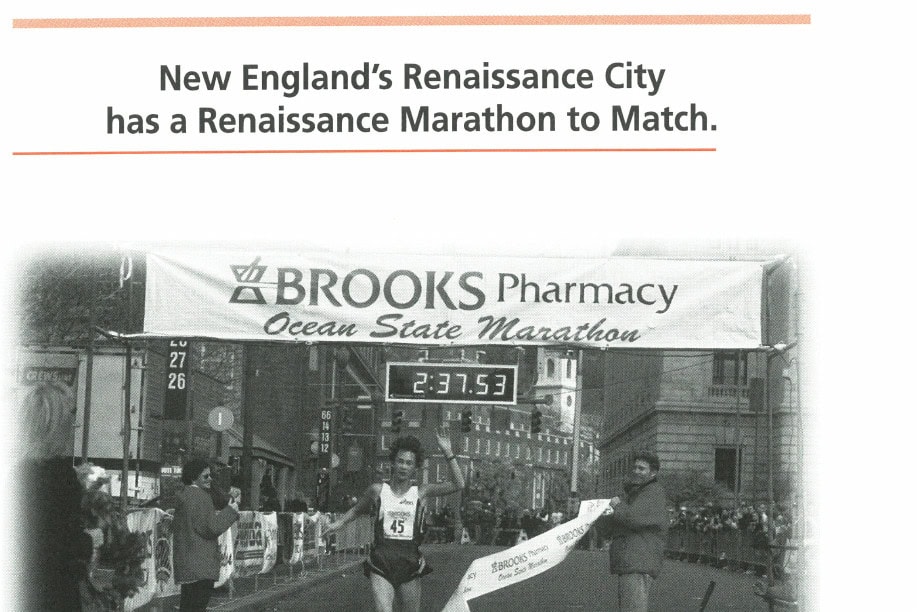
HOW FITTING that Providence, Rhode Island, hailed as “America’s Renaissance City,” hosts a marathon that has done its own bit of rebirthing. Voted in 2000 by Money magazine as the “Best Place to Live in the Eastern U.S.,” Providence is nearing the end of a spirited, decade-long revitalization, resulting in its current distinction as a top U.S. destination city. And in the nine-year-old Brooks Pharmacy Ocean State Marathon, run each fall from Warwick to Providence, the state has an emerging destination marathon to match. This jewel of a marathon is the perfect product of a proud state: as the first colony to prohibit importing slaves, the first to declare independence from Britain, and
The Basics
Brooks Pharmacy Ocean State Marathon
5 Division Street
East Greenwich, RI 02818
PHONE: 401/885-4499
FAX: 401/885-3188
WEB SITE: www.OSM26.com
E-MAIL: OSM26@IDS.net
RACE DIRECTOR: Gerry Beagan
YEAR RACE ESTABLISHED: 1993
USATF SANCTION: Yes
USATF CERTIFIED: Yes
CHAMPIONCHIP TIMED: Yes
START TIME: 7:55 AM (When the race was in November, it started at 9 o’clock). Runners must maintain a 12-minute per mile pace to receive services on the course.
RACE RECORD HOLDERS:
| Open men: | Igor Osmak, Ukraine, 2000, 2:14:24 |
| Open women: | Tetyana Pozdnyakova, Ukraine, 1999, 2:31:52 |
| Masters men: | Andrey Kuznetsov, Russia, 2000, 2:16:49 |
| Masters women: | Tetyana Pozdnyakova, Ukraine, 1999, 2:31:52 |
PRIZE MONEY/AWARDS: $112,000 total purse. Seven deep for open men/women, starting at $10,000 to the top male/female finisher. Cash award also to top male/female age-group winners (5-year age groups) plus course record and age-group record cash bonuses. Top male and female Rhode Island finishers receive a round-trip plane ticket to any destination in Florida.
TIE-IN EVENTS: None
NUMBER OF VOLUNTEERS: 1,000
MARATHON FINISHERS IN 2000: 1,565
PROPORTION MALE/FEMALE FINISHERS: 75% male; 25% female
COURSE MARKINGS: Every mile, with digital clocks at 5-mile intervals
MEDICAL AID STATIONS: Four on the course and one at the finish line
NUMBER OF WATER STATIONS: 15—Crystal Spring Water/Ultima
FUTURE RACE DATES: 08OCT01, 14OCT02, 13OCT03
This article originally appeared in Marathon & Beyond, Vol. 5, No. 5 (2001).
← Browse the full M&B ArchiveMore like this
1,000+ stories from 19 years of Marathon & Beyond
The complete archive of the legendary long-distance journal — digitized and free to read.
