

The Audacity Of Cavinwoodward
You would think—in theory at least—that the key to being a top ultrarunner is to be single minded, well organized, and happy to toil for hours in your own company. But of course every sport throws up the occasional maverick, someone who achieves success while defying conventional wisdom. Ultrarunning is no exception, and one of its prime nonconformists was Cavin Woodward, a pint-sized office worker from Great Britain who smashed records galore in a sparkling career. Woodward, who died in 2010 aged just 62, had a distinctly cavalier approach to running, some of the sport’s old hands saying he smashed records despite his approach and not because of it! His finest hour came in 1975 when he obliterated the coveted 100-mile world record in a race that has since been labeled the greatest 100-mile contest of all time by ultra historian Andy Milroy. Woodward hated training alone and often had to be pushed out the door by his wife to keep his mileage levels up. But when race day arrived, our reluctant hero was a man transformed. He had an unusually high arm action and ran with his head slightly to one side. Adrenaline pumping, he would shoot off at a suicidal pace, looking for all the world like he was tackling 5K instead of 50 miles. Onlookers and fellow competitors would do a double take, but the knowledgeable few would shrug as if to say: “Don’t panic, folks, that’s Cavin Woodward; he always does that.” Woodward explained his explosive fast starting with his mantra: “
Race as fast as you can for as long as you can.” And with tongue only partly in cheek, he would also explain he needed to seize an early lead because: “I like to see where I’m going.” Woodward competed to a high level in ultras for nearly 30 years (1969-1998) but rarely exceeded 75 miles per week or 20 miles on a single run, training deliberately at modest pace. He never bothered much with stretching or speed work, not exactly what the textbooks prescribe. His success, according to his son Ross, proved what consistency, self-belief, and sheer bloody-mindedness could achieve.
Woodward, a friendly, small-framed fellow who enjoyed stamp collecting and whose day job was in accountancy, hailed from historic Royal Leamington Spa in England’s West Midlands region. He linked up with Leamington Cycling and Athletics Club in 1963, aged just 15, encouraged along by his Uncle Fred, who had spotted the boy’s potential. Woodward would ultimately develop into the club’s most celebrated member of all time, gaining international fame while remaining loyal and competing for the club in races great and small over nearly half a century.
No fan of training Woodward freely admitted he hated the drudgery of training but loved races. He would never throw all his eggs into one basket by building specifically toward a single race, his reasoning that on any given day it would take only one thing to go wrong and all the sacrifices would have been in vain.
But he was excited and inspired by certain events. He was especially drawn to the Comrades Marathon and the London-Brighton race, but even those journeys of over 50 miles failed to persuade him to curtail his racing habit in order to peak on the big day. He wrote: “There is no way that I could train for weeks at a time in an effort to produce one good performance at the end of it. My philosophy has always been ‘to be race fit, you have to race,’ and that’s why, throughout my career, I’ve always tried to participate in at least one race a week, providing I am not injured. I don’t put pressure on myself to do well every time I go out to race. This means if I have a below-par run one weekend, I don’t get too despondent but can look forward to improving in the following race, knowing I only have seven days to pull myself back together again.”
Woodward was barely out of his teens when his strength and resilience caught the eye of senior club colleague Tom Buckingham, three-times Midlands Marathon champion, who urged him to try the Rugby Marathon. With little specific training under his belt, but eager to please old Tom, Woodward clocked 2 hours, 47 minutes on this debut. At the finish, in time-honored fashion, he declared “Never again” but soon felt the urge to try something even longer. He comfortably went under 3:30 in the prestigious South London Harriers 30 miles, an annual two-lapper in the capital’s suburbs that would ultimately be staged 49 times, making it one of the world’s top-10 longest-established ultras. The die was well and truly cast.
Three marathons in 1971 with clockings close to 2:30 encouraged him to tackle the first of what would become an annual ritual, the iconic London-Brighton 53-miler. His 6:10:58 and 15th place was impressive for a young debutant, but he decimated this a year later, grabbing third place in 5:34:47, behind Alistair Wood’s record of 5:11. The following day there were more celebrations in the Woodward household when twin sons Darren and Ross were born.
Private collection
▲
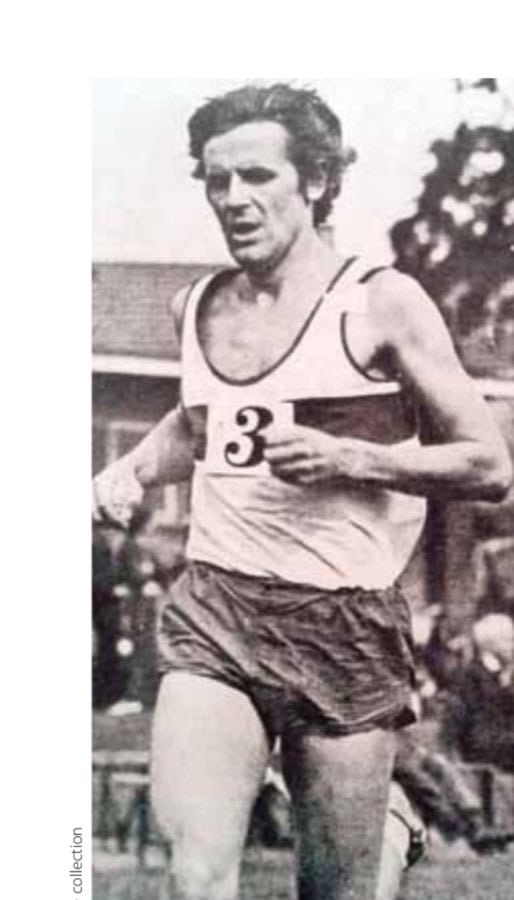
Cavin Woodward held world records but remained a loyal club man. Seen here running a local track race in Leamington Spa, England.
Woodward dutifully represented his club at events of all descriptions and distances, including marathons galore in the early 1970s. He managed a 30:47 at 10,000 meters in 1972 and top-three finishes be
came commonplace. In 1973 his fast-start tactic helped achieve outright victory at the Isle of Wight and Highgate marathons, a lifetime personal best of 2:19:50 at the Maxol Marathon in front of packed
Manchester United football stadium, and the third-fastest London-Brighton performance of all time (5:16:36). He also won the Two Bridges Race (36 miles) in commanding fashion in 3:25:51, by a margin of over six minutes. It would be one of
five victories at this annual Scottish classic, which took runners from Dunfermline Glen, over the Kincardine and Forth Road Bridges, to Rosyth Civil Service Sports Centre. Woodward grew to love it so much he plucked the names “Glen” and “
Ross” from the start and finish locations as the chosen names for two of his sons. Fortunately, wife Carol went along with this, much preferring these names to her husband’s original suggestion of “London” and “Brighton!”
“Backing off” for the sake of the family After Glen was born, helping Carol bring up their young family meant Woodward would regard 1974 as “a slack running year”—although it would seem anything but in the eyes of more conventional runners. He still completed four marathons,
including 2:23:48 at Rugby, and was pipped for victory by a mere six seconds by John Newsome in a sensational finish at London-Brighton. After this so-called quiet period, Woodward intensified his racing during 1975. Still only 27, he was
going his own sweet way and many friends and rivals would struggle to comprehend the racing program he set himself. Weekend after weekend he hammered along the roads at some of the toughest fixtures available, but there was little doubt Woodward enjoyed every minute of it all.
Private collection
Was he a crazy man heading for inevitable burnout? His consistency and his smiling face suggested not. Would a more circumspect approach allow him to peak at certain times and achieve performances beyond his wildest dreams? If Woodward ever entertained that thought, it didn’t linger for long. He knew what was best for him, and as 1975 got under way the victories and the records began to fall, thus validating his carefree outlook. With hindsight we see that Woodward peaked in 1975, and what’s more, it happened in a year when Britain sweltered in its hottest summer on record.
Woodward’s first big headlines in his golden year surrounded the April 30-mile track race staged by the Epsom & Ewell club. In the preceding seven days he had knocked out a 20-miler and three days of 13 miles and tried a carboloading diet for the first time. On the Epsom track it all paid off gloriously as he powered to a world best of 2:43:52, beating the old mark of Irishman Mick Molloy by 55 seconds. Cavin Woodward had truly arrived.
On a firm track in cool windless conditions, Woodward seized the lead early and after five miles had opened a gap of more than three minutes. He passed halfway in just under 80 minutes and reached 25 miles in 2:15:55, a huge gap of more than 18 minutes behind him. The 40-kilometer world best was his, and his fast finish secured the 30-mile record. Although nobody got anywhere near challenging him for the lead, he said the figures strung out around the track always provided something to chase. Among those figures was his mentor and close friend Tom Buckingham.
The record was certainly not a signal for Woodward to rest on his laurels, for three days later he ran a 5,000 meters for his club in 15:20 and the following weekend cruised to third at the Midlands Championship Marathon at Rugby. Woodward was hot in 1975, and so was the UK weather. Conditions didn’t encourage distance running, but Woodward was in the form of his life and wasn’t unduly bothered. He won his beloved Two Bridges Race in 3:26:45 before turning to his other favorite—the London to Brighton in September. ▲
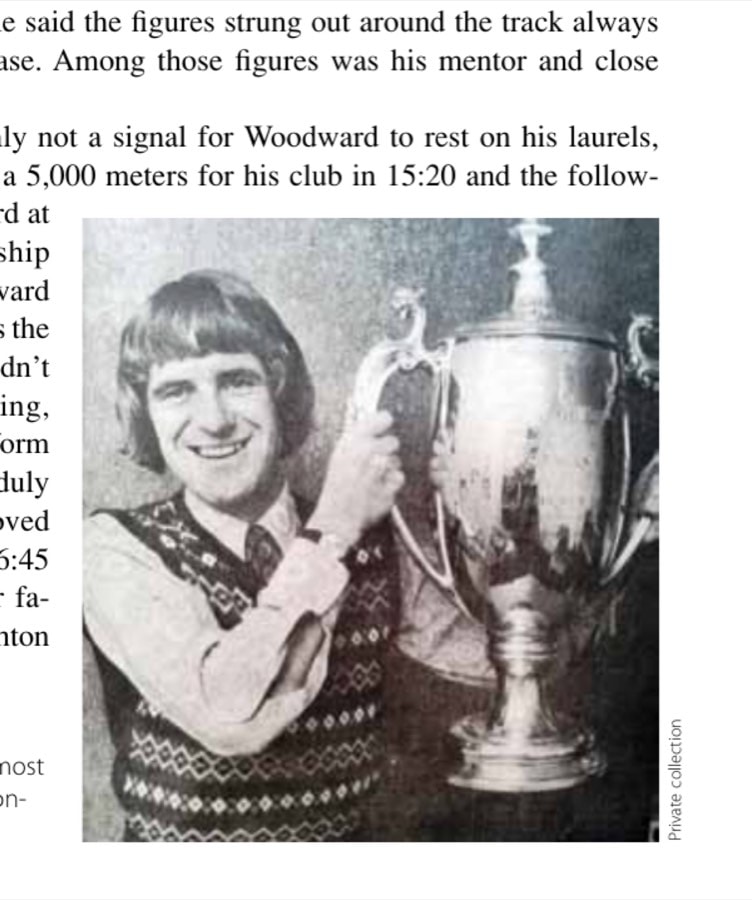
Woodward with one of his most coveted prizes, the 1975 Londonto-Brighton winner’s trophy.
Typically, he devised a four-week buildup featuring intensive racing, relatively little solo training, and no sign of any easing down. He squeezed five big events of between 10 and 30 miles into the month prior to the big race, achieving classy results in all. Many thought it was crazy and would harm his chances, but as Woodward would later explain: “I firmly believe the best results are obtained not by the amount of mileage or speed of training sessions, but by training consistently and racing frequently. I think you are more motivated to train if you know the next race is only a few days away.”
He came second in the South London Harriers 30 in 2:55:20, beaten only by local horticulturist Don Faircloth, a man with a 2:12 marathon under his belt. Woodward threw in a couple of marathons: Highgate in North London (2:28:47) and Rotherham in South Yorkshire (2:34:35)—plus a 52:54 10-miler at Nuneaton. He was clearly thriving on the adrenaline of racing, a situation he found impossible to reproduce in training. On paper it looked like a crazy way to prepare, but on the breezy seafront at Brighton the doubters would have to eat their words over Woodward’s “month of madness.”
Simply overpowering He stormed to a sensational victory just 65 seconds outside the course record. After the heartbreak of being narrowly defeated the previous year, the jubilant Woodward hit the finish line near the Brighton aquarium a remarkable 15 minutes clear of the field. The race featured more than 100 runners for the first time in its long history, including a record number from South Africa. It would be the last appearance of the latter for many years due to an IAAF ban prompted by that nation’s apartheid regime.
It was Woodward’s biggest achievement to date. He had never run more than 50 miles in his life before, and on crossing the line (52 miles after departing the shadow of Big Ben) was visibly overcome with emotion. He appreciated only too well that since the 1960s this race had been regarded the premier ultra in the world—effectively the Ultradistance World Championship. He recovered his composure to tell reporters that in three years as a serious distance runner, winning here had always been top of his list and ranked higher than his world record at Epsom.
Woodward was 28 years old, rarely exceeded 70 miles a week, raced every weekend, and was clearly possessed of a rare talent. The race organizers, the Road Runners Club, were so excited by what they had witnessed they immediately sought a way to secure the funding to sponsor Woodward’s passage to the Comrades Marathon in South Africa eight months hence. They were convinced they had finally found an Englishman to repeat Arthur Newton’s Comrades triumphs of the 1930s.
Meanwhile, Woodward turned his attentions to the next huge challenge—a 100-mile track event scheduled for October at the humble Gospel Oak Stadium in the small town of Tipton. Ultra historian Andy Milroy would later reflect upon it as “the greatest 100-mile race ever staged.”
Woodward revealed later: “I prepared three schedules for the 100-mile track race: one to break [South African] Derek Kay’s 11:56:56 world record by 20 minutes, one to break it by five minutes, and one to break John Tarrant’s UK record of 12:30. If I was going well, I’d aim to break the 50-mile world best of 5:01:01. My one big problem with this race was not knowing if I could cover the distance—the longest I had run had been Brighton. I decided to go for as fast a time as possible for 50 miles and then hang on as long as I could.”
It was cold, dark, and misty and the 18 runners shivered nervously as they gathered around the canvas tents at trackside for the 6:00 a.m. start. One of them, Australian Martin Thompson, said most talk centered on whether man-of-themoment Woodward would be able to run on strongly into the latter stages or be found wanting and give way to older and more experienced men like Ron Bentley (Tipton) or Siegfried Bauer (New Zealand). Bentley held the 24-hour track world record of 259.6 kilometers, although he was rumored to be carrying a groin injury.
At that time of the morning, conditions were not exactly encouraging. The cinder track was quite soft, and the air was cold and damp, the temperature barely getting above single figures (Celsius) all day. On the plus side, the small band of helpers was attentive and encouraging, and the race sponsors Accolade had laid on gallons of their electrolyte drink. With a massive 400-lap journey ahead, some of the runners were convinced Woodward wouldn’t dare employ his usual tactic of storming away at the start. They would be proved very wrong.
Off in typical Woodward fashion After they were sent on their way to a small but enthusiastic smattering of applause, Woodward immediately showed there was to be no compromise. The timekeepers and recorders sheltering in the small grandstand expressed surprise and amusement as he swept by. The first mile was passed in 5:19, five miles in 27:49, and 10 in 56:27. Although gray and overcast, daylight had fully broken by the time Woodward hit 20 miles in 1:54:26, his lead now a huge 16 minutes. If the chasing runners thought this was a suicidal pace they didn’t show it, for 15 of them were maintaining a world-record schedule themselves at the 20-mile point.
Woodward’s stats were already mind blowing. By 30 miles he was more than two minutes inside the fastest of his three prepared schedules, having brushed off some minor twinges in his right calf and a spot of trouble with a shoe. He swept through 50 kilometers in almost exactly three hours, showing absolutely no ill effects.
By 40 miles [64.3K] he was well on course to smash the 50-mile record, and this proved a real psychological boost for he now knew the effort of setting up the event and the preparations had all been worthwhile, even if things went wrong for him later on. In the 10 miles preceding halfway, he had planned 10 laps of 1:36 and 10 of 1:33, a task he pretty much achieved. He hit 50 miles with the clock showing 4:58:33—the first man to run faster than 10 miles an hour over such a distance.
Woodward felt a glow of satisfaction as he plowed on, knowing he could now relax a little, his confidence boosted by the remarkable realization he could take around two hours longer to complete the second 50 miles than he had the first—and still break the world 100-mile record! With 53 miles under his belt he allowed himself his first toilet stop, something he had been determined not to do before halfway, however urgent it might have been.
Tom O’Reilly (Small Heath Harriers) was second through the 50-mile point in 5:32:49, having by now overtaken Martin Thompson (5:45:20). Thompson was having problems but plowed on bravely, and he recalled: “I had shoe troubles between 20 and 50 miles, changing them three times and finally remodeling a pair of Tiger Montreals with a pair of scissors to allow for swelling feet. I also made a pit stop to shed some ballast—consequently I was very pleased with my time at 50 miles. I drank Accolade in the early stages and then switched to Dynamo after about 35 miles. Had a few mouthfuls of creamed rice from the tin at 55 miles, sucked away on barley sugars, and finally ended up drinking strong hot coffee.”
Woodward’s opponents were stopping and starting and trying all manner of different forms of refreshment, but he steamed ever onward. He stopped only rarely, once for a quick check on a blister after 59 miles. He was a long way inside record pace on passing 60 miles and hit 100 kilometers in a world best of 6:25:28—a huge 34 minutes inside the previous mark set in Germany just days earlier.
Although best known for his carefree front-running, it was now clear Woodward could also discipline himself to run according to complex and closely monitored schedules. In fact, making constant calculations of lap times and projected finish times in his head was proving helpful in combatting the sheer tedium of circling the same quarter-mile track time and again. Having been well inside his target at halfway, he concluded the second 50 miles of his run would require 10-mile splits of 74, 75, 76, 80, and 86 minutes to round things off.
The inevitable slowing begins His slight relaxation after halfway meant that in early afternoon he had completed 70 miles (280 laps) roughly six minutes inside the fastest of his three schedules. This was reduced to a mere two minutes when he treated himself to a short rest at the 78-mile point. Once he got going again and went through 80, the record was
still in his sights, but a marked drop in pace had become evident. Some onlookers began to wonder if Tom O’Reilly, very gradually closing the gap on Woodward, might cause a sensation by catching him—something unthinkable earlier in the day. Was Woodward about to blow up and pay the penalty for his earlier speed?
This idea didn’t linger in the cool air for too long, especially when O’Reilly began to look distressed, stopping three times between 65 and 80 miles. The hardy veteran Ron Bentley jogged past on the third occasion and decided tough love was necessary: “Get going!” he barked at O’Reilly, who quickly obeyed and never stopped again.
Evening was drawing in fast and it was getting cooler when Dr. John Brotherhood of the Medical Research Council emerged from his tent on the infield to request a sample of Woodward’s urine. He advised him fatigue was causing his body temperature to drop too fast and more clothing was essential. An additional T-shirt, sweater, rugby shirt, and tracksuit trousers helped do the trick, and the pins and needles Woodward felt in his arms began to ease. His unusual high arm action had presumably contributed to this. Quick calculations by the men with clipboards revealed he was still on course to beat the record, although his “dream” scenario of doing so by 20 minutes might prove elusive.
Woodward looked in good spirits as the end drew near. After passing 90 miles, his pace was down to almost two minutes per lap, which to him felt slow and labored but was still good enough to give him a 150K world best (10:44:55). This was heartening, and with less than 25 of the 400 laps left, Woodward steeled himself and picked up the pace a little.
It was distinctly chilly in the gathering dusk, but by now a large crowd had gathered and they cheered heartily as Woodward raised a gallop over the last mile. His head and arms rocking wildly, he clattered through the tape to collapse into wife Carol’s arms. The clock showed 11:38:54 for the 100 miles! He had beaten Derek Kay’s record set in Durban three years earlier by just over 18 minutes! It was an astonishing achievement for someone who had only ever run half the distance before.
The other runners had to push on through the dim light for up to four hours more. O’Reilly finished around 23 minutes adrift of Woodward to take a fine second, putting him third in the world all-time track rankings. Third was local runner Bill Carr (Tipton), who stuck admirably to a very even pace throughout while the others all had good and bad patches. Bob Jeans (Salisbury) was last man home shortly before 10:00 in the evening in 13th place, only just beating the tough 16-hour time limit.
Triumphant Woodward commented later: “I know in the early stages the critics were saying I was going too fast to crack the 100 miles, and my tactics of running as fast as I could for as long as I could would not pay dividends. But I hope I’ve proved running even paced is not the only way of winning races and breaking
records. I’d like to think that if a runner wants to try to run ultras fast from the start against the wishes of his coach, he can now convincingly argue that was the way Cavin Woodward did it!” Martin Thompson, fourth home in an Australian national record, praised the
organization and support: “It was superb, with times called and recorded for all 400 laps for all competitors. As the day progressed, spectators grew in number and in the final stages the encouragement from the crowd was terrific.” He recalled
hitting a bad patch less than 10 miles from home—completely drained physically and psychologically—and wanting to quit: “I took my first and only walk—150 yards—which brought me round to where the bulk of the spectators were. With all
the yelling and encouragement, I started off again at a painful shuffle. It seemed the finish was getting further away with every step. It is very difficult to explain the extreme mental determination it took to keep moving in the final stages. The
crowd really moved me—12,000 miles from home and hundreds of people yelling out my number and name!”
Recovery, in its fashion
Private collection
Courtesy of Tipton Harriers
After the race, Thompson stayed at Woodward’s home for several days while he recovered and recalled: “Both of us moved a bit unsteadily on our feet the fol-
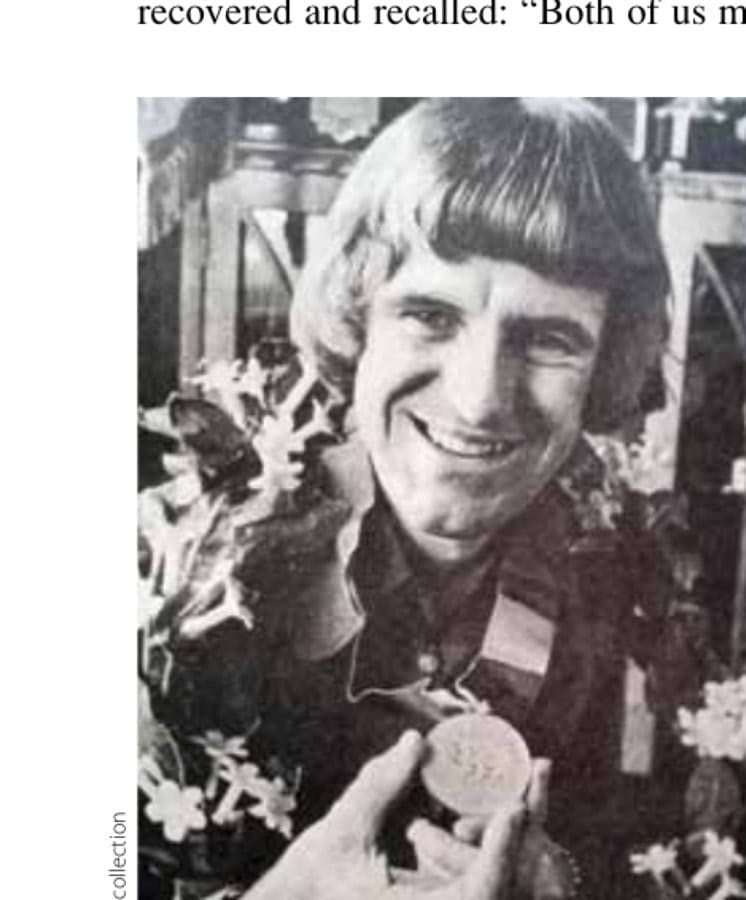
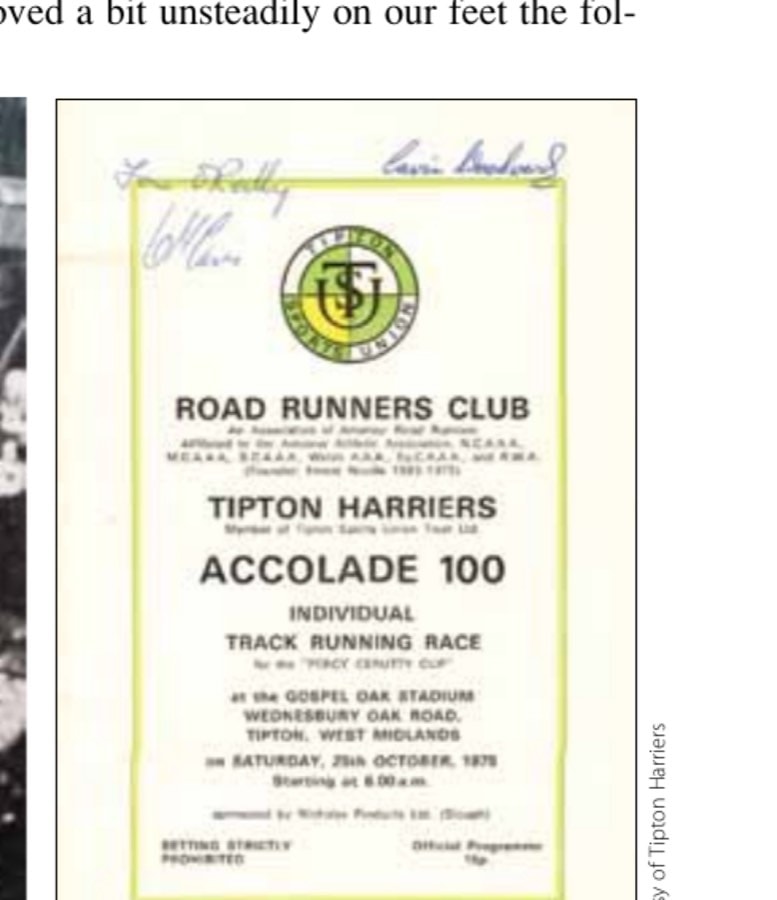
▲ Left, Woodward with the spoils of success after his 100-mile track world-best time in 1975. Right, an autographed souvenir from “The greatest 100-mile race ever staged.”
ad
lowing day. I had a swollen lower right leg, which was troubling me and ended up with it elevated for a couple of days. Cavin had a delicate knee—otherwise both of us felt pretty good.” A week later Woodward was back in action, turning out for his club in a local cross-country league, while Thompson was a little more circumspect and gave himself four weeks before a gentle outing at the Barnsley Marathon.
Ignoring his exhaustion to help his club’s cross-country team was typical of Woodward. Between 1965 and 1980 he ran for the team in 59 consecutive Birmingham meets. His appearances in this league spanned 31 winters, and he was a points scorer 106 times!
The 100-mile runner-up O’Reilly echoed Thompsons’s comments about mental toughness: “Any man who can contemplate setting a 50-mile record and then hanging on for another 50 has got to be a remarkably determined individual!” Many years later, O’Reilly would be asked by historian Andy Milroy why so few had beaten Woodward’s 100-mile time in the years since: “People were more lighthearted in those days—if you blew up there was another race next week. Runners have more to lose nowadays, there is more pressure, and more to win,” answered O’Reilly, pointing out that when Woodward won the Migennes 100K race in France in a course record, he was given a bread board, the same as the other runners! He said it was easier for ultrarunners to run their own races back
then, doing it for their own satisfaction as there were no national vests to go for and very little status attached to ultrarunning. Woodward told reporters his stunning and unconventional success was based on modest levels of training and he had never been coached: “No one can teach you how to train or race. It’s an individual thing, which has to be drawn from your own personal experiences and capabilities. I believe I achieved my ambitions and goals as a result of the abundance of races I’ve taken part in, balanced with my moderate, unpressured training schedules. Although at times I find it difficult to motivate myself to train, this is far outweighed by the enjoyment I get from racing, especially the comradeship in the ultra circuit. I really do run for fun. Whatever happens, I’ll never change my approach to training or my thirst for racing—for me, at any rate, it has worked.”
Carol: his motivation to train Interviewed by Irish marathoner Vince Regan, Woodward confirmed: “I detest training. My wife, Carol, often has to kick me out of bed when I don’t feel like going out. If I didn’t have a race to aim at I’d find myself skipping training.” Carol was his driving force and inspiration and also his planner and organizer, accompanying him to nearly every event—and without this bond he would have probably failed to sustain such high standards.
Prior to the 56-mile Comrades Marathon in 1976, a fund was set up locally to raise the airfares for Woodward’s family to accompany him to South Africa. Once enough was pledged, a humble and grateful Woodward admitted he now felt under pressure to run well as he couldn’t bear the thought of letting people down in case they felt conned out of their money. As it turned out, he delivered a powerful performance in conditions he had never faced before.
The trip was an idyllic three weeks that saw him train with Collegian Harriers, feted in the press, and treated like a visiting superstar. The warnings not to adopt his usual style of starting fast came thick and fast again, and he was constantly warned: “The Comrades is one race in which you don’t come back,” a reference to the hundreds of runners down the years who had started well, hit trouble, and been completely unable to get going again. Inevitably this failed to persuade Woodward to alter his style, and with 1,580 others he headed out of Pietermaritzburg for Durban full of hope and with a spring in his step. He led for the first 35 miles, the gap stretching to six minutes at one point, but then the heat, hills, altitude, and vehicle fumes combined to give him breathing problems, and he quickly faded to sixth. Assisted by a “second” on a motorbike, he was able to rally after given news on three separate occasions that men up ahead were in big trouble. Pegging opponents back in the latter stages was an unfamiliar scenario, but he proved the doubters wrong by coming back with a vengeance to grab second
Private collection
▲
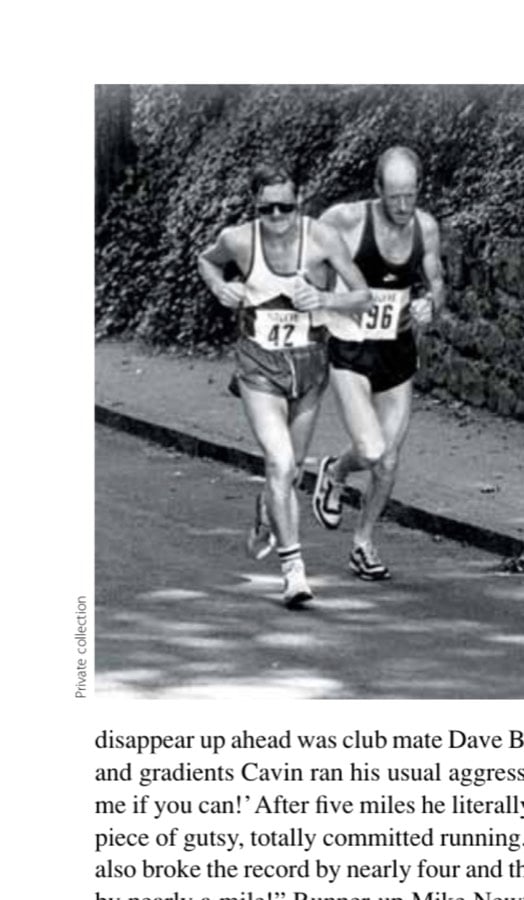
Woodward (number 42) climbs the notorious “Killer Hill” during the 36-mile Two Bridges race in 1983 in Scotland.
place, completing the iconic 56-mile route in just under 5:50. As the years passed, the pace didn’t slacken despite the pressures of a full-time job and a growing young family. In the summer of 1978 Woodward crossed the Eng
lish Channel to win the annual Migennes 100K in central France in a sensational 6:26:05, the best time achieved on this course in 25 annual stagings. Within a few weeks he also dominated the hilly Isle of
Man 40-miler in clinical fashion. One of those who watched his heels disappear up ahead was club mate Dave Bendy, who told M&B: “Despite the heat and gradients Cavin ran his usual aggressive race, effectively saying, ‘Stay with
me if you can!’ After five miles he literally ran away from us all. It was a brilliant piece of gutsy, totally committed running. Not only did he win by 19 minutes, he also broke the record by nearly four and this on a course that had been lengthened
by nearly a mile!” Runner-up Mike Newton, an accomplished performer on the ultra circuit, was amazed and described Woodward’s running as “simply genius.” Later that year Woodward was runner-up in a high-profile 100K showdown
at the Crystal Palace track, won in a sensational world best of 6:10:20 by Scotsman Don Ritchie, the pair setting times that would remain unbeaten for decades. The mid-1980s saw Woodward peak again. His sub-six-hour clockings at
the London to Brighton race were becoming almost routine now, and in 1984 he achieved the unique position of having been placed in each of the top six positions at Brighton. This race warmed him up nicely for a narrow 22-second victory in a
100K track contest in Geneva in 6:46:42. Awarded a cash prize, Woodward was concerned how the authorities back home might view a contravention of amateur rules, so he quickly spent the winnings in an electrical-goods shop nearby before
returning home. Then 1985 proved a great year, with a comfortable victory in the Nike 100K road event in 6:57:52, which was 20 laps of a circuit around North Solihull Sports Centre. This was followed by wins at the Two Bridges 36-miler (
3:40:40) and the Woodford to Southend 40 in 4:14:17. In the latter, runner-up
Mark Pickard noted with dismay that: “Cavin was already halfway through a cigarette and a beer by the time I got in!”
Time to back off a bit By the start of the 1990s Woodward was still a formidable opponent. His times were slower than in his peak years, but this was offset by the enjoyment of running races alongside his sons. After winning the Over-50s prize at the 1998 London-Brighton, he decided to call time on his competitive running career aged 51. By this point he had achieved 38 victories and 89 top-three placings in 217 ultras or marathons.
Retirement from high-profile races didn’t lead to a quiet life. He continued to run around his local area, delivering parish magazines and suchlike on training runs, and became a highly competent and competitive captain of a petanque (French game of bowls) club. He worked tirelessly in local youth and community affairs and promoted an annual charity fun run.
When he died suddenly of heart problems in February 2010, aged just 62, Woodward’s loss was sorely felt by many people, including distance runners across the globe. One of these, former club mate Jon Such, heard the news in his adopted home country South Africa and immediately pledged to start running again in his friend’s honor, having quit years earlier due to serious illness: “I had not run for several years and was very overweight and unfit. The shock made me take stock and I decided to start running again. In 12 months I dropped my weight and began running half-marathons at age 63 in around 1:30 and winning races in my age group.” Such flew back to the UK to run the 2011 Great North Run halfmarathon for charity in a personal celebration of his late friend’s life and career.
The family Woodward left behind remains rightly proud of his legacy. A three-mile memorial road race has been established in his name in Leamington, his widow Carol one of the main organizers. Son Darren announced in 2013 he was planning a run of 100 miles in 1,000 minutes for charity to mark the 40th anniversary of his father’s sensational run in 1975.
Cavin Woodward’s name also lives on via a local road named after him in the Whitnash area of Leamington—“Woodward Close.” One day perhaps I’ll visit this area, locate the road, slip on a pair of trainers, and pay tribute to a unique runner by tearing away down there at high speed!
Did you know that M&B has a policy of adding an issue to your subscription when a friend subscribes to M&B because you turned him or her on to the magazine? Have your friend give us your name when he or she subscribes, and we’ll tack on an extra issue to your current subscription. No limits on the number of referrals.
This article originally appeared in Marathon & Beyond, Vol. 19, No. 4 (2015).
← Browse the full M&B ArchiveMore like this
1,000+ stories from 19 years of Marathon & Beyond
The complete archive of the legendary long-distance journal — digitized and free to read.
