

The Badwater Team That Beat The Odds
Somehow Gary Roberts failed to fully take in his roommate’s strange habits: running on a treadmill placed in full sun; blasting the car’s heat despite Oceanside’s optimal weather; driving two hours each week to run in heavy-weather gear in the Anza-Borrego Desert. What finally got Roberts’s attention was one summer afternoon when Akos Konya came out of his bedroom wearing six layers of clothing and a hydration pack holding a half gallon of water. Intrigued, Roberts grabbed his video camera and began recording. What, he wanted to know, was going on?
Konya explained that he was training for a big race in Death Valley and wanted to simulate extreme conditions. It was hot in San Diego County that day, but not that hot. Then he set out for an open trail behind their apartment complex, returning just over an hour and seven miles later. The multiple layers suffocated his skin; he had to stop. After drinking glass after glass of Gatorade, Konya wrung the sweat from each piece of saturated clothing to demonstrate just how much moisture he had produced. This prompted a big Ewwww! from Roberts’s 10-year-old daughter, Mackenna. “
He’d told me a year ago he was going to do Badwater, but it really didn’t register with me,” Roberts explained a couple of months after they had returned from the 135-mile ultramarathon, considered one of the most grueling endurance races in the world. Despite the advance notice, it wasn’t until three weeks before the July 2006 event, when his roommate’s bizarre behavior finally appeared on Roberts’s radar, that it dawned on him: this is not going to be easy for me, either.
Good thing the epiphany came when it did, because nonrunner Roberts headed into Badwater representing half of Konya’s entire crew.
LONG TIME, NO SLEEP Sixty hours. That’s, like, three days. Roberts learned how long runners had to make it from the depths of Death Valley to Mount Whitney and wondered when
everyone was going to sleep. He and his wife, Anissa, had crewed together once before for Konya, at the San Diego One Day ultramarathon in Mission Bay. But that was a one-mile, flat, circular course within a makeshift tent city that their friend ran around for 24 hours. And they had help, unlike two years prior, when only Anissa was there for her friend as he completed his first ultra by running endless laps around a local track.
When they checked in at the Furnace Creek Visitor Center auditorium on the eve of Badwater, a race official asked Konya how many people were in his crew. Two, he responded. A friend named Kristin Pizzi, who had some ultra experience, had hoped to crew for him too but couldn’t make it. Still, the recommended minimum is four.
As most endurance athletes know, the Kiehl’s Badwater Ultramarathon is as unconventional in its approach to runner support as it is in its unusual setting. There are no tables set up at intervals with water, electrolytes, and snacks that entrants can grab on the go. There are no mist tents or sponge stations or other perks. Instead, assistance comes solely from those chosen to ride along open highway in triple-degree temperatures and sometimes-air-conditioned, sometimes-not trucks, SUVs, vans, and motor homes. They drive ahead, pull off to the side of the road, and then watch for someone who remains the center of their attention to the finish. The runner, too, increasingly contemplates them on the course. This symbiotic relationship not only keeps racers moving forward, but it sometimes saves their lives. Even the best-trained body can succumb to unrelenting heat, dehydration, and sleep deprivation in this hostile environment. Someone must not only keep tabs on the ultramarathoner’s bodily functions but recognize when an athlete is in serious trouble. As such, this race is as much about the crew as the runner. This story is too.
HOW IT ALL STARTED Akos (pronounced Ah-ko-sh) Konya, 32, grew up in a city of 125,000 just south of Budapest and at age 12 discovered orienteering. “But I cannot read maps very good, so I always came in last,” he said. “I realized I was a better runner than a
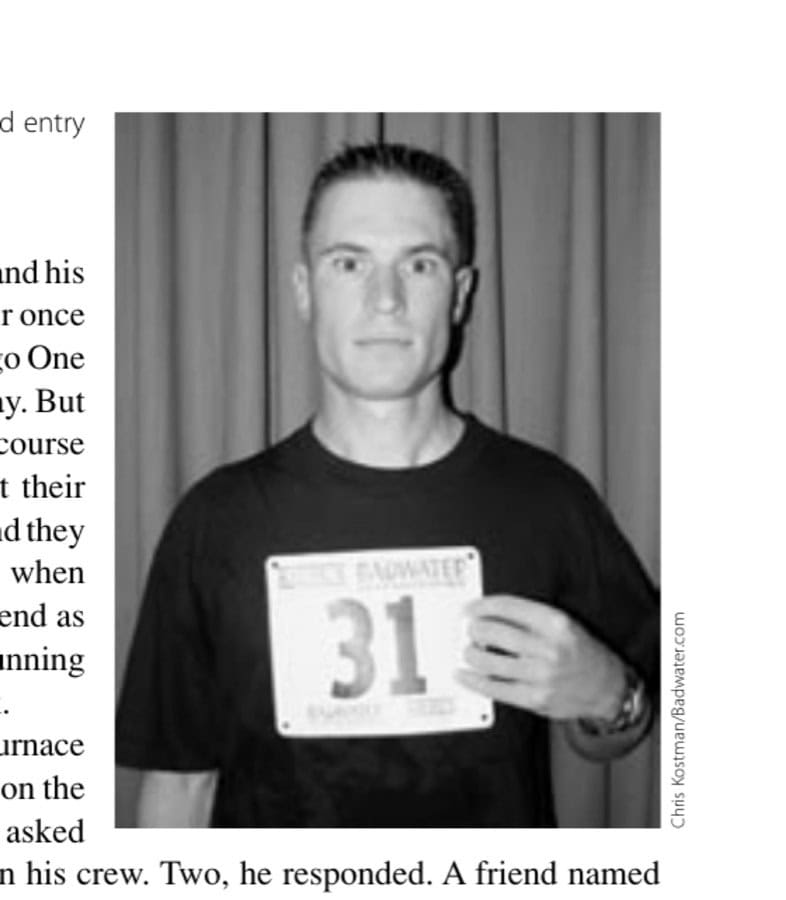
Chris Kostman/Badwater.com
▲
Akos Konya was 31 in both age and entry number last year.
map reader.” The Hungarian switched to more traditional track and field in high school and college and eventually worked up to marathons by his early 20s. His best time was 2:29:06 at the 1997 Budapest Marathon.
The former physical education teacher came to the United States in 2001 for a summer job at Yellowstone National Park and then moved to San Diego County to live with Hungarian friends and work in an Oceanside diner. “I love that this country has so many opportunities here, so many things to see,” he said. That same year, he had surgery on both knees after suffering for years with severe patellar tendinitis. A few months after the operation, a doctor cleared him to run again, but Konya didn’t, not for two years, and then only out of boredom.
By then, the 5-foot, 8-inch Konya, who weighs 130 pounds, had to start all over, and he had to start slowly. “And then I realized, if I run slow, it doesn’t hurt. When I was running marathons, I ran them in under-six-minute-mile pace. That was really hard for my knees. But if I ran slower, I could also run longer.” The Roberts family invited their friend to move in with them after learning his comrades had moved on in 2002.
Four years later, on the eve of the biggest race of his life, Konya never expressed concern that his crew was underprepared. It was Gary Roberts who openly worried, and mostly about falling asleep at 3:00 in the morning when his friend might need him most. So at a race orientation, when an older gentleman with a kind face volunteered to help a crew, Roberts immediately jumped up to accept his offer.
It turned out Team Konya had selected then-69-year-old Karsten Solheim of Glendale, Arizona, a soft-spoken ultramarathoner who created detailed spreadsheets for each of his races and who hoped for an invite next year. He had done numerous 100-milers and understood the needs of endurance runners—and their supporters.
So began the 29th version of Badwater the following morning, with the landscape awash in alpenglow as a bugle played the national anthem. Another horn signaled the 6:00 A.M. start for Konya and 26 other newcomers and slower runners. Twenty-eight others would begin at 8:00 A.M., followed by the final 32 at 10:00. That last field included frontrunner Scott Jurek, a 33-year-old Seattle resident widely known in running circles from his multiple Western States wins. Jurek had announced he would try to finish in less than 24 hours, which would smash his own course record.
Wearing the number 31, Konya took off in a specially designed cap and coveralls that Badwater “Chief Adventure Officer” Chris Kostman had suggested earlier when he happened to stop by Ruby’s Diner on Konya’s shift. The race director was in town for a cycling event in the San Diego area. Konya immediately invested in the outfit designed to mitigate the sun’s intensity.
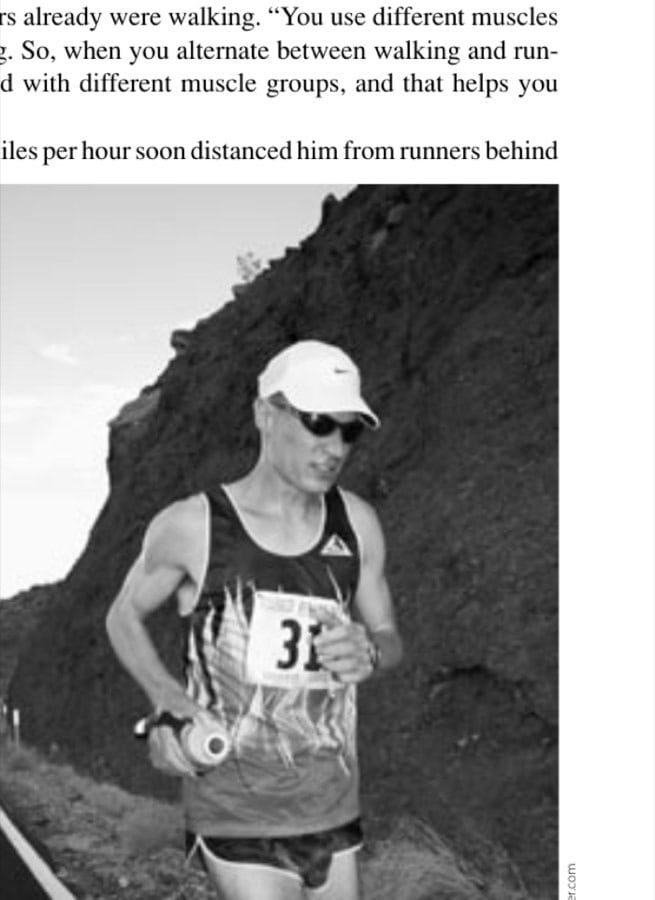
▲
Konya ran faster once he hit the course’s higher elevations.
Chris Kostman/Badwater.com
At 6:10 A.M., the temperature gauge on the Roberts’s black Ford Explorer already registered 104 degrees. The vehicle was loaded down with coolers of ice water for on-the-run soaks and hat dipping, gallon jugs of water and Gatorade, energy gels, more substantial foodstuffs, spray bottles, lotions, portable chairs, blankets, jackets, a bucket, and carwash-sized sponges. It is important for crew members to stay cool and well fed too; otherwise, they might not readily meet, let alone anticipate, the runner’s needs.
Each ultramarathoner runs on the white lines edging the highway. The white coating reflects sunrays rather than absorbing them like the rest of the road. It also helps prevent the soles of shoes from melting. A little later, Solheim explained to the crew why some runners already were walking. “You use different muscles walking than you do running. So, when you alternate between walking and running, you’re sharing the load with different muscle groups, and that helps you go farther.”
Konya’s average of 6.5 miles per hour soon distanced him from runners behind him. A routine developed in which one crew member, usually Anissa, ran up to Konya to pour cold water from a sponge over his head. Careful not to soak his socks and create blisters, Konya stopped and leaned over at the waist with his legs spread apart to diffuse any drippings. Sometimes he was also coated with cold water from a spray bottle. The crew kept ice inside a neck wrap to help keep him cool, too. Solheim regulated Gatorade intake and noted how much, or how little, the runner was able to eat for energy.
“The crew plays an important part in that they always need to be . . . dynamic and adjust to his needs because you never know what’s going to come up, how his stomach’s going to react to certain things,” he told Roberts, who videotaped the adventure.
CHECK IT OUT The crew learned that their guy was one of the leaders after the first checkpoint at Furnace Creek, which he reached in 2:42 for 17 miles. Another San Diegan rookie, David Goggins, was close, at 2:43. Jurek would cover the same distance later in the day in 2:45. At the next checkpoint 42 miles into the race, at Stovepipe Wells, the crew discovered Konya now was first overall with 6:31. Goggins would come in an hour later. Jurek’s time crossing the same spot was 7:02.
Someone in the crew decided to tell Konya he was leading the race. “I don’t believe it,” he mumbled while moving steadfastly, trying not to let the unusually high humidity and 120s temps override his determination. His supporters, however, were visibly more enthusiastic. They hadn’t anticipated this pace for this long. As such, they hadn’t been able to really rest; every time they drove ahead, their guy was coming up on them before they knew it. But they suddenly saw an upside. “
Since he is doing such a great pace, that bodes well for us maybe only having to stay up one night instead of two?” Gary asked. “Yes, that is hopeful for us, for sure,” his wife responded. At 1:00 P.M., and 45 miles into it, Konya was keeping up a great pace, which may have contributed to his lack of appetite. He was starting to power walk up inclines, which boded well for the return of hunger.
At 57 miles, it was noticeably cooler thanks to higher elevations, a slight breeze, and a splattering of clouds. It was 115 degrees as race officials periodically streamed by to ensure runners advanced on their own volition and not with motor assistance. The trio was becoming more aware of the spectators and officials eyeing them with open optimism. The halfway point was approaching. So was the 12-hour mark.
“THEY’RE TALKING ABOUT YOU, MY BROTH-AH!” Konya changed into a colorful singlet and shorts for the second half of the race. He was chafed under his arms and needed more sunscreen, but otherwise he seemed far less fatigued than you might have expected after he had run almost 70 miles in a natural furnace. Others watching the race unfold started to talk and take pictures. “He is doing awesome,” an executive with title sponsor Kiehl’s told Gary Roberts, camcorder at the ready. “I think he’s the talk of the race. I’d love to see somebody like a rookie come in and just blow the field away.”
Roberts mentioned this was the crew’s first time at Badwater, too. “Well, I hope you realize that this is an incredible accomplishment, that no matter what happens even after this point, he has run an incredible race,” she responded.
During the entire race, Konya kept his comments and his thoughts mostly to himself. “I knew that I had a long way to go, and I felt that I couldn’t keep that pace,” he later explained. “But definitely it motivated me—and maybe I ran faster than I was supposed to—when people came up to see me and took pictures of me and they were cheering. It was [an] amazing feeling; I still get goose bumps when I think about that.”
He passed through the Panamint Springs Resort in 12:22 compared with Jurek’s eventual 13:25. He had 60 miles to go as he watched the sun tuck itself in for the evening and asked for his reflective gear—another sign, Solheim said, that he was still mentally alert.
At almost 9:00 P.M., with just under 83 miles behind them, someone on the team noted that Konya was running negative splits. He was gaining energy as the evening air cooled to the 90s. He was continually told that he was in the lead but said little in acknowledgment. “It felt great at that moment that I am leading, but I knew that it was too early to be happy,” he later recalled. “I knew that there were so many good runners. I didn’t have experience; I didn’t know how to pace myself.”
Roberts, who videotapes arm wrestling tournaments for his web-based Arm TV, was a sharp contrast to his roommate’s reticence. “They’re talking about you, my broth-ah!” he yelled as Konya charged up an incline.
At 11:00 P.M., with 93 miles down and 42 to go, Konya quietly announced that he needed a break. He lay on the side of the road and grimaced as Anissa massaged his calves and quads and hamstrings. “Deep. Deep,” he said, wincing. He was mentally flagging as well. He had gone through the Darwin checkpoint earlier in 16:17. Jurek would arrive in 17:10. Goggins, the Navy SEAL from Chula Vista, was still very much in the race at 19:36, as were several others on the men’s side, including Ferge Hawke of Ontario (18:22) and Frenchman Stephane Pelissier (18:58). Canadian Monica Scholz, the eventual female winner, led the women with 20:42. “
He always gets like this,” Anissa explained to the crew. “He gets to a point where he doesn’t think he can push any further. It’s just a matter of getting up and doing it. He’ll do it; he always pulls through.” This time was no exception.
LONE PINE STRAIGHT AHEAD Around 2:00 A.M., Konya hit the 100-mile mark. He was more than 4,000 feet higher than when he started the previous morning, but he needed “to turn off my
brain for a little bit.” The rest worked. After a 30-minute roadside nap, he got his second wind, and was eating and drinking again and running at a decent clip. A green highway sign announced: Lone Pine Straight Ahead.
The day’s drama had long ceded to the ambient sound of insect incantations as the crew continually sat in waiting in the dark. Now, everyone appeared even more subdued as the hours wore on—even Roberts, whose vocal “Attaboys!” were becoming legendary on the course. “You’re doing good. You’re amazing,” he half whispered as his buddy shuffled by.
At 3:30 in the morning, the team came to a crossroads. Literally. “Straight?” Konya asked. “I dunno” Roberts responded. “Have you seen the map?” The buildings and street lights and other signs of civilization in Lone Pine offered a visual reprieve from the stony shadows and silent abysses of the wilderness of the past several hours. But at 5:00 A.M., the roads remained relatively still. Hints of another hot day were forming on the horizon. The crew, though, was focused on the huge hill ahead.
ad
Daybreak found cameras all focused on Konya as he gingerly strode ahead, appearing unfazed by the growing attention and applause from the sidelines. Someone on his crew suggested he was going to beat Jurek. “He’s coming. Don’t worry,” Konya responded, keeping his eyes on the road. He was now within striking distance of the finish, as one race official put it, but the switchbacks and steepness cruelly tormented him and tempered any enthusiasm Konya might otherwise summon.
But not his crew. The gravity of the last 24 hours hit each member at a different point. First was Karsten, whose words quivered as he called his wife about three miles from the finish to let her know they were far ahead of schedule and still ahead of the most likely winner. “It’s very emotional for me to be involved with a winning team, a winning man,” he told her.
Anissa’s turn came with one mile to go, when her husband proclaimed, “We did it!” “No, he did it,” she corrected, her voice cracking as she slowly steered the Explorer up the two-lane highway. “I don’t want any credit. This is all him. Look at him.”
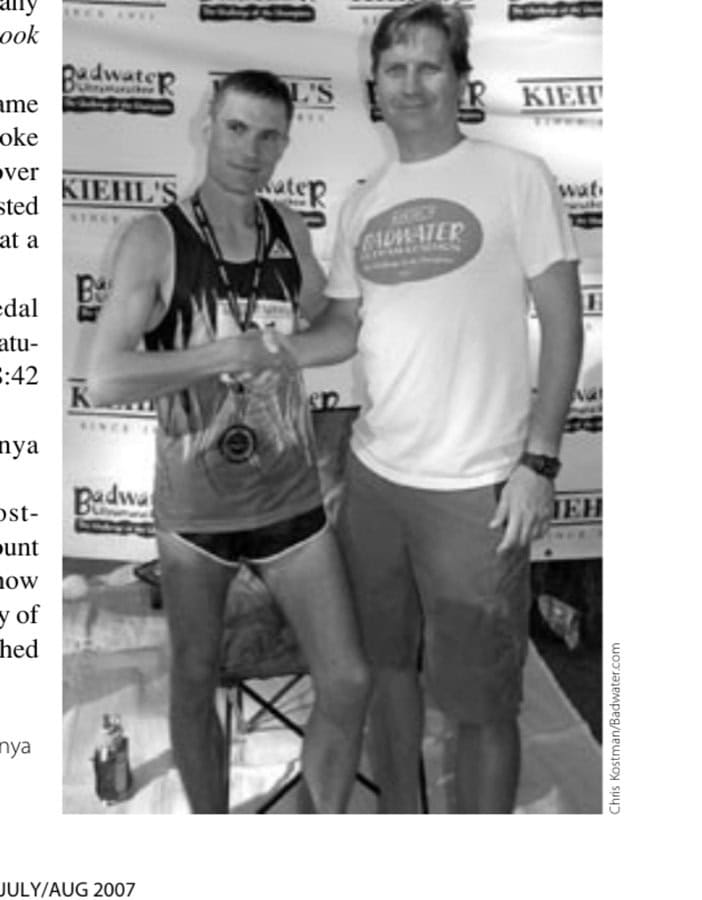
Gary’s breakdown came just after Akos Konya broke the tape, when he rushed over to fully embrace his exhausted friend. For once, he was at a loss for words. During the brief medal ceremony, Kostman congratulated Konya for his 25:58:42 finish. “
Is that good?” Konya asks. “You kidding?” Kostman responds. “I can count on a couple of fingers how many people in the history of this race have accomplished that.” ▲
First to cross the finish, Konya posed for a photo with Race Director Chris Kostman.
Chris Kostman/Badwater.com
FINAL PUSH
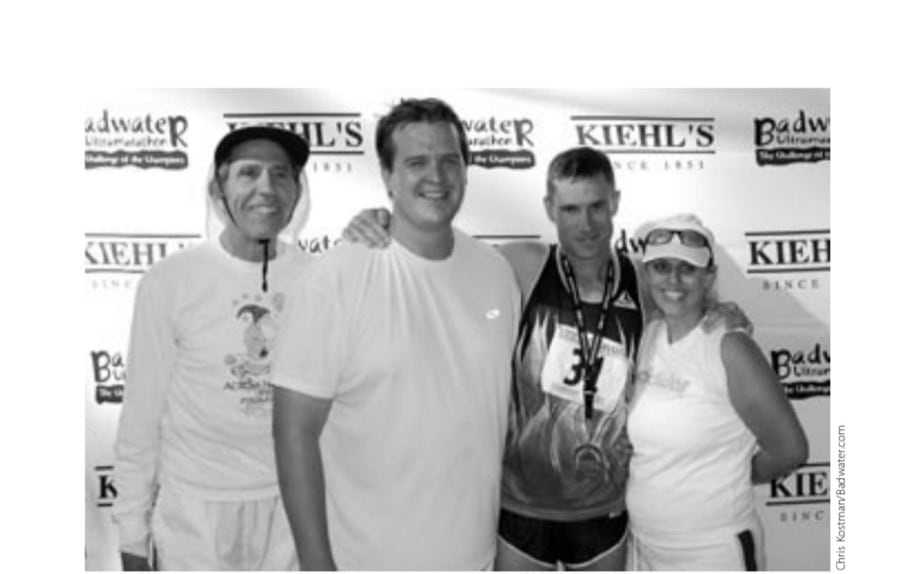
Chris Kostman/Badwater.com
▲ Team Konya (left to right) consisted of Karsten Solheim, Gary Roberts, Akos Konya, and Anissa Roberts.
Jurek would indeed catch up late in the race and surpass Konya’s time by about 17 minutes. Konya made sure he and his team stood with the rest of the clapping crowd to welcome Jurek home. Akos Konya returned to Oceanside a minor celebrity, at least to people familiar with his feat. Reporters wanted to interview him from as far away as his native Hungary. Gary Roberts set up a Web site to showcase the press coverage and videos at akoskonya.com. Some of the regulars at Ruby’s Diner asked their waiter to autograph a newspaper article. Everyone wanted to know what was next. Would he return to Badwater? And would he try to top his past performance? “
I just hope I can keep it up and I can run forever and not get hurt,” he initially told one and all. He’s now sponsored by Injinji, and The Running Room in Carlsbad provides his running shoes. He’s also aware that every race is different, and that every year brings new challenges.
In the year since Akos Konya’s amazing feat at Badwater, he has become a bigger name in the ultra world, handily winning regional races and most recently completing Southern California’s 179-mile Wild Miles Relay running only with La Jolla, California, runner Keith Kirby in 25:17—better than many of the other five- and 10-member teams on the hot, mountainous course. He’ll be at Badwater again this year, this time wearing bib No. 2 to Scott Jurek’s No. 1.
Until then, Konya is going to just continue enjoying his moment in the sun.
This article originally appeared in Marathon & Beyond, Vol. 11, No. 4 (2007).
← Browse the full M&B ArchiveMore like this
1,000+ stories from 19 years of Marathon & Beyond
The complete archive of the legendary long-distance journal — digitized and free to read.
