

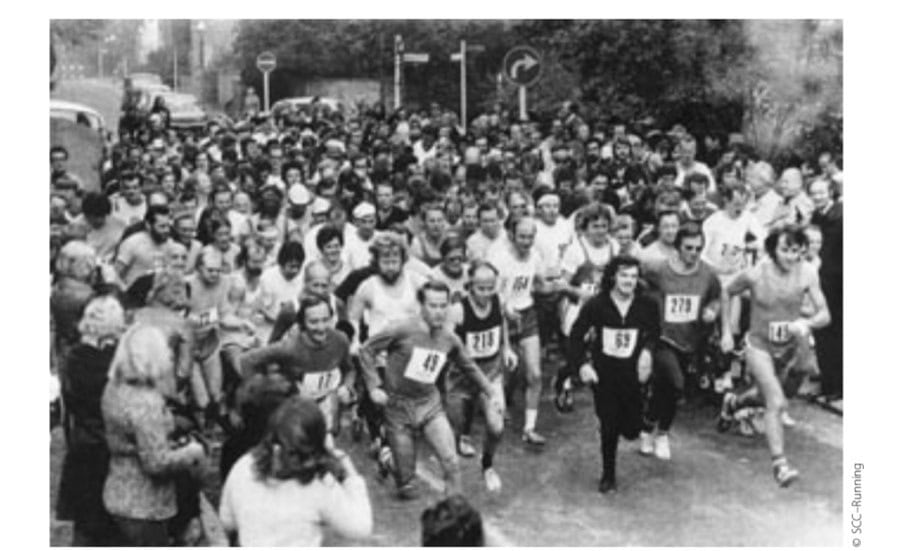
On October 13, 1974, when race organizer Horst Milde rounded up a little over 250 runners on an undulating course through the woods of West Berlin, he had no idea that he was about to fire the starting pistol on a success story that would go down in the sporting history books. Likewise, the 244 runners who passed over the finishing line that day hadn’t the foggiest idea that they would spearhead a movement that would grow to tens of thousands triumphantly powering their way through a completely altered city—and that in the near future, the walled city would rank alongside the established international marathon cities to become the fastest 26.2-mile street race in the world. Berlin holds claim to hosting the first woman to run under 2:20 as well as the men’s world record set by Kenyan Paul Tergat.
▲ The first Berlin Marathon in 1974.
It was toward the end of the 1970s that Horst Milde and his organizers toyed with the idea of bringing the race out of the woods and onto the streets modeled on marathon cities such as New York, Boston, and London. However, taking into account that West Berlin was the most militarized frontier town between the East and the West powers, it was a proposal that led the police chief of West Berlin to remark, “Milde is that madman who wants to run through my city.” The release of his quote to the press prompted the French military hierarchy to remind the local officials that, together with the British and Americans, they had controlled the three main sectors of West Berlin since the end of the Second World War. To organize a run through the streets of West Berlin, no matter how crazy the local authorities thought it may be, came down to who had the final say; the military won hands down. In 1981, the first 25K run—which would go on to write its own history—was held in West Berlin. The streets of Berlin had been opened to the runners for that event and Horst Milde and his Charlottenburg race club (SCC) were finally given a permit to run a marathon in the same year.
TAKING IT TO THE STREETS The most prestigious section of the planned route was to be the Kurfürstendamm, the chic shopping mile established after the Second World War. But it would be another part of the course that would cause the organizers a much greater headache. The marathon field was planning to pass by Checkpoint Charlie, the legendary border crossing between East and West Berlin used by diplomats and foreigners—a particularly delicate piece of terrain at the time of the Cold War, a killing field for East Germans attempting to escape to the West. For the Berlin police, this proposal was out of the question. This time it would be the chief of the political wing of the U.S. mission, John Kornblum, later the U.S. ambassador to Germany, who would intervene and give the green light. He merely placed a solitary soldier, whose job it would be to make sure that Checkpoint Charlie was passable through the gaps in the field. The transformation of the Berlin Marathon from dirt road to asphalt was an instant hit.
The entry numbers between 1974 and 1980 had sluggishly risen from 250 to 400. This was to multiply tenfold to 3,486 participants who wanted to run the new course in 1981. The race would also become truly international; whereas before, runners from six nations had taken part, now there would be entries from no less than 30 nations, and it would be the foreign runners who would lead the way. At first, it was the British athletes who would dominate, winning four times from 1981 to 1985. And then starting in 1987, it would be the Africans who would win the race to the tape.
Meanwhile, the Africans were doing likewise all over the globe, establishing themselves as masters of the long-distance race. With each year the entry quota
reached new heights. In 1988, there were 11,814 registered runners. In 1989, the field had climbed to 16,140. However, the rise in the number of runners in that year was overshadowed six weeks after the race by a much greater event: on November 9, 1989, the Berlin Wall fell. A day later, the phone rang at the office of marathon boss Horst Milde. On the line was Michael Coleman, an English sports journalist working for The Times and an avid participant in the Berlin Marathon.
IT MUST PASS THROUGH THE GATE!
© SCC–Running
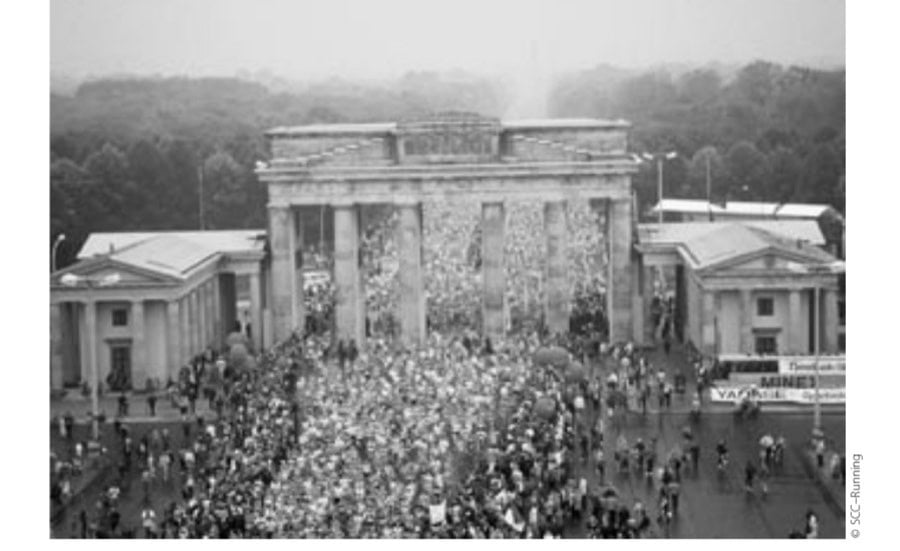
Coleman proclaimed to Milde that in 1990 the Berlin Marathon would be the race of the year, but the field must pass through the Brandenburg Gate! And events were cosmically lining up to allow that to happen. On November 12, the SCC held its traditional cross-country Run at Teufelsberg—Devil’s Hill. And for the first time in its history, runners from the East were allowed to take part without fear of repression. Subsequently a Berlin Marathon organization was set up that very day on the east side of the city to join forces with the SCC to prepare the passage through a united Berlin. Just days before, the Brandenburg Gate had been opened to pedestrians. The monumental Prussian gate, which had stood dormant in the no-man’s-land behind the wall for decades, was now the main crossing point for Berliners and tourists alike. East German border guards
▲ Reunification 1990—the first time runners from East and West Germany could pass the famous Brandenburg Gate.
were instructed to check passports, but they merely stood aside and clapped and cheered at the sight of people freely walking down Unter den Linden, East Berlin’s prestigious boulevard. This would set the scene for the sporting event of 1990.
In fact, nothing seemed impossible then. The euphoria was overwhelming. Berlin even decided to bid for the 2004 Olympics. Official registration for all the runners was drawn up, medals were pressed, and the Brandenburg Gate (now clad in scaffolding) was made presentable for the big race.
A blue guideline was laid down on both sides of the once-divided city, carving a route that would have done any tourist operator proud. The East German police unfortunately forgot to erect No Parking signs, and subsequently vehicles had to be towed away at the last minute. Runners from 61 countries would follow the blue line through some of the most historic landmarks in East and West.
It was a spectacular backdrop for the race. The tourist attractions, however, did not override the sporting achievements. Top athletes from all over smashed distance records. Australian Steve Moneghetti clocked that year’s fastest marathon time and Uta Pippig, originally from the East and later a three-time winner of the prestigious Boston Marathon, would tearfully cross the line first in the women’s event. The Berlin Marathon had finally come of age and could proudly rank alongside the great international races.
THE GROWTH IN SUBSEQUENT YEARS Horst Milde did not know how he could top this in the following year; indeed, the entry numbers dropped under 20,000 (from 25,000 runners in 1990). But once again, the Berlin Marathon was to make sporting and political history. The end of apartheid in South Africa enabled David Tsebe to win the race in 1992 in 2:08:07, setting a staggering new course record.
In 1998, the numbers began to rise, going to 27,621 starters; by 2002, the number of entrants had reached 41,000. In 2003, the 30-year jubilee of marathon running in Berlin caused the entry list to fill four months before the race began.
Some 48,000 booked a place in this sensational street run. The race was crowned the best in the world when the great Kenyan Paul Tergat sprinted over the line in 2:04:55, just one second in front of his training partner, Sammy Korir. Berlin was at last truly a front-runner. These herculean accomplishments are thanks to the dedication and persistence of one man, Horst Milde, who taught a city how to run. In 2004, at the tender age of 65, he decided to hand the reins of the Berlin Marathon over to his son, Mark.
The legacy of Horst Milde is indelibly written upon the sporting parchment of Germany and the world.
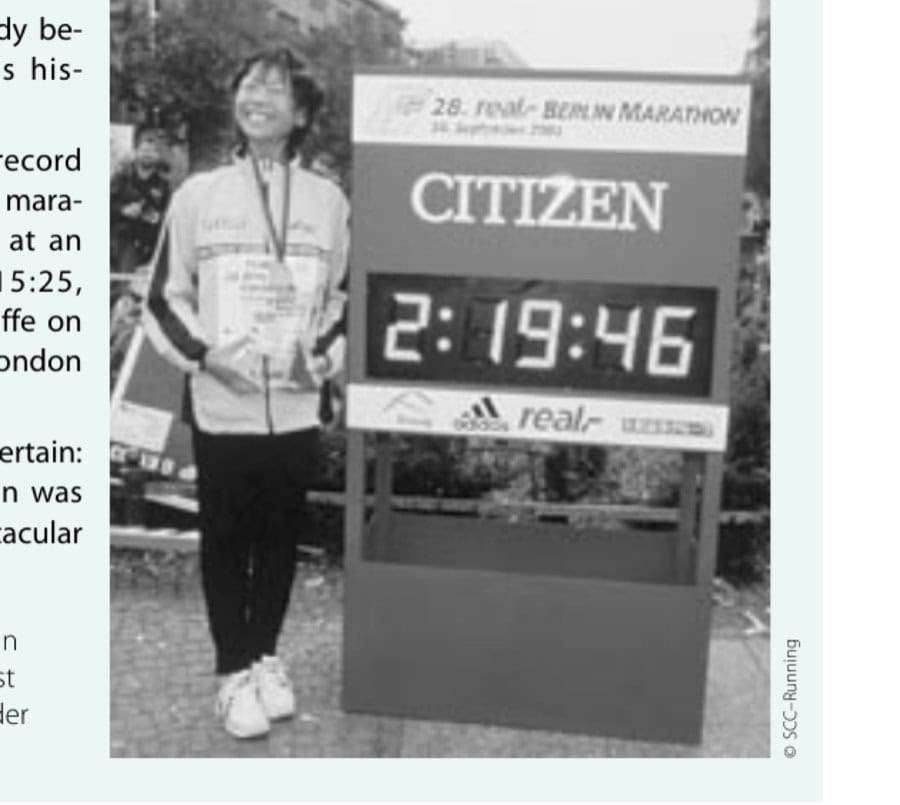
Hot Shots and Long Shots The Berlin Marathon is abundant in extraordinary performances and stories. “I can believe that one day a woman will run under 2:20,” Charlotte Teske, the German marathon runner, was quoted as saying in 1982 after setting a world-best time of 2:29:01 in the same year. Just one year later, the magic mark drew nearer when Joan Benoit finished the Boston Marathon in 2:22:43, a world record. A host of top women athletes in the 1990s, such as the East German Uta Pippig and Tegla Loroupe from Kenya, set 2:20 as their personal goal. In 2001, the organizers of the Berlin Marathon had already predicted a headto-head battle to the line between the aforementioned athletes, who would break the 2:20 mark—and broken it was! Eight minutes before the end of the race, the retirement of Loroupe because of a muscle injury made way for the Japanese runner Naoko Takahashi, the Olympic gold medalist from Sydney 2000, to storm ahead and take the tape at Kurfürstendamm in an unprecedented 2:19:46. After 20 years, the 2:20 barrier had been broken. But, sadly for Takahashi, it merely lit the fuse on the times the ladies were going to deliver in the following years. In fact, the record was broken just one week later in the Chicago Marathon when Kenyan Catherine Ndereba ran 2:18:47 while Takahashi’s performance in Berlin was already being proclaimed as historic. Today the world record for women over the marathon distance lies at an unbelievable 2:15:25, set by Paula Radcliffe on home ground in London in spring 2003.
▲
Naoko Takahashi in 2004 became the first woman to finish under 2:20.
© SCC–Running
One thing was for certain: the Berlin Marathon was never short of spectacular performances.
The first runner to crack 2:15 on the Berlin circuit was Colombian Domingo Tibaduiza in 1982. After that, the breaking of the course record was to become an annual event. And then with his 2:08:16 at the Reunification Marathon in
1990, Australian Steven Moneghetti rocketed home in the year’s best time—elevating Berlin to one of the greatest city marathons on the globe. From 1988, the women’s crème de la crème were regularly turning in runs
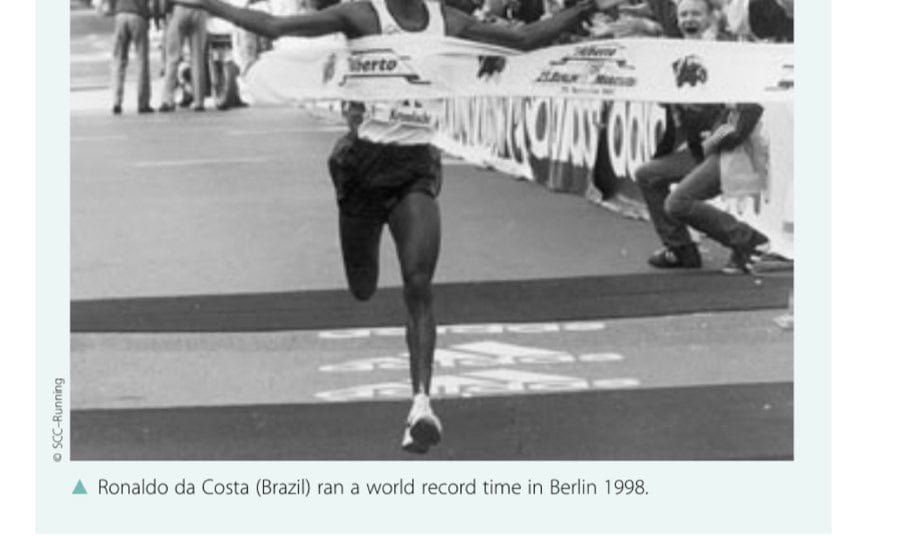
under 2:30. By 1999, Tegla Loroupe was scratching at the 2:20 mark with her 2:20:43 victory in Berlin. The first world record on the Berlin course came in 1998 when Brazil’s Ronaldo da Costa delivered a blistering 2:06:05 that still ranks today among the top 10.
The year 2000 saw Kenyan Simon Biwott joyfully cross the line in 2:07:42, a staggering performance considering that he was entered as a pacemaker and was due to stop running around halfway! The hare got away again the following year when Joseph Ngolepus, likewise a pacemaker, took the tape in 2:08:47.
© SCC–Running
Without a doubt the most exciting race was in 2002. The first three finishers—the winner, Raymond Kipkoech (2:06:47), Simon Biwott, and Vincent Kipsos—all reached the home straight with just five seconds separating them.
▲ Ronaldo da Costa (Brazil) ran a world record time in Berlin 1998.
And just as outstanding, the first five runners were all Kenyan and all posted times under 2:10. Naoko Takahashi from Japan could not top her previous year’s performance; however, her 2:21:49 did place her first among the women. Then in the 30th jubilee year of 2003, for the fifth time in its history, the Berlin Marathon would deliver another breathtaking world record. Paul Tergat crashed through the sound barrier at 2 hours, 4 minutes, and 55 seconds, with his friend and countryman Sammy Korir just one second behind him at the line. Kenya’s dominance on the male side was matched on the female side by Japan. Yasuko Hashimoto ran 2:26:32, the fourth Japanese Berlin Marathon victory in a row.
The Berlin Marathon 2004 A 42K SIGHTSEEING TOUR THROUGH 750 YEARS OF HISTORY Sunday, September 26, 2004, shortly before 9:00 A.M., the sky hangs heavy with clouds and a light drizzle falls on the thermometer, which reads 10 degrees
Celsius. Some 28,681 runners gather at the start line with Brandenburg Gate, Berlin’s famous landmark, behind them. The race will end with the runners passing through it. Behind that lies the small job of following a 42K blue line through eight districts. The broad street that set the field in motion was for 250 years a
riding path set in marshy undergrowth, connecting the town palace of the Kings of Hohenzollern and the residents of Charlottenburg beyond the gate. For today’s leading pack in the Berlin Marathon, it would prove once again
to be a painstaking event set at a blistering pace involving tactics, timing, and thousands of Euros. But for most of the runners it would be just one big adventure, and a long one that can take up to six hours.
For a relatively small number of runners, 648 to be precise, the race was to be a false estimate of their personal stamina. They would not reach the finishing line. For many of the 10,000 foreign runners, it was just a rather elaborate sightseeing
tour. The course was altered in the previous year, enabling it to wind its way through Berlin’s most historic and beautiful sites and places of interest. The starting shot had already been fired. By the time we had moved a kilometer
or so down the road to the Victory Column, a memorial commemorating wars gone by, the 15 front-runners had already reached the 5K mark. The lead pack consisted mostly of Kenyans, with the exception of three Japanese runners
and two athletes from Portugal. The boys were really setting an incredible pace—in fact about 20 seconds in front of the time recorded by Paul Tergat in the previous year, when he set a new world record.
Were these guys going to attempt to run 2:03? Back here with us, things are at a more leisurely pace as we gently jog down Strasse des 17 Juni, commemorating the workers’ uprising in communist-led East Berlin in 1953. The mass of runners then snakes its way down through
the government quarter. At around 7K, we pass the recently completed chancellor’s residence, a modern construction known locally as the washing machine. The city folk have a name for just about everything in Berlin. People
from outside the capital say Berliners have no sense of humor, but what the Berliners have is more like license to moan. Between the washing machine and the Swiss Embassy lies the Reichstag, built in 1894 and once again the
seat of German government after the transfer of Parliament from Bonn to Berlin in the 1990s.
© Uli Staiger / die licht gestalten
While we were trotting around the government buildings, the leading pack had crossed into the district of Kreuzberg, a poor but colorful multicultural area of Berlin. Marred often by the annual demonstrations on May 1, when anarchistic youth and police clash on the streets of Kreuzberg, the area is also famous for having the largest Turkish population outside of Turkey itself.
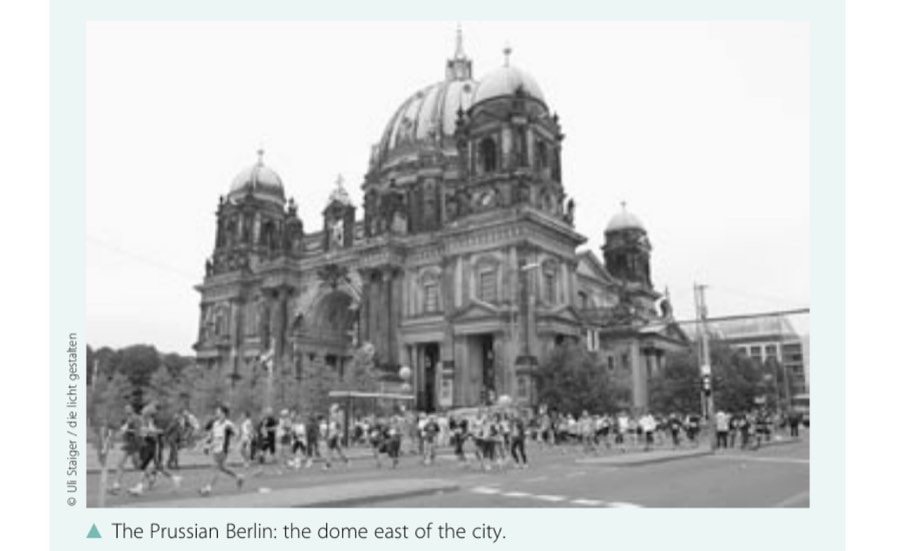
▲ The Prussian Berlin: the dome east of the city.
At the heart of this district lies Kottbusser Tor. It was at this point that a major disaster almost occurred because of wet streets. At around 14K, where the course takes a sharp bend to the right, one of the leading runners slipped and
fell. Felix Limo, a favorite, narrowly avoided what would have been a devastating collision. By halfway, the leading group had been reduced to seven runners, among them a solitary Japanese runner: Michitane Noda, a Buddhist monk
of the fourth generation who was due to succeed his father in administering a holy temple. When asked whether marathon running helped with his Buddhist meditation, he was quoted as replying, “Not in the slightest!”
A few minutes behind the men, elite Japanese runner Yoko Shibui, along with her male running partner, was distancing herself from her countrywoman Hiromi Ominami and the German Sonja Oberem at a remarkable pace.
Back at the sightseeing tour, we pass the Schoeneberg town hall, once home to the mayor of West Berlin at the time of the Cold War and where U.S. President John F. Kennedy proclaimed after the building of the wall in 1961 the famous
words every Berlin child can recite: “Ich bin ein Berliner” (I am a Berliner). At the point when most of the field was reaching the halfway stage of the marathon, the leaders were approaching the home straight. Reduced now to just three Kenyans, the first to come under pressure and to drop back was Josua Chelanga. Then inside the final kilometer, Felix Limo lengthened his stride to
distance himself from Joseph Riri. It would not be fast enough for the world record, but he would still deliver a world-class time of 2:06:44. The women finished as expected, with Yoko Shibui coming home first in
2:19:41—a new Berlin course record—and the fastest marathon by a female in 2004. All along the course, runners are entertained by musicians and bands, nowhere more so than Wilder Eber at around 28K, a normally quiet Berlin suburban hamlet with a roundabout displaying a fine statue of a wild boar. The euphoric
sounds of samba bands, whistles, horns, bells, and the vocal support of the crowds of spectators, who, it is said among the runners, “literally whip you through this section of the course.” In the early days of the Berlin Marathon, this was the penultimate section of the race, 36K, when you were expected to go flat out to the finish. However, trying that now at 28K, you would be finished.
We are now entering kilometer 32, the start of Kurfürstendamm. That was, in West Berlin days, the illustrious shopping mile for the wealthy and privileged and remains so today. Then we reach the Kaiser Wilhelm Memorial Church,
partly destroyed by bombing in the Second World War and then partly reconstructed to leave it still looking half destroyed, serving as a reminder of
the destruction that war does. And on the eve of the marathon, runners can attend a special service in the modern chapel built beside it. From here on, the sights hit you one after the other. The New National Galerie, a cool, flat pumpkin-shaped piece of architecture by Mies van der Rohe, recently hosted an exhibition of works from the Museum of Modern Art in New York that broke all records in Berlin with more than 1 million visitors. Between the 36th and 37th kilometer lies Potsdamer Platz, which was known in the 1990s as the biggest construction site in Europe. Today, erected on what was at one time a no-man’s-land between East and West, now stands a sprawling business and commerce complex with glass skyscrapers and stateof-the-art infrastructure. At 38.5K is the most picturesque part of Berlin, the Gendarmenmarkt. At 39.5K is the Berlin town hall, and at 40K are a very contrasting couple, on the right the Berlin Dome, seat of the Protestant Church in Germany, and on the left the Palast der Republik, a classic example of East German architecture of the 1970s. Built on the remains of the town palace of the German Kaisers, it had been badly damaged during building and was so immensely illuminated that it became cynically known among East Germans as Erich’s lamp shop, after party leader Erich Honecker.
ad
What then follows are the real classics along the prestigious 350-year-old boulevard “Unter den Linden.” This is Old Berlin, dominated by the architecture of Prussian monarchy, the opera house, the German History Museum,
and the quaint little houses with their strange roofs. Then we pass Humboldt University, the oldest university in the capital. We also pass Neue Wache, the memorial designed by architect Karl Friedrich Schinkel that tells the 130-year
German military history from the Prussians to Weimar to the Nazis and the DDR. Since the reunification of Germany, it serves also as a memorial to the victims of war and violence and houses the eternal flame.
Now there are just a few meters to go. In the near distance lies the true symbol of Berlin past and present and the most glorious of finish lines: the Brandenburg Gate. Beside it lies a construction site with the foundations for
the new U.S. embassy in Germany. The Brandenburg Gate was sealed off for years, standing dormant on a strip of wasteland as an icon of the Cold War that prompted President Ronald Reagan to demand, “Mister Gorbachev, open this gate!”
And in 1989, it was opened, and thousands of marathon freaks passed through the legendary monument. And the sight of the winged angel upon her chariot above the gate seems to produce wings on those runners
who have made it this far, so get ready for takeoff as you glide over the finish line!
Seasonal Half-Marathon Training That Will Improve Your Marathon Performance Part 2: Sometimes the Best Way to Run Long Better Is to Improve Your Short Game. BY GUY AVERY
In part 1 of this three-part half-marathon series, we reviewed (1) the numerous benefits of training for and racing a half-marathon, (2) how to set a realistic goal for your targeted half-marathon race, (3) how to select an appropriate training level based on your training history and current commitment level, and (4) how to understand all aspects of our comprehensive list of the various types of training that may be employed depending on your goal and training level. In part 2 of this series, we will outline the five different general half-marathon training programs (or schedules). While these schedules are all 13 weeks in length, they can be lengthened by repeating any combination of weeks 7 and 8 as needed—or by using our three-week extension schedule, which will be outlined in part 3 of the series.
You will need to refer to part 1 (in the September/October issue) of this threepart series to fully understand and follow the flexible training schedules that will be reviewed here. As training templates, these schedules represent broad guidelines that should further be tailored to your individual needs. However, when these general schedules are properly adapted by following both the broad and specific principles outlined here and in part 1 of this series, a very high probability of success will be ensured.
The intention of each level’s plan is that you perform the least amount of training necessary to achieve your goal while enjoying and benefiting from a great deal of training variety. We suggest that you choose the lowest training level that will enable you to make a sustainable commitment toward achieving your goal.
This article originally appeared in Marathon & Beyond, Vol. 9, No. 6 (2005).
← Browse the full M&B ArchiveMore like this
1,000+ stories from 19 years of Marathon & Beyond
The complete archive of the legendary long-distance journal — digitized and free to read.
