

The Champion of the Chip
Thus, I had flown to Boston to befriend the ChampionChip personnel and get permission to observe the operation. Meijer and Bruinink could not have been more gracious; not only would I be able to watch the system work, but I was also invited to be part of the crew.
Eiichi and I had little time to wait before Meijer and Bruinink arrived. Tall, intense, with a long blonde flattop and cheery blue eyes behind round glasses, Meijer was the faster-paced and more Americanized of the two. Equally tall, though quieter, with the rosy cheeks of a cold-climate outdoorsman, Bruinink seemed the more business-oriented. Both spoke the excellent colloquial English of the European educated classes. “Let’s go,” declared the ever-organized Meijer. “We’ll need the two of you to drive as well. Okay?”
PUT US IN, COACH
Eiichi and I were a bit startled, as we had thought being part of the crew meant moving the occasional box. Eager to be of use, however, we both assented quickly and trotted along in Meijer’s wake to find our vehicles.
Four gleaming, brand new Buick minivans were parked side by side in the hotel garage. Deep burgundy in color, each boasted the official logo of the “100th Running of The Boston Marathon” on the front side doors, and the “100th Running of The Boston Marathon” plastered across the top of the windshield. The vans had obviously been brought directly from the final assembly and purred with the latest in automotive technology. The rear cargo space in each van was jammed with the rubber mats, yellow computer boxes, and coils of wires necessary to time the 38,000 runners at start and intermediate points.
Meijer handed us our keys and told us to follow him westward through Boston and along the turnpike to Hopkinton and the starting point of the marathon. There we would unload the material for the start, and some of us would continue on to the half-marathon point to set up the intermediate timing.
Eiichi and I got into our vans and edged our way onto the still silent streets of Boston. It was 5:30 A.M., and we were on our way to the start of the 100th Running of The Boston Marathon.
As we sped along, it seemed evident that Eiichi’s willingness to drive in America somewhat outstripped his knowledge of American driving customs; nonetheless, we arrived at the start line in Hopkinton without incident, our official vehicle passes getting us through the area roadblocks that were already in place. It was now 6:30, and the sun was beginning to shine on what would be a fine day for running. Meijer indicated that we should stop near the start line, which was painted with wide ceremony across the three-lane street. We then hopped out to receive further orders.
This early on Boston Marathon morning, Hopkinton was pretty quiet, as the race doesn’t start until noon. But even at 6:30 A.M., there was certain activity on the town common. The four highly competitive local TV stations all go live from Hopkinton at 5:30, as do many of the radio stations. Reporters and camera crews roamed about, interviewing the locals and race volunteers, and the few runners who had come out early to check out the scene.
Alert entrepreneurs were already selling hot dogs, stale rolls, coffee, and Cokes to the nonrunners. Dogs and children bounced about in the crisp, early sunlight. At the start line, the viewing stand, which in a few hours would accommodate race bigwigs and sponsor VIPs, was already awash in festive bunting. We felt we were on hand for a most memorable occasion.
Eiichi and I gathered close to Meijer for instructions. He suggested that we unload the vans that were carrying the start line timing equipment, set it up and test it briefly, and then send a team down to the half-way point to set up the second timing station. We stamped our feet in the morning chill. “Well, let’s get going,” he said, and we headed toward the vans.
MY KINGDOM FOR THE KEYS
“Julia, I need the keys,” Meijer said upon reaching my van.
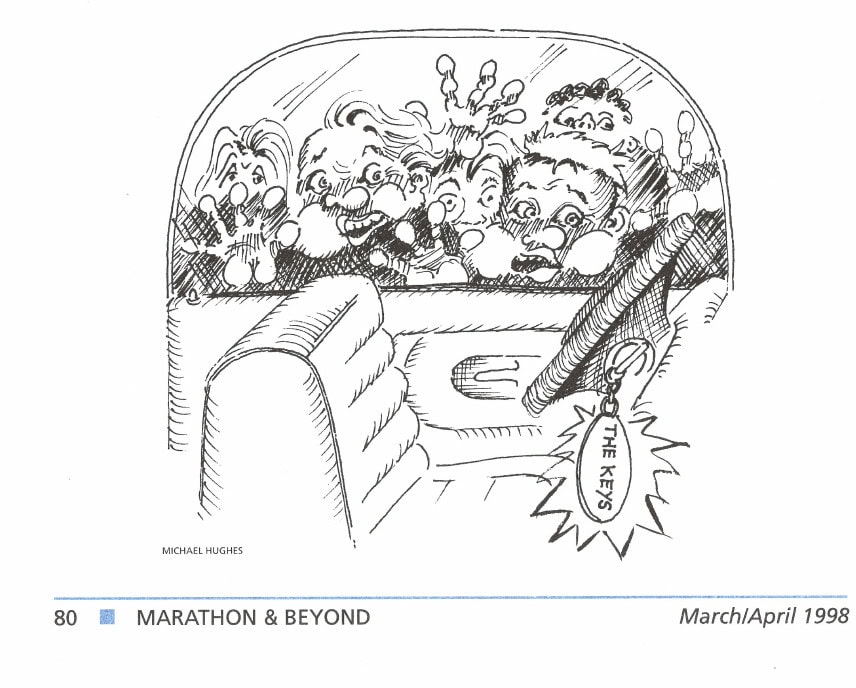
“No problem,” I replied. “The van is open,” and I scurried over to prove the point. I arrived as Meijer was futilely pulling on the door. I grabbed the handle myself and yanked. The door, open a crack, didn’t budge. Meijer and I pressed our faces to the glass; the key dangled playfully in the ignition.
We inserted our fingers into the crack. Nothing happened. I stared at the tantalizing keys, I stared at the timing equipment for the “100th Running of The Boston Marathon” resting inside the gleaming burgundy shanks of the “Official Car of The 100th Running of The Boston Marathon,” and I thought Ohnoohnoohno.
I explained that the car had somehow mysteriously locked itself. No one in our small cluster cooed sympathetically.
“I think we might ask the police chief for help,” Meijer said, very likely fighting back a string of choice Dutch swear words.
“Yes,” I gasped, grasping at what was obvious salvation. I trotted off toward the Hopkinton Common. The chief was readily located, slightly portly with badges agleam for the most important day of the Hopkinton year. An officer would come quickly, he told me. Within minutes, a young, moustached policeman puffed up, holding a long thin metal strip. We gathered at the car’s door; he slid the strip down inside the window, gthump, gthump; he pulled up and down to open the door. Gthump, gthump.
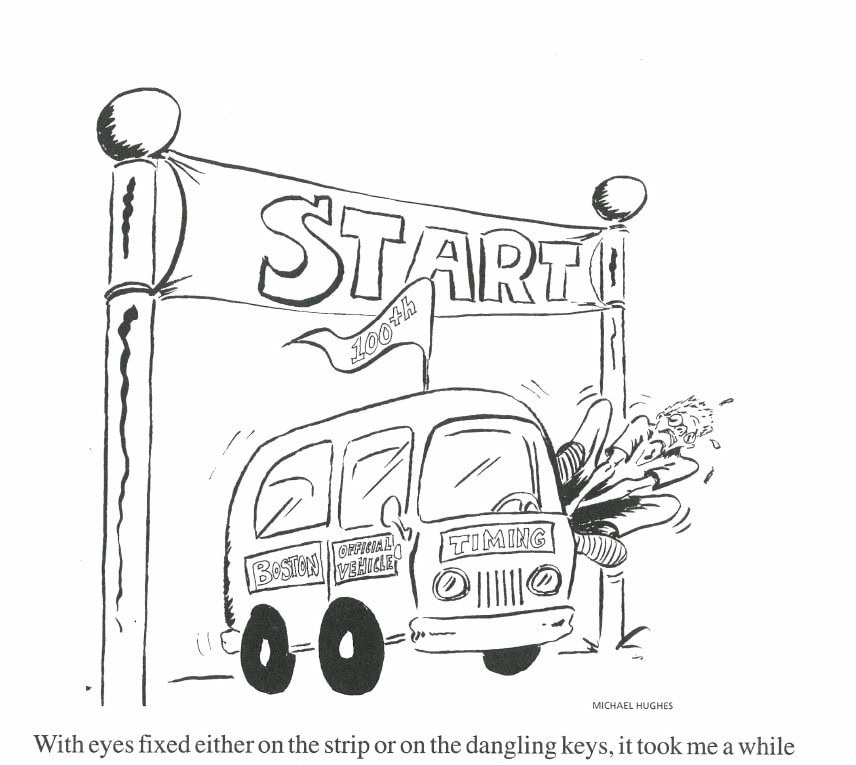
With eyes fixed either on the strip or on the dangling keys, it took me a while to realize that the officer and I were no longer alone with our little technical problem. I looked up, and into the wide lens of a TV camera. “What’s going on, officer?” queried a reporter from one of Boston’s four TV stations. Gthump, gthump, gthump.
“This woman from the Olympics,” replied the policeman, pointing to me, “locked the keys of this marathon vehicle inside the van, with the timing equipment in back.”
Word quickly spread. The quiet of the Hopkinton morning had now been shattered by the high drama at the start line: the timing equipment needed for “The 100th Running of The Boston Marathon” was locked in the van. From all points on the Common, reporters and camera crews converged on the burgundy Buick. Gthump. Gthump. Ohnoonnoohno.
A forest of camera lenses focused on the officer, manfully carrying out his task of rescue. They focused, too, on the distraught damsel in distress, recording for the breathless viewing audience her bleak squeaks of despair. Gthump, gthump. Ohnoohnoohno. Minutes dragged by as even the most obtuse mediaperson finally learned of our predicament and rushed to the scene.
Gthump, gthump; the officer continued to give it his all. Finally, he turned to me and announced the obvious: The lock on the Buick was too low; we would not be able to unlock the door. Squaring his shoulders for the folks viewing back home, he moved around the front of the car. He grabbed his billy club firmly by the throat. He purposefully stopped at the side vent.
DESPERATE MEASURES
Thwack! Tiny shards of glass sprinkled like little glimmering snowflakes over the front seat and over the ground beside the car. Reporters buzzed, cameras whirred. I covered my face with my hands, hoping the viewing public didn’t include higher executives from the local Buick dealership.
Meijer retrieved the keys, opened the back, and pocketed the keys without comment. The drama over, the timing system rescued from automotive imprisonment, reporters and camera crews drifted off to snare other riveting highlights of the morning.
Our group sprung to life, pulling out mats, uncoiling wires, placing the technical equipment. With obsequiousness worthy of the lowliest hoodlum in the presence of the Capo, I spent the morning scurrying for coffee, placing chairs at convenient places, arranging pencils within easy reach.
In comparison, a lapdog would be stingy in its attentiveness. The morning continued toward its 12 o’clock high. The runners started their journey to Boston, the system worked, Meijer grinned, and we headed back to Boston. I was allowed to drive my well-ventilated car. We met no irate Buick dealers.
BOSTON, April 19, 1963—Wednesday, April 10, 1963, breaks cloudy and raw over my Pequot Avenue home in Mystic, Connecticut. A few minutes before 6:45 A.M., when I set out running toward my English teaching job at Robert E. Fitch Senior High School, Groton, four miles away, ragged, soggy snowflakes clog the east wind and begin to mush roadsides and trails. I ponder switching from my customary brown paper grocery bag to a plastic wrapping for my cargo of clothing and papers. I decide to risk the brown bag.
This article originally appeared in Marathon & Beyond, Vol. 2, No. 2 (1998).
← Browse the full M&B ArchiveMore like this
1,000+ stories from 19 years of Marathon & Beyond
The complete archive of the legendary long-distance journal — digitized and free to read.
