

The Crucible
Two years ago I stood in this same place: the parking lot at the Pentagon transformed into the makeshift Runners’ Village in Washington, DC. I am waiting for the Marine Corps Marathon to start. Two years ago, I ran the Marine 10K. I stood here in my cotton T-shirt and sweatpant shorts among the thousands of runners, feeling like an impostor. I ran as much as or more than most of them each week but I did it alone, never in a race, never paying attention to time, only distance. I wasn’t a runner, just a person who ran. Today I stand in my high-tech running skirt and special wicking singlet. I do not feel like an impostor but instead like someone who has not only earned the right to be here but needs to be here. I am here to prove I can go the distance.
In the past year, I trained from the 10K to the half-marathon, and now I’m ready to take on the marathon. But really, the journey to this spot started on the day my son Nick deployed to Iraq. Or maybe it started before that, when he left for boot camp. Or maybe on the day we sat at the kitchen table while he signed his enlistment papers. Or maybe it started on 9/11, when he nonchalantly stated that, if there was a war, he would sign up and go fight, and I knew he meant it. Or maybe even before that, when he had set up toy soldiers to defend his castle play set, spending hours trying out offensive and defensive strategies, games I didn’t understand.
It’s hard to know where these things start, but I know where it will all end: at the finish line of the Marine Corps Marathon. * * * When Nick was 17, I told a friend who had a son the same age about his enlistment. “Oh, I’d never let my son enlist!” she insisted. I was shocked, not that she would feel that way but that she had the power to control his actions. No permission is needed to enlist. If the desire is strong enough, he will do it anyway, just as my father did.
▲
The author’s father, Louis S. Stahlman, USMC 1948–1952.
Courtesy of Gretchen Stahlman
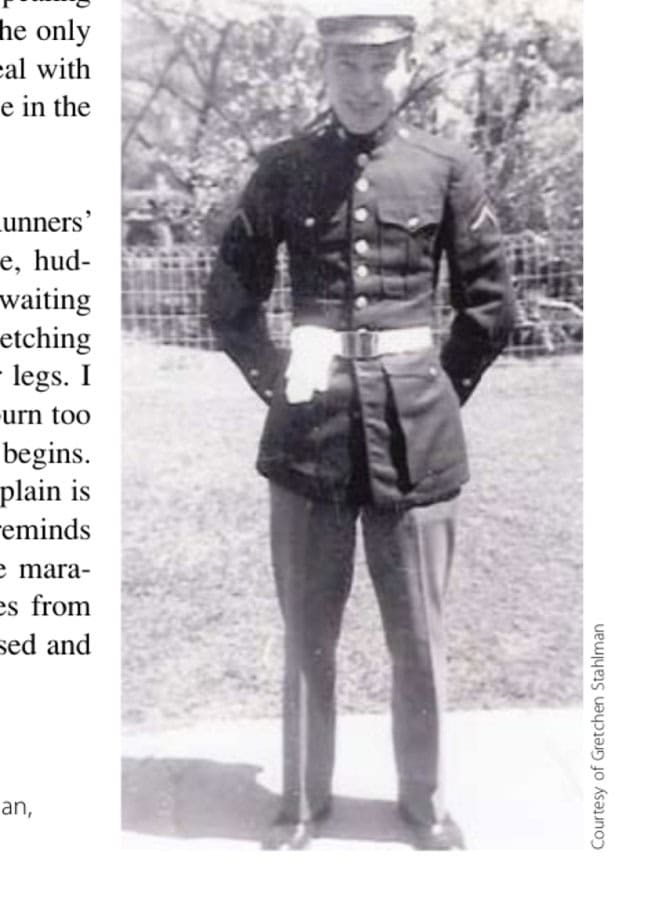
On June 16, 1948, my father, age 18, rode with his family to St. Louis, 60 miles northwest of Sparta, the small town where he grew up. When his father stopped at a red light, Dad saw opportunity in the form of the Marine Corps recruiting office. “
I’m getting out here. Go on without me.” He didn’t go home that night, but the next day he arrived in Sparta in the company of a Marine Corps officer in a shiny black sedan. The officer stepped out from behind the driver’s wheel; Dad slid out the passenger door. They approached the house, the officer’s heels clicking on the cement walk. My granny came out on the front porch wondering what this was all about, afraid to know. The officer explained that Dad had enlisted and was leaving immediately for boot camp. She was too shocked to do much more than to pray and hug him. Then it was time to go, to catch the train for Parris Island, and he was gone.
I know this story, although I haven’t known it my entire life. My father’s abrupt departure for the Marine Corps created a rift in the family that never healed. His mother blamed his father for running him off, and his father blamed his mother for her pride in her Marines—her uncle who died at Belleau Wood, her cousin aboard the USS Arizona, her nephew wounded at Okinawa—that made the choice appealing to a rambunctious young man. The only way to deal with it was to not deal with it at all, and so my father’s service in the Corps was never discussed. * * * It is not yet dawn when I enter the Runners’ Village. Runners are everywhere, huddling in tents looking for warmth, waiting in line for the porta-pottys, and stretching and testing the tightness of their legs. I try to stay warm so that I don’t burn too much energy before the run even begins. In one of the tents, a Marine chaplain is offering a prayer for runners. He reminds us of the supposed origin of the marathon: a messenger ran 26.2 miles from Marathon to Athens, then collapsed and
Nick with the author in the final minutes before leaving for boot camp.
▲
Courtesy of Gretchen Stahlman
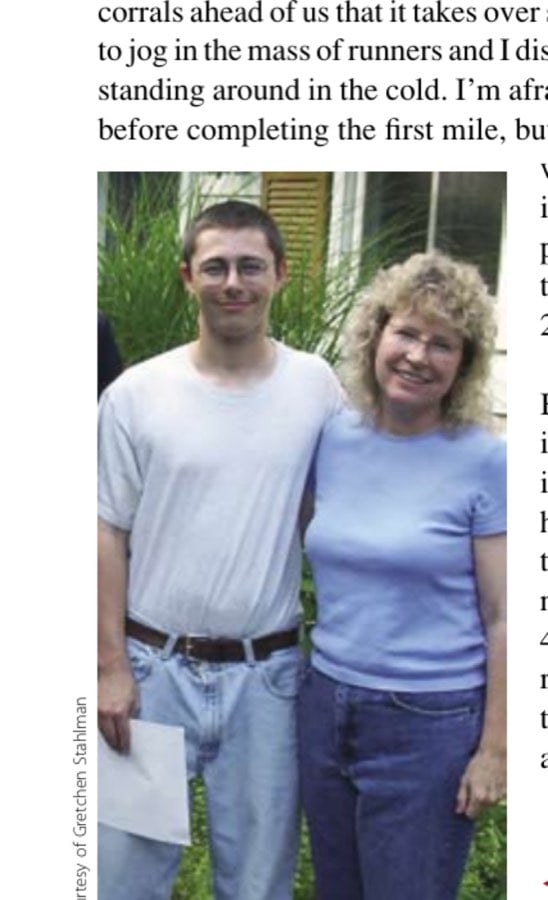
died. It seems like an odd story to bring up now, but it makes me smile because Nick has mentioned it to me several times over the last few months of training. “I wouldn’t run if a bear was chasing me,” he tells me. After four years of having
to run when ordered, he claims he will never run again. We’ll see, I say. In the morning’s first light, I line up for a last use of the porta-potty and then shuffle into the corral for my anticipated finishing time. It has been almost an
hour since I arrived in the Runners’ Village, nearly 20 minutes more to go before the race begins. It’s quiet in the corral as more runners fill in, and our anticipation grows; we just want to get going.
The sun rises over the horizon, a helicopter flies overhead, and the announcer’s booth plays rock ’n’ roll and gives the weather forecast: low 60s and sunny. Perfect, I muse, the Marines think of everything. But now it is in the 40s, and I’m shivering
from the cold, from nerves, from excitement. A baritone sings “The Star-Spangled Banner,” and I start to cry. I am really here, I am really doing this, it’s hard to believe this is really me, that I would take this on, that I might be capable of this.
I believe I can do it, but the day will prove me right or wrong. The starting gun sounds, but no one moves. There are so many runners in the corrals ahead of us that it takes over seven minutes to reach the starting line. I start
to jog in the mass of runners and I discover that my legs are completely numb from standing around in the cold. I’m afraid I might trip and fall and be trampled even before completing the first mile, but each step brings more circulation and more
warmth. I’m moving faster now. Each runner is starting to find his or her pace—some speed past me, I pass a few, I’m running faster than the speed I know I can maintain for the entire 26.2, but it’s OK. I am happy. * * *
Before Nick enlisted, the mere mention of his intention brought a rush of tears, immediate, as if I had sliced a sharp onion. Nick told me that he would rather live 10 minutes as a Marine than an entire lifetime as a civilian. I know too
many people, especially men, who reach their 40s only to discover they’ve built a minefield of regrets. They are plagued with the decisions of their lives, the ones made, the ones not made, a battlefield of coulda-woulda-shoulda.
I resisted telling Nick not to enlist, but my face showed my concerns every time he brought it up. If I persisted in discouraging his choice, if I let my fear rule us, if Nick let my fear overcome his desire, there could, would come a time when he looked back and wondered if he could have made it as a Marine. Could he pass boot camp? Could he hold his own in battle? Could he do, could he be who he envisions himself to be? “
It’s like that prayer that Uncle John told you,” Nick said to me. Lord, give me hard things to do so that I may know what kind of man I am. “I want to know what kind of man I am. I want to do hard things so I’ll know. I have to know.”
I did not want to be responsible for his not knowing the answers to those questions. It is better to know, possibly to fail, than to not know and live with perpetual doubt. It was my fear, not his, that could prevent him from knowing. He needed to know. One way or the other, he needed to know. He would conquer his fear later; I had to conquer mine now so that he would know what kind of man he is. * * * Already by the third mile, I need to pee. Too shy to peel off into the trees, I lose some time waiting in line at the porta-potty. Still, I’m glad I stopped. I want to feel good, and running with a full bladder does not feel good. And I didn’t come this far to pee on myself.
I’m warm now, and I toss my gloves and sweatshirt to the curb. The edge of the road is littered with cast-off clothing of runners that will be collected and distributed to the homeless. Now I’m running with bare arms, the breeze cool on my skin, and it feels like running at home. * * * In 2002, Nick, 16, dreamed of Saddam Hussein every night for almost a week. I was surprised since he normally seems so uninterested in current events. “
Mom,” he started out solemnly, “I have to tell you something.” He was so serious it startled me, and I instantly expected the worst. “I know what the dreams mean. If there is a war in Iraq when I’m 18, I’m joining up and going to fight.” “
I know,” I told him through sudden tears, “I don’t want you to.” He nodded as if he knew I would say that. “It’s not that I’m telling you what you can and cannot do with your life—you need to do what you know is right for you. It’s just that,” I took a breath to steady my voice, “I don’t want you to die.” “
I won’t die,” he promised. “I’ll go and fight but I won’t die.” He said this as if he could see the future, as if he had glimpsed his own destiny. It gave me a chill. I wanted to believe his vision but he was 16, the age of invincibility. Death, especially your own, is unimaginable. “
That’s why they send young men to war,” I told him. “An old man knows better.”
Since 9/11, I had searched for ways to cope with his desire to enlist. I had no role models, no one I knew who had been through this except my granny, who had died 20 days after Nick was born. I could not talk to her, but I could put the facts of her life together: her uncle dead, her cousin dead, her nephew injured, and her son gone to surely meet the same fate. A fatalistic voice inside told her that he would not come back alive, or, on the off chance that he did, he would be physically altered, or even if he sidestepped that fate, he would still be changed by his involvement in war. He would no longer be her boy, the one who ate seven of her cupcakes while she hung out the wash, the teenager who brought her a flower when he stayed out too late, or twirled her around until she got dizzy in their own private dance. Simply by his departure, she had already lost more than she could bear.
The fear, the sadness, the loneliness, the anger—these could all pale, if she allowed them to, when she thought of her own guilt in the matter. Her son wanted to escape his father, true, but he always wanted to make her proud, to join the ranks of the men she admired so much. With her damnable pride and her unending love that he sought to keep, she had unknowingly pushed him in the very direction she never wanted him to go. Now, I thought of my granny, that she never had a chance for a conversation like this with her son. She would have been grateful for this opportunity to advise him, to tell him of her fears, a chance to talk some sense into him before he made the biggest decision of his life.
Then I weighed it against the good that the Marine Corps brought to my father’s life. Before the Corps, he was a smart, athletic young man, a wild colt yearning for broader pastures. The Corps harnessed his abilities and desires and gave him the discipline and focus he needed. It gave him the ambition and opportunity to attend college, to get stellar grades that garnered a good career, far beyond what Sparta offered him. The Corps provided the foundation for his life; he provided the foundation for mine.
I looked at Nick, saw the yearning on his boyish face, the need for something more than this town, this mom could offer. “Promise me one thing. If you do decide to enlist, consider the Marines. You don’t have to become one, just promise me you’ll look into it.”
Nick nodded. “Because Grampa was a Marine, right?” “Yes,” I told him, “because of all the Marines in our family. I’d be proud to have you be part of it.” He promised. I still didn’t want him to enlist, but it was not my decision. It was his and his alone. I knew that if he became a Marine, he would serve his country with devotion, and the experience would have an everlasting effect on his life as it did on my father’s. And I knew that I was the one, like my granny before me, with my damnable pride in our family Marines, who had set him up to make the very decision that I most dreaded.
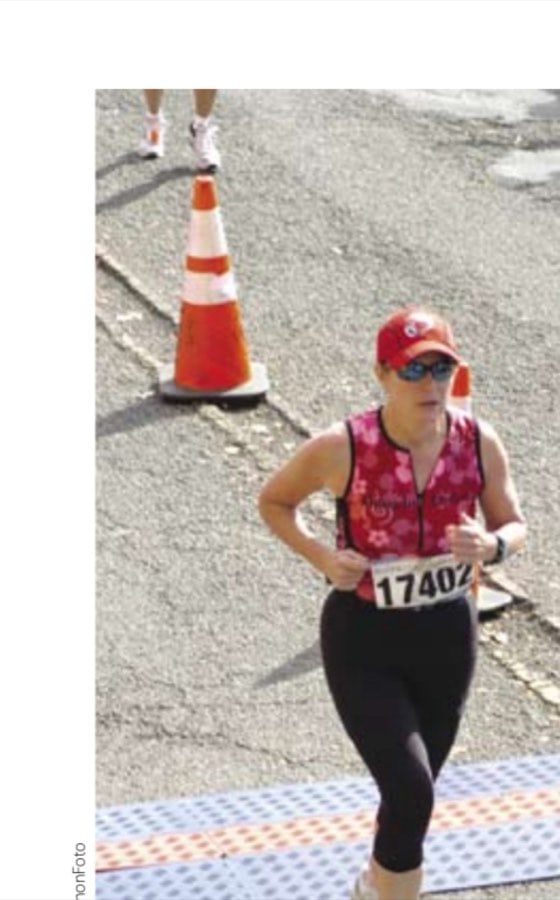
Photographed by MarathonFoto
* * * In the first few miles, runners chat with each other as they run. Some slow down on the upgrades, but I keep my steady pace. Now we enter a wooded section and fall quiet, the only sound our rubber
soles on the asphalt. We’re only at mile five, but reverence has set in. We can see the runners who have completed the loop we’re starting—they are on the uphill, we’re on the downhill, but they look strong, so we don’t worry.
We are incredibly peaceful, this congregation that trots together. We turn the corner of the loop and start the incline. As we near the top of the last hill, a guy stands with his bike and boombox that plays “
Sir Duke,” by Stevie Wonder. My race motto has been: Run if you can; walk if you need to; dance if you want to. I want to dance and so I do, just for a few seconds, but enough to garner chuckles from my fellow runners. ▲ Running at a slow and steady pace. * * *
In the fall before Nick left for boot camp, we ran together weekdays on the towpath along the old Erie Canal near our home in upstate New York. It was flat and quiet, and he never worried about anyone from school seeing him struggle. I slowly plod
ded along, keeping a steady rhythm. He dashed off out of view, and when I caught up, he was sitting under a bridge waiting for me. We were the tortoise and the hare until we both tired and walked a portion together. He would tell me about the book
he was reading on the life of famous Marine Chesty Puller, or we talked about Keeping Faith, a book about boot camp that we had both read. The recruit and author, John Schaeffer, had been a cross-country runner, and he found boot camp difficult.
I didn’t say anything to Nick, but I wondered how he would make it. When he read the book before bed, he told me, he got so jazzed up, he couldn’t sleep. For Christmas, I ordered a CD for him: Running to the Cadences of the
Marine Corps. Forty-one minutes of real drill instructors calling cadences and
real recruits responding, their boots pounding in rhythm as they ran. I heard the cadences playing in his room, the DIs calling, his responses, and I, too, felt the urge to run to the cadences. The snow made it impossible to run on the towpath, so I suggested the track at the community center, but he didn’t want to do that. It worried me that he was not running enough.
I bought a small MP3 player and loaded the cadences onto it. Alone, I took it to the track at the community center and started to run. It was a challenge to keep the faster pace the drill instructors set. I was winded after 20 minutes, but the next time, I pushed myself 25 minutes, then 30, 35. By March, I could run the full set of cadences: four miles in 41 minutes. * * * We enter Georgetown, running down the main thoroughfare of shops and apartments. College students cheer us on. A few have jars of Vaseline, and they hold out thick globs on tongue depressors. I wonder what it is for, and then I realize that if I needed it, I would know. I run on. Nine miles are done, and we leave Georgetown and head for the Potomac shore for the next loop. Ahead of me, I hear the loud voice of a Marine. He is running with two other runners who wear the singlet of the Semper Fi Fund, a sports program for disabled Marines. Each companion has a running blade for one leg, and they work at staying straight and tall in their lopsided runs. I know that to use the blade, they must have feeling in the amputated leg. They are feeling every step, just as we all are. * * * In August 2004, on the night Nick’s bus pulled into Parris Island, I waited up. Midnight, one, two, and as I lay awake in bed, I imagined him looking as small and lost as on his first day of school. Finally, at three, I slept. When I woke at eight, I knew his head had been shaved and he was dressed in fatigues and that he had not yet slept.
I wondered if Nick had taken the Initial Strength Test that he must pass to begin training: run 1.5 miles in less than 13 minutes, do 10 pull-ups, and do 50 crunches. I knew he could do the pull-ups and crunches, but I was less sure about the run.
I dressed in my running shorts and T-shirt. On the towpath, I plugged in the MP3 player, turned up the volume, and waited for the DI to order me to double time. I ran. Not fast but as steady as the call of the cadence. Left, right, lo-righty, lefty, right. I ran so that he would run better, my strength fueling his, 800 miles away, the only thing I could think of to do to ease my unrequited desire to help him.
I continued to run during Nick’s first year of service. Three miles, never more than four miles, just enough to sustain me. I listened to the cadences. He moved far beyond boot camp, but that was the only part I knew, the only part I understood, and so I stayed there. He progressed to combat training, then to artillery school, but
Photographed by MarathonFoto
I lingered on, trapped in boot camp with my drill instructors, staying with what I knew. Nick was stationed at Camp Lejeune, where he lived in the barracks and worked in a place he called “the shop.” He was there three months, six months, a year. His buddies deployed, but he did not. Maybe he won’t, I said to my father, some don’t. He didn’t say anything, just let me enjoy my complacency. It had been a long time since he had seen me not worried about Nick, and we both wanted it to last.
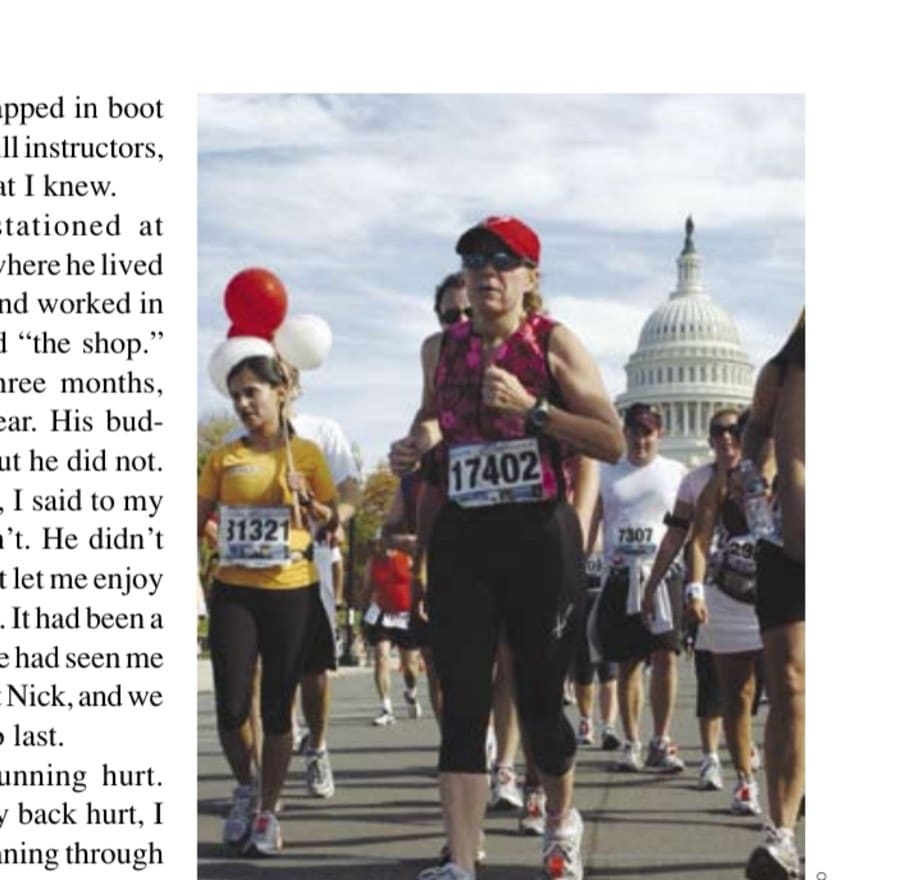
And then, running hurt. My legs hurt, my back hurt, I felt like I was running through pudding, my head throbbed. I attributed it to age, and I walked instead. I put away the cadences. I listened to recorded books, walking the streets of my neighborhood, slowly looking at the other houses, ▲ Passing the Capitol building. many that fly the American flag, but none with a blue-star banner in the window that I had in mine. I felt like a foreigner in my community, in my body. * * * At mile 12, Marines hand out packets of GU, a gummy mixture of electrolytes and nutrients to replenish our depleting energy stores. I take one in mocha flavor with caffeine that feels thick and rich in my mouth, like a highly concentrated drink from Starbucks. It gives me an energy boost, a spurt of sheer happiness, as I hit the halfway mark. Just like running the half-marathon, I think. Not so bad, I think I’ll do another. I turn the loop and trot toward the mall of monuments. * * * At Christmas 2005, Nick was granted leave. A slight snow had fallen. The plows pushed it aside, leaving the road shiny black and clean. We were in the car, I was driving, he the passenger.
“You know how I always joked that you couldn’t go to Iraq without a permission slip from your mother?” He laughed, “Yeah.” “And that I wouldn’t write one for you? Ever?” “Yeah.” He looked out the window at his hometown passing by. I waited for the light to change so I kept my eyes on the road, straight ahead. “
I changed my mind.” The light flicked to green, and I pressed the accelerator. I could feel Nick looking at me. “You have my permission to go to Iraq,” I said. These words were even more difficult than the ones I spoke that encouraged him to enlist in the Corps, but I said them strongly and clearly, owning them, with only a small quaver in my voice. “
Why did you change your mind?” “A lot of reasons.” I thought of my father, who had deployed with his unit only to be turned back before landing in Korea, and the regret he still felt over that. “I know it’s your job to go.” I took a breath and held it. “I know you want to go.” “
I wasn’t going to tell you,” Nick said as we passed another intersection, “but I already volunteered.” I was not surprised. Not surprised that he wanted to go, not surprised that he already volunteered, not surprised that he hadn’t told me.
It would be nine months more before the time came, but in September 2006, he deployed to Iraq, to Fallujah. * * * The streets of the capital are jammed with people. Most wave signs for their runner or wear T-shirts bearing the runner’s name. They watch for their runner, but they cheer for all of us. They clap, they call out encouragement, they clatter cowbells and tell us we are looking great. None of them are cheering specifically for me, but it all makes me feel good anyway. This is the perfect way to see DC, I laugh: no traffic, running along, people cheering you on, Marines handing you snacks and drinks. Everyone should see it this way. As I round the bend at the Capitol building, the Marine Corps band strikes up the theme from Rocky, and I truly feel that I can fly. * * * I don’t remember the summer before Nick’s deployment. I can look at my calendar and see that I did things, went places. I worked. I slept. I watched Law & Order. And I ate. My body hurt. I walked, but not far enough or fast enough to counterbalance the comfort eating. I ate mashed potatoes and gravy, I ate potato chips and drank beer, ate cookies. I ate a lot of cookies. And it made me feel better at the time. But afterward, when the comfort was digested and gone, I felt terrible. So I ate some more.
As the time of Nick’s deployment neared, I knew I couldn’t eat my way through his deployment. It was a false feel-good pill, a medication for the symptom and
Courtesy of Gretchen Stahlman
▲
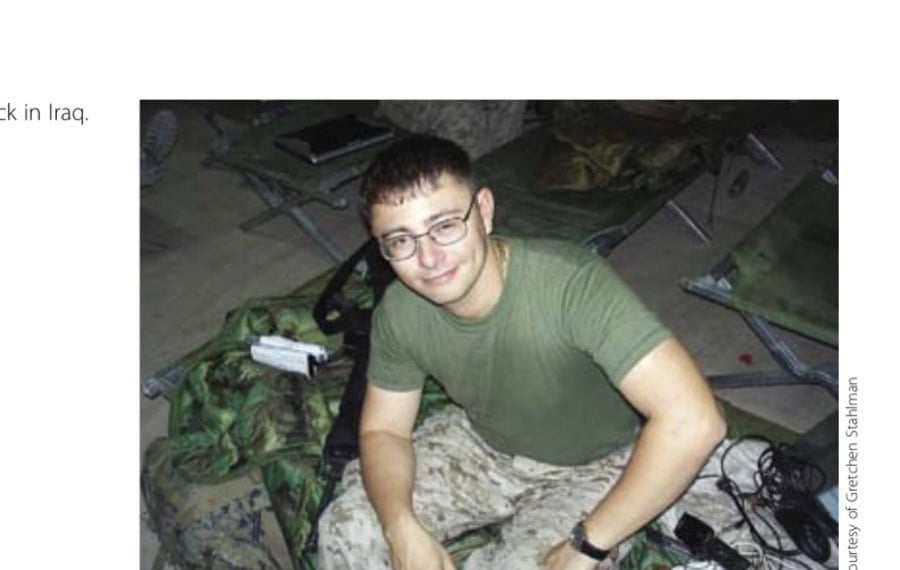
Nick in Iraq.
not the ailment. No matter how many cookies I ate, it wouldn’t keep my son from deploying. So I changed. I went back to what I knew, what I had used to cope when he said he wanted to enlist, how I passed his time at boot camp, then his first two years in the Corps. I started to run again.
I was surprised at how different my body felt. Where I had struggled through three miles, where four miles had been a major achievement, now it felt like nothing at all. I added a mile, and then another. I ran six miles, and I ran it every day.
My body changed; my mind changed. My time spent running came to feel like pensive meditation. For those 60 minutes each day, I ran alone, still with the drill instructor calling cadences in my ear but otherwise alone with my thoughts and worries. I didn’t have to pretend that I wasn’t consumed with worry. I didn’t have to answer questions from concerned friends and family on how Nick was doing when really, I had no idea. I didn’t have to worry about the government car pulling into the driveway—I wasn’t home, they couldn’t come, he had to remain fine while I wasn’t there, a mother’s logic. When I ran I was free of the obligations of work, the demands of the house, the needs of my younger son still in high school. And after the run, maybe it was the endorphins, but I felt better able to continue on, at least until my next run.
And it worked. By the time my son came home, unharmed, in April 2007, I had lost 35 pounds. “I’m afraid I’m going to break you,” he said as he hugged me tentatively. “No way,” I said. “I’m tough.” * * * At mile 21, the route crosses a concrete bridge back to Arlington. I have never run 21 miles before; my longest training run was 20 miles. Now I am in new territory.
The bridge feels endless; the bright sun glittering off the pavement looks like crushed glass. A blockade prevents traffic on the left side of the road; cars whiz by on the right. Runners start to walk, more and more, but I keep at my slow and steady pace. I do not want to walk. I will not walk. If I walk, it will be hard, maybe impossible, to run again. I want to finish the marathon running, so I plod along over the endless bridge.
At last I’m at the end of the bridge, and I cruise down the slope into Crystal City. This stretch loops back on itself, and I see the runners ahead of me, a steady stream, so many that, despite having passed other runners, I fear I am last. I am running downhill, and I dread the long uphill that the other runners are taking on, that I will take on when the route loops. But after the turn, I still feel like I’m running downhill and now the incoming runners are on the uphill. I know it must be my mind playing a trick, the fatigue of my eyes, an optical illusion, but it makes me chuckle—everything ahead looks uphill when you’ve run 22 miles. * * * I recognize this stretch from when I ran the Marine 10K a year ago. On that day, I lined up with 5,000 other runners. The summer before, Nick had returned from Iraq, married his high school sweetheart, and worked at Camp Lejeune. And then he deployed again, just a few weeks before my 10K run in Washington.
That day I pinned my number to my shirt and attached the timing chip to my shoe. On my back, I wore a sign: “My son is a Marine in Iraq. I hope that he is as proud of me as I am proud of him.” As I ran, other runners asked about Nick, when he was coming home, told me to thank him for his service. I felt as if I was representing both of us, even though I knew he hated to run.
After I crossed the finish line, I hugged several of the Marines who were there to support the runners. “My son is in Iraq and can’t hug me, so you have to!” None of them refused. Later, I chatted with other runners, including marathoners. I admired their shiny medals: the Marine emblem of the eagle, globe, and anchor as big as a saucer. I wanted my own, and I wanted to earn it. I decided that in one year’s time, I would run the Marine Corps Marathon. * * * At mile 23, the going gets tough—really tough. My joints start to hurt, my muscles tighten from the repetitive motion, four and a half hours of left, right, left, right, the same steady pace, slowing only for the crowded water stops. I’ve had worse pain while running—a shock through the knee that makes me hop, a back spasm that jerks me up—but this is none of that. This is the steady pulsing of overuse. My body wants me to stop running, but I’m not listening to it.
Just three measly miles to go. When I’m out on a training run, it takes me three miles to warm up. Walk, walk, my body whispers.
I stop and stretch under a bridge. I pull my right heel to my butt and then lift my knee to my chin. Then the left heel to butt, knee to chin. I stretch up, lean back, pull myself out of the position I have held since early morning. The muscles are grateful for the stretch and I feel my blood flowing again. I’m ready to take on another mile. * * * In July 2008, Nick completed his service and was granted an honorable discharge from the Marine Corps. He was ready to leave military life behind and start a new, civilian life. He and his wife moved to the house they bought 45 minutes from mine and he started college, thanks to the GI Bill. He had survived his experience, but I still had more miles to run.
In the weeks before the marathon, I focused on becoming strong enough to complete it. My life revolved around training: running miles, stretching, finetuning my nutrition. I felt compelled to run the marathon in a way I didn’t fully understand. I thought I had been running to keep my son strong, to be able to run to him if necessary, to keep my sanity. All of these things were true, but as the marathon neared, I discovered a new facet.
Just as the Marine Corps had worked its magic on my father, it had transformed my son. Nick was a lazy, slovenly teenager who never did anything more than was absolutely necessary. I knew a different man lurked inside, but I hadn’t known how to call him forth. Nick didn’t, either, but he recognized that he needed something drastic, something abrupt that would not coddle him as I did but kick his ass from boy to man. Through the Corps, he became motivated, inspired, ambitious, and capable—all that I ever hoped my son to be.
It transformed me, too. Where once I was soft and scared, now I was strong and durable. I had survived the solitariness of the mother with a son at war, and I knew the kinship of kindness from family and friends and strangers who prayed for my boy. I understood my place in my own family: daughter, mother, the one who carries on the genetic trait of raising a Marine. By running the marathon, I could show my gratitude for this transformation, letting my body speak in the language of the Corps: using my mind to power my body to do more than I ever thought possible.
There was only one thing I asked for in return. I wanted proof, a token, a symbol that I am strong enough, worthy of the title of “Marine Mom.” My father has one, my son has one, and I too wanted a medal bearing the eagle, globe, and anchor. They earned theirs through completing the Crucible, the 54-hour battle simulation obstacle course at the end of boot camp. They defeated the course on little sleep and meager rations, but on solid training and desire, the culmination of all that they learned and who they had become. This marathon is my crucible. At the end I would know if I had done enough, become strong enough, learned to endure enough and, if I am worthy, I would earn not the same medal that the
Marines in my family have worn but one unique to me. I would have my eagle, globe, and anchor that says this daughter of a Marine was good enough to be the mother of a Marine. * * * I keep my eyes straight ahead. Sounds are jumbling around in my head, bits of cadences, bars of fight songs, phrases of pep I used during training. Walk. Walk. Words are sounding over and over, looping on themselves, drowning out the sound of my hip joints. I let the sounds spiral around, a swarm of syllables obscuring the droning of my body. Walk. Walk.
I pass the signpost for 24 miles. Two more miles to go. How often have I felt that it was barely worth going out for a run if I was going to run only two miles? Two miles are nothing, but there is little to occupy my mind now, so it seems longer, every step is a mile, walk, walk, and all I can do is continue to take one step at a time. Left, right, walk, walk, lo-righty, left, right.
The persistence of the desire to walk surprises me. I had been on runs before where I felt the urge to walk and sometimes, many times, I gave in to it. But this was more than an urge, like the misnamed “urge to push” that occurs in labor when the body contracts unassisted. Walk. Walk.
I spin through the catalog of my mind, finding the things I most often think of when tiring in a run. In anticipation of need, I developed those things, knew I could rely on them to push me through these last miles. The image of my granny’s uncle in his World War I uniform at the battle of Belleau Wood—he had loped beside me for miles, limping on his leg that would later be amputated. Granny’s cousin, the spry hooligan who chose the Marines over reform school only to be entombed in the USS Arizona. Granny’s nephew, my father’s cousin, watching the mortar explode and knowing he would be wounded but would live while those behind him perished. My father, who never landed at Inchon as planned and always regretted it. My son, who hates to run and wouldn’t run if a bear was chasing him. I search my mind for them, wait for them to fall into place beside me. I am ready to hear their boots, feel their power, their strength at my back, pull new energy from our old bloodline.
Walk. Walk. Walk. Walk. I see them, one by one, not running at my side but standing by the side of the road that leads to the finish line—standing at ease, not cheering me on, not watching over me, just watching. I feel the biblical words rise out of me in anger and confusion, “Why have you forsaken me?” I curse my foolishness at the fantasies developed during those training runs. These men are not with me, I am not one of them, I am not worthy to wear the eagle, globe, and anchor as they did. I am silly and weak. Walk. Walk. I am kidding myself that I ever imagined that my strength, my life matched theirs. They had been a mirage, ridiculous and false, a snippet of my own arrogance to think that I, so meek and mild, could be their equal.
Photographed by MarathonFoto
▲
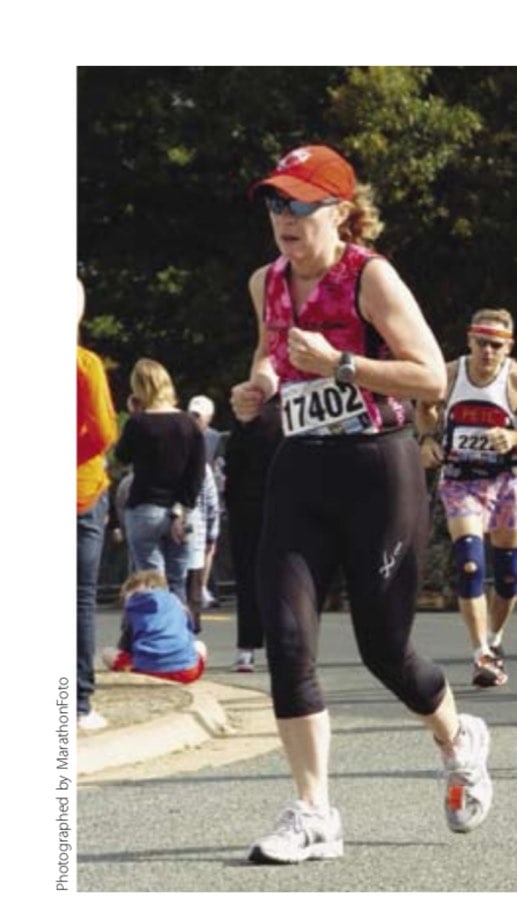
The author pulls energy from her bloodline to keep on running in the final miles of the Marine Corps Marathon.
I feel them fade from view. Still, I plead with them to run with me. They do not. I try to order them to fall in, although I know that won’t work. They stand their ground, as stubborn as ever, our shared family trait.
Why? I ask. Why won’t you run with me? Walk. Walk. Don’t quit. Just walk. Walk. Twenty-five miles. One point two miles left to go. Walk. I will not walk. I will keep running. I hiss at them: if you won’t run with me, then I will run
alone, damn it. Alone. And then I know: they will not run with me because I must run alone, just as I have done all along. This is my body made strong through perseverance. This is my mind made invincible through enduring the days. This
is who I am: a mother once too weak to run a mile, too soft to discuss enlistment with her son, now strong enough to help him enlist, to support his deployment, to welcome him home in gratitude and relief. I will not walk.
The last mile is hard. I am not strengthened by my thoughts. I am on the 10-mile hike that ends the recruit’s Crucible, fatigued and sleepless, carrying a 40-pound pack—each man must march it himself. This mile feels like eternity,
as if the road is stretching farther and farther, like black taffy, twisting into a long, sticky ribbon. The road is an asphalt treadmill, moving but going nowhere. I keep running. I will do this. I will do this hard thing so that I’ll know what kind of mother I am.
The crowds are thick and jubilant as I pass the 26-mile mark and start the arduous quarter-mile climb to the finish line. At the 10K, I had poured on a spurt of energy and surprised runners when I passed them on this final hill. It had felt good,
and I want to do it again, but I can’t. I pump my arms to gain momentum, but no matter how badly I want speed, my legs keep to the same pace, the ticking hands of a clock. I can see the finish line, a sweet sight. I pull at my reserves, left, right,
left, right, walk, walk, no, left, right, a few more steps, left, right, one more, raise
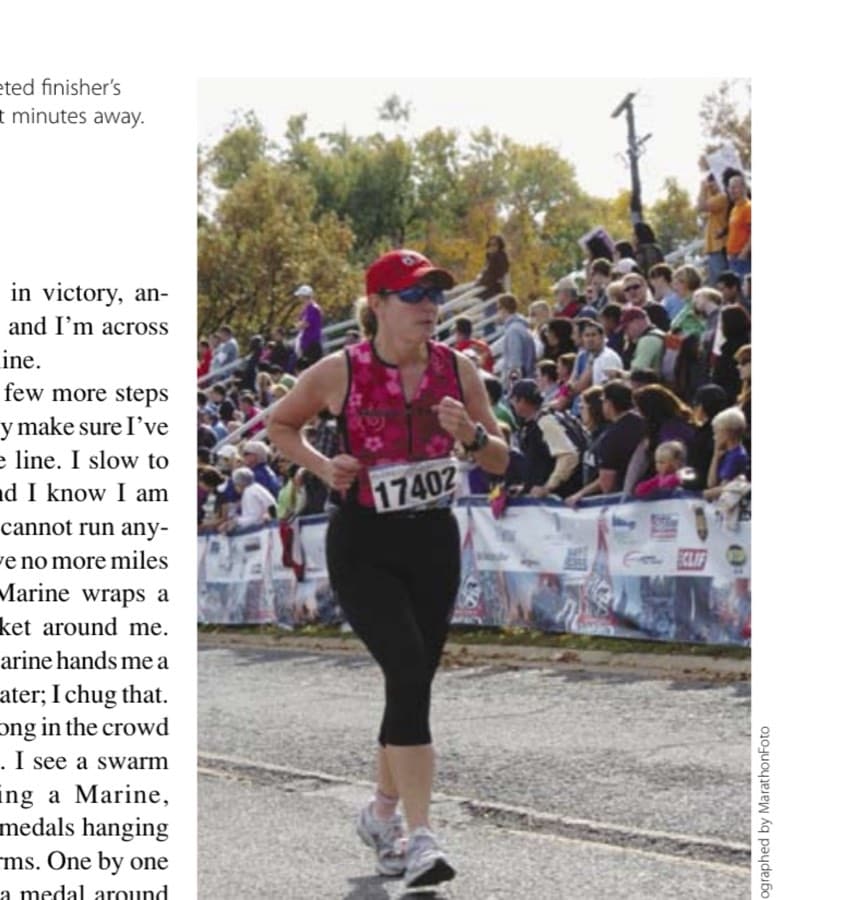
your arms in victory, another step, and I’m across the finish line. I jog a few more steps just to really make sure I’ve cleared the line. I slow to a walk, and I know I am finished. I cannot run anymore; I have no more miles to go. A Marine wraps a solar blanket around me. Another Marine hands me a bottle of water; I chug that. I shuffle along in the crowd of runners. I see a swarm surrounding a Marine, dozens of medals hanging from his arms. One by one he drapes a medal around each runner’s neck. I wait, I am patient, I am calm. I bow my head and he hangs the medal around my neck. It is mine at last, my eagle, globe, and anchor, so heavy and glistening on this bright and beautiful day. * * * It is the morning after the marathon. I feel good—not sore at all, although I can tell I used my muscles the day before. I don’t even need another hot shower to loosen up my body.
My flight home is not until 5:00 p.m., checkout time at the hotel is noon, and I’m not sure what I’ll do, where I’ll go in the intervening hours. I try to find a microwave to warm up my dinner leftovers for breakfast, but I can’t find one, so I eat the steak and mashed potatoes cold. They still taste good. I pack up my stuff, all the memorabilia from the marathon, and I wear my commemorative jersey. I place my medal in my handbag.
I wonder what to do with the flowers my boyfriend brought me. I know they won’t make the journey home, I don’t even want to try. I could leave them in the
Photographed by MarathonFoto
▲
The coveted finisher’s medal is just minutes away.
room for the next guest, or give them to one of the housekeeping staff or a random stranger whom I meet on the Metro on the way to the airport. All of these have a certain appeal to me: the random act of kindness paid forward from a premeditated act of thoughtfulness. But I don’t do any of those things.
I check out of the hotel and board the shuttle to the Metro station. I pull my suitcase behind me, carry the wrapped flowers atop my handbag. The station is at a mall where I have lunch. I’m hungry, very hungry, as if my body is pleading for the calories it burned the day before. I feed it what it wants: creamy soup, whole-grain bread, and a chocolate croissant. Girls who run marathons, I tell myself, can have a chocolate croissant.
I take the Metro to Arlington, passing through the turnstile, jerking the suitcase behind me. It has started to drizzle, so I check at the visitor center to make sure I know the route. I put up my umbrella and start the walk across the cemetery to my destination.
It all looks so different from yesterday, this same road then crowded with spectators, runners making this last leg to the finish line. I barely recognize the hill to the finish line; it looks like a rise, not a steep grade, not the final obstacle I had to overcome. The crews are taking down the barriers, rolling up banners, removing signs. The grass is trodden flat, and water puddles have turned into mud in the aftermath of the marathon.
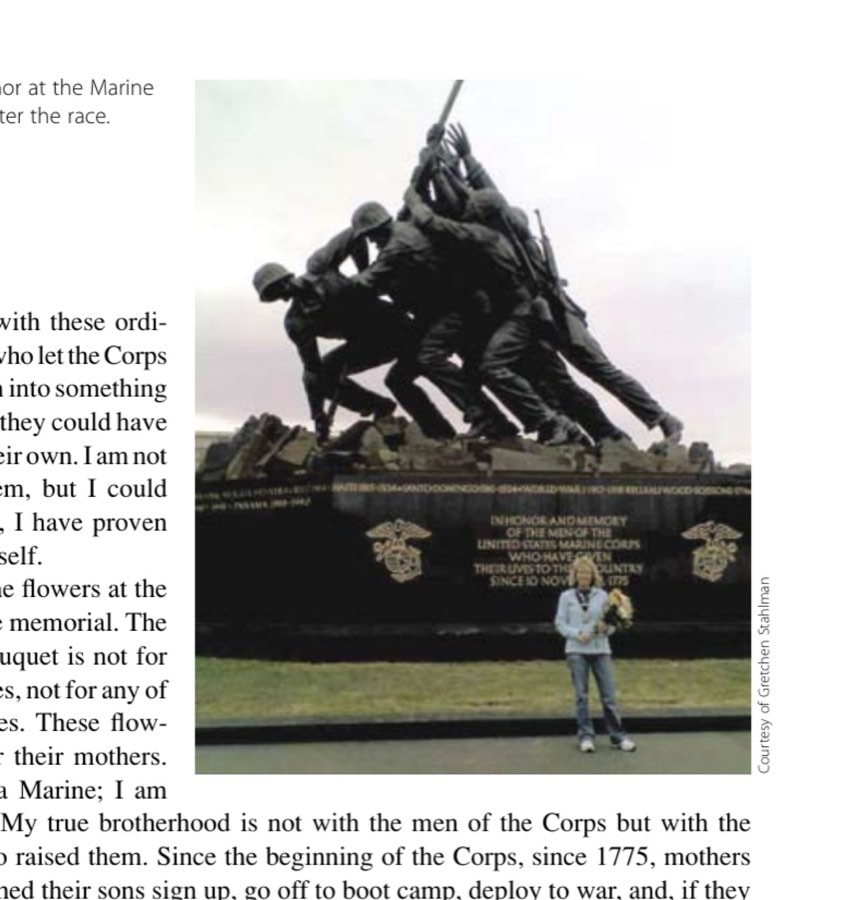
The Marine Memorial looks bigger than I remember it: the sculpted hands huge as they grip the flagpole, boots as big as five-gallon pails, helmets like umbrellas. The granite surrounding the monument shines even in the gray drizzle. Others have arrived, other marathoners taking pictures of each other in front of the monument, their medals dangling around their necks. I park my suitcase, set my handbag on top, and pull my medal out to put it around my neck. It hangs low on me, to the middle of my belly. I stand in front of the monument, flowers in my arms, and fumble with my cell phone to take a picture of myself. Another runner offers to take it for me, and I accept.
I am so small in the picture, the enormous Marines behind me constantly planting the flag atop Mount Suribachi. The eagle, globe, and anchor engraved on the monument flank me, and behind me, these words: In honor and memory of the men of the United States Marine Corps who have given their lives to their country since 10 November 1775. But I read it differently. I mean no disrespect to the men of the Corps, but there is no memorial for the ones to whom I want to show my respect this day. I change the words, erase the engraving, fill in the holes, and carve new words: In honor and in memory of the mothers of the men of the United States Marine Corps.
I touch the engraving of the eagle, globe, and anchor, feeling my medal swing out from my body as I lean in to touch. That is for the Marines in my family who through their simple lives have given me a view of my own. I feel a sense of com-
monality with these ordinary men who let the Corps make them into something more than they could have been on their own. I am not one of them, but I could have been, I have proven that to myself. I lay the flowers at the base of the memorial. The wilting bouquet is not for my Marines, not for any of the Marines. These flowers are for their mothers. I am not a Marine; I am a mother. My true brotherhood is not with the men of the Corps but with the moms who raised them. Since the beginning of the Corps, since 1775, mothers have watched their sons sign up, go off to boot camp, deploy to war, and, if they are blessed, come home again. Below the inscription on the monument are these words: Uncommon valor was a common virtue.
We mothers of Marines share not a virtue but common worry and fear and gratitude for their survival, and we share the sorrow for the mothers who have lost their sons. Our common virtue is our ability to cope with the choices of our children, to express pride over their service, and to endure, to always endure.
I put up my umbrella, shoulder my bag, and tip my suitcase onto its wheels. I walk around the monument, seeing the names of battles that once were bookish history but now are the reality of my family: Belleau Wood, where my granny’s uncle lost his leg and then his life; Pearl Harbor, where granny’s cousin still serves below the silky waters; Peleliu, where granny’s nephew spun in circles in his amtrac trying to return to the landing ship, and then Okinawa, where he was wounded in his knee; Korea, where my father never landed. Some day Iraq will be engraved there too, for my son and the tours he served there. And my motherly hope is that it will be the last engraving. It won’t be. There will be more war, more Marines, more mothers needed to raise them and then to let them go.
Courtesy of Gretchen Stahlman
▲
The author at the Marine Memorial after the race.
This article originally appeared in Marathon & Beyond, Vol. 14, No. 6 (2010).
← Browse the full M&B ArchiveMore like this
1,000+ stories from 19 years of Marathon & Beyond
The complete archive of the legendary long-distance journal — digitized and free to read.
