

“H
ow far can a human run in the cycle of the sun?” was the slogan of one notable 24-hour event in the 1980s, which neatly encapsulated the essence of the event. The 24-hour race has a natural quality to it that is missing from any other ultra event. The race limits are not delineated by some artificial construct of the human mind, like hours or kilometers or miles. The day has been an integral part of the cycle of life for eons, affecting the existence of all living creatures and plants.
The early history Man’s running has always been tied to this daily cycle of the sun. In the distant days of prehistory, hunters would follow the trail of their prey until dusk, sleeping on the animal’s tracks until sunrise, when their pursuit could continue. Until settlements grew up and running messengers were required to carry urgent information between homesteads and villages, actually running at night was not necessary or desirable.
The hemerodromoi of ancient Greece were the most famous of these early running messengers. The word “hemerodromoi” appropriately means “day runners.” It is from this period that we find some of the earliest known records of distances covered within a day. A Plataean named Euchidas ran from his hometown to Delphi, returning the same day, covering a distance of about 1,000 stades, which is approximately 113 miles/182K in 479 BC. According to Pliny the Elder, some time around 325 BC, Philonides, the hemerodromos of Alexander the Great, seems to have run the 1,200 stades (136 miles/219K) from Sicyon to Elis in a day, though the account of the run is not clear.
A Manx walker, Alswith, son of Hiallus-nan-ard, took part in one of the earliest challenges to cover a specific distance within a day. This took place close to 1,300 years later, around the 10th century, on the Isle of Man, a small island situated between England and Ireland. Alswith undertook to walk around all the churches on the island in one day. The roads were very rough, and there were many churches on the island. Alswith had almost completed his task, having covered
around 70 miles/112K, when he fell exhausted. Alswith’s feat is commemorated annually in the Manx Parish Walk. Some 200 years later in 1171, a shoemaker named Gilbert walked from Canterbury to London, 66 miles/106.2K in one day.
The actual 24-hour challenge may be based on a tradition that has more to do with allocating land based on endurance. Leo Tolstoy retold an old Russian folk tale in his 1886 short story “How Much Land Does a Man Need?” A Russian peasant travels to the land of the Bashkirs, a Turkic people who lived on the slopes and confines of the southern Ural Mountains and the neighboring plains. The peasant was told he could have as much land as he could walk around in one day, but he must get back to the place he started from before the sun set or he would lose his money. In his greed he tries to encircle too much land and dies from exhaustion trying to get back to the starting point.
This traditional way of allocating land appears not to be limited just to the Bashkirs. When Norse settlers came to Iceland in the ninth century, the leaders staked out estates, as much land as they could walk around in one day.
The Lakeland 24-Hour record in Britain is based on the same premise—unless the runner returns to his start point before the completion of 24 hours, the additional peaks he may have covered within the 24 hours do not count toward a record. The current record of 77 peaks covering a total distance of approximately 109 miles was achieved by Mark Hartell in 1997. The women’s mark is 64 peaks, set by Nicky Spinks in 2011. The rules of the challenge mean a claimant has to cover all the previous record holder’s peaks and add extra ones with at least 250 feet (76 meters) of ascent, one-quarter mile apart.
The first successful 24-hour run, in something approaching modern terms, took place in the 15th or 16th century. One of the running couriers, or peichs, of the Turkish Empire made a wager to run from Constantinople to Adrianople, approximately 200K/125 miles, between two suns (within 24 hours). The peichs were usually Persians by birth. They would normally carry messages between the two cities in two days and two nights. These running couriers always ran in bare feet. Their feet were reputed to be so hardened by this that the peichs reportedly had themselves shod, like horses, with light iron shoes! It is not recorded whether the peich undertaking the wager wore iron shoes; fortunately, his win is, despite the heat of an August sun.
Footmen and pedestrians In the 16th and 17th centuries, modern competitive long-distance running began to develop in the British Isles. By the early 18th century, various running footmen in service to the nobility of the period had reputedly covered more than 100 miles in 24 hours. Most notable among these were Owen M’Mahon, an Irish footman, who was recorded as running the 112 miles/180K from Trillick to Dublin in about
1728, and Beau Nash’s footman, Bryan, who reportedly ran from London to Bath, 107 miles/172K, more than once in 1732. Perhaps the earliest British 24-hour match took place in June 1754. For a “bett” of 50 pounds, John Cook undertook to walk or run 100 miles/160K. He took ill
after 12 hours and 60 miles/96K and was forced to forfeit the wager. However, John Hague, another Briton, was more successful eight years later when he completed 100 miles in 23 hours, 15 minutes. The idea of the lone athlete in a match against time continued for many years.
Foster Powell, the great pedestrian of the 18th century, set out from the Falstaff Inn, Canterbury, to go to London Bridge and back in September 1787, a distance of some 112 miles/180K, in 24 hours. He won his wager with 10 minutes to spare,
despite being given brandy instead of wine on the return journey,
The birth of the 24-hour race
Courtesy of Andy Milroy
The first actual 24-hour race, to cover as great a distance as possible in a day, was probably in October 1806. Abraham Wood and Robert Barclay Allardice, the two greatest pedestrians of the period, faced each other for the first and only time.
Wood had run 40 miles in 4:56 in bare feet, wearing just flannel drawers and a jacket, so quickly that few horsemen could keep up with him. Allardice, his opponent, was better known as Captain Barclay, the name under which he competed
in athletic matches. He was one of the greatest athletic figures of the 19th century and had walked 100 miles in 19 hours and run a quarter mile in 56 seconds. Partly because Wood hadn’t a backer willing to put up a big
enough stake, the gentleman Barclay was not keen to race the professional Wood. However, the race was arranged on the Newmarket to London Turnpike on a roped-off mile when a Spitalfield publican came up with 150 guineas. The match was for 600
▲
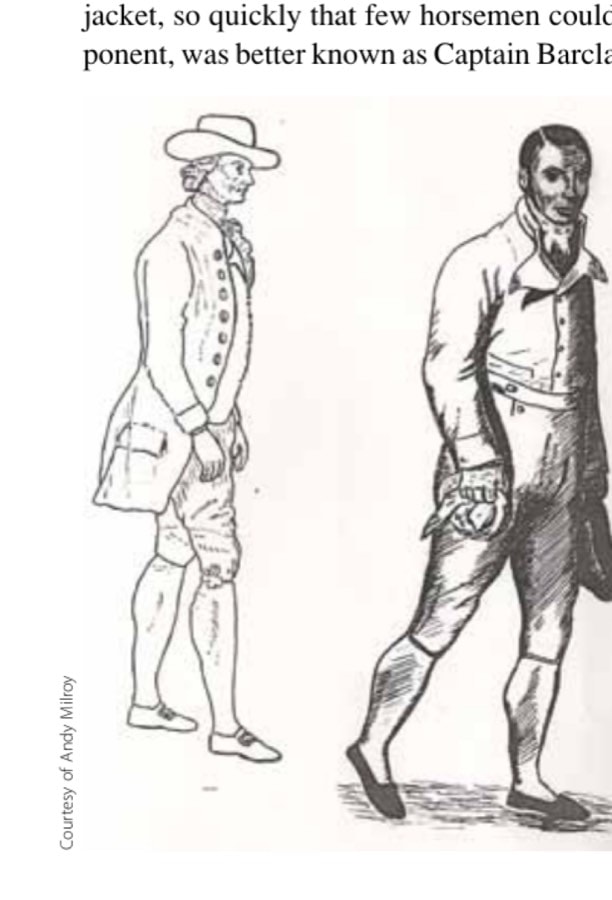
Foster Powell (left) and Robert Barclay Allardice. Barclay competed in the first 24-hour race in 1806.
guineas a side, and Barclay was allowed a generous handicap of 20 miles/32K. In other words, Wood had to win by over 20 miles! Arguably the first 24-hour race was the most successful yet seen in terms of the number of spectators who were determined to see the event. The race attracted the greatest crowd of people ever seen at Newmarket, which was a town well known as a venue for horse racing and thus used to large crowds. “Carriages from barouche and four to the dicky cart and the horsemen and pedestrian exceeded all accurate calculation.” A guinea was refused for a bed, all the inns were full, and even stables and haylofts were used profitably for accommodation.
In the period leading up to the race, Wood had been 100 to 90 in the betting but at the start Barclay was a five to two favorite. Both men were dressed in the appropriate garb for such a race in that period, in flannel with no legs to their stockings. In the first hour Wood covered eight miles/12.8K to Barclay’s six/9.6K. He had clawed back four of the 20 miles/32K he had given Barclay by the end of the third hour and at 24 miles/40K stopped for refreshments. Some 16 miles/25.7K later, after just 40 miles/64K, Wood retired from the match, amid great controversy. Apparently, after he had run 22 miles, some of his handlers had deliberately given him liquid laudanum, a form of opium. The “mastermind” behind this fixing of the race is perhaps easy to work out. Wood’s Spitalfield backer had never risked even 20 pounds on anything less than a certainty and on the day of the race was betting on Barclay to win!
Potentially one of the great 24-hour races had become one of its greatest anticlimaxes. It was a classic match between a faster runner over shorter distances pitted against a known stayer. Abraham Wood had run 50 miles in seven hours while in training but had stopped in the dangerous, wet conditions while still fresh, to avoid injury. However, the knowledgeable experts of the period considered that it was very likely that Barclay would have covered 135 miles/216K. This would have forced Wood to cover 155 miles/248K to win, which would have been beyond him.
It was to be left to a hostler named Glanville to achieve the greatest distance in 24 hours in this period, not Barclay or Wood. Glanville agreed to walk 142 miles/227K in 30 hours for a wager of 80 guineas. (It was acceptable in those days for a walker to run occasionally to ease cramps so his walk/run was described as “go-as-you-please.”) Glanville set off at a brisk pace and later broke into a shuffling “walk” of six miles/10K an hour. Despite great difficulty, he eventually won his wager, on the way covering 117 miles/187K in 24 hours.
The Napoleonic Wars, during the late 18th and early 19th centuries, had been a golden age for the gentleman walkers and runners. However, as the new century progressed, their premier challengers, the pedestrians, as the professional athletes were now known, increasingly had the field to themselves. This was to be so for the next 25 years or more, but the pedestrians often found the financial rewards
were small. In 1823 Hugh Russell, a young Irishman, undertook a match to cover a specific distance within 24 hours. The interesting thing about this performance was that he had to cover 100 Irish miles (an Irish mile being 2,240 yards/2,048 meters). He reportedly succeeded, thus covering 127 miles, 480 yards/204.825K.
Only one pedestrian was reported to have surpassed this mark, as far as I know, prior to the great revival of ultra-walking and -running in the 1870s. On the Helston road in Cornwall, well away from the gaze of the knowledgeable, a professional named Swain was said to have achieved 130 miles/209K in 24 hours, 5 minutes in 1856, this merely for a collection, not even a substantial wager.
The first women 24-hour performers There is very little recorded of early female performances in the event, though obviously women also had to cover long distances on foot as part of their ordinary lives from earliest times. Women first appear in the history of the 24-hour in the mid-18th century when, in July 1765, a young woman went a distance of 72 miles/115.8K from Blencogo to within two miles of Newcastle in one day. Later, in May 1827, on a half-mile stretch of the Carlisle Road, Mary McMullen, apparently about 60 years old, set out to walk 92 miles/148K in 24 hours. She subsequently made good that challenge, covering the distance with 31 minutes to spare. Two years later at Winchester she reputedly covered 96 miles in 23:40 for a public collection.
The six-day boom Russell’s walk had been around the Basin in Dublin, a 529-yard/483-meter course, and all the previous 24-hour marks had been set on the road. One man was to be responsible for the event moving to the track. American Edward Payson Weston in December 1874 succeeded in accomplishing a feat that had been long regarded as impossible—covering 500 miles/804.6K in six days. His success generated so much interest that the era of professional six-day racing was born.
Success had not come easily to Weston. Prior to his December walk he had failed to cover 500 miles three times in 1874. Reputedly, he had failed to cover l00 miles/160K in 24 hours 47 times in the 1860s before finally succeeding! However, in his earlier failures to cover 500 miles, Weston had covered 112 and 115 miles [180K and 185K] on the first day of his attempts to set world 24-hour track bests. Riding on the interest generated by the six-day racing boom, other walkers were to improve on this. Briton Harry Vaughan reached 120 miles/193K in a 24-hour race, and in a 26-hour event fellow countryman Billy Howes produced a daily split of 127 miles/204K.
The 24-hour record began to really take on a modern look when British runners George Hazael and subsequently Charles Rowell took the best mark from 133
miles/214K to 150 miles, 395 yards/241.763K in the first day of six-day races. Rowell’s style was well suited to such an event, being described as an incessant “dogtrot.” His 24-hour mark is even more remarkable in that he took only 22:28:25. If he had continued for the full 24 hours at the same speed, he would have gone over 160 miles/257K. This was perfectly feasible because after a mere three and one-half hours of sleep, he went on to subsequently set world bests at 48 hours of 258 miles/415K and at 72 hours of 353 miles/568K later in the race! Rowell’s mark was recognized within the pedestrian world as the 24-hour record.
There was at least one interesting 24-hour race at this time. In Italy on June 9, 1879, the Italian pedestrian Achille Bargossi won a challenge over 24 hours, running 165K to beat a horse ridden by its owner on a gravel path at the Villa Massani in Rome.
Female pedestriennes were also inspired by the public fascination with pedestrianism. The first woman to cover 100 miles in 24 hours was probably in distant New Zealand, which was not immune to the disease. Catherine Wiltshire, a 23-year-old emigrant from England who had previously undertaken pedestrian feats with her husband, including an attempt at 500 half miles in a thousand hours, sought to cover 100 miles in 24 hours in 1876.
She was acknowledged by “competent sporting critics to be the fastest female walker against time that has ever appeared in the colonies” and her style was “remarkably graceful and rapid.” She was initially credited with walking 100 miles in 21 hours and 50 minutes, but after covering the reputed 100-mile distance, she covered two more miles to make up for the fragments of the laps over and above the 28 that had to be gone over each mile. She finished this with 20 minutes to spare, in 23:40.
In the United States two years later, a French woman named Exilda La Chapelle covered 100 miles in 25:24, but this was probably the closest any woman got to Catherine Wiltshire’s mark in the 19th century. In 1877 Mary Marshall had achieved 90 miles/145K in Boston in a 100-mile match against time, and Amy Howard, the greatest of the women pedestriennes to tackle the six-day, covered 95 miles/153K in the first day in a six-day race in San Francisco in 1880, and obviously 100 miles was within her capabilities in a one-day event.
The great interest in professional long-distance endurance contests inspired amateur athletes to tackle such events. Britons John Fowler-Dixon and F. M. R. Dundas contested a 100-mile walking match in August 1877 in which the former became the first amateur to cover 100 miles in 24 hours. In the United States, J. Bruce Gillie, a Scottish/American, improved on this with 108 miles/174K, and then another British walker, Archibald Sinclair, covered 120 miles/193K at Lillie Bridge in London in 1881. Yet another Briton, James Saunders, came over to New York the following year and, in a race in the American Institute Ring, ran 120 miles, 275 yards/193.372K, apparently nonstop. The final word by the walkers,
at least in absolute best terms, was 131 miles, 580 yards/211.354K by Tommy Hammond of Britain in 1908.
Arthur Newton and Wally Hayward
Courtesy of Andy Milroy
Hammond’s walking mark was to stay as the best mark by an amateur for over 40 years, and for an even longer period the professional best remained with Rowell. It was Arthur Newton, the greatest ultrarunner of the 1920s, who was to take up the 24-hour challenge. Newton had made his name with wins in the early days of the Comrades Marathon in South Africa before coming over to Britain to set road bests for the London-to-Brighton and the Bath Road 100 Miles. He then turned professional and attempted to exploit his fitness in the 1928 Trans-continental Pyle race across the United States. He was hit by injuries in that race and in the subsequent event in 1929. Along with other veterans of the two races, he remained in training and made a limited career as a professional athlete in 500-mile relays, snowshoe races, and even six-day races against horses! The professional 24-hour world best attracted Newton, and he decided to have a crack at it even if he had to pay for the privilege, which in the end he did.
He promoted an indoor 24-hour in Hamilton, Ontario, in Canada in April 1931, at the age of 47. The track was specially built but was small, with 13 laps to the mile, but its design incorporated square corners to offset dizziness. The early pace was cut out by a fellow veteran of the Pyle races, Australian Mike McNamara, who picked up world bests for 30 and 40 miles before he continued on to 100 miles in a little over 14 hours. At this point McNamara stopped for a bath while Newton continued to circle the small track until the Australian returned. His return was to be delayed for some 20 minutes because McNamara was seized by cramps. Newton felt he was honor bound to take the same length of time off the track over his bath. This gesture, in fact, served no useful purpose since McNamara retired from the race soon after. Thus Newton was left well in the lead, aiming “to
▲
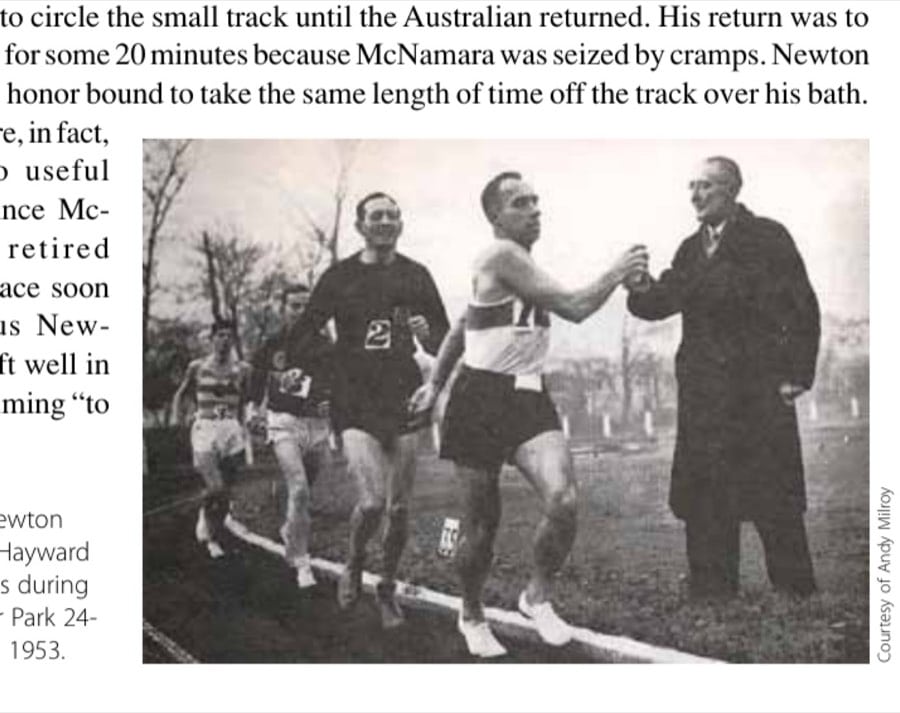
Arthur Newton gives Wally Hayward refreshments during the Motspur Park 24hour race in 1953.
travel with the most perfect rhythm” he was capable of achieving. He had covered 152 miles, 540 yards/245.113K by the time the full 24 hours had elapsed. The women’s 24-hour was to be raised to new heights by another South African-based runner. Geraldine Watson was a very tough individual who would set off on very long walks—200 miles/320K was quite an ordinary sort of distance for her—with only a small automatic pistol for protection. Watson had run the Comrades in 1932 and ’33 and then decided to enter a 100-mile road race organized at Durban in 1934. The race was held on a circular road course, in perfect weather for the first nine hours. The event was then hit by rain and gale-force winds. Despite these conditions, Watson clocked 22 hours, 22 minutes to become the first woman in the 20th century to cover 100 miles in 24 hours.
Arthur Newton moved to Britain permanently after the Second World War and persuaded the Road Runners Club to promote an amateur 24-hour event. The great South African runner Wally Hayward had come to England with the intention of setting records for the Brighton and Bath Road races. After Hayward had successfully completed these tasks, Newton persuaded him to stay on and tackle the RRC 24-hour.
The 24-hour was new territory for all the runners who lined up at the start of the Motspur Park event in November 1953. It had been initially suggested that Hayward should be opposed by relay teams of two, but the Road Runners Club decided to make it a straightforward race. In the Hamilton indoor race, Newton had reached the 100-mile point in less than 15 hours; in the Motspur Park race, Hayward blazed through the same distance in 12:46:34. It had been planned that Hayward would take a brief rest of 10 minutes at this point, but he was so tired that he wanted to come off the track for a shower and a massage. It was only after half an hour that he finally rejoined the race. By then he had stiffened and was cold. He was forced to run differently: he walked, then ran, then walked again before he finally got into a labored running rhythm. He was to struggle on like this to the end. He described it later as running “like a pig with its snout to the ground.” Hayward had apparently been aiming for 170 miles/270K, but he still finished with a very credible 159 miles, 562 yards/256.4K. Derek Reynolds, the 50-mile record holder, took second place, also passing Newton’s mark with 154 miles, 1,226 yards/248.96K. The Motspur Park race was also remarkable for the fact that the average age of its three finishers was 44 years!
The revival of the 24-hour Hayward’s 24-hour mark was to remain a sporting novelty for over a decade before a stalwart of the RRC, Don Turner, began lobbying for the club to revive the event. A 24-hour race was originally scheduled for October 1969, but by general agreement this was changed to a 100-mile event instead. However, eventually in November 1973, the RRC put on the 24-hour event at the Walton track.
Since 1953 there had been other 24-hour races elsewhere in the world. New Zealander Denis Stephenson had run 142 miles/228.5K along the Auckland waterfront in 1963 and then subsequently had covered 131 miles/211K on the track the following year. In 1971 another pioneer, Italian Enzo Boiardi, had covered 131.6 miles/211.831K on the track at Piacenza, and earlier in 1973 Armando Germani, another Italian, had run over 137.6 miles/221.479K at Trieste. Later that year, in South Africa, Alan Ferguson covered 138 miles/222K. The time was ripe for a revision of the world best in the event.
The 100-mile track races that had been promoted by the RRC in the late 1960s and early ’70s had given British runners some experience of the stresses likely to be faced in a 24-hour race. It was a veteran of such races, a 41-yearold Tipton miner, Ron Bentley, who seemed best prepared mentally. Passing 50 miles in 6:08:11 and 100 miles in 13:09:32, he did not stop at the latter distance, unlike Hayward. Bentley began to falter only when he reached Derek Reynolds’s British record of 154 miles/248K. With three and a half hours to go, Bentley strained a muscle in his right leg, and that, together with the torrential downpour of rain that happened about the same time, reduced him to walking, then running slowly. The drive and concentration that had pushed him to break Hayward’s mark evaporated on reaching the South African’s world best. In the last hour he just limped around the track with a blanket around his shoulders. He was able to add only two miles/three kilometers in that last hour, ending up with 161 miles, 545 yards/259.603K.
It is interesting to speculate what Newton, Hayward, and Bentley could have achieved in a second or subsequent 24-hour races. Since these runners set their records, it has become obvious that competitors usually improve as they gain experience in the event. Jean-Gilles Boussiquet, for example, improved with each of his first three track runs.
Following Bentley’s run, there was no sudden great explosion of interest in the event. From 1973 until 1977 the 24-hour event was still confined to just Italy and South Africa until Tom Roden ran 156 miles/251K at the Crystal Palace in London in 1977, the best mark in the world since Bentley’s run. Then, gradually, 24-hour races began to appear all over the globe, in the United States, France, Rhodesia, and Czechoslovakia.
In the United States, 24-hour races in the late 1970s were often low-key affairs with informal lap recording. It was such deficient recording that twice denied Park Barner’s efforts from receiving due recognition, on the first occasion nullifying a US record and then subsequently, in 1979, a possible world best with over 162 miles/261K. However, this confusion over recognition of world bests was to be eventually resolved when the following year one of the great figures of the event appeared, Frenchman Jean-Gilles Boussiquet.
Jean-Gilles Boussiquet Boussiquet had formerly been a soccer player and had been running less than two years when in November 1979 he tackled the 159 miles/257K Millau-Belves race. Boussiquet tied for second place in the race in 28:15:30. Three weeks later he tackled his first 24-hour, on the road at Niort, where he was second with 139 miles/224K. He learned swiftly and five months later, at Coetquidan, covered 162 miles/261K. This mark was not recognized for record purposes because no lap times were taken.
Boussiquet traveled to England to ensure that the next time he set a world best, it would be recognized. In October of that year at Blackburn, he officially broke Bentley’s record with 164 miles, 192 yards/264.108K. Obviously not content with that, a month later he returned to Niort to set a road best of 158 miles/255K.
Lausanne in Switzerland in 1981 was the first major international 24-hour race and saw a classic confrontation between Boussiquet, the 24-hour runner, and perhaps the top 100K runner on the Continent, the Czech Vaclav Kamenik. This match was reminiscent of that between Captain Barclay and Abraham Wood close to 200 years earlier.
Kamenik naturally went out fast, clocking 7:34:58 for 100K and 12:28:16 for the 100 miles, the fastest such split time seen up until then in a 24-hour. The Czech had overreached himself. Running a beautifully paced race, Boussiquet surpassed all the other contenders and took the world best to new heights, adding eight kilometers/five miles to the world best with a distance of 272.624K/169 miles, 705 yards.
Thus 1981 was perhaps the year that saw the event come of age. Three different runners covered more than 162 miles/260K in three different races that year. One such mark was by the 21-year-old Mark Pickard, who set a British record of 163 miles/263K. Fourth in that race was Dave Cooper, making his 24-hour debut, the start of his remarkable career in the event.
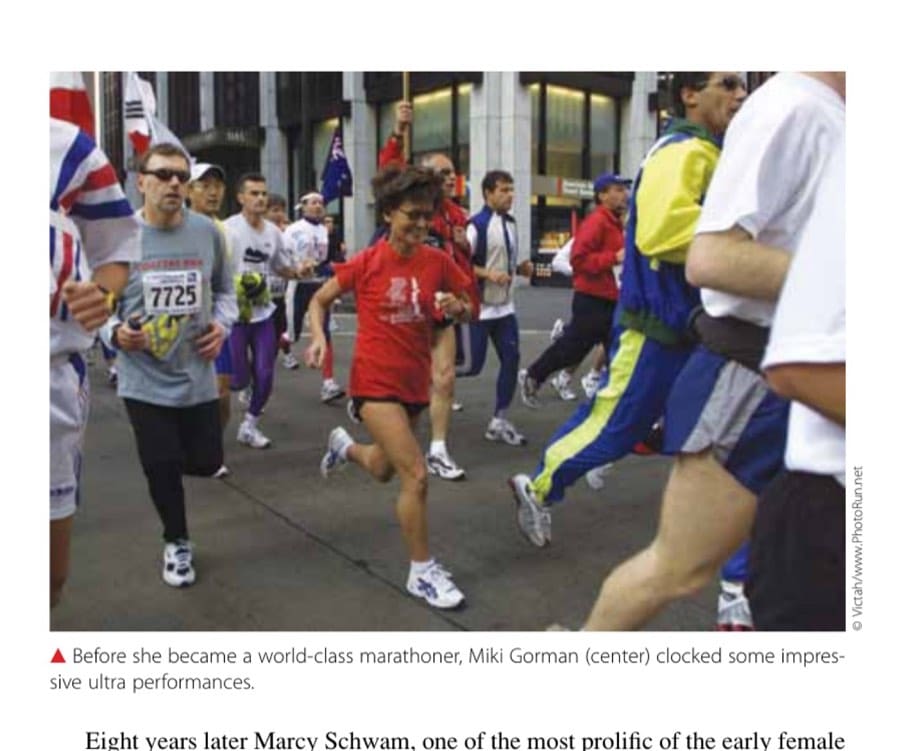
Women take the 24-hour seriously Women were encouraged to enter longer running events by the rise of the feminist movement in the United States in the early 1970s. Miki Gorman, a JapaneseAmerican, clocked 21:04 in running 100 miles in a 24-hour indoor race in Los Angeles, setting a track best. Gorman was subsequently to drop down to shorter distances, running the second-fastest marathon ever in 1976 of 2:39:11 and dominating the American marathon scene in the ’70s. Gorman’s world 24-hour mark did not remain on the record books for long; the following year a South African grandmother, Mavis Hutchison, ran 106 miles, 736 yards/171K. Hutchison had a subsequent career as a journey runner.
© Victah/www.PhotoRun.net
▲ Before she became a world-class marathoner, Miki Gorman (center) clocked some impressive ultra performances.
Eight years later Marcy Schwam, one of the most prolific of the early female ultrarunners, extended the world track best to 113 miles/183K, taking en route world bests at 50 miles, 100K, and 100 miles. Other Americans, Sue Ellen Trapp and Sue Medaglia, continued to move the world mark ever upward in the early ’80s; in 1981 the latter covered 126 miles/203.4K.
The British enter the fray That year had also seen one of the most competitive 100-mile road races of all time when Briton Martin Daykin beat his fellow countryman Dave Dowdle by some 23 seconds (12:16:46 to 12:17:09)! Dowdle had actually finished that race in fairly good shape but had been unable to withstand Daykin’s finishing kick. It was decided to promote a 24-hour track race the following year to enable the two runners to compete in a longer event. World and British record holders Boussiquet and Pickard were also invited to the race.
Weather conditions were wet and sometimes windy, but the fierce competition did much to mitigate this. Mark Pickard was an early leader, with Daykin and Dowdle a little way back. Daykin then began to push on with the intention of setting a new 200K best. Boussiquet unfortunately took ill soon after 100K. Daykin retired at 200K, and Dowdle was left alone in the lead. He overcame a
bad patch and rallied as the 24-hour time limit approached. Even a late, very heavy rain squall did not slow his determined drive to the finish. During his bad patch, Ron Bentley and Jean-Gilles Boussiquet were seen urging him forcibly back on to the track. Dowdle’s final distance of 274.480K/170 miles, 974 yards was a world best.
Dowdle had trained hard for the event, his training peaking at 240 miles/380K a week. His life prior to the race had consisted for many months of just running, eating, and sleeping, apart from when he was not putting in a full day’s work as well. The race took place in May, and as part of preparation he had covered over 3,000 miles/4,800K since the previous Christmas. As a result of this training, he was able to complete the race without significant breaks, moving at nine-minute mile/5.6-minute kilometer pace.
This race was also significant for another reason. Behind Dowdle was a battle between Lynn Fitzgerald and Ros Paul. The two women had contested the previous year’s London-to-Brighton race, with Fitzgerald eventually emerging as the winner. It was the first occasion British women had run a track ultra. Fitzgerald was to dominate the women’s race, setting world bests at 50 miles and 100K. She had problems at 100 miles but rallied to set a final distance of 214.902K/133 miles, 939 yards, a world best. Paul tracked her all the way and also surpassed the previous world best, with 129 miles/208K.
Three months later Ros Paul broke Fitzgerald’s mark, covering 216.648K/134 miles, 1,089 yards. Most remarkably, this performance was set on day one of a six-day race! Paul was to continue to set world bests at 48 hours and six days, too. Her performance was watched by an interested spectator, a certain Eleanor Adams.
Dowdle’s mark was to be surpassed on the road later that year at Niort by Bernard Gaudin of France, who recorded 274.715K/l70 miles, 1,231 yards.
A Greek dominates the day run You may recall the day runners of ancient Greece, the hemerodromoi, who appeared earlier in this article. Perhaps this is where the story comes full circle. The most famous of the hemerodromoi was Philippides, better known to history as Pheidippides. Philippides had run from Athens to Sparta in 490 BC to ask the Spartans to help fight against the invading Persians. His Athens-Sparta run appears to be a historical fact, unlike the later run from Marathon to Athens, which was added to the story many years afterward. Philippides’s famous run from Athens to Sparta was to become the basis for a race, the Spartathlon. In 1983, the first Spartathlon was won with great ease by an unknown Greek named Yiannis Kouros. Since this unknown runner had managed to beat several very experienced 24hour performers and cover the tough 245K/152-mile course in under 22 hours, the skeptical were convinced that he had cheated. Kouros was subsequently invited
to compete in a multiday stage race along the Danube. There he proceeded to show his true credentials, decimating the elite field. In 1984, the following year, he was invited to take part in the New York six-day race.
In Kouros’s first ultra track race, he covered 163 miles/262K the first day, 103 miles/165K the second, and 91 miles/146.4K the third. The knowledgeable members of the ultrarunning world waited for his inevitable retirement, but it did not happen. Yiannis Kouros shattered George Littlewood’s 96-year-old six-day record by 12 miles/20K!
Kouros returned to the United States later that year to compete in a 24-hour road race in Queens, New York. He went through 100K in 6:54:43 and 100 miles in 11:46:37 and achieved a finishing total of 177 miles/284K, this despite taking a very leisurely 27:50 over his final mile. Kouros had added six miles/10K to the 24-hour road best!
The following year the French Montauban 48-hour was endorsed as a championship event. Kouros was invited since he had broken the 48-hour record en route in his six-day run in New York. He did not make any concessions to the fact that he had a second day to run. In 23 hours he covered 283.6K/176 miles, 388 yards. He then stopped for an hour’s rest, having easily broken the world track best. He then continued to complete another 281 miles/452K to set a world 48-hour best.
Tougher opposition faced him later in the year when he returned to New York— Hurricane Gloria. The Queens 24hour one-mile loop was battered by five hours of 60 mph/100kph winds, driving rain, and falling debris. In order to surpass his previous road best set on the same course, Kouros was forced to use the whole 24 hours. His final total was 178 miles/286.463K, another world best.
© Stan Wagon
▲
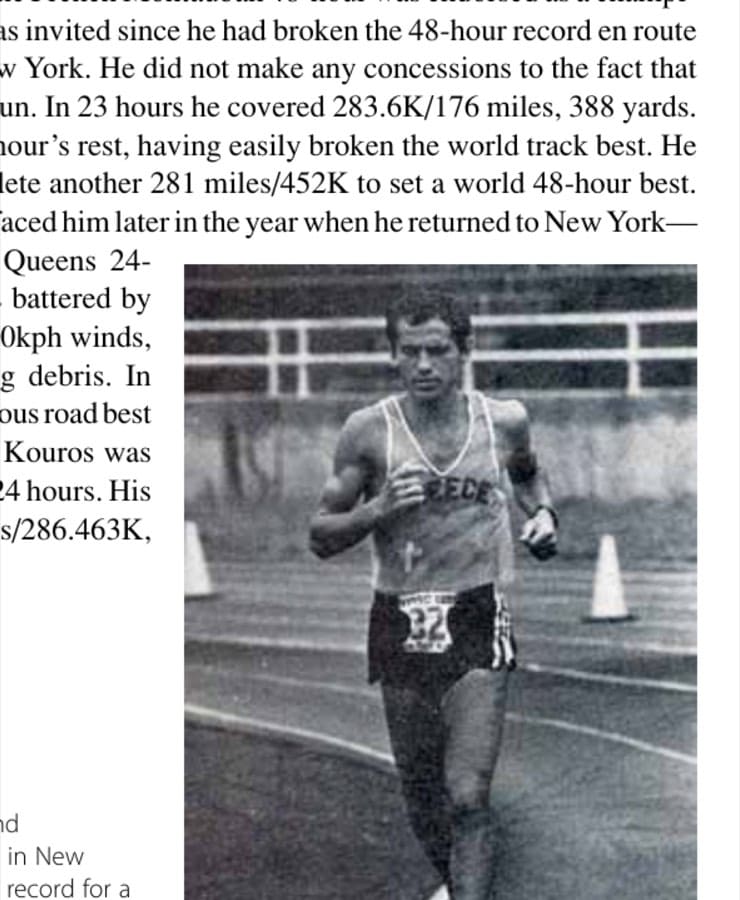
Greek ultrarunning legend Yiannis Kouros, shown here in New York in 1984 when he set a record for a six-day race, has the world best 24-hour track record, which is a staggering 17 miles greater than the next best 24-hour track performer.
Fierce female rivalry When Ros Paul broke the 24-hour track record in 1982, as I have said, it was under the watchful eye of Eleanor Adams. Adams herself took the record three years later with 138 miles, 777 yards/222.8K but wanted to go farther, to 140 miles. At Honefoss in Norway the following year, she just missed out on breaking her own world best, but the indoor loop and tough marble slabs of Milton Keynes gave her the opportunity to achieve her ambition.
Her most serious competition in the race would come from fellow countrywoman Hilary Walker. Walker had set a road best of 137 miles/220K in 1986, and the match between the two women was viewed with great anticipation. They were only 10 minutes apart at 100K, but Walker was forced to slow because of a back injury. Adams pushed on to set a new absolute best of 141 miles, 375 yards/227.261K at the indoor venue. At Feltham on the road three months later, Walker added two miles/three kilometers to that total, recording 143 miles, 527 yards/230.618K, and in 1988 improved her road best to 146 miles/236K. Meanwhile, the track best had been edging upward; Belgian Angela Mertens moved the world mark to 140 miles/226K in the same year.
Adams was to have the final word in her competition with Walker. In 1989 she traveled to Melbourne in Australia for a track 24-hour. There she averaged 10K every hour to finish with 149 miles, 411 yards/240.169K, her greatest 24hour performance.
International championships In 1990 the first International Championship was held at Milton Keynes in Britain on an 890-meter loop indoors around the shopping mall. The Milton Keynes venue offered protection from the vagaries of the weather, but its merciless marble surface was very hard on the feet and legs. Perhaps the greatest 24-hour field assembled up until that point contested the race. Don Ritchie was among these runners. He was widely regarded as one of the great 100K runners but had a poor record at 24 hours. That was to change. He ran away from the rest of the field, passing 100 miles in 12:56:13 and 200K in 16:31:08, achieving a final distance of 166 miles, 429 yards/267.543K, an indoor best. Eleanor Adams made a similar impact on the women’s race. She reached the 200K in 19:00:31, the fastest yet on any surface, and her final distance of 147 miles, 1408 yards/237.861K was second only to her own track record.
Kouros returns to set his greatest mark At Surgeres, France, in 1995, after a brief retirement, Yiannis Kouros returned to the ultra scene, this time as an Australian. He set a world track best of 285.363K/177
miles, 555 yards in the first day of the 48-hour. The following year, feeling in excellent form, he moved the world best onward at the Coburg track in Australia with 294.104K/182 miles, 1,316 yards. Kouros’s long-stated aim had been to run 300K in 24 hours. He was thwarted in this ambition in his next 24-hour by the very wet weather conditions in Canberra in March 1997 but still managed to set another world track best of 295.03K/183.3 miles. Still intent on 300K, and on hearing of the possibility of better weather conditions for the Coburg race six weeks later, he made another attempt.
Until the 200K mark he was moving well but was then affected by back and knee injuries and forced to settle for a final total of 266.180 kilometers. He returned to Surgeres in France for another attempt on the 48-hour best, but this was also hampered by injury. Sensibly, he now took the time to fully recover from his injuries, staying in Europe during the summer. By October, Kouros felt he was as ready as he would ever be. He entered the annual Sri Chinmoy 24-hour event in Adelaide. There he achieved his masterpiece: 303.506K/188 miles, 1,038 yards. After the race Kouros stated emphatically that he expected his world mark to last for centuries and that he would never race over 24 hours on the track again.
He could be right about his record lasting for centuries. His world record is 17 miles/27.3K greater than the next best 24-hour track performer and 13 miles/21K greater than the next best 24-hour performer who achieved that mark on the road.
Lomsky and Reutovich The women’s 24-hour had been developing meanwhile. Sigrid Lomsky, a former stalwart of the German 100K team, set a world road best of 151 miles, 706 yards/243.657K at Basel in 1993 to win the European Challenge at the age of 51. Her mark was to be the undisputed world absolute best until Elena Siderenkova ran 248.901K/154.6 miles in an indoor race at Podolsk in Russia in 1996. However, this latter mark could not be ratified.
In 1998 another Russian woman, Irina Reutovich, surpassed the world track best with 242.624K/150 miles, 1,336 yards in the national championships in Moscow in May. Reutovich established herself as the dominant female performer at the turn of the millennium. However, a new performer was to emerge. Winner of the World 100K, Edit Berces moved up to the 24-hour and forced the world best up to 250K on the track in 2002.
A remarkable Japanese runner, Mamiko Kudo, was to push the world track record up to 255.303K/158.6 miles in 2011 in Taipei in Taiwan. On the road the British runner Lizzy Hawker moved the world road record to 247.076K/153.5 miles in Llandudno in Wales in the Commonwealth championships.
This year in winning the World title in Steenbergen in the Netherlands, Mamiko Kudo took the world road mark out to 252.205K/156.7 miles, passing 100 miles in 14:35:36 and setting a world road mark of 18:45:51 at 200K.
In May 1998, Kouros returned to the 24-hour event, this time on the road. He ran 290.221K/180 miles, 589 yards at Basel in Switzerland to set a world road best. In 2002 at Saint Petersburg on the road, Russian Denis Zhalybin ran 282.282K/175.4 miles to produce the greatest non-Kouros performance to date. Ten years later in 2012, American Mike Morton set a US record of 277.543K/172.4 miles in winning the World 24-hour in Katowice in Poland, the greatest distance yet seen in an international championship. In 1999 Kouros ran 269K/167 miles and 262K/163 miles one week apart. Kouros is now in his 50s, and his former dominance is probably now a thing of the past, but his great achievements remain unsurpassed.
One interesting feature of the 2013 season has been the dominance of the USA team. In 2012 Connie Gardner matched Mike Morton’s feat in setting an American record at Katowice of 240.385K/149.3 miles in finishing second. In 2013 not only did Americans finish first and second in the men’s race—Jon Olsen with 269.675K/167.5 miles and John Dennis with 262.734K/163.2 miles—but they finished second, third, and fourth in the women’s race: Sabrina Little with 152.03 miles/244.669K, Suzanna Bon with 146.7 miles/236.228K, and Traci Falbo with 142.7 miles/229.702K. Not surprisingly, the United States won the female team title with 441.5 miles/710.599K, but so did the men with Joe Fejes’s 154.1 miles/248.143K taking them to a total of 485 miles/780.552K.
The future As to the future? For years top female ultrarunners have thought that 160 miles/258K is within their capabilities. With good competition and conditions, such a distance should be feasible in the next few years. Possibly the remarkable Mami Kudo could reach that distance. Closing the huge gap between the top male 24-hour performers and Kouros’s world track best is a much tougher task. To achieve this, regular, truly global competition is necessary, perhaps over many years.
The appeal and challenge of the 24-hour The 24-hour event is far more, however, than just the history of its record holders. A 24-hour is more difficult to organize than a 100K, for example, yet there are around 200 day races held each year, which indicates its popularity. The fact that a day is a natural block of time, familiar to all, means that the idea of running for a whole day appeals to many people. To run for a few seconds, or a minute, or even for an hour offers no real challenge, but to run for a whole day is something quite different. In his book Ultramarathon, Jim Shapiro said that the 24-hour race seemed a good tool “to pick up and use, to pry myself open to see what I am made of.” The appeal to many is intellectual as much as it is physical. There are many variables in running 24 hours, making it very difficult, if not near impossible, to
get everything right: the pace, the food, the most suitable clothing, the correct permutation of running/walking strategies, and all this before the environmental variables, such as weather and road and track surfaces are even considered.
Few people have mastered the event. Too often success is followed by failure. The race is so complex that consistency is very difficult to achieve. Dave Cooper of Britain ran his first 24-hour in 1981 but he was denied a fine debut by a forced retirement at 22 hours. However, he had found an event at which he could excel. He became acknowledged as the expert on the event after completing 35 24-hour races at a remarkable average of 134 miles/215.6K. His greatest period was in 1989. In a l2-month period he ran seven 24-hour races, each over 140 miles/225.3K, with an average of 144 miles/231K. The following year he set a personal best of 155 miles/250K for a world over-55 best, this after nine years in the event. Perhaps significantly, this last mark was achieved with negative splits.
Yet despite all this success, Cooper then hit real problems, which he found hard to handle despite his vast experience. For many, this is the true fascination of the event. Nothing can be taken for granted; no assumptions can be made. If a runner emerges from a 24-hour race unscathed, is it simply because he or she did not push hard enough, did not go close enough to her or his physical limits?
The correct pacing is crucial in a 24-hour run. Looking at performances of 160 miles/260K, there are two schools of thought as to the best way to tackle the 24-hour monster. Dowdle, Barner, and Boussiquet favoured the even-pace approach. (At Lausanne, Boussiquet’s 50K splits were 4:08:27, 4:16:42, 4:15:13, 4:14:16, and 4:54:38.) The other option is the fast 100-mile approach of Hayward, Kouros, and Ritchie. Most opt for the middle ground, with splits at 100 miles in the range of 13:05 to 13:15 compared with 14 hours plus for Barner and 13:30 for Boussiquet and Dowdle.
Interestingly, Kouros himself has adopted different strategies over the years. The blazing pace of his early career, under seven hours at 100K and under 12 hours at 100 miles, have latterly been tempered to a much more even-paced formula. His schedule is now so closely defined that errors in lap recording can be deduced from it. Perhaps responding to his experiences in the Westfield race, he would reach 100 miles in around 12:10 and 200K in around 15:20 to 15:50 before pushing on to 280K. It is worth noting, however, that his more-even pace schedule was still based on a faster start than either Hayward or Ritchie. Significantly, when Kouros went for broke to get his long-cherished 300K, he reverted to the fast start. Although he reached 100K in only 7:15, the 100 miles took just 11:57:59 and the 200K 15:10:27. His final 100K was close to nine hours.
However, for elite 24-hour performers seeking to run the optimal performance, there can be further complications: championships at national and international level. The 24-hour as an ultrarunning chess game, where the rooks, bishops, and pawns are one’s mental and physical resources, becomes even more complex with
the additional pressures of maintaining the optimal pace in sometimes difficult conditions while sustaining an adequate drinking strategy. Then add to that the need to take into account the needs of your national team!
Since the first amateur 24-hour race back in 1953, the event has come a long way, from a test of survival to a test of self-knowledge, tactics, and experience. However, the 24-hour remains a knife’s-edge run; the modern hemerodromoi strain to achieve their optimal speed while risking the ever-present possibility of a crash into the abyss of fatigue, injury, and exhaustion. That is the fascination and the attraction of the 24-hour race.
The first man reputed to have covered 100 miles under competitive conditions was the British pedestrian John Hague in 1762. The first track performance of 110 miles was by Edward Weston (USA) in 1870 in New York. The first over other significant distances are shown below. miles yds km 120 miles Harry Vaughn (GBR) London W I 1876 200 km Billy Howes (GBR) London W I 1878 127 1,210/ 205.493 130 miles George Hazael (GBR) London I 1879 133 110/ 214.144 140 miles Charlie Rowell (GBR) London I 1880 146 251/ 235.194 150 miles Rowell (GBR) New York I 1882 150 395/ 241.763 250 km Wally Hayward (RSA) London T 1953 159 562/ 256.400 160 miles Ron Bentley (GBR) Walton T 1973 161 545/ 259.603 260 km Park Barner (USA) California T 1979 162 537/ 261.204 270 km Jean-Giles (FRA) Lausanne T 1981 169 705/ 272.624 Boussiquet 170 miles Dave Dowdle (GBR) Gloucester T 1982 170 974/ 274.480 280 km Yiannis Kouros (GRE) New York R 1984 177 / 284.853 180 miles Kouros (AUS) Coburg T 1996 182 878/ 293.704 300 km Kouros (AUS) Adelaide T 1997 188 1,038/ 303.506 W = walking performance. I = indoors. T = track. R = road. Note that Hazael and Rowell’s marks were splits in a six-day race.
This article originally appeared in Marathon & Beyond, Vol. 17, No. 5 (2013).
← Browse the full M&B ArchiveMore like this
1,000+ stories from 19 years of Marathon & Beyond
The complete archive of the legendary long-distance journal — digitized and free to read.
