

The Good Book
“The essence of athletics is the pleasure you can get out of it.” Arthur Lydiard, Run to the Top
In 1962, a sports book with the simple title Run to the Top began to appear in the window displays of New Zealand bookstores. Its publication immediately generated excitement in local athletics circles, and its influence soon began to spread worldwide like concentric ripples from a pebble tossed into a pond. It also helped unleash a revolution in fitness training for everyone from the jogger to the elite athlete.
As the 50-year anniversary of the book’s first publication passed by unnoticed in New Zealand, it is opportune now to examine the impact and legacy of a book whose surviving coauthor reports as having sold more than a million copies globally. If that is correct—and there is a reason why sales figures are only approximate—it would place Run to the Top on the top shelf of New Zealand’s best-selling nonfiction titles. The book helped launch not only countless athletics careers but a stack of other running books, including probably the best known, the American James F. Fixx’s The Complete Book of Running.
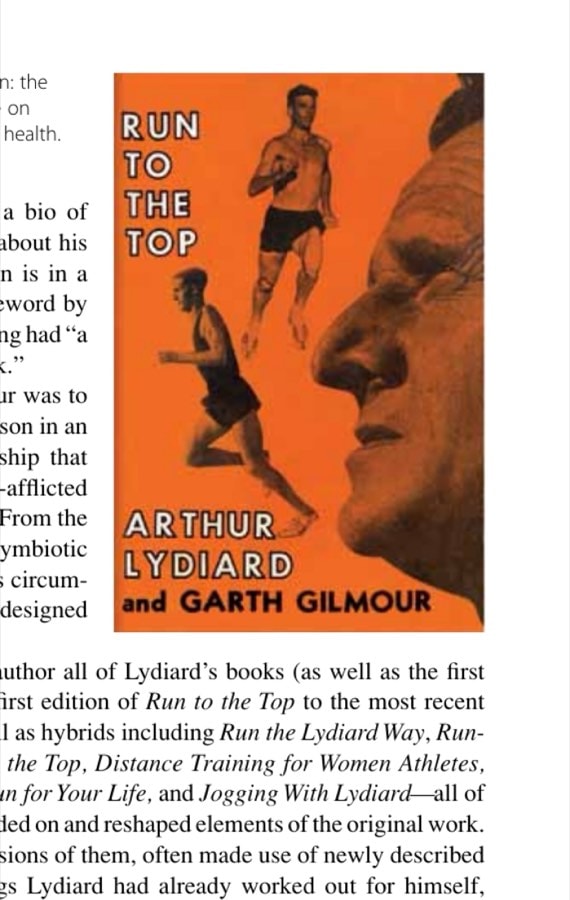
A product of Wellington publisher A.H. & A.W. Reed, Run to the Top’s original cover is dominated by a black-and-white profile portrait of Arthur Lydiard, whose ideas on endurance training were for the first time explained in some depth in the 181 pages. Leon Hamlet’s striking image of his subject captures the essence of the man. Frowning slightly and squinting into the sun, Lydiard surveys a point on a distant horizon with the cold calculation of a Roman general strategizing how to move his frontline troops forward. He is presented as the uncompromising, hard taskmaster that he was, and though his face looks chiseled out of granite, those who knew the man agree he had a warm heart and never asked his athletes to do what he had not already done.
Other elements of the dust jacket are clear-cut action photographs of Lydiard’s star athletes Peter Snell and Murray Halberg and some now rather dated-looking typography for the title and names of authors Arthur Lydiard and Garth Gilmour.
▲
Jacket of the original 1962 edition: the book that had a profound influence on endurance training and running for health.
While the back flap contains a bio of Lydiard, the only information about his collaborator in this first edition is in a paragraph appended to the foreword by someone who confesses to having had “a hand in the writing of this book.”
Auckland journalist Gilmour was to play Boswell to Lydiard’s Johnson in an extraordinary creative partnership that lasted 43 years until the stroke-afflicted coach died in December 2004. From the beginning, it was very much a symbiotic relationship, as if the fortuitous circumstance of their first meeting was designed by nature for its own benefit.
Garth Gilmour was the coauthor all of Lydiard’s books (as well as the first biography), from the seminal first edition of Run to the Top to the most recent editions of the same title as well as hybrids including Run the Lydiard Way, Running With Lydiard, Running to the Top, Distance Training for Women Athletes, the pioneering jogging book Run for Your Life, and Jogging With Lydiard—all of which, in many respects, expanded on and reshaped elements of the original work. These later titles, and other versions of them, often made use of newly described scientific explanations of things Lydiard had already worked out for himself, with a kick-start from a 1936 book titled Why? The Science of Athletics by F. A. M. Webster, founder of the School of Athletics at England’s Loughborough College. Lydiard credited Webster’s work with giving him his first comprehensive understanding of how the body works, particularly under the stress of training and racing.
Why was Run to the Top so influential, how was it put together, and what of the man responsible for writing the books bearing Arthur Lydiard’s name?
How the book was written Backtrack to 1961, the year after the XVII Olympic Games. New Zealand’s selfesteem was riding high after its team’s return from Rome with two golds and a bronze from athletics. The three medalists were all coached by the same feisty Aucklander whose forthright opinions, radical thinking, and jaunty self-assurance
© Tim Chamberlain
▲
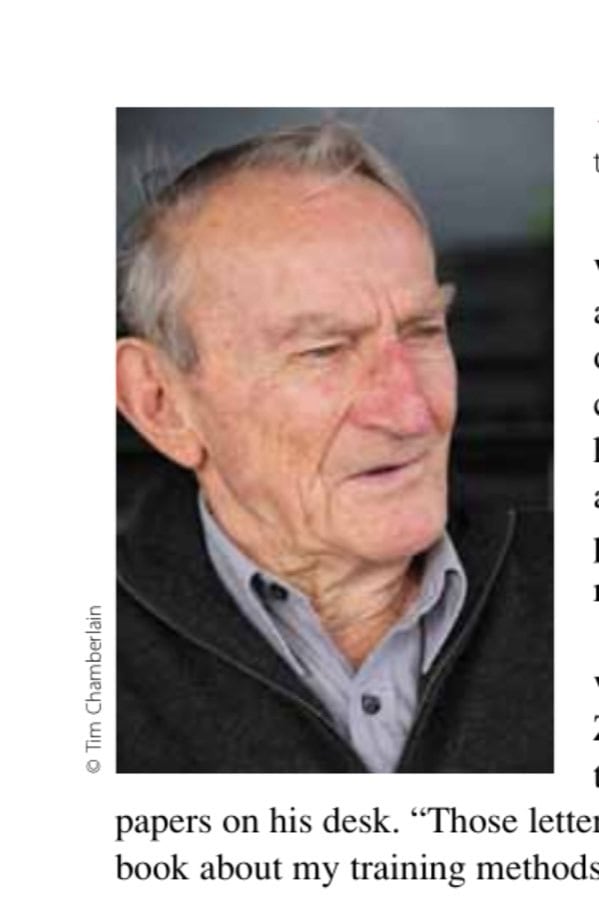
Garth Gilmour at 86: he captured Lydiard’s distinctive voice with absolute authenticity.
would put him on a collision course with sports administrators for decades. But with the success of Snell, Halberg, and Magee at Rome and with a crop of other talented performers emerging from his stable to achieve success on overseas tracks
and roads, Lydiard already had the results to prove that his ideas worked and that he deserved respect and support. Garth Gilmour was a 36-year-old journalist with the Auckland Star when he was sent out to
Zenith Shoes in Avondale to “have a chat” with the celebrated coach. Lydiard pointed to a pile of papers on his desk. “Those letters are from publishers—they want me to write a book about my training methods. What should I do?” “
Oh, well—write a book, Arthur.” “How am I going to do that? I can’t write!” “Well, you should get someone to help you,” Gilmour nonchalantly suggested. A little over 50 years later, the 86-year-old author recalls one of the defining
moments of his life. “Then he looked at me and asked, ‘Would you help me? Are you interested?’” Even now it seems he can hardly believe his luck. “That was an amazing thing, because I’d not met him before. It’s the fastest decision I’ve ever made.
We started the first chapter that night. He talked like a machine gun, much faster than my shorthand. I wrote down the salient points as we went along and fleshed them out from memory later.” As a journalist with some editing experience, Gilmour knew how to structure,
cut and polish reports and feature articles. A book couldn’t be that different. He would plot out the chapters, dividing the training system into its essential components so a reader could easily understand cause and effect and how one phase
leads logically to the next. Lydiard’s torrent of words would be filtered through the discriminating mind of his scribe and crafted into a coherent whole so that anyone could follow the program. As he would continue to do all his life, Arthur Lydiard was generous in dis
seminating his ideas to all who were interested, and the manuscript that became Run to the Top presented an ideal opportunity for him to do so. He never regarded himself as a shaman who would entrust his sacred knowledge to only an anointed
few. Nor did he have any inclination to erect barriers around his program to protect his own athletes from competition. Eventually, he would insist that his
greatest success and satisfaction was not in the medals and world records earned by elite athletes from many countries who ran the Lydiard way but in helping to motivate and encourage millions of ordinary people into getting off their TV couches to go jogging.
While Run to the Top was being written, its authors were both working two shifts. Before he began his day job at the shoe factory, Lydiard had already put in six hours on his milk round1. For the Star reporter, his other job was now as a book author. “
When I got home from work, I’d get out my trusty Royal portable typewriter and hammer out the night’s work. Then I’d take it back to Arthur for review at our next meeting. We’d meet two or three nights a week and once or twice during the daytime.”
Lydiard soon handed over his milk round to Olympic marathoner Ray Puckett, whom he coached, replacing this job with a Star distribution run. Gilmour remembers a time when he and his fellow author believed they could save time by outlining another chapter while dropping off newspapers to convenience stores. “I thought he could talk and I’d take notes while he was driving, but he was like a maniac behind the wheel: one speed—flat out—just like he talked. His old truck—bang, bang, bang, bang—hurtling around the corners. I gave up and just
ad
listened. Fortunately, I had a good memory, so I was able to transcribe the talk afterwards. But I never tried that again.” Writing the book was not simply a matter of taking notes and then typing them up. Gilmour put himself in the shoes of the prospective reader, subjecting Lydiard to the kind of questions an aspiring runner might want to know: where does hill training fit in with the schedule? What’s the purpose of it? Why is it important, and what does it do? “Arthur had lots of little bits he threw in and I threw out again. But there were occasions when he’d ask me to shift something, and it might involve retyping several pages. The time it took to do that! There was no cut and paste in those days.”
Partly because Lydiard was a man always in a hurry, the book was written “fairly fast,” according to Gilmour. “We worked hard at it,” he says, “and despite the fact that Arthur was always working or running, he was happy to give up a lot of time for the book.”
While the coach was learning about the process and demands of authorship, the journalist was catching the running bug. One night Gilmour was at a party with Lydiard and “Arthur’s boys,” as his training group had become known. As the unfit journalist bent down to pick up something, both knees gave a loud CRACK. “No need to laugh!” Lydiard admonished his athletes. “Even Garth could run a marathon.” “
I thought, Don’t be daft, but that remark set me going,” Gilmour says happily, “and three months later, I completed my first marathon.” Even while working on the manuscript, he had started training in secret, saying little about it to anyone, even to the man himself. “There was just something about Arthur, and I think that’s what others found, too.”
That something could just have been that Lydiard knew what others were capable of, long before they realized it themselves. Gilmour was afraid that if his new friend found out about the training, he would demand progress reports, intensifying the pressure he was already feeling at the Star and in the few hours available after work. He was producing so many words that it was hard to fit in his daily run. Sometimes he would head out at 2:00 a.m., while the city slept and the roads were clear, and run for up to two hours, taking to heart what the coach had told him to put in their next chapter: “There are no shortcuts to the top. I know. I have tried them and they don’t work.” “
I did set out, more or less, to follow Arthur’s program,” he affirms. “About that time, we were working on the training schedules, making sure we had them right for the book. Of course, you didn’t mess about with the schedules—you had to follow them properly.”
In running his first marathon and four others later, Garth Gilmour might also have been one of the earliest of genuine joggers to have trained the Lydiard way to complete the historic distance and fulfill his mentor’s prediction. Jogging, run-
ning—any form of daily exercise that elevated the heartbeat for 20 minutes or more—was excellent for the health, in any number of ways, as Lydiard propounded in their book. Not only was it good for you physically and emotionally, but by feeding a rich supply of oxygenated blood to the brain, it made that organ a whole lot sharper and more efficient, too. And as wise men knew in ancient times, the health of the body and mind are inextricably linked.
Lydiard’s laboratory was his own body, which he subjected to years of intensive training, supplementing the findings from his fieldwork on the roads of Auckland with his reading, his curiosity, and his intuition. “
You have to wonder at his tenacity and sacrifice,” Gilmour comments, “because while he was working two jobs, he ran 40,000 to 50,000 miles in training, just to find out how to run better.” It’s no surprise that Lydiard never found time to keep a training diary.
What does the book say about training? What did Lydiard say in Run to the Top about training for endurance events? The common belief, even among runners, is that Lydiard advocated a harsh regimen of 100 miles (160 kilometers) a week. While this is true, it is only a fragment of the picture. He never prescribed this as a year-round distance diet but as the optimal load for a 12-week conditioning phase. These three months spent in the buildup were the foundation of a balanced program that included hill training, cross-country, and speed work. The idea was to develop your aerobic capacity so your cardiorespiratory system could pump more oxygen to the muscles.
Once the heart could handle a heavier work rate, then athletes could gradually transition to developing their anaerobic capacity—that is, the ability to run at speed and maintain it while oxygen is being rapidly depleted. Lydiard argued that speed in an endurance race therefore depended on an athlete’s strength or
© Tim Chamberlain
▲
The great coach in a relaxed mood at a local road race on the Coromandel Peninsula, New Zealand, in 1997.
“conditioning.” In Run the Lydiard Way, he put it succinctly: “The fundamental principle of training is simple: it is to develop enough stamina to enable you to maintain the necessary speed over the full distance at which you plan to compete.” By carefully managing this structured program, a coach could fine-tune an athlete’s condition to be at peak on the day of the year’s biggest race. Even if Lydiard’s athletes weren’t the most talented in the field, they would be the best prepared, as he would occasionally remind them.
By the time Run the Lydiard Way was published in 1978, the master was advising his pupils to measure their conditioning input in time rather than mileage. He had realized that this was a more accurate and useful gauge of work done, as its yardstick was volume, not distance. It also reduced the temptation to be competitive with the clock over favorite courses while training. New Zealand had converted to metrics, anyway, so the young hardly knew the measure of a mile. Running “high mileage” was no drudgery to the Lydiard “disciples,” as they became known, because their coach insisted it should be enjoyable. Imagine that! In time, a lot of people did and found it to be fun. So the fun run was born, and Auckland’s Joggers Club (founded in the same year as Run to the Top’s publication by Arthur Lydiard and future mayor of Auckland Colin Kay) will tell you it was their Round the Bays event in 1973 that was the prototype of what soon became huge community celebrations of healthy living in cities around the world. It’s a reasonable guess that many joggers were as clued up about the Lydiard system from reading Run to the Top as the fleet-footed gazelles who bounded past them on Cornwall Park’s Twin Oaks Drive.
Even in the early 1960s, Lydiard’s ideas were affecting All Blacks2 of the caliber of superstar fullback Don “The Boot” Clarke. This was an era when it was not uncommon for an All Black to smoke. Clarke was a hulking Waikato dairy farmer who surprised many by taking up what Lydiard called “marathon-type training.” From 1962, any self-respecting New Zealand sporting person owned or had borrowed Run to the Top. Lydiard was proud that players of team sports were using his schedules and, incidentally, he related how Clarke had instructed him in the proper way to prepare a pot of tea.
It would be easy to fault the book for ignoring or glossing over what we now regard as accepted practice. There is little about rehydration because the Lydiard athletes hardly bothered except for a social cup of tea after a long run. In a short chapter on food, the word “carbohydrate” is not used. Instead, Lydiard recommends that his readers eat a normal diet, “with plenty of fresh lean meat and eggs.” But while the 1960s were early days for knowledge of the effects of nutrition on performance, there is little to disagree with here in his dietary advice.
There is a one-page chapter titled “A Place for Women” that offers encouragement—this at a time when the longest distance women were allowed to run at the Olympics was 800 meters. He says that while the field of women’s athletics
is wide open and unexplored, even he doesn’t know what they are capable of. Later in his career he did, coaching a large group of high school girls as well as other women by correspondence. In a chapter on amateurism and professionalism, he advocates an open, honest system where high-performance athletes have no need to suffer financial hardship. It would take until the 1980s before administrators began to change the rules and allow prize money to be paid openly.
In Run to the Top, Lydiard scoffs at weight training for endurance runners but later changed his mind about this and even pumped some iron himself in his senior years. “Arthur was very well read and had an extraordinary knowledge of things,” Gilmour comments. “He devoured learning on how the body works and what running does to it. When we were working on Run the Lydiard Way, he revised the simplistic explanations from Run to the Top into a couple of very fine chapters on what really happens. “
When we were cleaning out his things after he died, we found academic papers on physiology and studies of the human blood and how the heart worked. The pages had his scribbles here and there to draw attention to certain aspects. He was able to absorb this information and reproduce it in simpler terms so anyone could understand it. He was a very smart boy.”
Publishing history of Run to the Top Garth Gilmour is unsure how many copies of Run to the Top were printed initially but thinks that it could not have been more than 5,000. When Reed had sold all its stock and expressed no interest in reprinting (despite its having sold coedition rights to overseas publishers), he took it to Hodder and Stoughton in Auckland. “
I gave the revised manuscript to Neil Robinson of Hodder who said, ‘This will be like the Bradman3 book—it will go on forever.’ And as far as I can see, he was right. No one’s come up with anything better yet. Even the Kenyans train the Lydiard way.”
In addition to the two New Zealand editions—Run to the Top and Run the Lydiard Way—there have been one edition in the United States, two in Japan, and “two or three” from Meyer and Meyer in Germany, which has published the Lydiard books since the 1980s. Gilmour explains that all editions closely follow the original, with “slight modifications to certain aspects of the training—mainly in the schedules. And we expanded into editions for masters, women and girls, and boys.”
But by far the biggest-selling edition was one that its coauthor not only has never read but until the late 1990s had not received a cent in royalties for. He describes how he found out about his sensational overseas sales.
▲
The unauthorized Russian edition of Run to the Top.
“I was at my desk in the Star one day when someone handed me a copy of Novosti Press, which was a sort of brag-sheet the Russian Embassy printed in Wellington. The lead story was about me becoming Russia’s top-selling sports writer. It said they had printed 400,000 or 500,000 copies of Run to the Top and another 600,000 of No Bugles, No Drums—the Peter Snell story. We were paid nothing for either book. “
This was before they signed up to the international copyright conventions, so the Russians just helped themselves and did so for years. Sometime later they published a new edition of Run to the Top—also without permission—and I was paid one lot of royalties, about $1,000. Given the size of the print runs of my books in Russia, it wasn’t a great return. “
It will be doing some Russians some good—I hope,” he sighs, with a copy of one of the Cyrillic-script editions in his hands. “As far as I can tell from looking at this, it’s just a straight steal.” Complete with a familiar-looking ©.
A life in words Garth Gilmour spent his first five years on a sheep station at Pukerangi, adjacent to what is now the Otago Central Rail Trail, before the family moved to Dunedin for his schooling. After an unpleasant time at high school, he started with the Otago Daily Times at age 16. From there he went into the Royal New Zealand Air Force, getting his navigator’s wing the day the Japanese surrendered. Returning to journalism, he moved to the North Island. “First I was at the Wanganui Herald—now defunct. Three years later, the Taranaki Herald—now defunct. Then in 1957, the Auckland Star—same thing. In the 1980s I moved to the pitiful Auckland Sun—also now defunct.”
His bosses also employed him to train young journalists and subeditors in New Plymouth, Napier, and Auckland before this position also disappeared in the slash-and-burn corporate frenzy of the 1980s. “A trail of destruction behind me,” he laughs. “Bloody good newspapers, but they couldn’t beat television.”
By the mid-1990s, Gilmour had been quietly turning out books in his “spare time” for some 30 years. Aside from the Lydiard titles, his name had appeared as coauthor on autobiographies of Peter Snell, Murray Halberg, paraplegic athlete Eve Rimmer, and ultradistance runner Sandy Barwick, and on a book on squash with Dardir el Bakary.
Apart from a brief midcareer foray into public relations, he has now been a journalist for 70 years and continues to contribute occasional articles to newspapers and magazines. He has been an author “more or less full time” for more than two decades and has written 21 books. Twice he has worked on two manuscripts simultaneously and seen them published on the same day. Garth and wife Kay live on Auckland’s North Shore, a couple of minutes’ walk from a beach where they can enjoy the sea air without having to count their mileage. Both still train but now do so indoors on a stationary bicycle and a rowing machine. Gilmour remains a tireless advocate of the Lydiard system and claims he owes his longevity to the man. “
I wouldn’t be alive today if it hadn’t been for Arthur,” he says in a quiet voice that suits his low-key, self-contained manner. “Maybe I would have made 60 or 65, but when we first met, my lifestyle was crap. I smoked and drank far too much. There was a bunch of us at the Star who would finish at 3:00 p.m. We’d go to the pub and drink up to eight gin and tonics. I can remember driving home and closing one eye because I couldn’t cope with the double lines. Shocking, now I look back on it.”
Gilmour gives a candid response to a question about what he considers his strengths as a writer. “I guess it’s the ability to get inside my subjects’ heads . . . to construct their narrative styles, in writing,” he answers thoughtfully. “Doing these books has been sheer enjoyment for me. I didn’t write any of them for the money, though I won’t say the returns weren’t welcome. I never approached anyone to ask if I could do a book for them—it all just came to me. It’s fun, isn’t it?”
He is unequivocal about his career highlight. “I must say it was seeing Run to the Top, when I got my first six author’s copies. When I unwrapped them, I was somewhat euphoric.” Outside the living room doors, torrential rain is drenching the Gilmour lawn. Garth chooses his words carefully, as if composing aloud before writing. “The greatest satisfaction of my career has been the 40-odd years I spent with Arthur— not just for what we wrote together but for the difference he made to my life. He was a complex and fascinating man, with a wonderful sense of humor. That’s what made running with him such a pleasure.”
▲
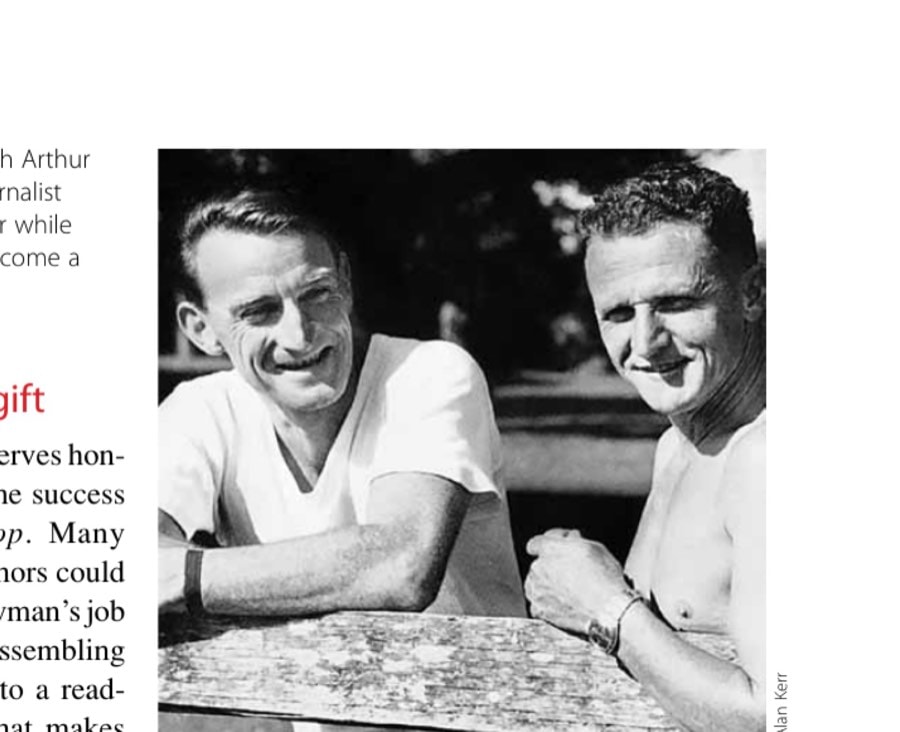
Garth Gilmour with Arthur Lydiard, 1962: the journalist became a marathoner while helping the coach become a published author.
Garth Gilmour deserves honor for his part in the success of Run to the Top. Many journalists and authors could have done a journeyman’s job in gathering and assembling the information into a readable sequence. What makes Gilmour’s input outstanding and of lasting value is the way he managed to capture Lydiard’s distinc
tive voice with absolute authenticity. When you read Run to the Top, it really does sound like the great coach is instructing you, the reader, on how to run to the best of your potential. Terms like “visionary” and “charismatic” are used loosely to tag many who attain fame in different fields, but if ever a New Zealander deserved both descriptors, it was Lydiard. His presence dominated any room he was in, less as a consequence of his celebrity status than as a function of the power of his personality and the certainty with which he expressed his opinions. This is evident on every page of his book, which remains inspirational to its readers to this day. “When I wrote Run to the Top for Arthur,” his coauthor says, “I did it because I believed that this is something that has got to be made permanent—it should always be around, because he won’t be. I thought, if he dies and leaves his system unpublished, it would be a great loss.”
Run to the Top is an important part of the Lydiard legacy, a monumental milestone on the road to good health, better performance, and greater enjoyment of life. In its own modest way, the book is an enduring gift to humanity from two unalike New Zealanders who became the best of friends.
Endnotes 1 Until the late 1980s, most New Zealand households enjoyed daily delivery of bottled milk. 2 The All Blacks are New Zealand’s world champion rugby team, and rugby is the country’s national game. 3 Australian cricketer Don Bradman is widely considered to be the greatest batsman the game has produced and remains a national hero of his country long after his 2001 death.
© Alan Kerr
An enduring gift
This article originally appeared in Marathon & Beyond, Vol. 17, No. 2 (2013).
← Browse the full M&B ArchiveMore like this
1,000+ stories from 19 years of Marathon & Beyond
The complete archive of the legendary long-distance journal — digitized and free to read.
