

Ihoisted myself out of the pool to check the workout board a little better, rested on my ribcage, slipped a bit, and came down hard on what I later found was my 10th rib. I still don’t know, about a month later, if I heard or just felt the popping /cracking, but I was in immediate pain and knew something had crumbled a bit inside. But who really wants to acknowledge that? I had a workout to finish and an impending triathlon I was worried I wasn’t trained for. I was running scared. Besides, I knew that broken ribs were incredibly painful, and once I managed to finish my workout, I figured the cracking noise/feeling I had was “normal” and everything was going to be fine. Heck, I even ran 10 kilometers later that day. But the next day it hurt worse. I still swam and ran but it really, really hurt. And I started to get a little scared. Each and every day it hurt worse and worse and worse, and I got more scared as time passed. I had just DNF’d my last triathlon, and I had no desire to continue that trend.
Back in 2010 I was a fat mommy of four kids, and while I had grown some amazing kids, I had also put my needs on the back burner for more than a decade. My youngest was turning 6, and I was finally ready to put my needs front and center for a time. I started by walking out along our beach in Mexico on a daily basis. I never imagined I would want to do anything more athletic, but after a while the Couch to 5K training program called to me and I included that with my daily walks. I very slowly began to lose weight and considered running. At first I could not imagine running more than 30 minutes at a time. For no reason, I would read marathon blogs and blogs of people doing much longer times and distances than I had in mind, but I had no desire to compete and no illusions as to my fitness. Very gradually, their reality became more normal, and it wasn’t long before I became a runner.
But runners who only run tend to become injured (or maybe I have a horrible form), so I eventually found cross-training. I read Hal Higdon and running
forums and decided I should cycle and swim. It was all very odd because all my life I have hated running with a passion. I would get out of breath and had no joy in the run, and really, how much fun can you have pounding your body against the ground and going so slow? I liked cycling but with purpose—to commute to work or head out with the guys (and try to beat them back when I was much younger)—but running just seemed like something you would endure because you’re too stupid to figure out something else to do. However, and this became much more apparent later in my weight-loss journey, running gives the best bang for the buck if you’re looking to lose weight. I could swim all day and never achieve nearly the calorie loss of an hour’s run. So it logically made sense, and very gradually I started to find my mind wandering and without completely going over to the new-age bandwagon, baby, I got Zen. And then I got stoned out of my mind. I found the runner’s high and I was hooked.
Satisfaction at the local Ironman So off I headed, down my beach path, tripping on endorphins (and the odd rock) in my Zen-little head space, happy as a clam and grokking on nature’s beauty— well, maybe only once or twice, but it was enough to hook me in and slowly, watching the others on the Daily Mile website, my competitive juices began flowing. Running for me became the gateway drug to 5Ks and 10Ks, the gateway to a triathlon. And once you go triathlon, the Ironman distance calls to you like a siren you cannot ignore. I used the excuse that I take a long time to warm up as pretext for the distance, but I’m starting to think I just like to punish myself, and as I get older I take a somewhat sneaky satisfaction in beating anyone (but especially men) younger. I stuck with Ironman Cozumel because it is a local race for me and the water is warm. I may have become a triathlete, but there was no way I was going to do a race where I’d need a wetsuit. We had been living in the tropics since 2007, and my blood had thinned to the point that I was wearing down jackets at 80 degrees Fahrenheit. So I kept doing the local shorter races and IM Cozumel, and four years passed by pretty quickly.
In the summer of 2014 I became aware of a triathlon in Cuba. I have always been fascinated with Cuba but could not imagine dragging our large family of six there, and life kind of kept on marching on, and I’d think of Cuba wistfully at times—it is just a hop away from us—but never gave a real effort. People would make noise about how Cuba was changing and time was of the essence to fully experience Cuba before it was ruined (by new leaders, by capitalism, who knows, really) but we were busy raising kids and not having lots of income to throw at a tropical island. Then my second-born moved back to the United States and we became a family of five. And I kept reading about the sliding-scale entrance fee (I was a member of the Facebook group for the event by then) and the insurance to
allow remittance of your entrance fee and visited traveler forums and eventually it occurred to me that we could do this and I should do this and yeah, it wasn’t likely to be pretty or well organized but, hey, what an adventure it could be. And before I could think anymore or plan or strategize, my fingers took hold of the credit card and I was signed up. I don’t think I told my husband about it for at least a month.
By December 2014 we had gone back to the United States, and I was frantic to get my training in, but the climate, even in California, was so much colder than anything we have ever experienced at home in Mexico that I was having trouble getting out on the bike. I was being a good little soldier, though, doing my runs and my swims and my bikes until I got stupid in the pool and I thought my Cuba triathlon was over before it had even started. We came home to Mexico after Christmas in California, and eventually the pain became great enough that I went to the doctor fully expecting him to tell me to toughen up because I was just being a big baby and there was nothing wrong. I walked out with a diagnosis of a 10th-rib fracture and medication. I now had two weeks before the triathlon.
My husband was not very impressed with the $35 (Mexican peso) doctor, so off we headed to an English-speaking one (whom he could talk to, as his Spanish is not that great) and got our second diagnosis of 10th-rib fracture and the instructions to skip the triathlon or just take it very, very easy. I was very careful to keep the doctor in the dark about the length of the triathlon. I was in pain but I wasn’t stupid enough to give her the opening to agree with my husband; I was only stupid enough to really want to do the event. I get a little hardheaded and stubborn sometimes—not so as you’d really notice, though.
Then there was the steroid thing So with husband finally on board we started planning for the trip. I think he actually expected me to skip the event and just vacation at first, but I was slowly able to increase my efforts and the medication I was taking was really helping. Honestly, it was almost magical how well it helped, and I decided to Google the ingredients and see exactly what they were. Some muscle relaxants, some arthritis stuff (huh? Whatever, it was working) and um . . . oops! . . . glucocorticoid steroid. I was pretty sure those were not allowed in competition and started to research all that is holy about steroids and triathlon competition. You might be surprised to find that not many people are going to help you figure out how long you can take steroids before a competition and still test clean. I know! Go figure.
I knew I had to stop taking the medication, but it really helped with the broken-rib pain, and honestly, I didn’t want to stop. And really, who is going to test some old lady way at the back of the middle of the pack in the first triathlon in a country she wasn’t even legally (at that time) allowed into? I mean, what are
▲
Boarding our Russian transport to Cuba.
Courtesy of Kathy Smith
the odds? But I found a new, completely legal medication (Mexico really sucks at providing pain relief even though it is incredibly easy to get so many other drugs over the counter), and more than a week out I was off the old stuff and only needed a few more days of the new stuff before I was able to train with just Tylenol. So, phew, crisis averted (but again, has a back-of-the-pack or middleof-the-pack athlete ever been drug tested? Seriously?). What a joke. I was taking this way too seriously and put it out of my mind.
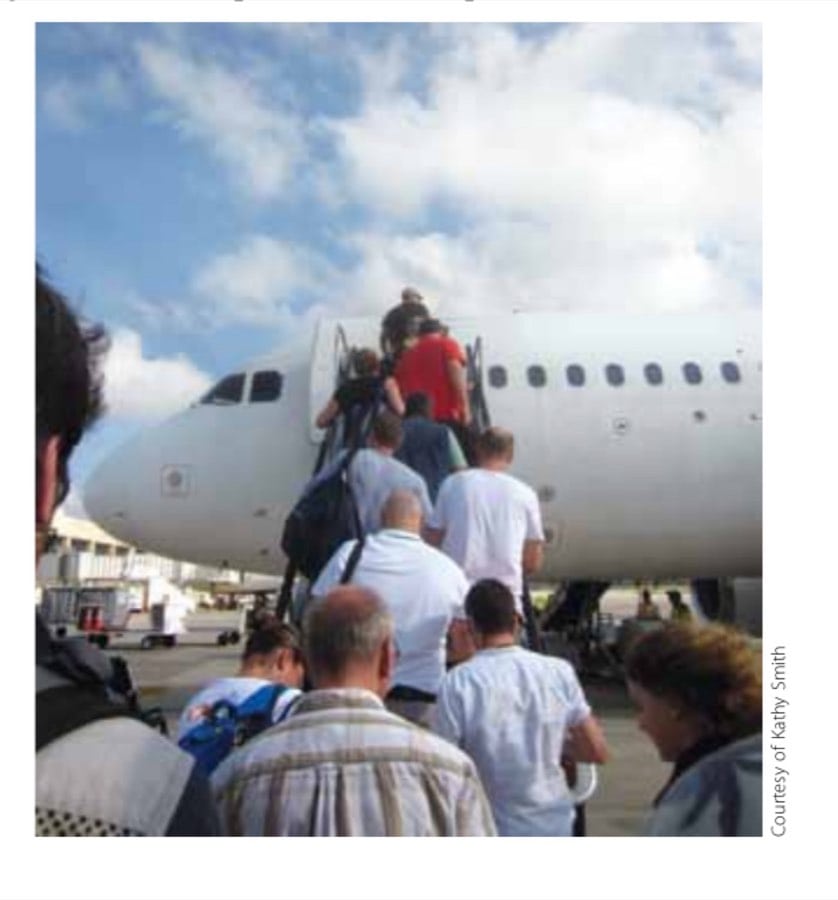
We left hot Cancun and flew into La Habana on a tired old Russian plane. We needed Cuban visas before we could leave Mexico, but they’re pretty used to the dance there and they were very kind in charging us only 1,000 Mexican pesos (about US$17 each) for the four of us (#1 son stayed behind) when we know that many get gouged pretty badly to the tune of US$25 a head for the visa. The triathlon organization in Cuba had told us to copy its logo and affix it to all the pieces of luggage, and I’m not sure if it was the logo on the luggage or our beautiful faces (I’d prefer to think the latter), but we got a great deal on the visas in Cancun. And you know the horrific fees the airlines charge for checking a bike? I had tried my damnedest to figure out what we were going to be charged for the bike ahead of time, but there was no joy to be found on that subject. Cubana Airlines is purposely very quiet on many fees, and many times here in Mexico information and actions completely depend on the person you get and not the rule or guideline. So I nervously brought the giant bike case up to the counter, proud label of La Habana Triathlon front and center, and hoped for the best. I was astounded when we were charged not only no bike fee but no baggage fees at all for the four bags. Viva Cubana!
We arrived in La Habana in frigid (to us) temperatures, surrounded by other arrivals from Rome, Russia, and London all experiencing the longest wait for immigration on planet
Earth. I’d like to think I’m a pretty seasoned traveler, having visited Europe and almost all of South America and North America, and this was the slowest-moving group of immigration agents known to mankind. Regardless of the number in your family, each member had to go individually through immigration. They did, however, have a special section set aside for families (we assumed with young children) to skip all the lines and there was rarely much of a wait over there. We joked about kidnapping a kid just to get through immigration. We must have spent two to three hours waiting in line, waiting for immigration, but finally, after retinal scans, photos (I know! Insanity!), and perusals of the not-allowed-in-the-country lists, we were released upon aduana (Customs), which decided to throw caution to the wind and allow our family of four and bike in without a second look.
Then there’s the matter of cash I had read it was important to change money immediately in Cuba after arrival, right there at the airport, as we would be assessed yet another fine/fee/tax before leaving the airport grounds, so into line we went for the cadeca (which is your money changer in Cuba). Being American, we had no access to our ATM card or credit card in Cuba, and if you’re going to be spending any money there you will need to bring it all with you. It is apparently in the works for ATM cards with the Visa logo to begin ATM access with Obama’s changes, but we never had the opportunity to try. Living in Mexico, our only access is Mexico pesos, so I had wads and wads of pink, green, and blue pesos stuffed all over camera cases, my person, and purses. While in line an obvious-looking American dude started talking to my husband and girls, and later I found he was the infamous Dave Orlowski, third in the original Ironman triathlon back in 1978, our first brush with greatness.
Finally, satiated with Cuban pesos, we were able to help the taxista figure out how we were going to load the taxi with bike box and four suitcases, backpacks, purses, and more. The poor taxista was sure we would need another taxi, but we’re a little bit more Mexican than American and stuffed the bike into the trunk, tied down the door, stuffed ourselves into the taxi, and loaded our laps with baggage and off we headed to the casa particular (private residence) for our stay during the triathlon. Our casa particular had arranged for this taxi to meet us at the airport, but as you might imagine that there are plenty just waiting for you there. Lots of people like to know exactly how much they’re in for costwise, but I found pretty much universally in La Habana, I would figure out the local price for a taxi and then at the destination pay the driver that amount unless I wanted to tip. It worked out very well for us and no one ever complained—well, not to our faces, at least.
In Cuba you have the choice of either hotels or the homes of Cubans. In the city of La Habana, stand-alone homes are beginning to become popular, but I wanted us to have the cultural-exchange type of experience with a casa particular and
Courtesy of Kathy Smith
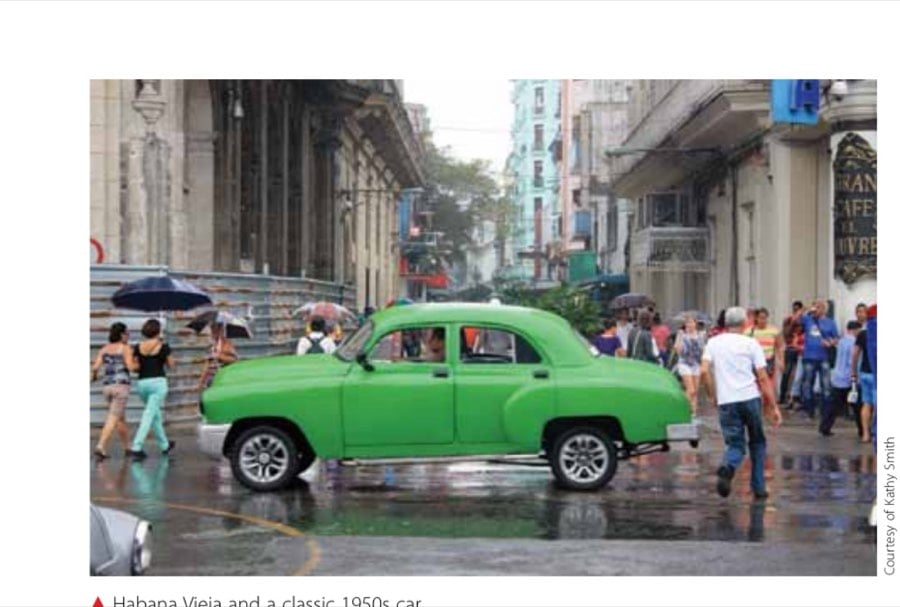
▲ Habana Vieja and a classic 1950s car.
we were not disappointed. We had an amazing time with the family, the helpers, the aunts and uncles, and their kids. As there is no Internet and there are only five channels on the TV, we ended up doing a lot of talking. Our particular house was directly across from the university in an old colonial that had been lovingly cared for, and we spent many nights on the rooftop talking with the family and watching the world go by. They enveloped us with such warmth and care that we can’t wait to go back. And the girls even survived and thrived without Internet!
This being the first long-distance event for Cuba, I expected some problems. All my triathlon experience is from Mexico, and I have done a number of firsttime events here also as the sport is still very new here. In Cuba, from what I had read, there was real difficulty in obtaining athletic nutrition let alone water, so I expected to pretty much be on my own. There would likely be a course that we would all be informed about and maybe a finish line, but I wasn’t sure there would be much more than that. Well, they would have to have timing chips, right? The swim practice on Friday did nothing to alleviate my impression that this would be an adventure. There were no signs, no Internet that I could get on to see if there was any information on the website, so I took a shared taxi and got completely ripped off, getting used to the new currencies. Yes, plural. There is a tourist currency (the CUC) and the national currency (national pesos). Normally, I’m a huge frugal freak so it took some doing to put that monetary loss in a bubble and blow it away but, hey, Eso es Cuba. After walking a few kilometers all over the marina area, I finally found the swim practice just in time to see the
elite triathletes competing in the sprint the next day come out of the water and head out on a bike-familiarization ride. I entrusted my bag to the Aussie trainer for the USA team, shimmied into my swimsuit, and headed out with two other intrepid explorers into the marina. The water was cold! I decided to stay away from my fellow swimmers after a boat honked (seriously, do boats honk?) at them and tried to swim yet stay away from trouble. There apparently had been boats surrounding the elites to keep them from harm, and they could warm up and practice but they also likely got there on time.
Ah, yes, public transportation Mission accomplished, I headed to package pickup, got my supermarket plastic bags (well, the first time, you’re not expecting much, right?) and numbers and headed back to town. The swim start was a US$20 taxi or 80 US cents macina plus 20 US cents local bus ride from downtown. The macinas are the old 1950s cars that Cuba is so famous for, but by the end of the trip they were already normal transportation for me. You flagged one down, asked if it was going to your destination, and either packed in with five or six others or found another one. The buses, in contrast, were sardine packed. One night we were eating dinner, and across the street we saw an enormous (normal) crowd waiting for the bus. We had come to find that waiting in line is not only as natural in Cuba as breathing air but almost as common, so we didn’t think much of it. We then didn’t even take note as the bus arrived, but eventually we began to notice that the bus was not leaving. Not all that versed in the ways of bus commuting, we didn’t think much until a police car drew up in front of the bus, then another police car, and then a police truck (which I could only assume was a paddy wagon). Then eventually, one car left, the truck left, the bus left, the crowd was dispersed, and the last police car left. I asked the restaurant hawker what had happened, and he explained that likely someone desperate to get home and completely frustrated with the chaos of the bus stop called the police to resolve the filling of the bus. I was very impressed to see that the disturbance was resolved without violence or arrest.
There are some particularly spiffed-up cars parked around the high-rent downtown hotels, and some of the athletes posted pictures of the rides they took in those. If you had stayed in a host hotel there were rumors of chartered buses, and I fully expect the elites competing on Saturday likely had those available. I had heard grumblings about the lack of service for the age-groupers in the longer events on Sunday, though. Again, first-time event, so they’re going to have glitches. I really wanted to stay off my feet on Saturday, though, so we spent the day on the tourist bus, which took us all over the old city (at least twice) and very, very close to the marina (start of the swim). I decided to ride my bike to the drop-off and used the familiarization from the tourist-bus route to get to the marina without difficulty.
It isn’t easy to get lost in Habana, though, as you can always get directions from someone and they’re usually right! It seemed everyone was pissed about the idea of leaving their run bag along with their bike bag at drop-off, but I honestly could not see the problem. They told us we’d have access to the bags the next morning, so I left what I thought I might need and planned to bring either a completely different change or additional stuff the next day.
Hey, it wasn’t like we were going to win the thing, right? We were just in this for the adventure and experience. I personally was just hoping to nail down nutrition better after failing miserably at IM Cozumel 2014. We’d had unseasonably cool weather at IM Coz (for us locals), and I had passed one aid station after another on the bike, blissfully content that I was “nailing” my hydration as I didn’t need any water or Gatorade. Unfortunately, I found just how wrong I had been when I started the run, had a great first lap, and then completely fell apart on lap two and ended up with 3 liters of IV fluids in the med tent, unable to start lap three. So Cuba was going to be a test of attire (brand new SOAS top, never-before-worn bike shorts, new shoes, Osmo nutrition, and never-before-tried Clif bars on the bike). Yeah, I was throwing caution to the wind and daring the gods to strike me by breaking all the no-new-stuff-on-race-day rules I could imagine. I had worn a different version of the shoes (Hoka Bondi), and how different could the Stinson be? I’m telling you, I really am a disrespectful triathlete.
The nonorganization of drop-off bags After drop-off, where we still had no information on the route of the bike, swim, and run and hoped they were the same as had been advertised, I bummed a ride in a taxi from some fellow Mexicans and headed back to town, mission accomplished. Lots of folks were not about to leave their precious T2 and T1 bags at drop-off, though, and some found that race-day morning they had no way to get their T2 bag to T2. Like Cozumel, Cuba had split transitions, and like Cozumel, you bring T2 bag to T1 and they take it to T2 at some point. I had tried, before heading to drop-off, to take my bag to T2, but at 4:00 p.m., just hours before race start, T2 was still a vision on the organizers’ website and not one person in the immediate area had any inkling of when it might become reality. Again, this was to be an adventure, and I was taking none of it very seriously, but then we’ve already established I’m a very bad triathlete.
After all the drama and worries and concerns, the swim went off, well, swimmingly. I was a little miffed to be the only one not in a wetsuit (yeah, apparently minutes before the start they decided to allow wetsuits, it was just that cold) and the only one in just a swimsuit, but what are you going to do? I don’t even own a wetsuit, so I had the brilliant idea to put on bike shorts over my swimsuit. At this point I think my triathlete cred was at rock bottom. I was, however, very colorful
Courtesy of Kathy Smith
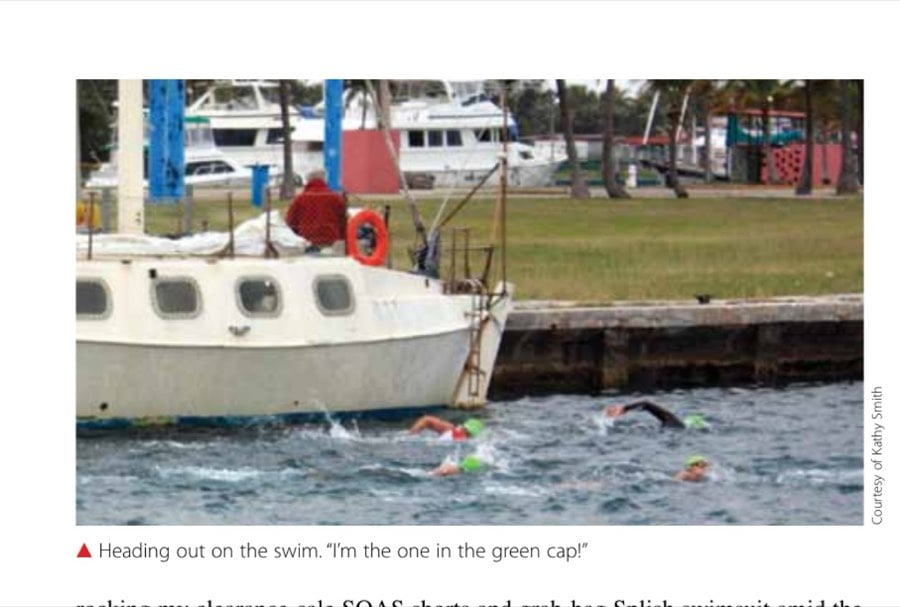
▲ Heading out on the swim. “I’m the one in the green cap!”
rocking my clearance-sale SOAS shorts and grab-bag Splish swimsuit amid the sea of gray and black wetsuits. The half-distance athletes went into the water and headed off. We jumped in quickly afterward and the race (c’mon, race?) was on. Oh, my gods and goddesses, the water was cold. I remembered seeing so many of the volunteers hanging for dear life onto ocean buoys watching us and floating pieces of wood that were likely supposed to be rafts that I tried to buoy their spirits by waving to them before I realized I likely looked like I was drowning and reminded myself I had a long day ahead. We had a 3.8K track (that many said was actually 4.2K) that wound all over the marina and I was more than ready to get out by the end. Four volunteers hauled my sodden ass out of the water and up the steep exit ramp. I ran into a camping tent (yes, the women had a tent for changing—that much I could establish before the race) to change and got as nekkid as an old lady in the YMCA as I wanted nothing wet on me heading into the bike. Cuba was still very cold and my blood was stuck on tropic time.
I was sure I had been at the very back of the swim pack and worried I would not be able to figure out the course (yes, leaving T1 I still had no idea what the bike course was and it would be hours until I did) without a pack of riders around me. Luckily, I found a pack and we headed out. And I was astounded to find I never need have worried about finding the route—the Cuban triathlon organization must have hired every young person in the city as the entire route through the city, kilometer after kilometer after kilometer, was lined with either a volunteer, a police officer (also to control the traffic), or a military volunteer, and usually there was a combination of all three. You definitely could have gotten lost, but you likely would have had to drag a cop, army guy, and volunteer along with you,
very intent on leaving the course. I have never seen such a show of force and, yeah, I know, communism, socialism, yadda yadda, but everyone I interacted with on the course was very excited to be there and effusively cheered me on. It was an amazing and impressive sight to see. Eventually a group of us, two Mexican guys and a girl who had traveled together, and myself, held about the same pace and hung together, taking in the sights, remarking about the amazing volunteers, wondering where we were going, chatting, counting our money in case we needed to buy water/food, and kicking back at about the energy level of about a lazy Sunday ride. We were in this event just to finish and have a good time. Everyone else could race; we just wanted to finish and be happy.
Hopefully, still on the real course So we headed down the road and on to the autopista (freeway). At this point I figured we would likely head on the out-and-back of the original route, but the Mexicana and I, having been dropped by the guys at some point, were still wondering if we were on the right road. We even backtracked up an on ramp to make absolutely certain we were on the long-distance route as all we could see were the cyclists in the half. With no other options we headed out and hoped for the best. Eventually, we split up and we both tucked into our own races. I was loving the countryside, and as the road we were on was closed to traffic it was a carefree ride. I still didn’t know where I was going, but there were others out and I was keeping track of my mileage in the event that I was on the wrong road and hoped that I could take that distance of the real, correct route.
About one-third of the way down the autopista, I saw a moto and a rider going in my direction. I had already seen the men’s leader and the Cuban leader with a moto escort coming toward me, and I was very curious as to what that particular moto was doing as it seemed to be hanging with one rider. It seemed I would be able to find out as I was gaining on the pair, and all too soon I found myself leading the race. Let’s try that again. I was leading the women’s race. I have watched enough of the Tour de France and read enough pro-triathlete blogs to know what a moto escort does, and the moto driver remarked to me, “You know, we thought the American was going to be taking first place, but hey, looks like you, la mexicana, are in first, and yea for you!” I was wearing the colors of Mexico on the bike, my jersey and arm warmers I’d picked up in Cozumel, and if you didn’t look at my gringa face, you would think I was the Mexican rider. I was absolutely certain this would not last—that either la española I had just passed would retake first or the true Mexicana would pass me, so I quickly took a picture to show my family that I was once la campeona and had held first place in a race. Hey, there were only three women entered, but you have to take your victories whenever available.
Courtesy of Kathy Smith
▲
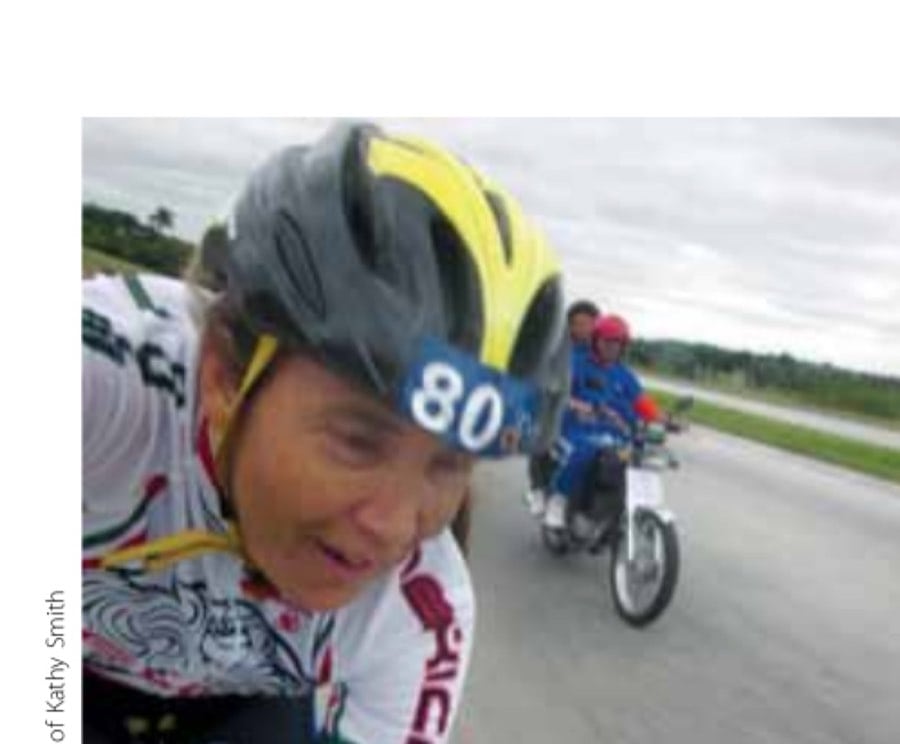
OMG—I’m in the lead? (Well, me and my moto escort).
And dear readers, I held first place all the way back through the second loop of the bike (aha! Now we knew the bike route) and into T2. I was burning all the matches I could find to stay in first place and rode my legs into the ground. That
moto was like a drug and I drank deeply. I knew I was emptying all the stores but I couldn’t stop myself. I loved the lead. I felt (comparatively) less pain than in any other IM. I was hanging on tight to that blue ribbon and enjoyed it so much
the six hours passed too quickly. Surely, this would be where my luck would end, though, and I would drop to second or third as my run is very pedestrian. I had assumed we’d have a tent at T2 but that was not to be, so I stripped to my bra (it
was only way after the event that I realized I must have horrified those poor young volunteers) and changed out of the stinky bike tops (two for warmth), greeted my daughters and husband, and headed to an absolutely revolting porta-potty
to change my bike shorts for a skirt. I had picked up a running skirt (honestly it is likely a tennis skirt, so well versed am I in athletic attire) at a thrift store in California and really wanted to wear it in Cuba. I thought I looked particularly
cute in it, and at 54 you will go to great lengths to look cute.
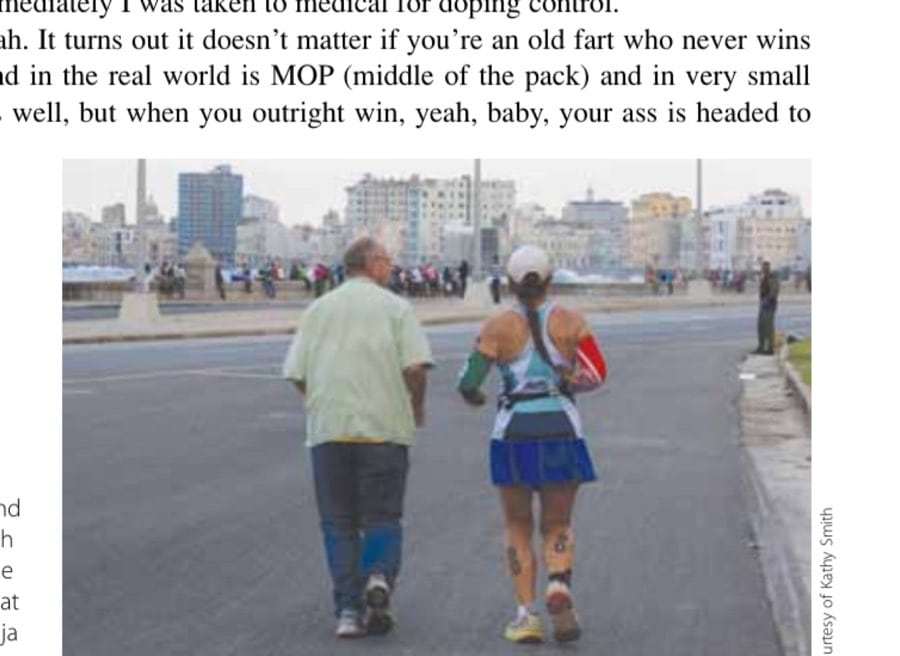
Heading into the marathon, and still! in the lead My husband and girls watched me head off down the road and then headed out on the course to greet me later on, you know, the run course that had been outlined and mapped in all the triathlon information. Yeah, the one that unbeknownst to them had been changed to loops along the seafront. We ran into old Habana, and many pockets of tourists were along the course drunkenly cheering us on, likely wondering what the hell was going on. In all my previous triathlon marathons I have always employed a walk/run strategy, but suddenly, as race leader (yeah, three women, but still . . .) I found I didn’t want to lose that. I had raced the bike,
scared I’d be overtaken and content to simply come into T2 with wasted legs, but hey, la campeona, and have my family see me leading the race, but now I wanted more. Unfortunately, that meant I was going to have to race (for me) the marathon. Normally, I just survive it. So I began bargaining. I would run the entire first hour. At this point I didn’t yet know we were doing laps. After I had run a full lap and had ascertained the route and the number of loops, I decided to run two laps. After two laps I was still winning (pinch me!) so I bargained for a third run lap. This winning stuff doesn’t come easy, does it? The only offerings on course were water and, well, water, and oh! Ice! Yeah. I had a bottle of Coke I’d brought, and that was the nutrition I was testing.
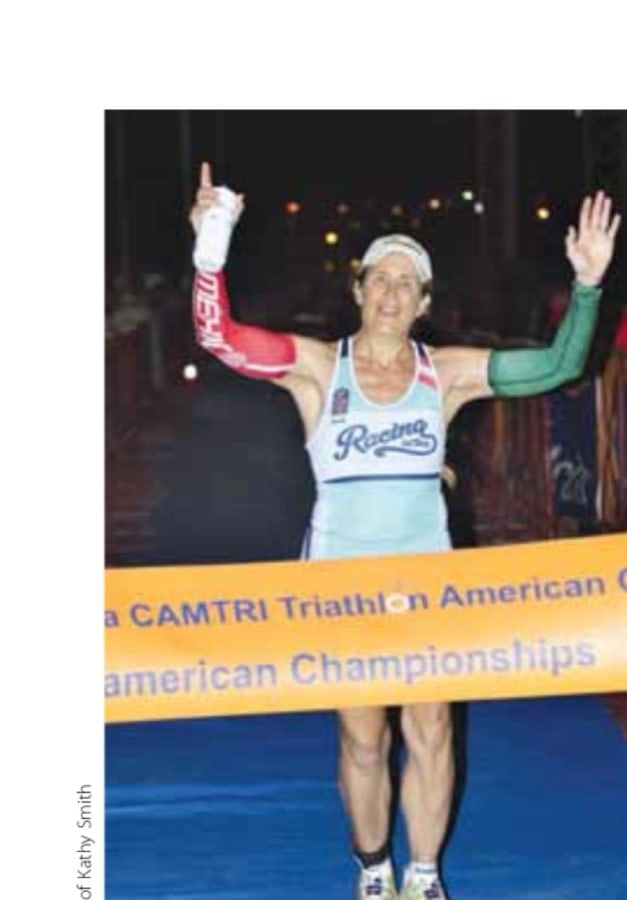
So on the third lap it started to occur to me that not only did someone have to win but I just might be that someone. After all, why not? I would keep running, no resting, no walking, and maybe I could hold off on la mexicana and la española. And then I lapped la española, and la mexicana still seemed to be well in back of me, and on the fourth lap I bargained a short walk. The volunteers all seemed to know I was in the lead, and they ran with me and cheered me and on the very last 2.5K a large group of guys at one aid station gave me a rousing cheer, and honestly, how can you not respond to that? I ran as fast as my old, tired, empty legs would allow, and I finally made the last pass toward the chute. And just as I had dared to dream (but only during the last two laps of the run), oh, my gods and goddesses, there was a banner! I got to run through the banner, and oh, my gods and goddesses, I was the winner.
And immediately I was taken to medical for doping control. Um, yeah. It turns out it doesn’t matter if you’re an old fart who never wins anything and in the real world is MOP (middle of the pack) and in very small events does well, but when you outright win, yeah, baby, your ass is headed to
Courtesy of Kathy Smith
▲
My husband runs a bit with me during the marathon. That is Habana Vieja in the distance.
▲
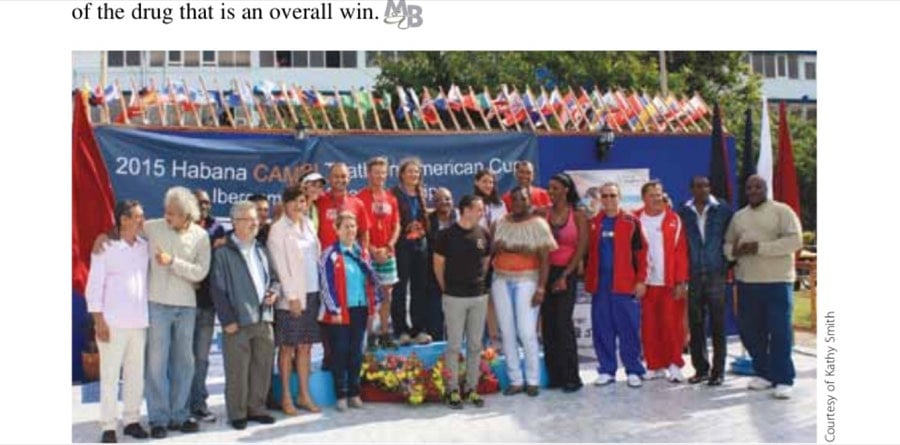
doping control. But the award ceremony was amazing. I was interviewed on television. I got to meet all kinds of artists and famous personalities, and at the awards ceremony I watched the American flag hoisted and the
anthem played and I thought to myself, I cannot be dreaming, for I never dared to dream this dream, but if I’d had the balls to, what a dream come true, and I got a little choked up at the anthem (how can you not?) and I’m sure
the photogs loved that shot and I simply drank it all in, the headiness of the ceremony of the win. Because the Cubans didn’t care that I was an impostor, someone who never should have won, an old lady with a slow time that is laughable as a
winning time; they celebrated and marveled and encouraged me to believe that for that day, I was la campeona. And there are no words to describe the headiness of the drug that is an overall win.
Courtesy of Kathy Smith
Courtesy of Kathy Smith
La campeona!
▲ Award presentation with artists and dignitaries.
This article originally appeared in Marathon & Beyond, Vol. 19, No. 4 (2015).
← Browse the full M&B ArchiveMore like this
1,000+ stories from 19 years of Marathon & Beyond
The complete archive of the legendary long-distance journal — digitized and free to read.
