

The Marathon Life Of Reilly
So you think you would like to be an athletic agent. Zephyring through airports to exotic locations, schmoozing with fit-looking thinclads, running helter-skelter down forested trails in the Bois de Boulogne. Checking into your Tower Hotel room overlooking the Thames in London or into the midtown Manhattan Sheraton. Walking from the winding pools and waterfall to the beach at the Hotel Intercontinental in San Juan, or watching the sun go down over Waikiki Beach as you sip a mai tai at the Honolulu Marathon’s host hotel, the Outrigger Reef. You say you would like to watch Ryan Hall laugh after an ekiden leg in Japan, Deena Kastor smile in New York’s Central Park, or Martin Lel and Paula Radcliffe pose for cameras beside London’s Tower Bridge?
You think you can handle the occasional 20-hour day? Decipher and respond to 30 phone calls, 50 e-mails, and 25 text messages in that same interval? Knock out athletic contracts with sponsors hard to come by and make race appearance, airfare, hotel, airport transportation, massage, and other ongoing accommodations and arrangements for those who would gallivant around the world seeking fame and fortune as well as making or breaking your reputation?
You’re willing to keep fit by running 50 miles per week. Yet often you find yourself away from the familiar trails of home on gallops through not-particularly navigable streets, over bike paths that suddenly evaporate, on busy highways alongside beaches, and over impromptu mazelike running courses in strange places?
You feel you can handle being an effective doctor on call for those whose sudden sprained ankle or depressed attitude over a bad race unexpectedly has them calling? Explain apologetically to race directors that the athlete they were counting on for an expo talk can no longer attend? Tender an excuse to an event manager having witnessed a subpar performance by an athlete you hyped as ready for a personal best? Sleep four hours and then get up and do it again?
Let Reilly do it
Boulder Wave, Inc.
On many a daily basis, athletic agent Brendan Reilly is faced with all this and more. But the trick for Reilly and other agents to the fast and durable is to maintain a buoyant spirit and enthusiasm, just when each would like to pack it in over another unforeseen glitch in what sometimes can be a halcyon existence.
Then there’s all that prep time few take into account. Those who would be confidants to professional harriers may find their credibility rising if they can run or they possess their own history of clockings and placings.
For 10 years in childhood while growing up in Windsor, Connecticut, Reilly played soccer in the autumn, ice hockey in the winter, and baseball in the spring. Yet the hand of fate unexpectedly interposed a watershed moment when the Connecticut Yankee in his junior year of high school switched from baseball to cycling. “
We had two different race accidents where guys on my teams got concussions,” he explains. “So the school for insurance purposes canceled the team for my senior year. A couple of cycling teammates said, ‘Any fool can run.’ So we switched over to track and went directly into the mile (4:47) and two-mile (10:05) my senior year.”
Reilly got the bug and competed one semester each in cross-country and track while at Boston College. During his life nearby the Charles River, the man
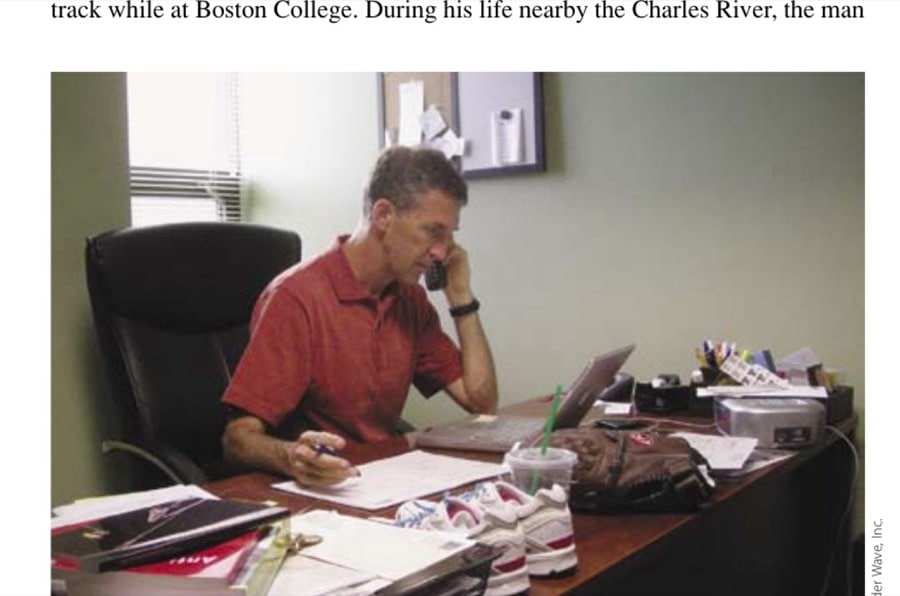
▲ Brendan Reilly communicates with his athletes from above the Boulder Downtown Mall.
developing a 10K PR of 30-plus discovered what many of us learn over time: training is one thing, but genetic talent often helps carry the day. “I remember one time, Chuck Cobb—a guy who lived in the next town over from me in Connecticut—he and I were in the same race as (eventual 1984 Olympic marathon silver medalist) John Treacy when we were freshmen,” says Reilly. “I’d only been running about eight months so far. Indoor two-mile on a 200-meter track, and before the race, our big worry was, we figured John Treacy was going to lap us at least once. Would he lap us twice? And that was kind of our first test with world-class athletes. Sure enough, he blew by both of us a mile into it. He just missed catching Cobb, but he lapped me a second time.”
Even though Reilly showed no extraordinary talent at running, a high school teammate, future Olympic pentathlete John Helmick, earlier had recognized a 16year-old lad with the eternal curse of putting one foot in front of the other. “Nah, Brendan,” he said as the two shared a New England trot, “you’re one of these guys, I can already tell, who’ll be out there, 40 years old, going to road races.”
Language skills are always useful. Reilly studied Russian as well as math at Boston College and also picked up some German during a junior year abroad in Vienna. A stint working for Marathon Tours was followed by studies at the Fletcher School of Law and Diplomacy, where he was majoring in diplomatic studies. After his first year at Fletcher, however, a Time Magazine cover story on Japan piqued his imagination, and he switched his focus. This led to a five-anda-half-year sojourn as an industrial economist in Tokyo, marriage to (and later divorce from) a Japanese woman, and fluency in a language that would become key to much bigger things in rarefied atmospheres.
Although Boulder has a reputation as a high-altitude aerie for all levels of aerobic sports participation, arriving there in 1993, Reilly found himself giving seminars to businessmen on how best to cope with work assignments in Japan. When the seminar company, Pacific Vision, decided to relocate to Michigan, Reilly stayed on in the Colorado destination. Carpe diem. A large 10-bedroom house previously used to accommodate seminar residents became part of a different Rocky Mountain vision.
Home away from home for foreign runners “I really think there’s something here in Boulder to start running some kind of service,” Reilly once commented on his vision, “not just to the Japanese, but to all the foreign athletes who want to come in and train at altitude.” That was the thinking, and in ’93 that’s what inspired Reilly to develop highaltitude training camps. With Tad Hayano, who at that time was working for Asics, the pair lured 40 Japanese Federation athletes, coaches, and doctors to Boulder for a high-elevation camp.
Boulder Wave, Inc.
Luck may be whimsical, but persistently placing oneself in its path almost invariably brings results. Continued work with hosting Japanese groups led to his newly formed company, Boulder Wave, being hired by the Recruit Running Club in 1995, through the 1996 Olympics. Recruit’s coach at the time, Yoshio Koide, even today has the status accorded to the likes of Knute Rockne and John Wooden in the United States. In a country where marathoning is as worshipped as football in the USA, Koide was then coaching Yuko Arimori, who would go on in Atlanta to add an Olympic bronze medal to the silver she earned in Barcelona. But he would also coach Naoko Takahashi to Olympic gold in Sydney and to history’s first sub-2:20 marathon, as well as Hiromi Suzuki to World Championship gold in Athens. Reilly cites Koide and his methods, as well as those of coach Bill Squires of Boston, as being among his most important influences.
Meanwhile, training in Colorado, Arimori discovered Boulder Wave’s assistance to be exceptionally helpful. Daily, Reilly simply did what it took to expedite things, with no task at the wrong hour or too difficult. “I kind of lived with them, did training with them,” he says. “I’d work as pacemaker and rabbit for them on some of their workouts. Drive around and hand out water bottles. I was kind of like a domestique of the Tour de France.”
For his first seven to eight years in Boulder, domestique Reilly became interpreter, travel agent, and arranger as well as accompanist on course reconnaissance junkets, including five trips with Arimori to the Olympic course in Atlanta, or with Reiko Tosa and Yoko Shibui to the World Champs course in Edmonton. He had no intention of becoming an agent. The shepherding of athletes had become quite lucrative.
That is, until a telephone conversation with someone in London. The someone with the famous salt-and-pepper mustache and renowned for running 10,000 meters in red socks and in well under 28 minutes. “
I get this call one day and it’s this thick British accent,” relates Reilly. “And this guy I had no idea ▲
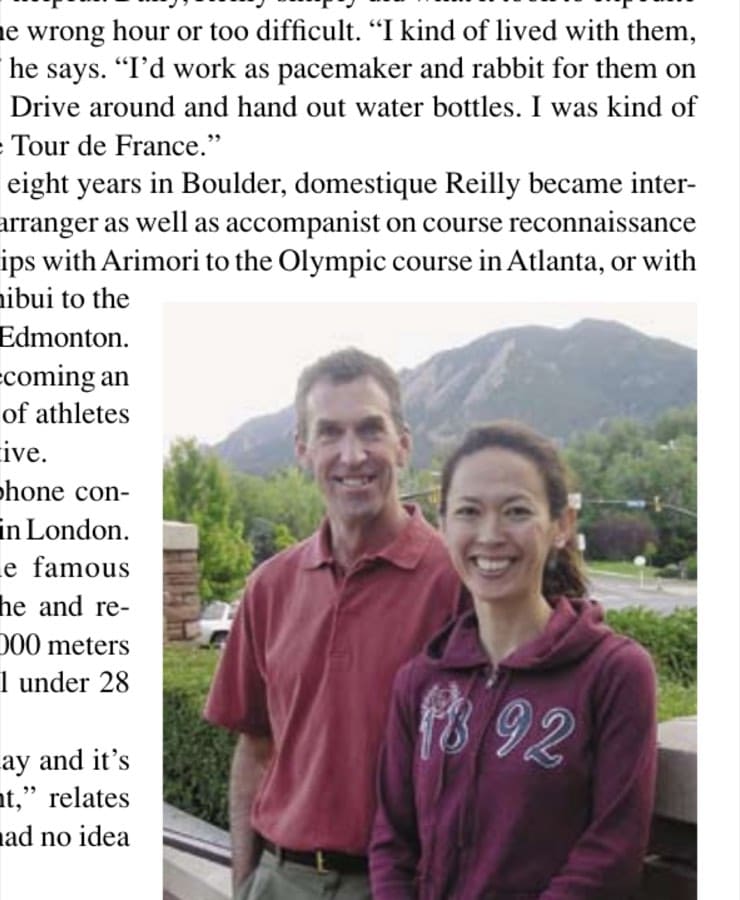
Brendan with Olympic double marathon medalist Yuko Arimori, another of his clients, below the flatirons in Boulder.
who he was—I knew the name, but nothing else. Guy calls up and goes: ‘Hi, my name is Dave Bedford, I’m the director of the Flora London Marathon, and we’re interested in having the gold medalist (Hiromi) Suzuki come over to race next spring and have been asking around, and apparently you’re the guy I should talk to.’ So this is absolutely the first conversation in my life with Dave—he’s since become a very good friend—but it’s just like, ‘Sure, I can do this.’”
Reilly’s candor, enthusiasm, and knowledge of Japan and its athletes were well received in the marathon world. “To be fair to him, he (Bedford) was very up front with everything,” adds Reilly. “I don’t think he tried to take advantage of me. We set up a pretty fair contract for Hiromi (Suzuki) to go over there. She got injured before the race and actually never went. But that was the beginning of the agent side of the business.”
It’s all in the friendships you develop Over time Reilly has developed meaningful friendships at big-city marathon events, and through each relationship loyalty derives. “Fortunately (Chicago’s) Carey Pinkowski and Dave Bedford were pretty straight up with me from the beginning,” agent Reilly says of his education in negotiations. “They didn’t try to take advantage of me. And I think it’s served all of our interests, because now I’m extremely loyal to those two guys. They always bring in my athletes every year. And I know they haven’t screwed me because I know what other race directors now offer to comparable athletes.”
Bedford and Arimori each plays into several of those long 24-hour on-thejob periods mentioned earlier. Reilly’s longest day bracketed the 1996 Olympic Marathon in Atlanta when Arimori struck bronze and he said he spent “28 hours with about an hour’s sleep.” Yet he says last year’s London Marathon race day exemplifies the marathon hours agents sometimes endure. Reilly explains that the Japanese like to get up five hours before a marathon, so a 26.2-mile race day typically begins at 3:30 or 4:00 a.m. “
The Japanese athletes all go off on a walk or a run, then come back and take a quick shower, have something light to eat maybe around 5:00, 5:30. (Romanian) Constantina (Dita) would be down there having something as well. The final hour people are back in their rooms, putting their last things together. Go off to the race start, say about 7:30. Get off to Greenwich, first taking care of all the women. Make sure everything’s fine with them, water bottles, final prep, striders, whatever last-minute adjustments they need. Make sure their race numbers are on without covering their sponsor logo, all this kind of thing. So you get the women off, and a half an hour later the men are taking off. So then I go over to Atsushi Sato, who was trying to qualify for the World Champs in 2009. Same thing. Take care of him over the last bit of it, and he’s off and running.”
Reilly’s London day had only just begun. The American agent then took a Renault shuttle van back to the hospitality/press center near the finish line and Buckingham Palace, watched the excitement generated during a televised viewing, and waited either to celebrate or sympathize after the race. But on any such day there usually are doping tests—which can take up to two and a half hours depending on dehydration levels—medical assistance for anyone who fell or became injured during the race, press conferences at which he interprets, photo ops accompaniment, as well as calls to or meetings with sponsors when performances have been positive. “And then go off to the awards ceremony that night,” he adds of the conclusion to a 20-hour day, “and hopefully celebrate.”
Reilly sees host hotel lobbies such as in London, New York, Chicago, and Boston as business opportunities. “I think if you look at the New York City Marathon and London Marathon weekends, they are basically our industry conventions,” he explains. “Everyone is at those two races. Every shoe rep, every race director, every other athlete, every coach you want to meet, every agent is there. Just by default, without having an annual convention for the world of marathon running and for professional distance runners, these two races have become our main events for doing the business side.”
Raising the bar All kinds of business get conducted in big-city marathon watering holes as well, such as Kitty O’Shea’s in Chicago, Rosie O’Grady’s in New York, or the late Fern Bar in Boston’s Copley Plaza Hotel. Yet Reilly drinks very little. He says the man who often holds court in London’s Tower Hotel bar sees this abstention as a handicap. “Brendan,” said Dave Bedford, known for getting to the point, “no one’s going to take you seriously until you’re drinking four or five pints with them.”
Yet humor aside, it’s that same apparent vulnerability and application to duties that has built Reilly’s reputation. Let’s take a typical June day in Boulder, which will soon find Reilly at his desk on the fourth floor in a hatbox-sized office on the Pearl Street Mall bustling with tourists, shoppers, buskers, and mountain people of all descriptions. It has rained for about a month, and the vegetation is more like that of Eugene, the South Boulder Bobolink Trail a puddle-strewn, overgrown jungle of deciduous foliage. There are any number of trails, bike paths, and quiet avenues situated below the massive Flatirons, giant anvils up to 600 feet high that begin Boulder’s mountainous backdrop. From his one-bedroom condo near the quarry famous for its Rocky Mountain Shootout, Reilly is out for a trot early.
In the office Reilly hunkers down in front of a laptop and plows through e-mails. He cuts a thin figure, his wavy dark hair giving him that look deriving from relatives having come from the Emerald Isle. Like Welsh rarebit Steve Jones,
Flotrack gamer Thomas Chamney, or Brendan’s Irish cousin Gerry, Reilly has the ability to string together words that hold attention spans. Candor might be the word for Reilly’s various interview segments that will approach 15,000 words. Although throwing in contemporary “likes” and “you knows,” he manages to field telephone calls before returning to points in an ongoing interrogation, the answers to which he feels are important to make. None of the framed photos stacked up against one wall has yet been put up. Reilly’s too busy, the sort of intent work that results in the female athletes he has shepherded having garnered nine of the 30 medals from the 10 most recent Olympic Games or World Championships. Do the math. That’s 30 percent.
And speaking of such rarefied achievers, suddenly Olympic marathon champion Constantina Dita arrives with a flourish. She has the nearly translucent azure-blue eyes of Deena Kastor. Many cosmetic firms would find appealing a smiling face framed by a wavy mane of shoulder-length blonde locks the Lion King would find alluring. Dita is just one of Reilly’s Romanian entourage, including Lidia Simon, Luminita Talpos, Adriana Pirtea, and Nuta Olaru. A testament to his capabilities and surroundings is that all the Romanians eventually have been able to buy homes in the area.
Many people worldwide are aware that Dita surprised the women’s field in Beijing. But less well known is how Reilly’s assistance over the years helped the Romanian gain confidence. “He set up many big races for me, like Chicago, London, and New York,” she explains. “And when an agent puts you in a big race, it’s amazing because for my first time in London, in 2003, we flew (with) all the big names, the elite runners of the world, so for me, it was something special. And he did a good job, and we are working well during almost seven years together.” According to the Romanian, it’s also the little touches. “I had a surprise from Brendan,” she said of her return from Beijing to Colorado, for which Reilly had set up TV news appearances and a celebration party of a hundred friends, including members of the Romanian community. “He was waiting at the airport with a limousine.”
There’s safety in blending in Today Dita has come to her agent’s office for practice. During the upcoming Steamboat Classic weekend in central Illinois, she was to throw out the first pitch at a Peoria Chiefs’ baseball game. The three of us go out onto the courthouse lawn beside the busy Boulder mall, and Dita and Reilly play pitch and catch. No one recognizes her, nor will they as we lunch in a sun-infused mall restaurant, for the stunning Romanian Olympic champion in an American college town of attractive youth remains all but anonymous.
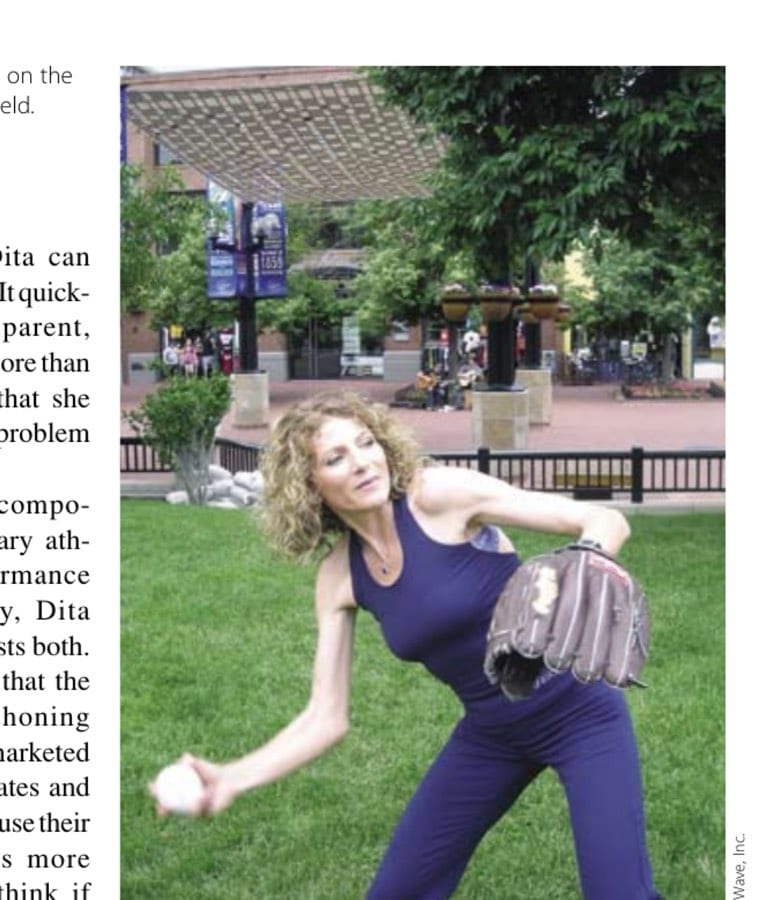
However, Dita can throw a baseball. It quickly becomes apparent, with a series of more than 60-foot tosses, that she will have little problem in Peoria. If the two components of legendary athletes are performance and personality, Dita certainly manifests both. Yet Reilly feels that the sport of marathoning has been undermarketed in the United States and that events could use their prominent stars more effectively. “I think if you’re putting up a prize budget of $50,000 to $60,000, you should think of more creative ways to use your athletes,” comments Reilly. “And the managers will cooperate with this. I don’t think the managers are concerned about, ‘Oh yeah, I’ve got to get my athlete out of there two hours after the finish.’ It’s like, give their athletes something to do, and they’ll do it.”
Reilly has been instrumental in discovering new ways Dita might be more effective as such a distance-running ambassador. She now wears custom-made shoes from Asics and in three June weekends has signed autographs and visited hospital patients and staff with Joan Benoit-Samuelson and Uta Pippig at Green Bay, Wisconsin’s, Bellin 10K; electrified the Peoria Chiefs’ stadium; and then was the featured celebrity for a Stadium Stampede 25th-anniversary party for sponsors, guests, and athletes in mile-high Denver’s Invesco Field, home of the Broncos. “
At the end of it they brought the whole crowd out onto the floor of Broncos Stadium,” Reilly conveys. “And up on the big Thundervision, this 40-foot-tall screen, they showed the last 15 minutes of the Olympic marathon. You just get goose bumps watching it.”
Boulder Wave, Inc.
▲
Dita cranks it up on the roads and on the field.
Still, these are difficult times to promote minor sports clamoring for more recognition. “The challenge now is that we’re in absolutely the worst economic conditions you can think of, when you’re trying to get financial support for your athletes,” adds Reilly. “Not only on sponsors, but I think the whole racing conditions, race directors’ budgets are down. I mean start money is down. Appearance money and special bonuses are down. Prize money is probably limited. I know race directors are all trying to do the best they can, but we all have to cooperate in this. And it makes it tough. Your athletes still have a mortgage to pay, they have their groceries to buy, and if everything’s down, you’re fighting for everything out there.”
Creative thinking by agents is part of the answer. Recently Reilly not only signed up a number of his athletes to adidas contracts that will guarantee financial support for another year, but through those negotiations a new development camp in Romania will be funded, including weekly instruction in English.
Back at the office, Anna Davies arrives. She assists Reilly in all those arrangements that follow sequentially upon arranged appearances or training arrivals. Telephone calls begin to come in more often; others are made either in English or Japanese. In between dealing with travel reservations, race-appearance conversations, arrangements for appointments, and more, Reilly interjects germane comments on how the running community might better market itself.
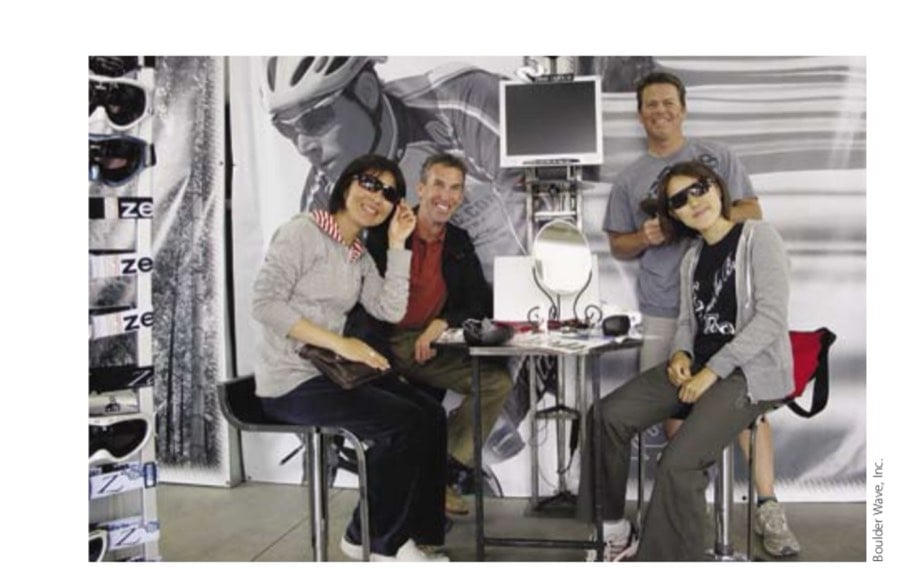
Focusing on additional sponsorship And speaking of marketing, one of the agent’s afternoon appointments will be at Zeal Optics, a Boulder company that wishes to place its sunglasses in Japan. To help promote this cross-Pacific growth, a meeting is scheduled with 1991 World Champs marathon silver medalist (thereby the first Japanese female international track and field medalist in 63 years) and now coach Sachiko Yamashita, and one of her protégées, Tokyo Marathon champion Yoshimi Ozaki—then training for the World Champs in Berlin. They meet us at the facility, where fluent-in-Japanese Michael Jackson (no relation to the late pop star) treats the two much like Fifth Avenue models in letting them try on different pairs of stylish shades.
While at Zeal, Yamashita commented on why she works with Reilly. “Not only is he taking care of athletes over here, but in Japan as well as anywhere he goes the extra step in hospitality,” she relates. “If Brendan wasn’t here, there is no way so many Japanese would come here. There is a comfort factor. If something goes wrong, it’s good to know it will be taken care of.”
Later in the afternoon, Reilly is back in the hatbox, armed with phone and computer. There he might be conversing with Xtenex shoelace execs regarding their stretchable product placement in client shoes, talking to Japanese coach Koide about nutritional products and testing company, Know Your Body (KYB),
Boulder Wave, Inc.
▲ Prior to the 2009 World Championships, Coach Sachiko Yamashita and Yoshimi Ozaki meet with Michael Jackson from Zeal Optics, a Boulder company that wishes to place its sunglasses in Japan.
or making last-minute arrangements for Dita’s and his separate travel arrangements for Peoria’s Steamboat Classic 4-Mile. The sun is still above the foothills early that evening when Yuko Arimori walks through the lobby of Boulder’s St. Julien Hotel, a red-and-yellow brick, green-and-blue metal marvel. She still looks the part of a slender marathoner, and a smile lights up as she greets both the author and Reilly. In Japan, the marathon star is said to have the same popularity as Michael Jordan in the United States. Arimori is recognized everywhere in the island empire. In Boulder, she strolls through the hotel lobby without anyone giving her a second glance.
The double Olympic medalist, however, has owned a home in the county for years, and a 12-month bar-graph calendar she displays on a tabletop shows how her life ping-pongs back and forth between Japan and Colorado.
What is one of the secrets of her success? Listen up, all who venture to run 42K or longer, no matter the pace. The answer is beyond marathoning. It’s long walks. That’s right, walking. Bob Kennedy had it right when he said Americans train too hard on their easy days. Japanese runners exercise more restraint. Four Tokyo Electric Power Team marathoners that week are seen jogging at over 8:00 per mile or slower down Broadway in Boulder. But then, their coach is Hiromi Taniguchi, the famous
Japanese World Champs gold medalist known for his gyroscopic agonista appearance while racing. Running slowly on easy days is better. Reilly says it all goes back to just after World War II, when the Japanese first competed internationally and came to the Boston Marathon. “They just have this mind-set, like, we’re smaller than everybody else, we’re weaker than anybody else, we’ve got to overcompensate,” explains Reilly. “Certainly the basis of every single Japanese distance runner is this overdistance training. Time on feet.”
Arimori is known for taking long, slow walks. “She walked to Gold Hill one time,” says Reilly of her 13-mile hike up a canyon to over 8,000 feet of elevation. “She walked from south Boulder (elevation 5,300) to Gold Hill.”
It comes down to time on your feet. He also mentions some physiological as well as mental advantages. “Essentially what you’re doing with all this training is you’re building up your capillaries, you’re building up your oxygen-delivery system, which doesn’t really matter if you’re doing 6:15 or 8:30 a mile. You’re just out there on your easy days, 60 minutes in the morning and 60 in the afternoon, two more hours of building up the system. . . . . But also I think mentally, it just makes you tough as nails. If you’re out there knowing you’ve got a five-hour walk to do today, one way they might do this is they go out and do their normal hour or 70-minute training run, have their breakfast, maybe around 11 o’clock meet, and then, bang, everybody goes off (on) five-hour walks, see you back here at 4:00. But the whole point is just keep moving for those five hours. If you’re doing that twice a month or once every four weeks, suddenly the time block for a world-class marathoner to think about the intense mental concentration that goes on for two hours and 10 minutes or two hours and 22 minutes is not really that imposing.”
Arimori concurs that her long walks and time on her feet assisted in achieving her medals. Yet although five trips to Atlanta gave her confidence in knowing the course, that familiarity apparently was not a factor in her outcome. “Depends on the runner,” she explains of such knowledge. “I don’t think it really worked for me. Of course, if before I race, I know the course, I can do something more special during the race. But on race days, I can’t conquer everything, right? It doesn’t matter if the pace is more fast or more slow, and I don’t know if I can run exactly in a planned position. So everything changes on the day. If I know the course, of course it will be helpful. But it’s not important. Because after the race, (gold medalist) Fatuma Roba, she said (Arimori laughs): ‘Do you know why you couldn’t win? Because you run too much.’ She didn’t run before (the race). (Silver medalist) Yegorova, she didn’t run before (either).” “
Too many notes,” as the king said to Wolfy Amadeus Mozart. Still, Arimori maintains a friendship with Reilly and appreciates his accompaniment during those middle-of-the-night reconnaissance trips down Atlanta’s Peachtree Road and others.
Boulder Wave, Inc.
“I should say a long word,” she smiles while seeking the appropriate translation in English on a device like a Blackberry. “I want more great words to use. But maybe ‘honesty’ and ‘sincerity.’ His work, his personality is like that. So that’s why athletes trust him.”
When all is said and done, however, Reilly likes the Japanese models for race appearances, marathon training, and club support. Of course, money solves lots of problems and permits taking risks with new training-group financial models as well. “
We really need to go off to some different corporate sponsorship models,” says Reilly, “whether it’s a bank or an airline or ING Financial Services, and say, ‘OK, you’re doing all these races, what do you think about starting off a kind of high-end team, without going nuts on the numbers, $400,000 to $500,000 for a half-dozen athletes, coach, accommodations, and various support. We need a three-year commitment through the 2012 Olympics.’ I think it is up to agents like me to think, ‘OK, we’ve got to put all this other stuff on hold for three months and really do deeper studies on what kind of numbers are we going to bring in to these people?’”
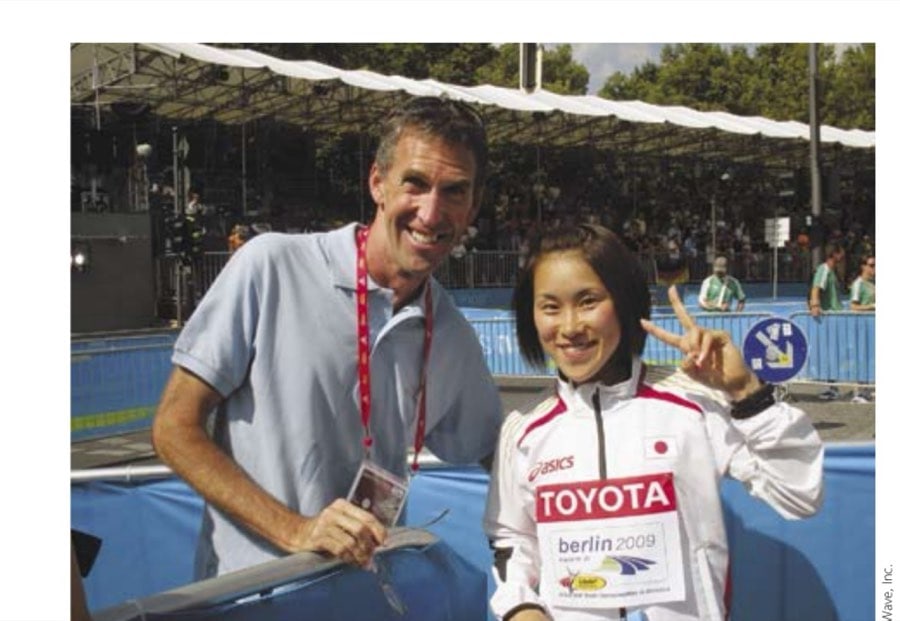
▲ Marathon silver medalist Yoshimi Ozaki with her agent, Brendan Reilly, after the World Championships Marathon in Berlin.
Never a dull moment It’s been a busy month, including Reilly’s spending a Saturday morning with client Sara Vaughn and her husband, Brent; Romanians Nuta Olaru and 1996 New York City Marathon champion Anuta Catuna; and 1991 World Champs marathon gold medalist Mark Plaatjes up in 8,500 feet of elevation at the Joe Colton Run above Rollinsville. There are always things to do and people to see. “If you throw in the last month where we’ve had 35, 40 Japanese athletes out here training, just every day somebody’s got something going on,” Reilly relates of his marathon interpersonal dealings. “Somebody’s going out to the airport, somebody’s going training, somebody has a race going on, somebody needs physical therapy or a massage.”
To illustrate his ongoing whirlwind existence, the following Friday Reilly phones from the airport. Bad weather in Chicago has short-circuited his trip to Peoria. He will make the one-hour journey back to his condo, do some work, and then return to Denver’s DIA to catch a 7:00 p.m. nonstop flight arriving around 10 p.m.
No matter the hour, however, the bottom line is Reilly finds his work highaltitude heaven. “I know it sounds kind of corny; like this is the sound bite you’re supposed to give: ‘Most of what I do in this job I love,’” Reilly concludes. “I love having all these athletes in Boulder training. I love the experience when someone like Naoko Takahashi came out of college, a 34-, 35-minutes [10,000 meter] college runner, nothing good, nothing great, and working with her team over five years. And you look at the end of it, and there you are: an Olympic champion with a gold medal. You trust in athlete development, especially with the people you work with the longest. “
You get somebody like Sara Vaughn, who’s just starting off, obviously she was a good runner at CU. But right now, she’s on this string where she’s had five straight meets with PBs [after interview, became eight straight, including first three European meets of pro career—Ed.]. Everything’s just dropping like a rock, all her PBs. You just get caught up in that excitement. You know your athlete is feeling better and better in her athletic career, her future, where this could go. And of course, you want to be like part of that. You just figure, OK, how can we help her get to where she thinks she can go? “
I tend to appreciate how much work goes for some runners to get their PBs. And I think we always have to bear in mind that for some runners, their potential is going to be that Olympic gold medal. Constantina, Naoko Takahashi, or Mizuki Noguchi. There are other athletes out there whose potential might be a 28:59 10,000 meters or 15:55 for a women’s 5,000. And you have to respect that. And I do, and I think the athletes feel that, as well. I really like sharing that feeling with someone who’s gone out and done a PB after Boulder training.”
This article originally appeared in Marathon & Beyond, Vol. 14, No. 4 (2010).
← Browse the full M&B ArchiveMore like this
1,000+ stories from 19 years of Marathon & Beyond
The complete archive of the legendary long-distance journal — digitized and free to read.
