

The Marathon Thattriedto Kill Me
November 7, 2004. It is just before noon, I am running on First Avenue, approaching the 18-mile marker of the ING New York City Marathon, and I am in trouble. My legs are heavy, I can’t seem to cool off despite pouring cup after cup of water over my head, and I feel sick to my stomach.
Looking to my left, I make eye contact with the runner next to me. “I feel terrible,” he says. “I think I’m going to stop.” I nod, understanding his distress. However, while he can simply pull up, stop, and let his body take the rest it seeks, I don’t have that option. I’m a pace-team leader.
What have I gotten myself into? I am struggling to make it another mile, and I still have eight of them to go. And not just do them, but do them on pace to finish in 3:15, all while being a nurturing guide and helpful coach along the way in order to get my charges to the finish line.
I made it, even though I was fully expecting that the next time I would see my wife and friends was gazing upon them at my own funeral. I really mean it. I thought this one, marathon number 70, was going to cost me my life. But to understand how I got into such dire straits when it is my role to help others, not to be hanging on for dear life, requires taking a number of steps backward.
BIRTH OF AN IDEA, NEW YORK STYLE Three years before, I had first approached the New York Road Runners Club about offering pace teams at its premier event. My contact liked the idea, and I had some good credentials to back up my ability. I had recently worked to establish the Clif Bar Pace Team, which had been launched at the Los Angeles Marathon, and had helped put together teams for marathons in Columbus, Cleveland, Twin Cities, and Pittsburgh, among others. Unfortunately, we had started talking about doing teams for New York too close to the race.
The following year we started talking earlier, and I had even more experience putting together teams including several more for Clif Bar, but the idea was again passed over by the Road Runners Club. Still, I kept in touch because I felt it could be done, despite the logistical difficulties of New York. I knew I had the experience and the contacts to make it work. I just needed the opportunity to prove it.
A break of sorts came in the spring of 2004, courtesy of the Road Runners, and it even involved a New York City marathon: the More Marathon. This was a first-year marathon for women 40 and older, sponsored by More magazine. The Road Runners Club wanted me to put together a team of leaders for this event, which was to be held entirely in Central Park.
Keeping with the theme of the race, all the leaders were to be women. We were able to deviate from the age 40-plus requirement, although, as it turned out, only a few of the eight female leaders were under 40. And what a group of women it was! If you have ever run the road through Central Park, you know it has some roll to it. In some parts of the country, it would be considered hilly. Now try to run that five-mile loop five times. The women of the More Marathon pace team did it and proved to the Road Runners Club that pace teams can benefit a marathon. Certainly their performance also showed that I could pull together a high-quality team and represent the event and sponsor well.
Fast forward to early September 2004: I have just received an e-mail. The New York Road Runners Club wants to go forward with the pace teams for New York! While that gave me about eight weeks to prepare, I had done my homework and had started planting seeds during the summer just in case the project received the green light. I had already put together a list of potential pace leaders and had even approached a few of them to see whether they would be available. Some would be, while others already had plans, but I kept after it. By the time the go-ahead was given, I had a good number of people on the hook, with the rest lined up by the end of the month.
With approval secured, a multitude of details had to be worked out. Uniforms, signs, bibs, and Pace Bands all had to be ordered, hotel rooms had to be secured, travel arrangements had to be coordinated, and expo staffing had to be planned. Logistics is one of my strengths, yet I had never been so challenged in my life.
NOW BOARDING, NOW ENTERING A DIFFERENT WORLD The task was daunting, and I hadn’t even gotten to New York yet! That day came with a 4:00 A.M. wake-up in Columbus, Ohio; a ride to the airport from my understanding wife, Star, who would be joining me and the team for the festivities later in the week; and a 6:00 A.M. flight to New York City with another person who would help at the booth for the first few days.
New York has a four-day expo, but it is well known in marathoning circles that the first day of any expo is the lightest. That is just what I told Wendy, who had agreed to help at the expo and also to serve as a team alternate. Two other people were going to meet us in the afternoon; the expo didn’t start until noon; and it was going to be a piece of cheesecake, which I told Wendy she had to try while on her first visit to New York and noted that she might even get the chance to go sample some of it at a deli during a slow part of the expo. I honestly believed all of this.
Well, setting up the booth was a snap, and when the doors opened at noon, the initial crowd was quite manageable. In fact, I don’t even remember the moment when we were crushed by attendees. But at some point in the first few hours, I remember looking over at Wendy working the table next to me and realizing we were in trouble. The people just kept coming, asking questions, wanting paceteam bibs, Pace Bands, safety pins, and information sheets. We were doling out all of these—bam, bam, bam—hour after hour. It was the craziest thing I’ve ever dealt with. I lost any sense of what I was doing, even where I was, just moving on autopilot as fast as I could. I surmise that it was what taco makers at fast-food restaurants experience—meat, lettuce, cheese, tomatoes, sour cream; meat, lettuce, cheese, tomatoes, sour cream; meat, lettuce, cheese, tomatoes, sour cream. You get the picture.
We were working as quickly as we could, yet not making any headway. How busy were we? I went to the bathroom at 11:55 A.M. before the show opened and not again until 8:15 P.M. And I was hydrating in preparation for the race in a few days! “
Deer in the headlights” doesn’t begin to explain how unexpected things were. To top it off, our two helpers didn’t make it. One came down with the flu while the other had travel problems. A pair of race volunteers jumped in for a couple of hours in the late afternoon to help, but the damage had been done—we had been beaten to within an inch of our running lives by a pack of expo attendees!
All the way back to the hotel—a 30-minute cab ride—I just kept apologizing to Wendy, and all the way she kept laughing at me: “Oh, the first day is always light, you’ll be able to check out the expo, get away for a while, no problem!” she quipped, mimicking my comments to her when I drafted her for the job.
Honestly, I had every reason to believe that would be the case. I had just come from the Marine Corps Marathon expo a week before, where the crowds are pushed through the basement and parking garage of the host hotel. That event was part of our efforts for the Clif Bar Pace Team, and we had handled it well. The first day there, three of us were able to manage, and we had considerable downtime; and even in the busiest times it wasn’t one after the other, on and on for hours!
BACK IN THE SADDLE, AGAIN? Riding back into the city from our hotel near LaGuardia Airport the next morning, Wendy joked that she was scared to go back. As we walked into the Javits Center and saw the crowd waiting in line an hour before the show started, I actually broke into a panic sweat. The second day of the expo dawned just as crazy as the first; thankfully, we had reinforcements who helped us contend with the crowd. Days three and four were nonstop traffic too, but with our full roster of pace leaders on board for various shifts, we handled the crush.
The final total for pace-team sign-ups was 6,092 runners for 10 groups (30 pace team leaders total), spread over three starting lines. That’s an average of more than 200 for each group at each start, although leaders for such times as 4:00, 4: 15, and 4:30 were likely to see more than 300 to 400 at each start, and that was just runners who registered at the booth. Often people don’t know pace groups are taking part in a race or they never make it to the booth at the expo and simply jump in with a group race morning. While there were 36,000-plus finishers at New York in 2004, I wouldn’t be surprised if as many as 10,000 at some point ran with a pace group.
Finally, after what truly was an ultramarathon, four days of hard work came to an end with the expo’s conclusion late Saturday afternoon. We had virtually run out of Pace Bands and many of the pace-team runner bibs and now needed to finish our preparations for the next morning. That included preparing pace-team balloons with our planned times, distributing uniforms and jackets the Road Runners had graciously provided the team, and reviewing the plan for race day one last time.
We started the team meeting at our hotel at 8:45 P.M. It was the first time I had the opportunity to gather the entire team in one spot—quite impressive! I was jazzed but also running on fumes. How tired was I? I addressed the group as “youse guys” twice in the meeting! I had picked up a New York accent in four days! I laughed so hard I couldn’t get control of myself, so tired had I become after all the hubbub of recent days.
As we departed for our rooms, I had a few things to take care of, including getting my uniform ready, my number pinned on, and my chip laced onto my shoe. Imagine my horror when I checked my uniform and found that it was a women’s medium! I had already distributed the shirts to everyone, so I was left with this. When I went into the bathroom to put the shirt on, I laughed so hard at my look—with the tight fit and high collar—that I cried. My laughter attracted the attention of my wife and our two roommates, who all thought I was having a nervous breakdown. When I walked out of the bathroom, I thought the same thing as they exploded into laughter!
With nothing left, all my energy gone, we finally all retired for a hoped-for five hours of sleep. I figured that if I could just get my heart rate down and rest
for a bit, I would be fine. After all, I had been doing this for a long time, pushing myself at expos and through countless race weekends, only to get on a course race morning and get the job done as a pace leader.
Just in the past few weeks, I had paced 3:20 at St. George (3:19 and change, October 2); raced to a 2:54:57 at Columbus (October 17); and paced 3:20 again (3:19 and change, October 31) at Marine Corps. What was one more marathon? In October 2003, I ran four in a row, pacing 3:50, 3:10, and 3:10, and then doing a 3:09 on my own to cap the four-week run. I don’t golf. This is my hobby, my fun, my relaxation. This is who I am, what I do. I’ll be fine, I said to myself. I honestly believed all of this, too.
T MINUS FIVE HOURS AND COUNTING—FAST Race morning emerged cool, 48 degrees, and virtually windless. Our team bus was parked in front of the hotel at 5:00 A.M., we boarded at 5:30, and we were at the Fort Wadsworth starting area before 6:00. It was all done now except for the wait—but not before our appearance on Good Morning America for its national weather bit. When the pace team arrived with signs and balloons in hand, a show producer saw a great backdrop for the weather broadcast. As the leaders waved and hammed it up for the nation, I was hit by a wave of pride in what we were doing and was quite pleased that these pacers could enjoy some time in the spotlight. At the same time, I was ready to get things rolling so I could do what for me is the most satisfying and relaxing part of these pace-team weekends—run.
Our plan called for each of the three color-coded teams to head for their respective start areas at 8:00 A.M., so as the clock hit its mark, everyone traded pats on the back, handshakes, hugs, and kisses and headed off to the lineup areas. We were pioneers, certainly a group of like-minded individuals with considerable
Courtesy of Darris Blackford
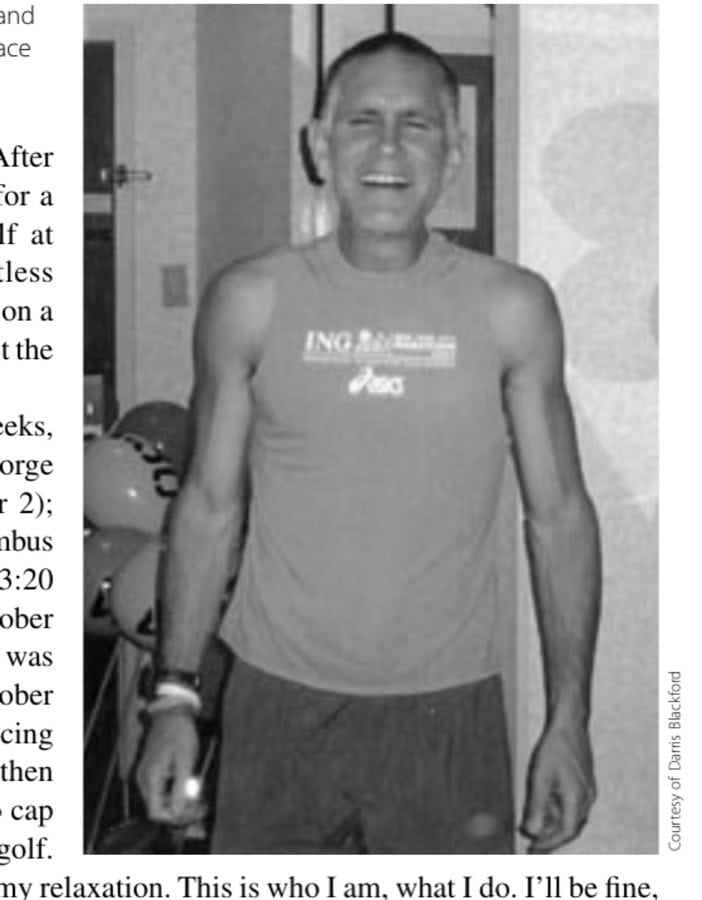
The author, tightly wound and tightly bound in an ill-fitting, pace leader shirt.
Courtesy of Darris Blackford
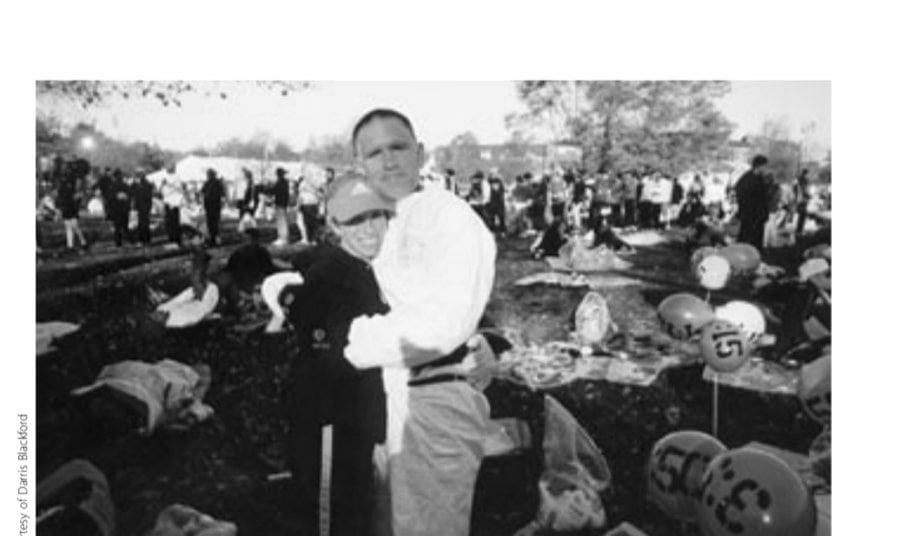
Woodstock, New York City Marathon Style: The author and his wife at Fort Wadsworth await the start of the marathon.
pressure on each of us, and we shared in the fear and trepidation that comes with assuming responsibility for the fate of others in a marathon. Sure, it is their race, as we tell them again and again, but we still are putting ourselves, our experience, and our expertise on the line for thousands of runners. But this was a good group, as good a group of leaders as I had assembled. I knew it was out of my hands now; like me, they had to run, cheer, encourage, and otherwise lead the way for others to succeed. It was now time to contend with the day, the weather, the crowds, and that minor issue of each of us running 26.2 miles on pace.
AND WE’RE ROLLING For me, this task started so well that it was scary. Heading up a group of nine other leaders covering times from 3:15 to 5:30, I was in the green start, which put our group on the lower portion of the Verrazano-Narrows Bridge. Above us, the
other two start lines, orange and blue, each had 10 leaders as well. As we were led to the start line from a holding area, I could see some of my fellow leaders carrying their signs and balloons. Our impact was already evident, as runners
who were going to stay with us as long as they wanted or could were grouped around each of the leaders. Getting into position was easy and the crowd not too daunting, in my view a testament to having three starts, which for the most part makes New York three
separate races for the early miles. I’ve run and paced at Chicago and Los Angeles,
and those single-start races felt much more crowded. Considering the fact that one year I was tripped in the first 100 yards of Los Angeles—balloons flying one way, my pace-team sign the other, and my body skidding down the middle of the street—I know what a crowded start feels like.
From virtually my first step in New York, I was in regular marathon stride. The bridge features an upgrade, which causes slowing in the first mile, but I hit my mark just a few seconds slow. That was fine since the other side of the bridge is a steady downhill. I recall thinking that I already felt a bit too warm but dismissed it as resulting from the lack of wind on the lower portion of the bridge.
And so it began. I was right on pace by mile two, and at mile three we merged with one of the other 3:15 groups from the top bridge. Things were going great, and I even said so to my group through Brooklyn. “What an awesome day! This is great! Way to go, everyone!”
I typically get enthused as I pace and try as much as possible to encourage those running with me, but my enthusiasm drew a comment from a runner that perhaps held a message to be heeded later: “Don’t get too excited yet!” I registered that comment in my mind right next to the feeling-warm part at mile one, but otherwise I was in pacer mode and loving my place in the marathoning world.
THE BOTTOM OF THE BRIDGE FALLS OUT Funny thing about marathons—you can go from feeling great to feeling poor in a single step. For me on this day, this transition took a few more steps, enough to get me over the Queensborough Bridge. The bridge grade is steep, and with each footfall I was feeling the effects of my recent running escapades, the pressure of putting the team together, and the illustrious expo. My future did not appear bright as the big city drew closer.
Coming off the bridge, runners reach what is supposed to be one of the most exciting places on the course in New York: entering Manhattan at First Avenue. While not as large as I was expecting, the crowd nonetheless was big and animated, yelling loudly and strongly. I heard a few of the usual “Go, balloon guy” and “Good job, pacer” as we turned the corner and headed onto First Avenue. At the same time, I heard a voice in my head, and the message wasn’t so kind: you’re not feeling too chipper any more, are you?
No, I wasn’t. I was starting to feel lousy, and I had passed only mile 17! In the span of one mile, I had gone from strong leader to suffering survivor. Certainly we always feel worse than we look. While my mind had my chest ripped open, innards oozing, leg muscles bursting, and spraying blood in all directions, to observers I looked the part of a successful pacer. My watch told the same story. I was on pace, getting the job done, serving well as that nurturing guide and helpful coach to get my charges to the finish line.
BACK AT THE BEGINNING, SORT OF With the 18-mile marker in sight and a runner to my left telling me he is considering stopping, I reviewed my options. Yes, I know I said earlier that I don’t have the option of stopping, but that doesn’t mean I didn’t consider it. It is like those short, fast 5K and 10K races I sometimes run, when I feel awful, everything is on fire, and I consider the idea of taking a tumble, getting good and bloodied, so people will feel sorry for me and I have an excuse for stopping rather than just quitting because I am in discomfort. I never take the fall, and in the end I laugh at myself for even considering such a thought—until the next short, fast race, that is.
Passing mile 18, already feeling bad, I get more news from the front lines: my legs just took on some mysterious weight and now feel like bags of sand. My body, of course, is protesting that it can’t carry these things with me anymore. Everyone on board this frame of mine, all my body parts, is voting to stop.
Then it hits me. I can duck down one of the streets we are passing every hundred yards or so, jog and walk for a bit, and rejoin the course over by Central Park! I truly thought about it, even remember moving closer to the curb so I could slide in between the spectators, ask a cop for directions, and be on my way. Do it, the voice yelled. You’ll feel so much better; you won’t hurt anymore; you’ll be able to complete your task, on paper at least, as you come across the line on time.
Then, through the yelling, I heard another voice: Do it, and you’ll always know that you failed, and everyone who ever thought pace teams couldn’t work at New York will be right! The Road Runners Club had believed in me and in this idea. The other pace leaders believed in me and in this idea. Heck, even runners who didn’t know me or any of the other pacers told us all weekend how thankful they were for our being there and what a great idea it was to have pace teams at New York.
So there, on First Avenue in New York City, I made a pact with myself: I was going to finish this job, and if it took everyone coming to my funeral three days later, then so be it. I was not going to quit.
GOOD IDEA, IN THEORY Of course, the reality was that I still had about eight miles to run, on pace, while trying to encourage others along the way. Truth be told, there weren’t many runners still around me who were going for 3:15. I already was passing former runners who had become walkers. Every once in a while, I would come up to someone with a 3:15 pace-team bib and would call out for them to hang in there, but I knew their race was done. They had left it on one of the bridges, or perhaps even at the starting line, having run a pace for which they weren’t trained.
According to Alberto Salazar, everyone is a coward at the starting line as fear fills our minds about the task at hand. But at the expo, many people are as brave as the day is long. They feel good and decide they are going to go for it in the race, even if their training was a bit spotty; and then they pick a pace that isn’t suitable, but what the heck, they feel good! Standing in a convention center, days before a race, it is easy to be brave. Same at mile one; we’re all champions! “That—gasp—first mile was—gasp—a bit quick, Larry, but—gasp—I’m on PR pace!”
That isn’t to say that everyone made this mistake. Many who were running within their abilities and had started with me had already gone ahead and were set to finish under 3:15, maybe even under 3:10. The bigger question for me was how was I going to do?
I was still feeling very bad but by playing tricks with my mind was able to click off several miles unscathed. In one game I play to get through rough patches, I recount my regular training route: All you have left is getting to the highway and back or, when I am closer, All that is left is the lake and back, and so on. The game grew tiring, though; it became a bit difficult to refer to images of running for so many miles when I was actually trying to deal with running so many miles.
GETTING BY WITH THE HELP OF OTHERS—PART ONE Then I switched to thoughts of others. Come on, if Dick Beardsley can run in the 2:40s after all he has been through, you can do this! I was inspired by his comeback story from injuries and other woes. I even turned my thoughts to our newly adopted dog, a chocolate Lab mix named Sunday—appropriate, since my wife and I were married on a Sunday, run most of our races on Sundays, and became engaged at the start of a marathon on a Sunday—who has a bum rear leg. It apparently was broken when she was a pup and never set, so it hangs uselessly. If she can get around without a care in the world, you can do this! I offered to myself.
These thoughts helped, as did music being played by a small band around mile 23. The song in particular was fitting, albeit unusual, as it is one of my favorites but not one you would ever expect to hear on a street corner in New York being performed by an unknown group of musicians during the marathon. “Welcome stranger, to the humble neighborhoods,” go the words to the song “Bhindi Bhagee” by Joe Strummer and the Mescaleros.
As the song was being performed I remembered that Joe had recently died and then recalled that I might yet meet that fate upon completion of this arduous task. I swear I was thinking this. Scary thing was, I was OK with it. In fact, I was considering how I could go out dramatically as I crossed the line. Maybe crash into the actual finish line stand, or stumble and collapse as everyone watched, the scene dutifully captured by the race photographers and news crews.
Unfortunately, I still had to run a 5K before I would see any rest, starting with an uphill of almost a mile! Step by step, I lifted the sandbag legs, churning concrete under me as I continued up Fifth Avenue. At this point, walkers seemed to out
number runners; certainly most of the participants I was encountering had slowed their pace considerably. I was still on target for my goal, though, which was to be within two minutes of the target time.
For many races, such a range is not necessary, and pacers strive to finish just under the overall time; but with New York you need such a cushion for a variety of reasons. The slower start notwithstanding, it is difficult to run in a larger field
than in some of the smaller ones I have paced. New York wasn’t too crowded, but it was large enough to hamper your progress. Further, it is very difficult to cut the proper tangents along the course because of the number of spectators. Between
dodging other runners and going around the spectators, I bet that we ran at least 27 miles. Still going up Fifth Avenue, I knew we would be entering Central Park soon, and from this I drew strength in the knowledge that I
would be on a section of the More Marathon course that my wife and the other women had mastered in March. I had run parts of the course as I encouraged them that day and remembered this particular part
fairly well, with its slight uphill and nice downhill. I took my mind back to that day and rolled along as best I could with thoughts of “the greatest marathon I can never run” filling my head. I still don’t
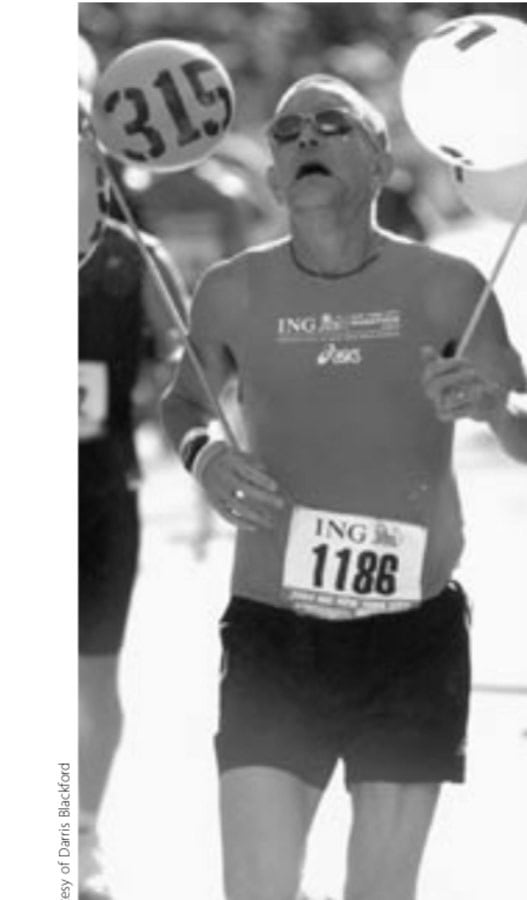
know how those women ran that loop five times. Whereas the final mile of the More Marathon continued along the roadway in Central Park and “The Official Marathon Death Mask.” Cost? Work a four-day expo, organize
30 pace team groups at three starting lines, and run 26.2 miles.
Courtesy of Darris Blackford
RUN AS THOUGH YOU ARE DYING
onto the finish, for my race we left the park, ran along Central Park South, and then reentered the park at Columbus Circle. Being from Columbus, I thought for a nanosecond about any coincidence, but I quickly shifted my thinking to what I saw before me—a giant movie screen showcasing runners in the race!
CAPTURED ON FILM FOR POSTERITY I saw people I didn’t recognize, one after the other, and wondered where the camera was located that was picking up their images. Would it show me falling across the line for everyone to see? Just then, I was on the big screen, balloons and all, making the turn into the park. I looked closely—where was the blood, the open wound in my chest, my leg lacerations? I felt very, very bad. Shouldn’t my appearance match?
Looks aside, I still wasn’t finished, still had to get up the final hill of the race. Ahead I could see the mile-26 marker taunting us, and beyond that I could see the finish area. I was going to make it! Often, when I’m at this point in a pace race, my eyes start welling up with tears as I become overwhelmed with happiness after having helped others achieve their goals and doing my job well.
This day there were no tears. I was not happy, knowing that it had taken way too much out of me to get to this point. I charged up the final section of the course, balloons held high, spirit carried low. Checking my watch for chip time, it read 3:16:14. I was within the window of plus or minus two minutes, had done as required, but my streak of always being two minutes or less under the time had ended. I made my time but felt that I had let myself down.
I swayed and swooned through the finish chute, feeling as bad emotionally as I did physically. I pulled a finish line blanket over my shoulders and held it close, seeking to find some solace, hoping to get away from the self-loathing. I did get past it, but it took others to get me there.
GETTING BY WITH THE HELP OF OTHERS—PART TWO As the other leaders began finishing, I heard them telling each other how things had gone well for them, how they had reached their goal, how much they enjoyed the experience and were proud to have served other runners in such a unique way. Ever so slowly it all began to sink in for me, and I began to feel better about myself and my performance.
Truth be told, we had all done our jobs to the best of our abilities, and we had helped thousands of runners along the way. Even if those marathoners who ran with us didn’t all reach their goals, they did benefit from a steady start and an even race pace by a great group of runners. And yes, in case you think I hadn’t noticed: not only had we done all of this, but we were all still alive to talk about it.
This article originally appeared in Marathon & Beyond, Vol. 9, No. 5 (2005).
← Browse the full M&B ArchiveMore like this
1,000+ stories from 19 years of Marathon & Beyond
The complete archive of the legendary long-distance journal — digitized and free to read.
