

The Mystique Of The Marathon
What would we do for fun if the Persians had won the Battle of Marathon? This thought occurred to me while I was in Greece last fall to celebrate the 2,500th anniversary of that battle—and the legendary run from Marathon to Athens by Pheidippides, who announced “Rejoice, we conquer,” and immediately died.
If the Persians had won, would their general have dispatched a sailboat across the Wine Dark Sea with news of the victory? If so, perhaps the word “marathon” might be applied to a regatta, not a running race.
The legend of Pheidippides—and it is more legend than historical fact— inspired a race in 1896 at the first modern Olympic Games over the same 25-mile route. Only 17 runners participated in that first marathon. In 2010, 20,000 runners appeared for the 2,500th-anniversary celebration, and races with twice as many runners had become common throughout the world in Berlin and London and New York and Chicago and beyond—races that, by the way, are called “marathons,” that term having conveniently taken hold as a description of a running race 26 miles, 385 yards long.
The marathon has undergone incredible changes since I ran my first race at that distance: Boston in 1959. First, more and more women are running, outnumbering men in more and more marathons. Marathons have both become more expensive and more difficult to enter, the 2011 Boston Marathon filling its field in eight hours and three minutes after opening for registration. While big-city marathons with their 40,000-runner fields often are “more fun” than smaller races, not everybody enjoys being slowed by crowds—particularly when it comes time to achieve an elusive Boston qualifier (BQ). Charities continue to attract large numbers to the sport, but running lately has suffered some stress faults, which may need to be mended.
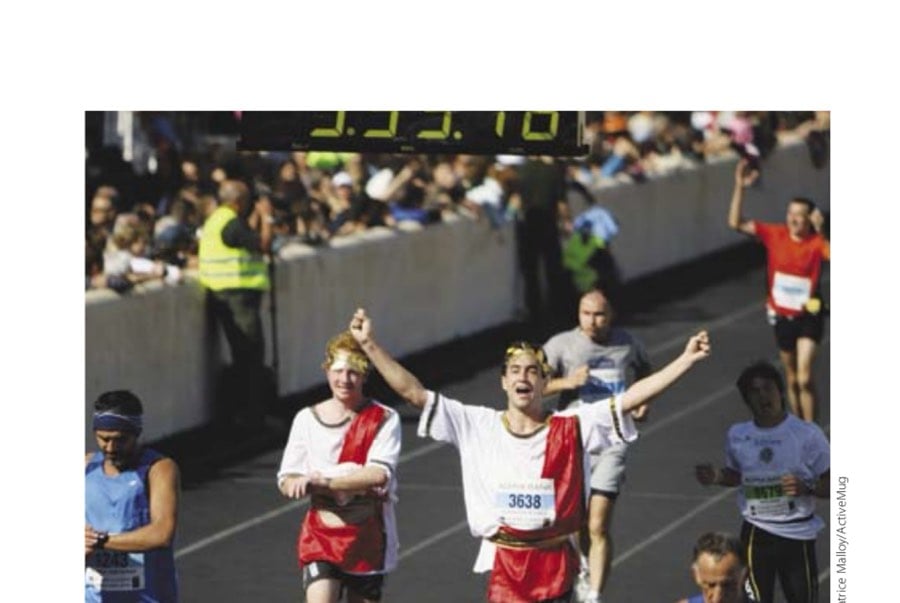
© Patrice Malloy/ActiveMug
We also have more gadgets, everything from GPS watches to heart monitors to map-tracking devices. I recently recorded an app for a training program that you can download onto your iPhone. But running remains a simple (if not easy) sport. Marathons attract people of all sizes and levels of ability. Fulfillment of the goal to run 26 miles and finish vertically, not horizontally like Pheidippides, continues to challenge us both physically and emotionally—as it did a woman who stopped by my booth at the Chicago Marathon expo last fall. The woman was crying. She could not talk. She made a few hand gestures in an attempt to cover her embarrassment but still failed to stem the flow of tears. I smiled—tolerantly. I told her to relax. I knew the reason for her emotional breakdown.
The next day, she would run 26 miles, 385 yards! Some runners shed tears crossing the finish line. I did this once myself after finishing fifth (first American) at the Boston Marathon in a time so fast I knew I never would come close to duplicating it, because never again would I be able to summon the will to train as hard as I had for that peak performance. “The marathon can humble you,” four-time Boston and New York City Marathon winner Bill Rodgers once said. Billy meant that sometimes even the best runners crash for reasons not easily explainable. It happened to him in the middle of that span of victories when he failed to finish one year at Boston after running in the lead much of the way. But the marathon can humble you in many ways. The classic long-distance race can expose all your nerve endings and bring you closer to recognizing the real you, all flaws and virtues on the surface. Whether or not the
Courtesy of Hal Higdon
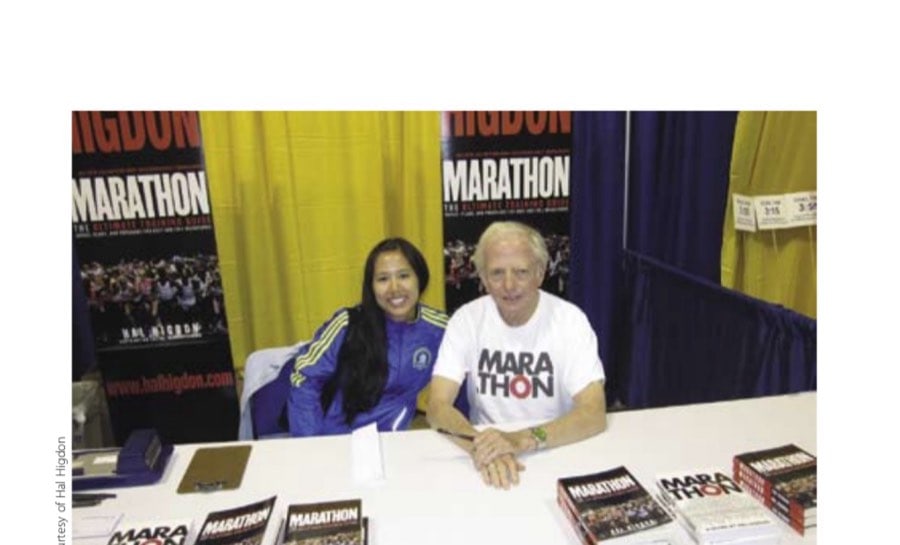
woman standing before my booth realized it, she was displaying a humbling emotion not uncommon among marathoners. It is just that some of us (men mostly) are more adept at hiding our emotions. The tears eventually stopped. The woman made an unnecessary apology. She
thanked me for the training program that after 18 weeks had altered her life. She bought a copy of one of my books as a gesture of thanks. She came around the desk and posed for a picture. She thanked me again and, eyes still moist, moved
on to her runner’s equivalent of an appointment in Samarra. I never got the crying woman’s name. I never found out how she did in the race, her time, or whether it matched her expectations. I never learned what motivated
her to run what most certainly was a First Marathon (in caps). I never learned whether she cried again crossing the finish line, although I suspect she did. And at the starting line, too. And maybe a couple of times en route. Unless she shows
up at my booth at some future marathon, I probably never will learn whether she would run a second marathon, or a third marathon, or a fourth, or more. Many, many runners have achieved success using my training programs after
reading my bestselling book, Marathon: The Ultimate Training Guide, or discovering those programs online. I estimate having coached a half-million marathoners, based on sales of the book and visits to my website, halhigdon.com. One woman
who stopped by my booth at the Indianapolis Monumental Marathon said she had used my Novice 1 program in 13 consecutive marathons. But that’s not the record for loyalty. Some months after that, while I was having dinner on the Plaka after
the Athens Marathon in Greece, a woman at a nearby table claimed to have used me as the coach for all of her marathons—and she had just finished number 51!
The drive to finish Not everybody understands the drive that causes a seemingly large percentage of the population to punish themselves and train for months for the seemingly dubious pleasure of running 26 miles, 385 yards. One year at the Twin Cities Marathon, approximately eight miles into the race, I heard a woman in the crowd comment: “To think, they paid to do this.”
I understood what she meant. Twenty-six miles is a long way. Adding 385 more yards makes the distance even longer and further confuses people who do not understand what motivates us to run marathons. “How far was that marathon?” they ask after we show up at the office on Mondays with medals hanging around our necks, limping but with smiles on our faces. Despite the rising popularity of big-city marathons, not everybody knows—or understands—why the distance is a precise (but foolish) 26 miles, 385 yards. Even thinking about running that far takes a certain amount of endurance. And courage. And maybe even arrogance. Yet somehow those of us who call ourselves marathoners do it again, and again, and again.
The woman’s comment at the Twin Cities Marathon failed to disturb me. First of all, I thought there was some truth to what she said. Second, I was too busy running as fast as I could to worry about what the spectators were thinking.
Only later would her remark return to haunt me. It was obvious that she failed to comprehend the mystique of the marathon and why running such a quirky distance appeals to so many otherwise normal people. How do you fully explain to friends and family the joy and pain that go into running 26 miles and 385 yards? The woman at Twin Cities certainly would have found ludicrous some of the goals I had used through a long career to motivate myself. As a younger runner, I focused my training on making an Olympic team and winning the Boston Marathon. Even though I had failed in achieving both goals, I came close enough to make the quest worthwhile.
As I aged, I often chose more-quixotic goals to keep myself moving from day to day and year to year. Sometimes, these goals were outside the competitive arena. One summer, Steve Kearney and I decided to run the length of the state of Indiana. Steve is a close friend, a teacher and coach from Chesterton, Indiana. We persuaded eight other runners to join us. When people asked afterward why we wanted to do such a crazy stunt, Steve and I would shrug and say, “It seemed like a neat thing to do.”
Selecting goals Not all of those who arrive at the starting line of a marathon will have motivated themselves by choosing goals as ludicrous as some of mine. Indeed, a large percentage of people entering at least the most popular marathons are running their
first marathon—and it may turn into their only marathon. Thirty-six percent of those who run Chicago each year are first-timers, and that percentage is typical of most major marathons. Nevertheless, each one of those nouveau marathoners will have chosen goals as carefully as I have chosen mine.
For most of them, the goal is only to finish the 26 miles, 385 yards. And that is how it should be. But those of us who have been running more than a few years often choose different goals. We want to run marathons in 50 states; we want to run marathons on seven continents. If you follow my advice and run your first marathon in a sensibly slow time aimed mainly at getting yourself to the finish line, you may want to pick bettering that time as a goal for your second or third marathon. Certain numbers contain their own magic; thus, runners attempt to break six hours or five hours or four hours. To be asked your time for the marathon and be able to begin your answer by saying “three” puts you in an almost-elite ego-building category, even if your time was only 3:59:59. Respond with a time that begins with “two,” and if the person asking a question also is a marathoner, his eyebrows will rise, his jaw will drop. I know because I possess a marathon personal record of 2:21:55, and I see the reaction of people when I tell them my time: “What planet were you born on?” That may sound fast—and it was in its day—but consider that were I able to recreate that time today, I would finish nearly three miles behind today’s world elite. That’s the men; I would also finish more than a mile behind the fastest women.
Finishing times mean much less to me today than they did decades ago, and it is not entirely because I know my best times are behind me. Most important is just being there, doing that. For me, and for many other experienced runners, it is not merely the race itself but also the preparation that goes into the race: the steady buildup of miles, the long runs on Sundays, the inevitable taper, the ceremonial aspects of the total experience. Two positive aspects of marathoning are that it provides focus for your training and that it offers a recognizable goal.
If you love to run, you appreciate the motivation the marathon provides for those long Sunday runs and those fast midweek track workouts. Marathon training focuses the mind, and that may be the best excuse for racing this distance.
I continue to work out daily, not to improve my times at the marathon and at other distances but simply because I enjoy being physically active. When possible, I pick scenic courses that provide me with enjoyable sights and sounds. Races are just a byproduct.
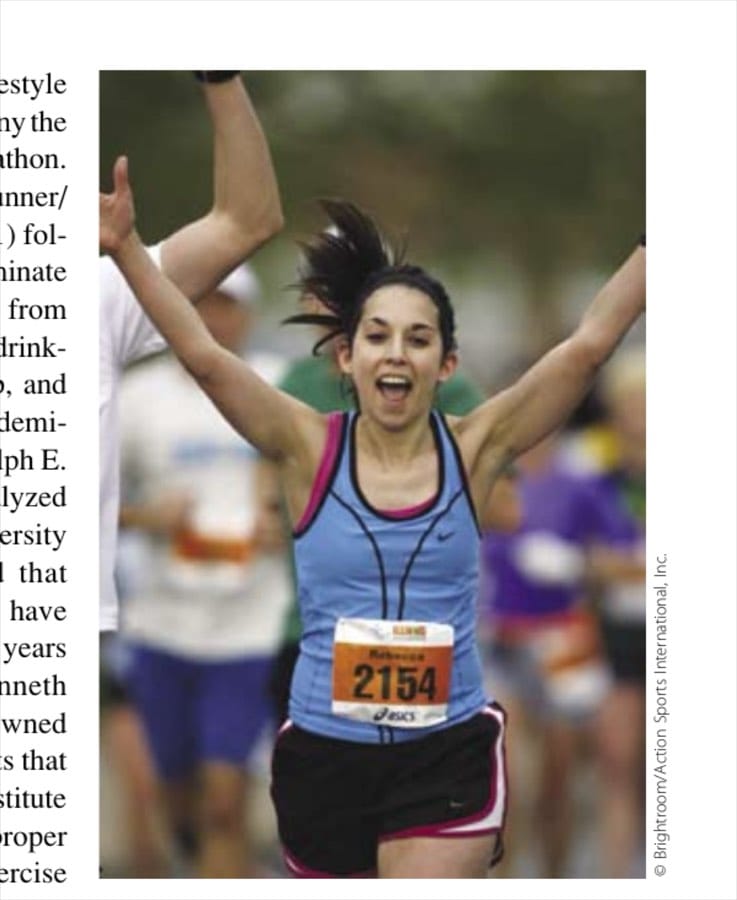
The marathon lifestyle Another positive byproduct of marathons is improved health. Marathon running has the potential to significantly increase your life span and to affect positively the quality of your life. Again, it is not so much the running of the race that af-
© Brightroom/Action Sports International, Inc.
fects your health but the lifestyle changes that often accompany the commitment to run a marathon. To become a successful runner/ marathoner, you need to: (1) follow a proper diet, (2) eliminate extra body fat, (3) refrain from smoking and avoid heavy drinking, (4) get adequate sleep, and (5) exercise regularly. Epidemiologists such as the late Ralph E. Paffenbarger, MD, who analyzed the data of Harvard University alumni, have determined that these five lifestyle changes have the potential to add several years to our lives. In fact, Kenneth H. Cooper, MD, the renowned author of Aerobics, suggests that researchers at his Cooper Institute in Dallas believe that the proper combination of diet and exercise plus preventive health maintenance can extend life by as much as six to nine years! The marathon lifestyle is definitely a healthy lifestyle.
But it’s not without some risks. Running is a stressful activity. Running for 26 miles makes it even more stressful. In extreme weather conditions (specifically warm weather), the stress can be extreme if runners do not slow down and drink more fluids during the race. “We’re unquestionably more at risk the hour a day that we run,” suggests Paul D. Thompson, MD, director of preventive cardiology at Hartford Hospital in Connecticut, “but the other 23 hours in the day, we are much less at risk. In balance, you’re much safer exercising than not exercising.”
Risk aside, there definitely is a mystique about running a marathon—no doubt about it. You can run 5K races until your dresser drawers overflow with T-shirts, but it is not quite the same as going to the starting line of a marathon. And while the half-marathon serves as a useful interim goal for runners new to the sport, finishing 13.1 miles is not quite the same as finishing 26.2. Marathons, on average, seem to be bigger events than 5K or half-marathon races, even when those shorter-distance events attract large fields.
Arrive several days in advance of a marathon and you know you are at a big event, regardless of how many people are entered. Maybe the excitement is partly anticipation among those who have entered. Each runner has committed so many
Risky runners? How risky is running? Paul D. Thompson, MD, director of preventive cardiology at Hartford Hospital in Connecticut and a 2:28:15 marathoner, concedes that runners incur some risk. While delivering a lecture titled “
Historical Concepts of the Athlete’s Heart” at the annual meeting of the American College of Sports Medicine, Dr. Thompson cited several seminal studies quantifying the risks of exercise, beginning with one of
his own that suggested that sudden cardiac death was seven times more likely during jogging than at rest. He estimated the incidence as one death annually for every 15,240 healthy joggers. Another study, published in the New England Journal of Medicine, of
fered similar statistics: one cardiac arrest for every 18,000 previously healthy men. A national fitness chain, however, claimed one death per 82,000 members or per 2.6 million workouts. “There is cardiac risk from exercise,” concedes Dr. Thompson, “but this
risk is small and, at least in adults, most common among those who exercise least.” What safety precautions should you take before becoming a runner or signing up for your first marathon? If you are older than 35, if you
are overweight, if you smoke or once smoked, if you have high blood pressure or high cholesterol, if you follow a fast-food diet, if you have a family history of heart attacks, or if you don’t already exercise, your
degree of risk is greater than someone without those “ifs.” Check with your family physician before starting to run, and once out the door, follow a sensible training program.
miles in training for this one event that the race takes on a level of importance above and beyond the ordinary, regardless of the size of the field. One year I visited Toledo, Ohio, to lecture the night before the Glass City Marathon, with its field of about 1,000 runners. Compared with marathons in New York or Chicago or London or Berlin, with their fields of 40,000 runners, that is pretty small potatoes. Yet despite Glass City’s relatively small field, the same premarathon excitement was present. I could feel it around me as I spoke. People often talk about there being a “glow” around pregnant women. That is certainly true, but there is a similar glow around expectant marathoners. If not nine months, many of them have devoted 18 weeks of preparation for their big event. All the people
in my audience at Toledo had worked hard to get ready for the race. Looking at their faces, I envied them. What is it about the marathon? Is it the race’s history? Its traditions? The many fine runners who have run it? The marathon is all of that, but there is also a mystique about the distance itself. Would the race have the same appeal if it were a more logical 25 miles? Or 40 kilometers?
Footsteps of Pheidippides
© Patrice Malloy/ActiveMug
The establishment of the marathon at the unquestionably odd distance of 26 miles and 385 yards (or 42.2 kilometers) certainly adds to the mystique. The fact is that, technically speaking, all marathons are precisely 26 miles, 385 yards. Anything
longer and the race is considered an ultramarathon. Anything less and either the course was mismeasured or it is something else. The first event to be called a marathon was held in 1896 at the first modern Olympic Games in Athens, Greece.
This long-distance footrace was staged at the end of those games to recreate and commemorate the legendary run of Pheidippides in 490 BC. In that year, the Persians invaded Greece, landing near the plain of Marathon
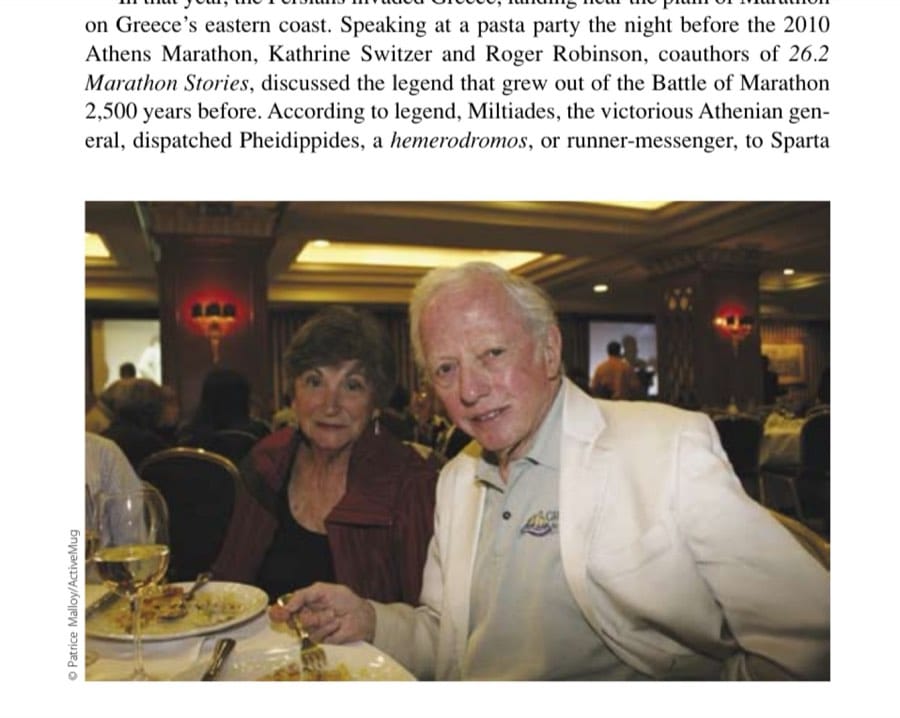
on Greece’s eastern coast. Speaking at a pasta party the night before the 2010 Athens Marathon, Kathrine Switzer and Roger Robinson, coauthors of 26.2 Marathon Stories, discussed the legend that grew out of the Battle of Marathon
2,500 years before. According to legend, Miltiades, the victorious Athenian general, dispatched Pheidippides, a hemerodromos, or runner-messenger, to Sparta
(150 miles away) to seek help. It reportedly took Pheidippides two days to reach Sparta. The Spartans never did arrive in time to help, but the Athenians eventually overwhelmed their enemy, killing 6,400 Persian troops while losing only 192 of their own men. Or so it was recorded by Greek historians of the time, including Herodotus, the most famous historian of the classical era.
But was Pheidippides the same messenger who, according to legend, ran a route that took him south along the coast and up and across a series of coastal foothills before descending into Athens, a distance of about 25 miles from Marathon? Pheidippides announced, “Rejoice. We conquer!” as he arrived in Athens—then fell dead.
Ah, legends. Latter-day historians doubt the accuracy of the legend. These include Robinson and Switzer, who suggested at the pasta party that if there was a hemerodromos, he may not have been the same one known to have relayed the request for troops to Sparta. There may or may not have been a hemerodromos by the name of Pheidippides who died following a postbattle run to Athens. Robinson and Switzer noted that Herodotus failed to mention a hemerodromos; the story appeared four centuries later, when the history of the battle was retold by Plutarch.
Nevertheless, as the authors conceded, “Every marathon, somehow, ends in Athens.” The legend took on the imprint of historical fact and was certainly no less worthy of respect than legends involving mythical Greek gods such as Hermes or Aphrodite, who supposedly emerged full grown out of the brain of Zeus. It seemed perfectly suitable at the 1896 Olympic Games to run a race in Pheidippides’s honor from Marathon to the Olympic stadium in downtown Athens. It was particularly fitting that a Greek shepherd named Spiridon Louis won that event, the only gold medal in track and field won by the Greeks on their home turf. Among the American clubs represented at those first Games was the Boston Athletic Association (B.A.A.), whose team manager was John Graham. So impressed was Graham with this race that he decided to sponsor a similar event in his hometown the following year. Races of approximately 25 miles (40 kilometers) had been held before in Europe, including one held in France before the Olympics. But nobody had attached the name “marathon” to these races, and there was not yet a marathon mystique.
Fifteen runners lined up at the start of the first Boston Athletic Association Marathon in 1897 to race from a side road in suburban Ashland into downtown Boston, and a legend was born. (A previous American marathon was run in the fall of 1896 from Stamford, Connecticut, to Columbus Circle, near the finish line of the current New York City Marathon, but it failed to survive.) The Boston Marathon remains the oldest continuously held marathon. It continues to retain its status and prestige, and it attracted a record 35,868 finishers in 1996, its 100th running.
Determining the distance For a dozen years, the official marathon distance was approximately 25 miles. That was the distance run in the 1900 Olympic Games in Paris and the 1904 Games in St. Louis, as well as in the Boston Marathon for its first 28 years. Then in 1908, in London, the British designed a marathon course that started at Windsor Castle and finished at the Olympic stadium. This was long before course-certification experts measured race distances to an accuracy of plus or minus a few feet. Nobody challenged the British course design, which reportedly was laid out so that the royal family could see the start of the race. The distance from start to finish for that marathon was precisely 26 miles and 385 yards. For whatever reason, that distance eventually became the standard for future marathons. The Boston Athletic Association waited until 1924 to lengthen its course, moving the starting line from Ashland to the nearby town of Hopkinton, where it is today.
Frank Shorter tells the story of running the marathon trials for the 1971 Pan American Games. At 21 miles, he was lockstep with Kenny Moore, a 1968 Olympian. “Why couldn’t Pheidippides have died here?” Shorter groaned to Moore. In that case, it was Shorter who “died” and Moore who went on to win the race. Shorter one-upped Moore the following year at the Olympic Games in Munich, Germany, winning the gold medal while Moore placed fourth and Jack Bachelor placed ninth. That was the best recent showing by American marathoners in the Olympics until Meb Keflezighi and Deena Drossin (now Kastor) won silver and bronze medals in Athens in 2004.
The running event that is so popular today might not have been the same if the plain of Marathon had been closer to Athens. Exercise physiologists tell us that it is only after about two hours of running—or about 20 miles for an accomplished runner—that the body begins to fully deplete its stores of glycogen, the energy source that fuels the muscles. Once glycogen is depleted, the body must rely more on fat, a less-efficient fuel source. This is one of the reasons runners hit The Wall at 20 miles, and successfully getting past that obstacle is what makes a marathon such a special event.
Twenty miles is the longest distance that I ask people using my training programs to run in practice for the marathon. Particularly for those training for their first marathons, I want them to touch the edge of The Wall, not collide with it. You significantly increase your risk of injury and overtraining, both of which may hurt your race-day performance, if you run much farther in practice. Nevertheless, many of us who consider ourselves accomplished runners run 20-milers as part of our marathon buildup without excessive pain and with little fanfare. It is only when we stretch beyond that point that people sit up and take notice. Would a million people line the roads along the Boston and New York City marathon routes if the distance were only 20 miles and if there were no Wall to conquer?
Glycogen and The Wall A phrase frequently used by marathoners is “hitting The Wall.” This usually occurs around 20 miles, about the time the body runs out of energy. Often this happens so suddenly that runners feel as though they crashed
into a brick wall. Their pace slows. Their breath becomes labored. They struggle to finish. It can be said that the first half of the marathon is 20 miles long, the second half, six more. Physiologically, runners hit The Wall when they deplete their muscles
of glycogen. Glycogen is the sugarlike substance that serves as the main fuel for our muscles when we exercise. It is stored in the liver and in the muscles. When you run long distances, you deplete your glycogen
stores and eventually run out of energy. With glycogen gone, the body begins burning fat, a much less efficient fuel source. Not all runners hit The Wall. With proper training, you can teach your body to burn fat more efficiently. Refueling on the run with sports drinks
and gels adds to your glycogen supply. Proper pacing also will allow you to hurdle the feared Wall and achieve a peak performance.
No, they want to see us tempt the fate of Pheidippides. They come to see us suffer, although inevitably both spectator and runner leave fulfilled only if we demonstrate through our successful crashing through The Wall and crossing of the finish line that we are victorious.
Changing your life For many runners, completing one marathon is enough. They cross the line and, overwhelmed with the experience, think, Never again! Only 13 miles into the Chicago Marathon and struggling, Nicole Kunz of McHenry, Illinois, swore to herself that she never—absolutely never—would run another marathon. Within 24 hours after finishing, however, Kunz already had begun to consider training for the Flying Pig Marathon in Cincinnati the following spring. She ran that marathon and then New York before taking time off to have two children.
Kristine Nader of Chicago had a similar reaction during her first marathon: “I figured it would be one and done. The whole time I trained, I kept telling myself, This is nuts. Why am I doing this? What was I thinking? I am so glad I am only doing this once!” Then when she saw her family cheering her at mile 14, she realized this was something she wanted to do again—and again. Nader recently completed her third marathon.
© Robert Rayder
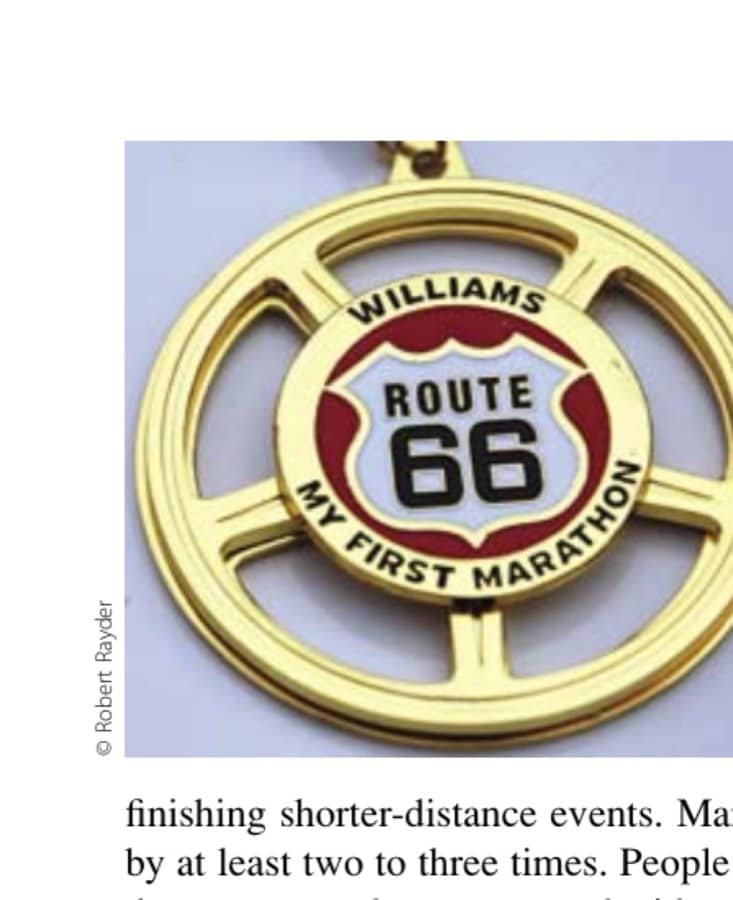
Marathoners may change their minds the next day, the next week, the next month, or sometimes as soon as they get to the end of the finishing chute, but nobody can deny that a marathon—particularly a first
marathon—is a very special event. A very, very special event. Finishing a marathon changes your life forever. Professional photographers who take pictures of runners crossing the finish line find that marathoners make
much better customers than do those finishing shorter-distance events. Marathon photos outsell shorter-event photos by at least two to three times. People also buy multiple photos of themselves at the same marathon, compared with only a single photo at a shorter race.
Why? It is the same reason that people order more pictures at weddings. Completing a marathon is like tacking a PhD at the end of your name, getting married, or having a baby. You are special, and whether anyone else knows it or
not, you certainly do. Your life will never again be quite the same, and regardless of what the future brings, you can look back and say, “I finished a marathon.” Regardless of the large number of people running marathons today, you are still
part of an elite crowd. Some runners finish their first marathon, place their medal in a drawer, hang their photo on the wall of their office cubicle, and go on to different challenges. They check off one item on their bucket list, things they want to accomplish before
kicking the bucket. For many, however, that first marathon is merely the beginning of a lifetime journey. Running marathons becomes a continuing challenge of numbers: personal records (or PRs), which exist to be bettered at each race.
Even when aging brings the inevitable decline in performance, new challenges arise as the lifetime marathoner moves from one five-year age bracket to another. In the area of performance, success breeds success.
It is also possible to run marathons recreationally, not caring about time or finishing position but participating merely for the joy of attending a great event with all its accompanying pleasures. I have run many marathons in this manner,
running within myself and finishing far back from where I might have had I pushed the pace harder. One year at the Honolulu Marathon, I started in the back row and made a game out of passing as many people as possible—but doing it at
a pace barely faster than theirs so as not to call attention to my speed. I did not want it to seem that I was trying to show them up. Beginning with the 1995 St. George (Utah) Marathon and prompted by an article I wrote ranking the marathon
courses most likely to yield fast times so people could qualify for the 100th Boston Marathon, Runner’s World began to organize pacing teams led by editors running slower than usual while shepherding others. I have led pacing teams on several occasions. It’s fun, and it’s rewarding to help others meet their goals.
I have also run marathons in which I stopped at planned dropout points, using the race as a workout to prepare for later marathons. At the World Masters Championships in Rome one year, I ran the marathon at the end of a week’s track competition mainly so I could enjoy the sights and sounds of the Eternal City. In the last miles of the race, as I entered a piazza with a panoramic view of St. Peter’s Cathedral across the Tiber River, I paused for several minutes to absorb that view and only then continued toward the finish line in the stadium used for the 1960 Olympic Games. How fast I ran and how well I placed were the last things on my mind. Crossing the finish line, more refreshed than fatigued, I was approached by an Australian runner who announced, “This is the first time I ever beat you.”
I felt obliged to correct him: “You didn’t beat me. You merely finished in front of me.” The Australian stammered an apology, but he had missed what I believe to be the point of the marathon, or at least he was not aware of the way I had chosen to run the marathon that particular day. In a marathon, except at the elite level, you do not beat others, as you might in a mile or a 100-meter dash. Instead, you achieve a personal victory. If others finish in front of or behind you, it is only that
their personal victories are more or less than yours. A person finishing behind you with less talent, or of a different age or sex or various other limiting factors, may have achieved a far greater victory. And if the person’s main goal in running the marathon was to raise money for charity, the amount of money collected may be a more important barometer of success than finishing time. One beauty of the marathon is that there are many more winners than those who finish first overall or in their age groups. “Everyone’s a winner” is a dreadful cliché, but it happens to be true when the race involved is 26 miles and 385 yards long.
A lifetime of marathons Reporters sometimes ask how many marathons I have run. For many years, I would respond, “About 100.” This amazed them: “You’ve run 100 marathons?” I had to correct them because I did not want to read in the newspaper the next morning that I had just run marathon number 101. “No,” I would say. “I don’t know how many marathons I’ve run. But it must be about 100.”
Then in the spring of 1995, a year before the 100th Boston Marathon, I got curious about the exact number. Using the library at the Boston Athletic Association, I searched through old running magazines and newsletters for past marathon results. I was able to identify several races that I had little memory of running, including one in which I had finished first! But the actual total number of marathons I had run was fewer than what I had been telling reporters for years: It was only 90.
That was the bad news, but the good news was that with a little effort over the next 12 months, I would be able to run my 100th marathon at the 100th Boston. Thus, running a marathon a month became my goal for a year.
Run 10 more marathons I did, using the 100/100 challenge to motivate my training for more than a year, a very enjoyable year as I ran marathons from Memphis, Tennessee; to Hamilton, Bermuda; to Seaside, Oregon. That 99th marathon in Oregon, one month before the 100th Boston, fittingly was called the Trail’s End Marathon, although Trail’s Pause might have been a more appropriate name in my case, since I still had to run the 100th Boston.
The 100th running of the Boston Marathon was one of the most difficult marathons of my career. That event coincided with publication of Boston: A Century of Running, my coffee-table book commemorating the 100 years of the race. I spent most of the week before the race doing media interviews and then three days at the expo signing copies of the book and talking to runners—that plus a series of parties, including a breakfast of champions featuring most of those still living who had won the race. That included Canadian Johnny Miles, winner in 1925. It was a heady time, but by race day I was physically exhausted.
Courtesy of Hal Higdon
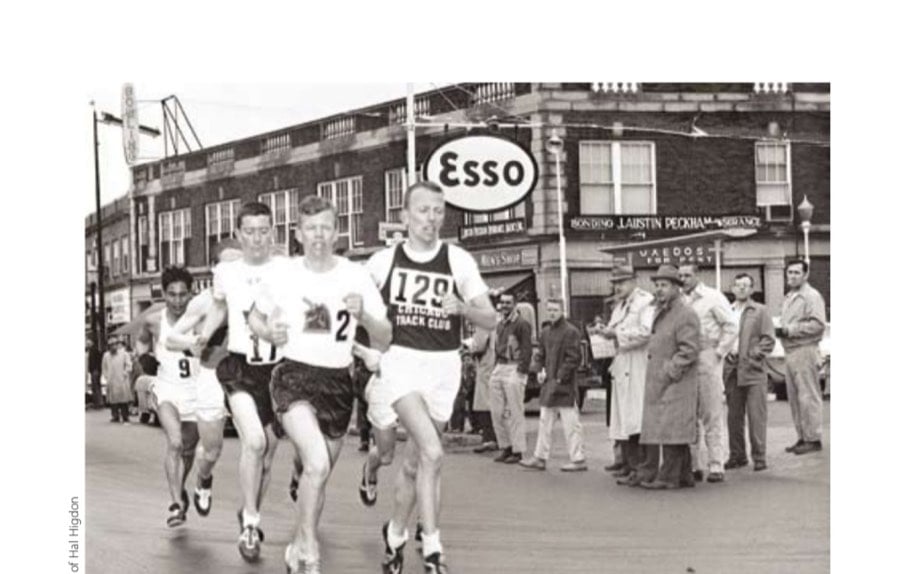
My wife, Rose, and I had rented a house on Hopkinton Green within sight of the starting line. Rather than line up with the masses that morning, I watched the start from the house’s front yard, then went in to view the race on TV. The
lead runners had passed three miles before Rose suggested, “Don’t you think it’s time to go run?” I joined the runners in the back of the pack. The atmosphere seemed electric, all the runners realizing that they were part of a true historic occasion. But by
eight miles, my battery was fully discharged. I hit The Wall well before there should have been any Wall to hit. The Newton hills were still another eight miles down course, but my previously steady stride had been reduced to a stumbling
shuffle. And although it had seemed relatively warm in Hopkinton, with a tail wind pushing the runners, as we got closer to the ocean, the wind switched, becoming a chilling head wind. Near the halfway point, I picked up a discarded
long-sleeve shirt from the gutter. It was soaked with sweat, but it helped keep me warm to near the top of Heartbreak Hill, where I spotted a Mylar space blanket, also discarded. I wrapped it around myself as one more defense against the cold
wind off the ocean. I continued running and finished the 100th Boston in an unmemorable six hours, including the half hour or so it had taken me to cross the starting line after the gun sounded. One hundred being a round number, I probably should have called
it a career, but I decided to lead pacing teams at the Chicago Marathon the next
several years and then did the same at Honolulu. After running seven marathons in seven months to celebrate my 70th birthday, I found myself with 111 marathons on my résumé: another number that sounded good when people asked how many I had run, a frequent question thrown at me, especially by first-timers.
At my appearance at a running store in Kalamazoo, Michigan, one young woman who asked that question seemed amazed. “Eleven marathons?” she asked. “Wow, that’s a lot.” “No, not 11,” I corrected her. “One hundred eleven marathons.”
That truly dumbfounded the woman, but I am far from being the record holder when it comes to the number of marathons run. Sy Mah, a Toledo, Ohio, runner who often ran two and sometimes three marathons on a weekend, finished 524 races that were longer than 26 miles before his death from cancer at age 62 in 1988. Continually adding to the total was the focal point of Mah’s running, so it was important that he keep precise records for each of his races. Mah usually finished in the high three-hour range. I once told Sy that if he focused his attention for six months on a single race—training specifically for it, resisting the temptation to run other marathons so that he could taper and peak—he could probably improve his time by a half hour and maybe even break three hours, putting him near the top for his age group. Smiling, Sy conceded my point, but we both knew that was not what he was about. His joy was running as many marathons as possible and adding to his impressive string of numbers, which earned him an enviable spot in The Guinness Book of World Records. In 1994, Norm Frank of Rochester, New York, broke Mah’s record. Frank, who ran approximately 40 marathons a year, had pushed his record number to a devilishly difficult 965 by the end of 2010 and had an ultimate goal of 1,000. Horst Preisler of Germany, ran his 1,000th at the Berlin Marathon in 2000 and has now done more than 1,800.
The marathon never ceases to be a race of joy, a race of wonder. Even when disaster strikes, when bad weather overwhelms you, when an intemperate pace results in a staggering finish, when nerves and anxiety stand in the way of giving your maximum effort, when your number one rival soundly thrashes you, when 18 weeks of training appear to have gone down the drain with little more than an ugly slurping sound, there remains something memorable about each marathon run.
The crying woman with whom I spoke before her first marathon in Chicago instinctively knew that fact. Her training leading up to that event certainly had been part of a lifetime change, a passage of sorts, one that sparked the flow of tears. If that becomes the only marathon she runs in a lifetime, it would be memorable. If she should continue to run additional marathons, each would be memorable, some more memorable than others.
The marathon continues to attract us, like moths to a flame. Excerpted from the fourth edition of Marathon: The Ultimate Training Guide. Copyright 2011 by Hal Higdon, all rights reserved.
This article originally appeared in Marathon & Beyond, Vol. 15, No. 6 (2011).
← Browse the full M&B ArchiveMore like this
1,000+ stories from 19 years of Marathon & Beyond
The complete archive of the legendary long-distance journal — digitized and free to read.
