

Why run the marathon? However simple that question may be, the answer can vary as much as the field itself on race day. Whether the runner is a professional or not, the path to the 42K can be a byproduct of another sport or distance, a long-term goal, a way out of poverty, or a test of the waters. For those who run the marathon as an occupation, the stakes increase tremendously. Whatever it is that propels elite athletes to embrace that distance for a living, the process by which they commit can emerge at any time, as shown by a sampling of some of the top American talent.
From hardship For Fernando Cabada Jr., of California, his road to elite status was primarily driven by hard lessons he learned as a child of an oft-imprisoned dad. Forged at an early age, Cabada was able to turn that influence around in a constructive and positive direction. “
I had a father who kind of pushed sports onto me—basketball, baseball, stuff like that,” Cabada said. “He was in and out of prison in my life. He wasn’t a very patient man, being incarcerated for so many years as he was. So when he’d come out, he would try to make up for lost time all in a weekend, so it was really hard on me. Whenever he would go back to prison or jail, I would stay away from those sports. Everything he taught me, I stayed away from because I only did it out of fear, and I didn’t want to get in trouble or get yelled at by him.”
As a third-grader living on welfare in the ghettos of Fresno, however, Cabada discovered a sport that he enjoyed and in which he began to receive some recognition. As a youngster, he felt he had no identity, no claim to fame, so to speak. But that soon changed when in school he ran the half mile in physical education class. “
I remember I got fifth place, I think, my first time we did it in our class, and second place the second time,” he recalls. “Growing up prior to that, I didn’t have any confidence. I wasn’t good at anything. I didn’t have anything that anyone knew me for. So for the first time, among that class, I got some positive feedback. That was really great for me.”
© Paul Clerici
!["[Running] structured my life for the better. It makes me feel better. It makes me feel good. Even now, I continue to keep running because it makes me a better person." —Fernando Cabada Jr.](https://marathonhandbook.com/wp-content/uploads/906813_fig1.jpg "The Path To 42K 11")
For a young, impressionable, and supportstarved kid, that attention sparked a fire. “I liked it. Who doesn’t like becoming somebody? It made me [think], like, ‘Oh, I’m a somebody in this world!’” Fueled also by encouragement from his mother, Cabada continued to excel in high school, when as a sophomore he won the 1,600-meter conference championship (4:22); at Virginia Intermont College, where he earned seven NAIA (National Association of Intercollegiate Athletics) National Championship titles; and after college, when he won the 2008 US marathon title at Twin Cities (2:16:31). “
It was something to be good at,” he said “[Running] structured my of running. “It structured my life for the better. life for the better. It makes me It makes me feel better. It makes me feel good. feel better. It makes me feel Even now, I continue to keep running because good. Even now, I continue to keep running because it it makes me a better person.”
With several top-10 finishes in the marathon, makes me a better person.”— including a seventh-place 2:11:53 at the 2012 Fernando Cabada Jr. US Olympic Trials in Houston, Cabada says, “It just kind of happened. Whenever it came to long runs, it felt easy.”
While the longer distance seems to be where Cabada’s strength and talent are best suited, the marathon is not something he loves. “I like competing,” he says. “I like the competition. I like preparing and my body beating their body across the line—that’s the whole idea. But as far as running, I wish I could say I love it that much. I think I’ll always run, but I don’t know if I’ll go do 20-milers on the weekends [after retiring].”
Cabada has experienced so much hardship in his life that he cherishes the resulting good fortune from his hard work and determination. Some people may find themselves fondly looking back only after retirement, but he appreciates his place in life. He recognizes how special everything is while he’s in the moment. “
It’s showed me how great my life has been,” he said. “When I was little, I used to wish how I had a different setup . . . I wish a lot of things that I didn’t have growing up, and now I appreciate where I came from and all the years I’ve been running.”
That fresh approach—from experiencing a victorious 2012 Rock ’n’ Roll Los Angeles Half-Marathon (1:04:56) to a 16th-place 2:18:23 Boston Marathon six months later—fills Cabada with a sense that he is at an age and in a position where his career is still improving.
“I’ve been running close to six or seven years professionally—where I’m running for money—and the coolest thing is I realize that now, I still have three, four, five years left and it’s going to be really fun,” said the 32-year-old. “This is not the end. I’m happy about that.”
Born into running “I grew up in a running family,” said Serena (Ramsey) Burla, whose father, Chris Ramsey, a high school girls track and cross-country coach for nearly 40 years, ran the 1974 Boston Marathon in 3:01. “We were always a very active family. I did tennis, baton twirling, basketball, softball, and track camp. It [running] was never pressed on me, but I think [it was] just the impact of seeing the sport in action.”
At a young age, she would often accompany her father to his practices and meets, where—watching runners train, compete, and come together as a team—she began to witness the joy of the sport. “I always saw the passion with the girls, the emotion and the love for the sport,” she recalls. “The girls just brought me in, let me do cool-down laps.”
She began her running with short distances, such as the 200 and 400 meters in school and the local two-mile turkey trots, and the overall enjoyment and competition lured her. “I was always very competitive,” said the former University of Missouri All-American. “I definitively have that competitiveness, but I [also] have that genuine love and the way running makes you feel and the satisfaction afterward, the combination of that.”
After success at the 21K, which included a second-place 1:10:08 at the 2010 US Half-Marathon Championships in Houston, it was off to the marathon. “Yeah, it’s that progression in long-distance runners’ lives,” she said. “And part of it is that challenge—that element of the unknown—that so many things can happen in a marathon. . . . I like that element of putting it all out there and seeing what happens in a marathon.”
As Burla began that transition, however, she faced challenges that forced her to redirect her competitiveness. In 2010, at the age of 27, she fought synovial sarcoma, a rare form of cancer, in her hamstring that resulted in the removal of half that muscle in her right leg. Two years later and cancer-free, she was among the leaders in the US Olympic Trials Marathon when hypoglycemia (low blood sugar) forced her to drop out.
But remarkably, between those life-altering hurdles, she debuted with a 2:37:06 at the 2010 New York City Marathon, came in second again at the US Half-Marathon Championships (1:11:38), and was sixth at the 2011 Prague International Marathon (2:35:08). “[
With] what happened when it was a question if I would ever run again, I just decided I haven’t given enough to not run again, so let’s try the marathon,”
she said. “I’ve already overcome so much, so let’s try the marathon and see if my body holds up and if I can do it.” She has done it, with such feats as a secondplace 2:27:59 at the 2013 TCS Amsterdam Marathon and a third-place 2:28:27 at the 2012 Seoul International Marathon.
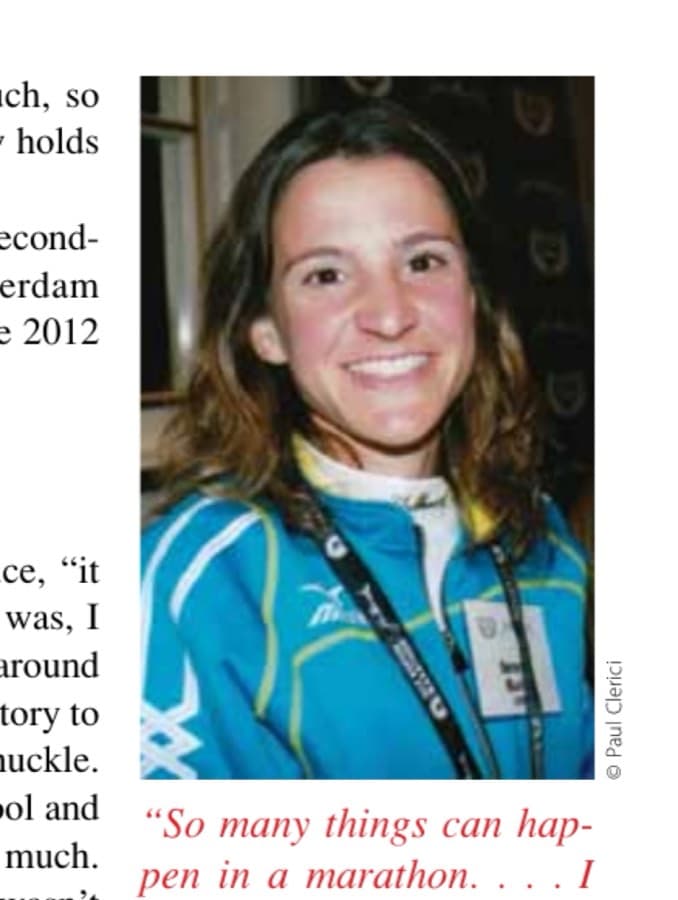
“For me,” said Stephanie Rothstein-Bruce, “it was running right from the beginning. I was, I think, 5 years old and my dad had me run around this cemetery. I know, it’s a really weird story to run around a cemetery,” she said with a chuckle. “And then I ran when I was in grade school and “So many things can haphigh school. I didn’t like it necessarily that much.
pen in a marathon. . . . I I thought it was very hard. And I probably wasn’t like that element of putting doing all the things right.” it all out there and seeing At Xavier High School in Arizona, where she came in second at the 2002 state championship what happens.”—Serena 1,600 meters (4:58.47), a tragic event galvanized (Ramsey) Burla her connection to running. “
My senior year of high school, my dad passed away—it was actually while I was on a run,” she said of her father, James, who succumbed to prostate cancer. “So from that moment on, something changed and it became a gift—not that I have to run, but I get to run. It became something, like, this is my gift and my talent. Ever since then, it’s never been a chore to me. It has a special place in my heart. Every time I’m running, I kind of have a piece of him with me. It’s really special.”
At the University of California, Santa Barbara (UCSB), she ran cross-country and primarily the 3,000, 5,000, and 10,000 in track. “In high school I ran the mile and thought, Oh, I’m a miler. Of course, I got to college and got my ass kicked, so I’m like, ‘I’m not a miler!’ So I moved up right away with the 5K and then the 10K.”
Then her collegiate career and her education were nearly derailed when her mother said they were out of options to pay for college. Her mother had sold the family home and moved into a small apartment; her late father’s business had run out of money; her mother’s low-level income was deemed too much of a risk for a loan; and any borrowed, scholarship, and job-related money was gone.
But after the school, her Gaucho teammates, and an anonymous donation afforded her the means to stay at UCSB, she graduated as a multiple record holder
© Paul Clerici
Spiritual connection
In the family One of Jason Hartmann’s first competitors was his father, who ran in high school and a little bit in college. He not only introduced his son to the sport, but he never
© Paul Clerici
and two-time 10K All-American. She then made the jump to the 20K and half-marathon and eventually to the marathon. “Sometimes your body just tells you when it comes to what your strengths are in races or workouts,” she said. “When I wasn’t very good at changing pace or if I would go out too hard in a race—I usually kind of went over my edge— usually that tells you that I can run at a fine line for a very long time like great marathoners can do. Then I looked at what my goals were, and if I wanted to be top in the US and eventually in the world, I needed to go to the event that I was going to be best at. And then I found that the “If you manage [the maramarathon was that for me.” thon] right, and you have
In 2008 she came in fifth at the Twin Cities energy, you just can get Marathon (2:40:07) but then began to suffer from stuff out of yourself in that injuries, including a stress fracture of the sacrum
race more than you can (between the spine and pelvis), and she also was diagnosed with celiac disease, an incurable condi- get from any other race. I tion that can damage the small intestine and does feel that you really achieve not allow the body to absorb certain nutrients but things mentally and you’re pushing barriers that you can be managed with a gluten-free diet.
Once she regained her strength and resumed might not be able to do in an elite-level schedule of training and racing, any other race.”—Stephanie Rothstein-Bruce built up her competitive profile Rothstein-Bruce with a second-place 1:08:26 at the 2010 USATF National 20K Championships, a third-place 2:29:35 at the 2011 Houston Marathon, a third-place 2:32:47 at the 2012 Honolulu Marathon, and a 2:35:31 for 15th woman at the 2013 Boston Marathon. “
I like the slow burn, like you stay at this really uncomfortable feeling for a good half hour, 40 minutes, and then it’s really painful the last 10K,” she said of the marathon. “But if you manage it right, and you have energy, you just can get stuff out of yourself in that race more than you can get from any other race. I feel that you really achieve things mentally and you’re pushing barriers that you might not be able to do in any other race.”
© Paul Clerici
relented, to the point where that competitiveness initially backfired. “In seventh grade I did cross-country, and he said I should train a little bit,” Hartmann recalls. “He used to pound me all the time, so I hated it. He beat me down, in everything; like, we played basketball growing up and he’d always elbow me and stuff and it’d be a little rough. My dad’s an ultracompetitive person. So am I. Then I got to the point where I got fast enough to beat him. Once I got ahead of him, he never railed me again.”
Hartmann realized he lacked the skill to excel as a short-distance runner, so he gravitated “It’s a certain level of excitetoward the longer distances: 800 meters, mile, ment that’s in a marathon. two miles in high school; 1,500, 5,000, 10,000
There’s not a tomorrow in meters in college. “My attributes are more for longer distances. the marathon. For us, it’s one Even back then, I probably would have blown out day. I love the pressure [of] my hamstring,” he laughed in regard to any at- trying to be [the best] on this tempt at shorter distances. “In college, naturally one day.”—Jason Hartmann it’s a progression, unless you’re just truly fast enough to compete at a high level in the 1,500. So I stepped up the distance to 5K and 10K in college. It’s just a longer period of time you have to deal with pain.”
When asked if he could naturally handle that kind of pain better, Hartmann answered with a quote from the film Man on Fire, when Denzel Washington’s character is asked by an athlete if she’s tough, “And Denzel goes, ‘There’s no such thing as toughness. There’s trained and there’s untrained.’ So, if you train yourself, you can do anything.”
At the University of Oregon, the three-time cross-country and three-time 10,000-meter All-American had no intention of running the marathon, ever, even when he was told he would. “One of my assistant coaches at the time said, ‘You’re going to be a marathoner one day.’ I was, like, ‘No way! No way I want to run that distance.’ I never really saw myself as a marathoner,” he noted.
After some postcollegiate success in the 20K and half-marathon, he debuted in the marathon at Chicago in 2006 with a top-20 time of 2:15:50. He also turned in a similar result at the 2008 US Olympic Trials in New York, where he came in 10th at 2:15:27. But he did not initially welcome his marathon destiny. “
I don’t know if I necessarily had the success right off the bat, so you kind of develop a certain level of frustration because you didn’t run successfully right
off the bat,” he said. “So I guess probably a few years ago [was when] I felt my strong suit was ultimately there in the marathon to give me the best chance to make the Olympic team.” Hartmann ran 2:16:44 at the 2012 US Olympic Trials in Houston, but it was his victorious 2:12:09 at the 2009 Twin Cities, 2:11:06 at the 2010 Chicago, and a pair of fourth-place Boston finishes in 2012 (2:14:31) and 2013 (2:12:12) that have made him one of the top marathoners in the nation. “There’re so many things that can happen,” he said. “You can be great and doing well, and develop a blister on your foot. You can be doing well, and get a cramp. There are so many unknowns that happen in the marathon that the average person watching doesn’t necessarily see. But also you have this training for this one day where I’m trying to get all my training to count here to do really well on this day. That’s exciting. It’s a certain level of excite
ment that’s in a marathon. There’s not a tomorrow in the marathon. For us, it’s one day. I love the pressure [of] trying to be [the best] on this one day.”
Out of the water A swimmer and soccer player in junior high school, Alissa McKaig preferred the water and the field to the road. It was in the pool, not on the track, where she did her laps—that is, until she was knocked down by a serious injury of unknown origins. “
I got what’s called pars defect. It’s like, basically, I cracked my vertebrae on both sides. In seventh grade!” she said with a slight laugh at the uncertainty of the cause. “So I wore a back brace for three months and they thought it was healed, so I started swimming and playing soccer again. In eighth grade the pain came back and so I was in the back brace again for another three months. In that time it wasn’t healed, so they put pins in and I wore the back brace for another three months.”
Her goal throughout this painful, drawn-out ordeal was to make the varsity soccer team when she entered high school, so rehab and training were paramount after so much time off from physical activity. With help from her mother, who had run a couple of half-marathons when her daughter was younger, McKaig turned to the roads. “
I had no concept of running. I’d never run before,” she said. “But I knew I had to get back in shape because I’d literally not done anything for six months. So I just started running. My mom had this four-mile loop around our neighborhood that I would do and she would Rollerblade with me or ride her bike. I guess I had the running bug because I would see how fast I could do it one day [compared to the day before].”
But for McKaig, running was still a means to an end—varsity soccer—and not a means unto itself. She still swam and played her midfielder position for
school, but she finally added cross-country and track at the behest of her soccer coach, who was also a fan of running and who recognized her talent in the sport. “He said to just try it, but I said I don’t think I’d like that,” she said of crosscountry. “But I did. And at my high school, they would let you do soccer and cross-country in the same season—they were both in the fall—so it was kind of a nice way to ease into it and I didn’t have to give up soccer. But I loved it and found I was kind of good at it. And I did run track that spring, which I always thought I didn’t want to run in circles [because] that sounds so boring,” she laughs. “But then I loved that, too. And the next year I didn’t swim and I didn’t play soccer. I just ran. And I’ve run ever since.”
For McKaig, though, the marathon was another means to an end—to strengthen her track output. At the age of 24, in her first effort, she turned in a top-20 time of 2:37:29 at the 2010 New York City Marathon for second place in her age group. And that was it for her, or so she thought. “
I don’t even really know how it came about,” she said. “I joined ZAP Fitness in 2009 and my coach said let’s just do one—New York—and the training will be good for me and I’ll get stronger and it’ll be good for track, and my 10K will get better because I’m going to be stronger.”
McKaig followed up that dip in the long-distance pool with a 2:38:23 at the 2011 IAAF (International Association of Athletics Federations) World Championship Marathon, an eighth-place 2:31:56 at the 2012 US Olympic Trials Marathon, and a 2:45:02 at the 2013 Boston Marathon. “I really like it!” she now says of that long distance.
Planned Before turning to the marathon, Antonio Vega spent his days in high school playing soccer—as his father, Luis, did professionally in his homeland of Chile—and as a place kicker in football; and at the University of Minnesota in cross-country and track. “I got into running kind of late. My senior year of high school was my first time out for any kind of running.”
Despite the tardiness, and being an All-American harrier and three-time winner of the NCAA Cross-Country Championships, Vega soon realized that his talent suited even longer distances. “I never really had a ton of success on the track, but found I was much stronger on the roads than anything else,” he observed. “My transition in the marathon was pretty quick. I guess I always thought I could excel in that distance, so I kind of progressed pretty quickly into the marathon. So that was really what facilitated my jump into the marathon.”
That progression included the 15K, half-marathon, and 25K, but not before a premature trip to the 2008 US Marathon Championships at Twin Cities with a 16th-place 2:23:41.
“I was just right out of college and the farthest distance I had run was 10K. We decided it’d be a good idea to run a half-marathon to get ready for an actual marathon. First one was okay—I ran 64-something; nothing stellar by any means,” he said of his 11th-place 1:04:26 at the 2008 New York City Half-Marathon. “The marathon definitely takes some time, some practice getting used to it. My first marathon didn’t go very well. Then I started improving on my half-marathon time, my 15K time, and it seemed like it was time to give it another shot.”
When Vega returned to Twin Cities in 2009, he improved greatly with an eighth-place 2:15:45 at the national championship. And in 2010, he won the US Half-Marathon Championship in Houston with a personal-best 1:01:54. “
Things kind of build on themselves and I felt like after my first marathon went so poorly, I just needed a positive experience to feel that confidence,” he said. “[The 2:15:45] I felt was pretty good at the time.”
Vega was on his way. With top-eight places in 2010 at the US championships in cross-country (eighth), 15K (third), seven miles (fourth), and 10 miles (second), he was named the 2010 USATF Men’s Long Distance Runner of the Year. And at that year’s Boston Marathon, Vega was the fourth American (2:13:47). “
This might sound kind of weird, but I really enjoy that suffering you have to do out there to get through those rough patches,” he said. “That’s what I enjoy a lot about the marathon, is that you hit these patches where it’s, like, I don’t know if I could go on this pace anymore, and mentally you’ve got to overcome it and move through those rough patches as they come. The marathon is a big deal; it’s not something you just decide to do. I enjoy the preparation for it and the actual act of doing it—that’s why I enjoy it so much. Every day you just want to see how much harder you can push yourself.”
After an exciting and promising stretch of races, however, Vega underwent hernia surgery and a pelvic stress fracture in 2011, a few years after he had also dislocated his knee. But on his way to recovery, he turned in a ninth-place 47:53 at the 2012 US 10-Mile Championships at Twin Cities. “
For me,” he pointed out, “I really like just kind of getting into that rhythm and just kind of plugging along and grinding at that pace for a long period of time. I always knew I’d like that. Tempo runs were my favorite thing in college, just that pace for a long period of time. The marathon is definitely that; you just pick a pace and you go at it for as long as you can. That’s what really drove me to it over and over again, even after the first one didn’t go very well.”
After burnout Michelle (Lilienthal) Frey was an athletic late bloomer in school. “I played every sport but running in school until I realized I wasn’t good enough in any other sport to actually make a team in high school,” she said with a laugh. “I started running my sophomore year in high school.”
© Victah/www.PhotoRun.net
!["My best races are when I get in a rhythm and you kind of start out easy and [in the] second half pick it up a little bit and to actually feel like you're really racing the last six miles as opposed to just struggling the last few miles." —Michelle (Lilienthal) Frey](https://marathonhandbook.com/wp-content/uploads/906813_fig5.jpg "The Path To 42K 12")
She made the varsity team, all-state her first year, and earned seven track and cross-country state titles at Iowa City High School. At the University of Wisconsin, she ran the 3,000, 5,000, and 10,000 and earned All-Big Ten honors. But after a half-dozen years of running crosscountry and track, it became clear something wasn’t right. “
Toward the end of college I kind of got a little burnt out, just tired,” she said. “Too much intensity, too much racing. I didn’t enjoy racing on the track, really.” She took a break from running when she moved to Philadelphia for graduate school. But running slowly worked its way back into “My best races are when I get her life. “I started to run recreationally for fun in a rhythm and you kind of and fitness and I was starting to really enjoy start out easy and [in the] secit again, so I started to do local 5Ks and I was ond half pick it up a little bit actually starting to run my fastest times ever and to actually feel like you’re off of, like, doing hardly any training and just
really racing the last six miles enjoying it,” she said. as opposed to just struggling The resurgence prompted her debut at the the last few miles.”—Michelle 2005 Philadelphia Marathon, but to maintain her newfound enjoyment she avoided any serious (Lilienthal) Frey track work, speed work, or hard training. “
My goal was to break three hours. I was just going to run mileage. I didn’t really want to do workouts. I just kind of wanted to have fun with it. And then I ended up running 2:49:22, and I was really surprised,” she said of her third-place showing.
She then learned that the US Olympic Trials B standard was 2:47, so she targeted another goal. At the 2006 Boston Marathon, she turned in a 16th-place 2:40:23 as the second American. “I actually did some workouts to run 2:47. And I had a huge breakthrough,” she exclaimed. “I had an awesome time at Boston.”
Once again, she was informed of another goal, that the A standard was 2:39. In response, she chose the US National Championships at Twin Cities six months later and came in fourth in a time of 2:35:51. “
I had another pretty good race,” she said. “I think all along, even from high school, I’ve just been really good at running a certain clip for a long time. I’m not that fast to run a good 800 or a good mile, but I’ve always been good at long tempo runs and long runs. I always knew that, and I thought eventually I would do
a marathon, but I didn’t think I’d start this early. But once things started clicking and I was having fun with it, it just became addicting.” But then injuries hit her plantar fascia tissue and hamstring, which delayed her ascension in the marathon ranks. “It’s kind of been a long comeback after that,” she said. The steady climb has included a 2:48:46 in 2008 (US Olympic Trials in Boston), 2:42:54 in 2009 (Twin Cities), 2:42:38 in 2010 (Boston), and a 2:37:03 in 2012 (US Olympic Trials in Houston). “If you can get in a rhythm and you can just clip them off mile after mile, it’s really fun. If you have a day where you’re not getting in a rhythm and everything kind of feels like a struggle, it’s a really rough day,” she said. “I love it! My best races are when I get in a rhythm and you kind of start out easy and [in the] second half pick it up a little bit and actually feel like you’re
really racing the last six miles as opposed to just struggling the last few miles.”
From soccer “I considered myself a soccer player first,” said Jason Lehmkuhle. “My JV soccer coach said, ‘I’m going to cut you if you come out for soccer because you’re a way better runner than you’re ever going to be a soccer player.’ It was a rough couple of days when he laid that out for me. I had mixed feelings. I think deep down I probably agreed with him. But I thank him ever since. It was the right thing.”
On his way to the marathon, Lehmkuhle stood out as he increased the distance. He was a Drake University All-American in the 5,000 and 10,000 and competed at the 2000 US Olympic Trials 10,000 (30:32.29). He also won the 2003 Garry Bjorklund Half-Marathon (1:06:35). “
I always knew that as the distances went up, my relative performance was better,” he said. “Even in high school I had it in the back of my mind that I want to run marathons some day because I think that’s a distance that I’d be really good at. Relative to my competitors, as the races got longer, I did better.”
After he overcame a string of injuries after college, and once he committed to the marathon, Lehmkuhle showed tremendous endurance and consistency: 2:18:24 at the 2003 Chicago, 2:16:27 at the 2004 US Olympic Trials, 2:22:46 at the 2005 IAAF World Championships, 2:19:03 at the 2006 Twin Cities, and 2:12:54 at the 2008 US Olympic Trials. “
For me it was just that the longer races felt so much more natural,” he said. “Even in high school when I was in a mile race, I could compete all right, but it was just so much more of a struggle—the effort of it. In the two-mile race, I felt very much more within myself racing the whole time. . . . And same thing as I got into college, the 10,000 was the most comfortable race for me. That was the race where I really felt most within myself, running with a good rhythm. So I just felt
coming out of college that the next step would be the marathon. And certainly, at this point, running marathon pace is the most comfortable pace for me.” Lehmkuhle continued his long-distance assault with top-10 results at the 2008 New York City Marathon (eighth at 2:14:30), 2009 New York City (10th at 2:14:39), 2010 Boston (ninth at 2:12:24), and first place at the 2011 Ohme-Hochi 30K in Japan (1:32:08), the first American winner since 1983.
Lehmkuhle, whose new terrain is in graphic arts, had said of his love of marathons prior to his retirement, “It is kind of addicting because it’s more of a challenge than any other race. And there are a lot of things I hate about the marathon. I really hate that you train for three, four, five, six months for one race and then any number of variables can ruin that race for you on that day and then you have to wait another three, four, five, six months to do another one. But I think partially for that reason is why I’m so drawn to come back and do it. And even if you run a good marathon, you come back and think there’re a couple of minutes left out there somewhere [where] I could do better.”
Destiny For Josh Rohatinsky, the marathon wasn’t necessarily a matter of choice. “It’s one of those things where I don’t pick my event, my event picked me. I don’t think it was that it appealed to me so much as just I was naturally better at it, and just having come into that naturally I think is what happened more than me saying I like this better than the 15K.”
From the beginning, it was cross-country for Rohatinsky. In high school he won the Utah state championship seven times, and at Brigham Young University he won the NCAA Cross-Country Championships in 2006.
Upon graduation in 2007, he competed in his first marathon, which was the US Olympic Trials in New York, and turned in a ninth-place 2:15:22. One year later, at the New York City Marathon, he improved to seventh place in 2:14:23. “
They have been amazing and they’ve gone well,” he said of those marathons. “It’s always a test every time you go out. I like being out there and competing against the guys, but for me the marathon is more of a challenge to myself, firstly, whereas in shorter distances it just goes by so quickly. But in the marathon, [I] have time to really challenge myself and you learn a lot more about yourself over 26 miles than you do over 5K. It’s a completely different experience in the marathon.”
Rohatinsky is a Mormon and spent a few years away from running while serving a mission for The Church of Jesus Christ of Latter-Day Saints in Uruguay. He stopped competing in 2010, received his master’s degree in 2012, and stays close to running as an endurance-events race director. “
It’s an amazing feeling at the end of it when you finish,” he said of the marathon, “even if it maybe wasn’t your best day.”
!["If you manage [the marathon] right, and you have energy, you just can get stuff out of yourself in that race more than you can get from any other race. I feel that you really achieve things mentally and you're pushing barriers that you might not be able to do in any other race." —Stephanie Rothstein-Bruce](https://marathonhandbook.com/wp-content/uploads/906813_fig3.jpg "The Path To 42K 14")
!["It's a certain level of excitement that's in a marathon. There's not a tomorrow in the marathon. For us, it's one day. I love the pressure [of] trying to be [the best] on this one day." —Jason Hartmann](https://marathonhandbook.com/wp-content/uploads/906813_fig4.jpg "The Path To 42K 15")
This article originally appeared in Marathon & Beyond, Vol. 19, No. 1 (2015).
← Browse the full M&B ArchiveMore like this
1,000+ stories from 19 years of Marathon & Beyond
The complete archive of the legendary long-distance journal — digitized and free to read.
