

The Sun Never Sets on the Team Captain
THE PROVIDIAN Relay doesn’t even begin for two weeks, but I’m already exhausted.
Others tried to warn me: “Watch out for team members who wait until just before the start to bail on you.”
I’ll admit, the race does sound daunting. The relay began in 1995 with only nine teams, but the latest edition boasted over 250 teams of 12 runners each, running 199 miles across the San Francisco Bay Area, from Calistoga in the north to Santa Cruz on the Pacific Ocean in the south. The course winds through beautiful Napa Valley, across Sonoma County, down through Marin County, across the Golden Gate Bridge, down the peninsula, and over the majestic but intimidating coastal range of San Mateo and Santa Clara counties (aka Silicon Valley). Each team member runs three legs, averaging about six miles each. The true test of endurance of the relay, however, is during the downtime.
Imagine being stuck in a van with five others (most relay teams have two vans: one for runners 1 to 6, the other for runners 7 to 12), each runner smelling like he or she has just run seven miles and a shower nowhere in sight. Most people become either the best of friends or the worst of enemies by the time they hit the beach in Santa Cruz.
People had bailed from The Flying Burritos (my team) before, but disaster struck with only a week to go. Three girls I had recruited from Southern California, who said they were all so eager to run, dropped out at about the same time. Then another teammate from work was hit by a car while helping someone cross a street in San Francisco. He would be fine, but he’d broken two ribs, his arm, and his wrist. At least his excuse was genuine.
So now we were eight—eight runners who would barely be able to run their own legs, let alone the remaining four. I entered scramble mode, calling friends, friends of friends, anyone I could think of who ran at all. I brought business cards and registration forms to my kickboxing class. With just two days to spare, my scrambling paid off, and The Flying Burritos were back up to full strength.
Bob, my co-captain, and I drove around the Bay Area in rented vans early Saturday morning before the run, picking up our runners; then we met to organize the vans before heading to the start in Calistoga.
AT THE START
We arrived about an hour early, received our race numbers, plastered our van with “Runner on Road” signs, and waited at the starting line to cheer on Jen, our first runner (and one of three Jens on our team—what are the chances of that?).
Van 1 left a few moments after she did. Most legs took 40 to 60 minutes to complete, and we wanted to make sure the next runner had plenty of time to get ready.
Now those of us in van 2 had four or five hours to kill. We’d arranged that van 1 would call me when the fifth runner left (informing us “It’s time to leave”) and again when the sixth runner left (telling us “Move it or lose it”). We stayed in Calistoga for several hours, shopping for some random items (ice, batteries, and fruit). Calistoga is a cute little town, but we were eager to be off.
The first van exchange (van 2 takes over from van 1) was at a Baptist church in Napa, deep in the heart of Northern California’s wine country. When our van arrived at the church, its contents went their separate ways. Some went to eat at the church cafeteria, where coffee and cookies were available. Others grabbed their sleeping bags and headed to a quiet corner. This period was by far the most difficult time for those of us in van 2. We were antsy; we didn’t much want to sit, sleep, or eat—we wanted to run!
After a couple of hours, we got our chance. Bob called, telling us the sixth runner had just left on her leg, and we should get ready. Van 1 arrived in a rush a few minutes later, and not far behind them came another Jen, the sixth runner on our team. She looked ecstatic. She passed her wristband to Greg, who was off like a shot. We made sure Jen was okay, congratulated her, and then loaded up the van and were off.
When Greg told us he was fast, he wasn’t exaggerating. We barely beat him to the next exchange point, where Josh, our next runner, took over. He, too, was actually a much faster runner than I had thought, and we beat him with barely enough time to make the exchange with our next runner.
Then on to exchange point 10. This was one of the legs I was interested in seeing. The leg was marked as the most difficult, and Greg (the only Flying Burrito with experience at running in this relay) said more than once that he felt sorry for the runner “stuck” with the number 10 leg. As Jon (our number 10 runner) and I stood waiting for the exchange, I had to agree. Jon would be literally running over a mountain.
Jon was a friend who’d flown up from San Diego to be on our team. I knew he could do the run, but I also knew from past experience that he was going to give me a hard time about it. I took it like a man and didn’t let on to Jon that his third and final leg, which ran up the side of the Santa Cruz Mountains, was even more difficult. As Greg had said: “Who’s runner number 10? His third leg . . . I feel for that guy.”
Jon left in a rush, and we had a few minutes to relax. He’d estimated that it would take him about an hour to do this mountain leg. Tahiea, our number 9 runner, took some time to loosen up from her just-completed leg with some stretching, a post-leg luxury our van hadn’t had to this point, considering the speed our runners were unleashing.
TIME TO CHANGE GEARS
I realized that my time to run was rapidly approaching. I found myself frittering over details that, as captain, I needed to stay on top of, while I attempted to change gears from captain to runner. Considering the multifaceted responsibilities of being captain, I was looking forward to running, where my most
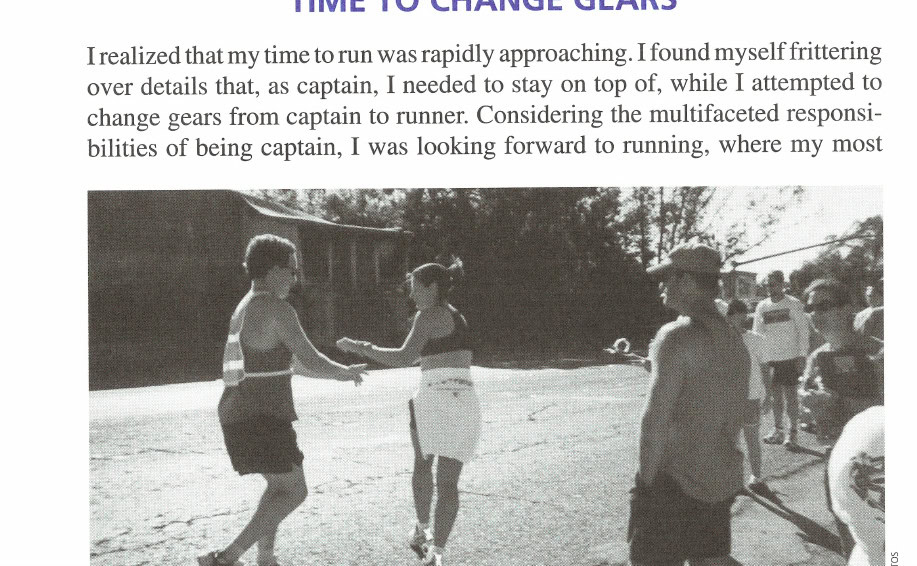
pressing duty would be to put one foot in front of the other. Ah, the simple pleasures . . .
My leg began northeast of Petaluma and ran through the town where they’d used the main drag as the nighttime cruising street in American Graffiti. Then I’d pass off west of the town, out in the rural areas where cows are king and California makes some of its best cheeses. Our next runner would then take us from rural Sonoma County to near the Marin County line. Where Sonoma County could brag about the American Graffiti strip, Marin County lay claim to hosting Martin Mull’s crew during the shooting of the 1980 film, Serial.
We arrived at the exchange point on the other side of Jon’s mountain, everyone unloaded, and I circled the parking lot under my own power trying to stretch out the last several kinks. Sure, I told myself, it was only 6.5 miles, a distance I could do in my sleep, but all it took to mess up our chances was a twisted ankle. No one on the team had yet collapsed, and although I’d survived the rigors of team captain, would the simple act of running be my undoing?
We’d find out soon enough, for a moment later Jon came flying around the corner and slapped the band (aka a high-tech baton) around my wrist. I was off and running, with Jon’s, “It’s up to you now, Joey,” ringing in my ears. Hey, a little pressure would do me good about now.
The entire leg was a blur. At one point, just as I left downtown Petaluma, a man walking his dog gave me topographical news: “Just one more hill to go; you’re almost there.” Turns out he was a bit topographically challenged: I had roughly four miles of hills to go.
Additionally, rumors had come back through the running grapevine that kids in Petaluma were throwing eggs at runners, which was a daunting thought. Besides being famous for cows, the Petaluma area was one of the largest chicken-producing (and therefore egg-producing) regions in California. The kids’ ammunition supply would be virtually endless.
Any egg-throwing going on in Petaluma was probably part of a “down with the relay” movement promoted by several Northern California communities. We’d seen a sign in Calistoga that read “Relay Go Away,” and some of the Napa Valley wineries had posted signs proclaiming their sentiments regarding the relay, which apparently detracted from efficiently getting customers into their tasting rooms (and yet Sutter Home Winery sponsored the Napa Valley Marathon—go figure).
I thought of none of the politics during my run. I finished just as I was getting warmed up, handed the wristband to Jen (Jen number 3, that is) and watched her vanish down the road. Tahiea handed me a bottle of water, which I gladly accepted. I spent several seconds stretching for injury-prevention’s sake, put on a dry shirt, and mentally cooled down and changed gears back to being team captain. The van was off again on its merry way.
As planned, van 1 was waiting for us at the next exchange point. They would run to the Golden Gate Bridge. I live in central Marin, so I invited my van to shower and get cleaned up at my place. It took all of five seconds to get general agreement on that. We would have probably been better off staying where we were so we could get some sleep, but someone mentioned the magic words “Italian food,” and after a dozen hours of nothing more substantial than energy bars and Gatorade, Italian suddenly sounded mighty fine to us.
A QUIET DINNER
Little conversation accompanied dinner; we were too hungry and exhausted. We left the restaurant and headed for the south side of the Golden Gate Bridge. Our van would take over in the Presidio, the former army base that dated back to 1776, when the Spanish sent a handful of men north to make a presence (which led to an attempted possession). In the wave of base closures the United States was just coming out of, the Presidio (once the plum assignment for military personnel) had been deeded over to the city of San Francisco, where dozens of special interest groups were haggling over what should be done with some of the most prime real estate on the planet.
The other van was still an hour away from us, so we spread ourselves around to catch some sleep. I crashed behind the driver’s seat, while some of the others took their sleeping bags and wandered off onto the clearing in front of the parking lot. Just as I closed my eyes, the phone rang. Van 1 was ahead of schedule and nearly finished.
There seemed to be hundreds of people at this exchange point: runners, volunteers, and folks who just wanted to see what the party was all about. Unfortunately, the restrooms were about 200 yards away, so by the time I walked over to them and returned, the exchange had already taken place and our runner was gone. Van 1 didn’t even hang around to say hello before they cut out to find a place to sleep.
The next several legs were ranked as “hard” in the race literature, but looking at the maps it was difficult to understand why. Then it occurred to me that it might have something to do with the often iffy San Francisco weather. Add in the wind-chill factor, and the temperature must have been in the mid-30s. We had 15 minutes at Ocean Beach, stretched out south of Cliff House, to wait for Greg. Although it was still freezing cold, Josh warmed up in only shorts, a T-shirt, and a reflective vest. I asked him if he could make it in such flimsy clothes. “Oh, I’ll warm up,” he said.
Greg roared in, averaging a sub-6:00 pace, and Josh took off, determined to warm up quickly. Josh’s speed was one of the truly amazing surprises; we’d never guessed he was so fast. He sure had his work cut out for him. He had to run the long uphill from the beaches of San Francisco to Daly City (the city south of San Francisco where maybe six houses a year fall off the cliff into the ocean far below). The climb was work under any conditions, but the cold and wind made it almost unbearable. Poor Josh came in looking absolutely beaten. We asked him how he felt, and he answered by throwing up all over the side of the road. A moment later, rid of all he’d eaten in the past few hours, he smiled, took a swig of water, and said he felt fine.
EARLY-MORNING EXERCISE
We cheered on Tahiea as we drove past her, and then settled in at the next exchange point. While the others slept, I got out of the van and stretched. It wasn’t nearly as cold here, the wind being shut off a bit by the coastal mountain range along which we were running. Jon’s leg would be much more pleasant than Josh’s had been—except for the fact he’d be doing it at 2:30 A.M.
Jon hauled himself out of the van just moments before he was to take off. He then proceeded to nearly beat us to the next exchange point—where I was waiting, again shifting from captain to runner.
My second leg could best be described as surreal. I’d never before run at 3:15 A.M. The 3.9 miles took me 37 minutes (a bit disappointing, but I was almost too tired to care). I actually felt numb while running. As soon as I finished, I was hit with a wave of nausea. But the feeling passed, and we were off to the next van exchange.
I remember almost nothing between stepping into the van and our pulling into the Canada College parking lot to hand over to van 1. I woke up in time to realize we were parked and everyone was pulling out sleeping bags.
The college opened several buildings to the runners, including the cafeteria and the showers. They also allowed runners to catch some naptime in the gym; they were considerate enough to keep it heated and darkened.
I showered while the others slept, then went to the cafeteria to grab some oatmeal, which was quite possibly the best meal I’ve ever had in my life.
Back in my captain mode, I dialed van 1 on the cell phone, prepared to hear of some disaster:
“A runner bailed—”
“Our van broke down—”
“We’ve all decided to quit and go back to bed—”
Imagine my surprise to learn that everything wasn’t just going well, but they’d be finished with their six-pack of legs in roughly 90 minutes. I shot up, filled with extra energy. Three of the Flying Burritos were sitting in the cafeteria, hunched over cups of coffee. The others I had to locate in the darkened gym and wake them up.
We figured we had plenty of time to get to the next van exchange, but we arrived a couple of minutes late. Van 1 was peeved, but then they realized, Hey, we’re done with our legs—let’s go party in Santa Cruz!
The first three legs of our final six were pretty uneventful. My mind was on Jon’s upcoming leg (the one Greg had warned us about) as well as my own last leg. After all the running and cramped van travel, my legs were starting to cramp up. Did I have enough left in the tank to get me to Santa Cruz?
TOO MUCH KNOWLEDGE IS DANGEROUS
Jon had some time before his turn, so he took out the relay leg maps to chart his course. His leg began with 4.5 miles straight uphill, then took a right turn and ran uphill for roughly another 4 miles. He asked that we park the van at the point—roughly halfway on his leg—where the road turned so we could give him more water, and some encouragement. No problem, we assured him.
He left on his leg, and we headed uphill. We passed him after he’d knocked off a couple of miles, and he looked really beat. Much of the color had drained from his face, but he managed a wave and a smile.
At 4.5 miles we pulled over and gasped. The hill he had yet to climb was immense. I walked downhill to meet him before he reached the van. When he came up a few minutes later, he looked totally exhausted. “Dude, I’m spent,” was all he could manage as I handed him the water.
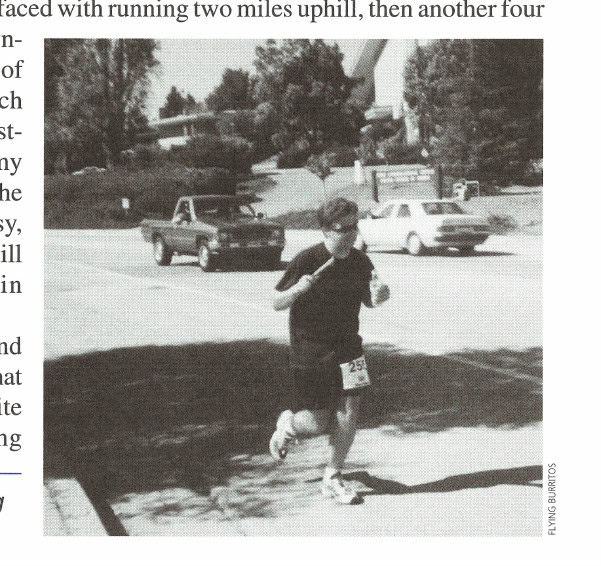
Fortunately for all of us, Jon made it—barely. My last leg began at an old construction yard. I was faced with running two miles uphill, then another four to five miles straight downhill on the western side of the coastal “hills,” which were now looking Everest-like to us. The pain in my legs refused to leave. The uphill was relatively easy, but as soon as the downhill began I knew I was in trouble.
My legs hurt worse and worse, and it didn’t help that I was being passed by elite runners who began long
after we did but had caught up way too easily. I learned later that one of the elite teams was Team Dean: one guy who ran all 199 miles by himself!
Somewhere on the descent, a man handed me a water bottle and said, “You’re almost there.” Then I heard “a mile to go!” from a group of students from the University of California at Santa Cruz. Even their sign proclaimed “One Mile to Go!” I almost cried with joy.
I made it to the end of my leg in 1:15—75 minutes to run 6.5 miles. My team handed me water as I sat against our van and shook from the pain. Eventually, we got back inside to drive the homestretch.
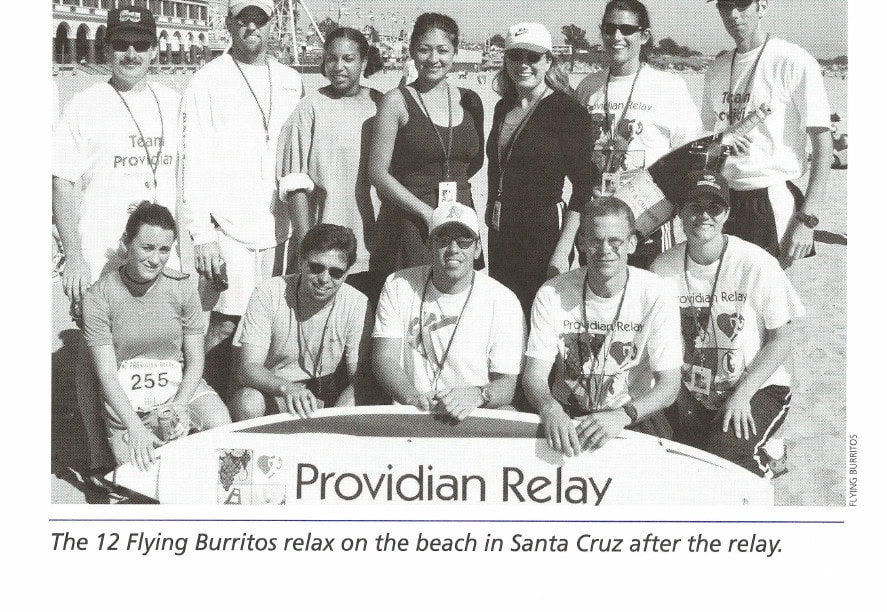
The Santa Cruz beach boardwalk was transformed into one huge party. We waited for our last runner, then ran as a team to the finish line on the beach. Our time was 29:00:32. Not bad, considering 11 of us were first-timers.
None of our runners got lost. None got hurt (at least not permanently). As captain, I’d take some time to be impressed later. For now, I just wanted to get horizontal. Tomorrow I’d have plenty of time to be happy.
This article originally appeared in Marathon & Beyond, Vol. 5, No. 6 (2001).
← Browse the full M&B Archive1,000+ stories from 19 years of Marathon & Beyond
The complete archive of the legendary long-distance journal — digitized and free to read.
