

The Running Man
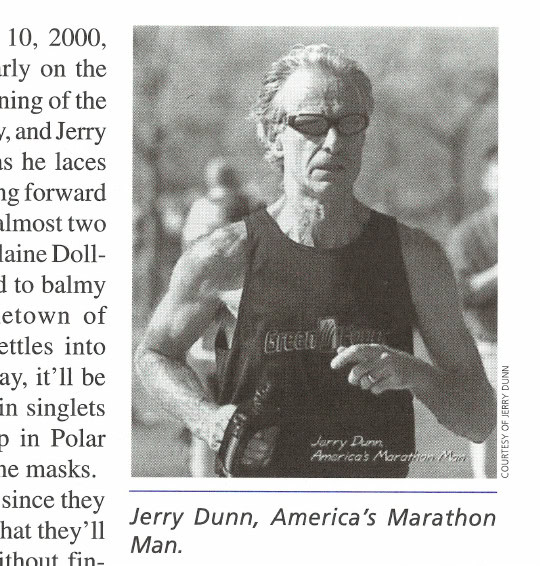
Sunday, December 10, 2000, Tampa, Florida—It’s early on the morning of the inaugural running of the Hops Marathon by Tampa Bay, and Jerry Dunn is somewhat excited as he laces up his shoes. He’s been looking forward to this race for a long time—almost two years—and so has his wife, Elaine Doll-Dunn. The pair have traveled to balmy Florida just as their hometown of Spearfish, South Dakota, settles into deep winter mode. After today, it’ll be quite a while until they run in singlets again; they’ll be bundled up in Polar fleece, GoreTex, and neoprene masks.
This will be the first time since they were married five years ago that they’ll be running the same race without finishing together, but they have talked long and hard and decided to break custom on this particular day. Running together through life may be their shared mantra, but today, Jerry and Elaine will focus on individual goals.
The prerace routine is not much different from the majority of mornings for Jerry: an early alarm, glass of Green Magma, a cup of coffee and a donut, and it’s time to get on with the day. Armed with a pair of water bottles and a pocketful of power gel®, the Dunns walk from the Hyatt Regency to the Ice Palace, home of the Tampa Bay Lightning and site of the start of the race. There they mingle with the 3000 other eager participants awaiting the gun. Jerry smiles at his wife when he hears the announcement come over the loudspeaker: “America’s Marathon Man, and his wife, Mrs. South Dakota, are here for today’s race.”
Hey, he chuckles to himself, they’re talking about us. And why not? They deserve some recognition. By completing the 26.2-mile scenic tour of Tampa, they’ll both be achieving incredible goals.
Jerry, 54, plans to give the Hops Marathon all that he’s got, to make it his fastest run of the year. It’ll be the 200th time since January 1 that he’s gone the marathon distance, and he wants a time to remember. For number 200 in 2000, the last one better be good. At 62, Elaine is going for the finish; she’s unconcerned about standings and has no need to put on an appearance of speed. For her, Hops is the 26th official marathon of the year—her marathon of marathons is almost complete.
BEEN THERE, DUNN THAT
What kind of person does it take to fulfill a dream of running 200 marathons in a single year? Certainly someone who is highly motivated, goal-oriented, and able to maintain a total focus of body, spirit, and mind. But Jerry Dunn wasn’t always the ambitious, athletic type, able to pursue an improbable outcome with total success. In fact, he runs today like a man possessed because the Jerry Dunn of “before” was the near opposite of the Jerry Dunn we know today.
Growing up near the Indianapolis Motor Speedway, Jerry led a rather ordinary existence. He was a paperboy at age 10, liked rock ‘n’ roll music, and didn’t fare too well in sports. He zipped through school with excellent grades and recalls childhood as a very comfortable time. And then he hit 18, when everything changed.
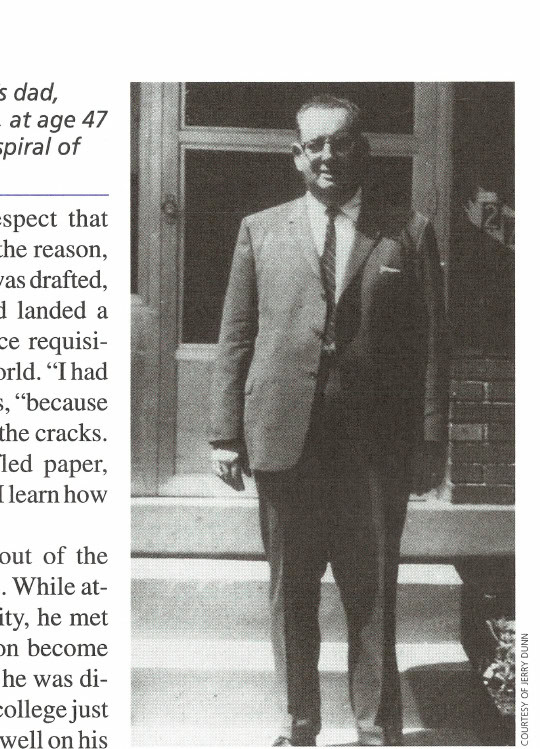
“I remember my Dad coming home from work and calling for me to help him get out of the car,” says Jerry, as though it was yesterday rather than a quarter of a century ago. “He got inside the house and said he was just tired, that he’d be fine if I got him a glass of water and a cigarette. That was his final request.” Three hours later, the overweight smoker was dead from a massive coronary. He was 47 years old. Jerry was devastated; a 20-year downward spiral of self-destruction began.
College seemed like a good idea for a high school graduate who didn’t want to repeat the minimum wage, paycheck-to-paycheck existence of his father; but Jerry found himself unwilling to apply himself when it came to the books. He flunked out. The following year, he was drafted into the army. Though he knew little about the army life and had no family connection to the military, the thought of becoming an officer drew Jerry in. Perhaps, he says now, it was the notion of commanding respect that held the appeal. Whatever the reason, Jerry enlisted right after he was drafted, and before he knew it had landed a desk job handling ordinance requisitions halfway around the world. “I had a pretty good setup,” he says, “because I basically slipped through the cracks. I went to Germany, shuffled paper, slept, and partied. Man, did I learn how to drink.”
In 1968, Jerry bailed out of the military to return to college. While attending Ball State University, he met the woman who would soon become wife number one. By 1970 he was divorced, had dropped out of college just before graduating, and was well on his way to becoming an alcoholic. He’d also been seduced by a world he’d missed in the military: the better-than-being-drunk highs that came from smoking marijuana. Jerry moved to Florida to take a restaurant management job.
All went well for several years, but after taking a leave of absence to travel, Jerry found he didn’t want to return to the regular workaday life. When his grandmother died and an inheritance came his way, Jerry bought a fast car, took odd jobs tending bar, and landed a construction gig that was more party than work.
“It was a perfect situation for someone with no ambition who liked to drink, do drugs, and hang out at the beach,” says Jerry with complete candor. “Life was a party and I thought I was having a ball.” It didn’t take long for Jerry to give in to the allure of cocaine. While something prevented him from becoming an active buyer, Jerry partook of the white powder whenever it was offered—and that was quite often. “A voice deep in my gut told me to be careful, this is serious stuff, but I made no bones about snorting when my friends had it around.”
Jerry’s story is in no way unique: like many who wrestle their lives back from the vortex of addiction, he reached bottom before he recognized it was time to get well. “I was turning 37 years old,” he says of his epiphany, “and I had just ruined my second marriage and cracked up my car. I knew that if I kept going in the direction I was headed, I’d end up just like my dad, only sooner.” The day after his birthday, Jerry swore off liquor and drugs.
RUNNING THROUGH RECOVERY
Jerry had taken up jogging at the suggestion of a friend, but it wasn’t until after he was sober that he thought athletic activity was good for anything more than fending off a beer belly and impressing girls at the beach. Running soon became a substitute for boozing, and Jerry turned his addictive personality toward this positive force. “My life was chaotic; so many things seemed out of my hands,” he says of those first months of sobriety. “But when I put on my running shoes, I felt in control. When I ran, I felt at peace.”
For the first time in years, Jerry set goals for himself. The first was to complete his marketing studies and get a college degree. The second was to run 26.2 miles. With the finish line of his educational goal in sight, Jerry took aim at the Philadelphia Marathon. He says the 1983 race was the most difficult thing he had ever done in his life, but when it came to a choice between finishing or dropping out, he had had only one choice. “A lack of self-esteem is common for alcoholics,” he explains, “and I felt that if I didn’t finish that race, all hopes of regaining confidence or self-worth would be lost. Completing the marathon signaled the true beginning of my recovery—and the end of the mess my life had become.”
While postgraduate studies in counseling and massage therapy led him in new directions professionally and personally, that first marathon became a foundation on which Jerry was able to build. He ran marathon after marathon and began extending his range, entering the world of ultras with a 100-mile finish in the Green Mountains of Vermont (22:41:30).
By 1990, married for a third time and back on the straight and narrow in Indianapolis, Jerry acknowledged that running had probably saved his life. He began to feel that his chosen sport held some bigger meaning for him. He believed running offered him the opportunity to go beyond personal satisfaction, giving him the chance to give something back.
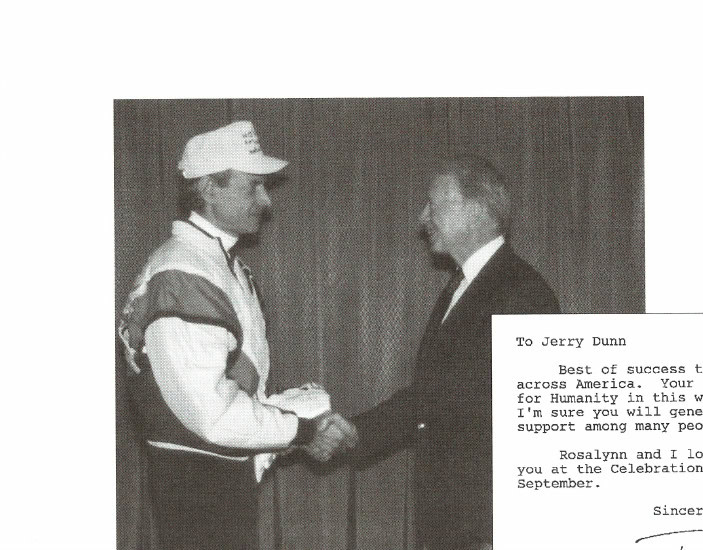
On Thanksgiving weekend that year, he embarked on his first multiday effort, a 150-mile run across his home state of Indiana on behalf of Habitat for Humanity. Dubbed “Across the State in 28,” his goal was to run the 150 miles between Illinois and Ohio in no more than 28 hours running time.
Six months after that success, Jerry was off running again, but his follow-up project was enormous in scope. Dubbed “Shore to Shore in 104,” Jerry set out to run almost a marathon a day for three and a half months, traveling by foot from San Francisco to Washington, D.C.
Despite the difficulty of traversing deserts and mountains and dealing with bone-chilling storms and unbearable heat, Jerry came to realize that his body was capable of holding up to a regimen of long, slow running day after day. He may not be fast (his marathon PR of 3:23 came in 1985, and he’d never approached that time again since), but he had the will to keep going.
Jerry’s story of “hope for everyone, no matter how down they may be” caught the attention of the national media, and besides helping raise more money for Habitat, the exposure validated his increasingly obsessive belief that he was meant to be running for reasons greater than himself.
93 IN ’93
“During the transcontinental run, I came up with an idea,” says Jerry when asked how he concocted his next running-oriented stunt. “My father dominated my thoughts as I ran across the country, and I realized that I would turn 47 in 1993; that’s the age he was when he died. I felt I had to do something special as a tribute to my dad, something that at the same time was a celebration of life.”
A group of high-mileage enthusiasts known as the “mega-marathoners” had come to Jerry’s attention. While he knew he would never approach the staggering number of lifetime races logged by the biggest names in the group, he was intrigued by the notion of trying to surpass the record for the most marathons run in one single year. Britain’s Steve Edwards held the record, having run 87, but Jerry realized he had averaged 25 miles a day for more than 87 days during his transcontinental fund-raiser. Being fond of symmetry, he set his sights on doing 93 marathons in 1993. His third big project was born.
Almost as soon as he announced his intentions, Jerry was subjected to some serious flak. While Edwards had sought out races for each of his marathons and worked out the mind-numbing logistics to enable him to officially compete in each one, Jerry was taking a less orthodox approach. His idea was to run the marathon distance twice each weekend: once in a race and once the day before, unofficially over the official course. The nature of the “unofficial” runs was a bone of contention to some who keep a watch over such things, but Jerry was undeterred. He soldiered on with his plan.
Ironically, while researching his upcoming feat, Jerry spoke with mega-marathoner Ed Barretto, and he learned that Barretto had run 101 marathons in 1991 using a similar official race and unofficial run method. Barretto said that a goal of 93 was commendable, but it wouldn’t be a record as far as he was concerned.
“Going for a record on other peoples’ terms isn’t what this is really about,” Jerry said at the time. “This started as a personal thing with a message intended to make a difference in other peoples’ lives.” Still, Barretto’s 101 hovered in the back of his mind. Since the original plan called for two marathon distance runs a weekend, with the 93rd and final effort to be the New York City Marathon in November, sticking to schedule allowed Jerry to keep up the pace until the end of the year. By December 31, instead of 93, he had completed 104.
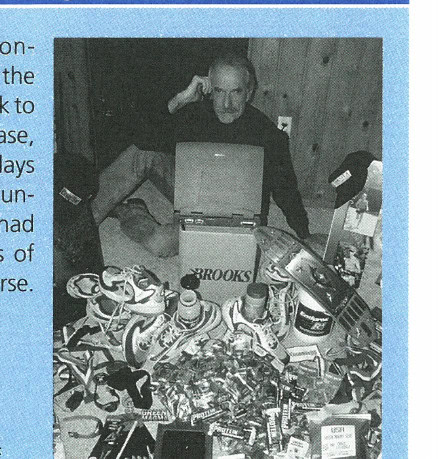
For the most part, race directors were delighted to help, and in many stopovers they put Jerry in touch with locals willing to give him a cot or a meal during his stay. By the time he got under way, Jerry’s persistence and impressive portfolio of media hits helped him secure enough product sponsorships to be fully equipped with shoes, sunglasses, insoles, energy bars, electrolyte drinks, antioxidants, and recovery foods. Some of his travel expenses were paid, and he even drummed up enough cash from sponsors and speaking engagements to be able to say he made money running that year.
Still, to contribute his share to the mortgage and spend some time with his wife and focus on their less-than-perfect marriage, Jerry returned to his massage practice in Indianapolis four days of the week. At least, most of the time.
AN UNEXPECTED SURPRISE
While laying out his itinerary, Jerry realized that South Dakota’s Black Hills Marathon and North Dakota’s Bismark Marathon were scheduled one week apart in the fall; he seized the chance to take a week off from the return-home-to-work routine to explore an area of the country he had never seen.
When the race director for the first event picked Jerry up at the airport, he shared his delight that the self-proclaimed “Marathon Man” had chosen his race. He was proud that 1993 was to be the 16th running of his scenic event, and he insisted that Jerry meet the three people who had run every previous edition of the Black Hills Marathon.
“He mentioned The Old Timer, The Kid, and Wonder Woman,” Jerry recalls with a smile. “I was married at the time and had met hundreds of people over the course of my travels, including all kinds of attractive women, but when I met this Wonder Woman, I was immediately struck by her. It seemed strange at the time because I’d never done this kind of thing, but I felt compelled to pursue her.” Her name was Elaine.
The female version goes something like this: Elaine Doll’s son saw Jerry on television the day before the race talking about his 93-marathon stunt and called her, babbling that here was someone she just had to meet. Elaine was a pioneer in the town of Spearfish, for she’d started running at the age of 40, just before the Black Hills Marathon began. At the time, it wasn’t exactly the thing for a widowed rancher’s daughter with seven children to do. The long and short of it is that at the prerace packet pickup, Jerry and Elaine were introduced.
“There was this little skinny guy there, and sure enough, it was Jerry,” Elaine says today. “I happened to mention that I liked to drink Exceed but that it was really hard to find. At the starting line the next day, a friend of mine handed me a water bottle and said some guy showed up and said this was for you. Would you believe, it was Exceed?”
Jerry ran the first part of the race with Elaine and her entourage of running buddies before they became separated, but at the end of the race he sought her out and asked for a date. She refused, but he said he wasn’t about to leave town until they had least had a chat over lunch. “What could I do? I wasn’t about to stand in the way of this man’s 93 marathon goal, so I accepted.”
Elaine’s birthday was coming up, and she came home the day after that first date to find a pathway of arrows laid out on the floor of the house. They led to the bathroom; she opened the door and was inundated by a sea of balloons. “They were everywhere,” she says, “on the ceiling, stuck to the walls, in the bathtub, and there was blue bubblebath, too.” On the counter was a vase with a single red rose, “a real one, mind you, not plastic, which is what you usually get around here. When Jerry came to the door, I said to him, ‘You are seeing something no one in Spearfish has ever seen before: Me, speechless.’ It was incredibly special.”
Jerry was gone by week’s end to continue his running mission, but he and Elaine spoke frequently by phone. It didn’t take long to realize that his third marriage was about to end. The pursuit of a record for the most marathons in one year had brought his commitment to the relationship into question even before he began; his wife never understood his motivation and bemoaned the financial impacts of the offbeat quest. Elaine, on the other hand, seemed to understand what he was doing and why. She was a runner herself. She’d been married to a bronco rider. She was used to extremism. She could relate.
BUMPS IN THE ROAD
Within six weeks of meeting, Elaine Doll and Jerry Dunn had rendezvoused several times, including at the Denver International Marathon, which they ran together. Not long afterward, Elaine developed a persistent urinary tract infection; after unsuccessful treatment and extensive tests, she was diagnosed with bladder cancer. She was terrified to learn that the surgery necessary to save her life would result in the removal of her bladder—and devastated to think that she would be relegated to inactivity by virtue of an iliostomy. Her bladder would be an external bag. She pushed Jerry away.
“It had been fun and romantic and exciting up until then,” Elaine says, “but we had only just met, and I didn’t want him to have to feel responsible for me or burdened by this.” Elaine’s family rallied around her, and when Jerry offered to travel to Buffalo to be by her side during surgery, she told him to continue pursuing his dream.
Instead of joining Elaine and feeling like an unwanted intruder among her close-knit family, Jerry kept in contact and maintained his focus on his multimarathon goal. Even from afar, he managed to make Elaine speechless again.
“There I was, lying in my hospital bed, contemplating either the end of my life or a dreadfully altered life,” she says with obvious emotion, “when a package from Jerry arrives.” It was an Asics box with a new pair of sneakers in it, which said to Elaine: You are a runner. You will run again.
Inside the lid, in bold, forceful script, was an inscription:
When you come to the end of all the light you know and you’re about to step off into the darkness of the unknown, faith is knowing that one of two things will happen. There will either be something solid to stand on, or you’ll be taught how to fly.
“We’ve all been on that edge at some point,” continues Elaine, “and there are times when we need someone there to tell us that things will work out.”
Widowed at the age of 23, with three children under three and pregnant with a fourth, Elaine learned the art of survival early in life. “When the world throws these kinds of things at you, you can sit back and complain, or you can change the diapers and get on with your life.” Elaine picked up the pieces. She remarried five years later, had three more children, and dedicated herself to her
teaching career. All seemed right with the world until, after 23 years, her second marriage ended in tragic divorce. “That was the hardest period of my life,” Elaine says now, “but it was another lesson that I was destined to learn.”
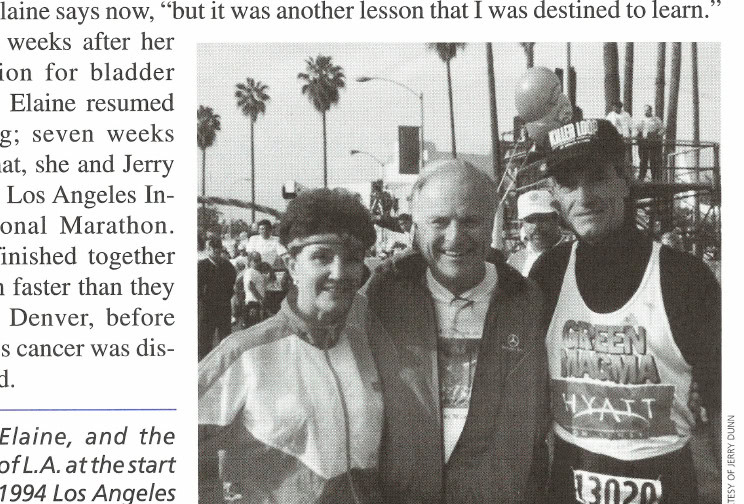
Six weeks after her operation for bladder cancer, Elaine resumed running; seven weeks after that, she and Jerry ran the Los Angeles International Marathon. They finished together and ran faster than they had in Denver, before Elaine’s cancer was discovered.
NEXT ON THE LIST
For Jerry, “93 in ’93” was a sort of turning point. He had not only proved that he could conceptualize, plan, organize, and find ways of funding extreme tests of endurance but had also shown that his 47-year-old body could hold up to the persistent accumulation of miles.
In addition, he continued to demonstrate his ability to attract media interest with his message that anyone could pull themselves up by their own bootstraps if they chose to take charge of their lives. His mantra, “Don’t limit your challenges, challenge your limits” made for good press, and he gained the confidence to share it whenever he was given the chance.
“Jerry is always a little embarrassed when I first mention his accomplishments,” says Don Walker, a running buddy from Spearfish who plays the role of proud father, brother, and friend. “He is kind of reticent talking about it, except when it’s with a group of runners or someone from the press is around. Then you see another Jerry, a guy who’s sure to let them know who he is and what he has done.”
People who meet Jerry are either awestruck by his accomplishments or write him off as a complete megalomaniac who happens to run. Whatever your first impression, to get to know Jerry is to like him and call him a friend. “It may be hard to believe,” says the man who has been the subject of hundreds of television segments, radio stories, and feature articles in everything from local newspapers to national magazines, “but I used to be shy. I was always a loner, and it took me a long time to be comfortable with the attention I got.”
The paradox is that while Jerry truly is humble at heart, to create the platform to deliver his message of hope and self-redemption, he had had to become a rather blatant self-promoter and media hound.
The months following the exhausting year of marathons were a time for Jerry to reassess his focus in life. “In the middle of the desert during the transcon, I broke down in tears,” he says, “and finally made peace with my dad. A voice told me that running was what I should do. I didn’t know why or where it would lead me, but after setting the world record in 1993, it seemed to make a little more sense. I did have something to say.”
Jerry had more than his share of media attention, but it was the contact with people while running or hanging out at a sponsor’s booth that kept him going. Everywhere he turned he saw evidence that he, a former drug-snorting drunk, was making a difference in other peoples’ lives.
A HEARTFELT LETTER
Fairly typical is the letter he received from a New Jersey grade school student in mid-1993. After saying he was writing an article for his school newspaper and needed some more information, Nahoom Kim asked for an autographed picture of Jerry. “Please don’t copy the signature,” the young student implored, “so I know it came directly from your pen. I want to keep this as a souvenir so I can remember you as long as I live and so I can remember not to take drugs.”
On the other end of the age spectrum was a touching cab ride shared with 71-year-old Bill Wallace en route to the Palos Verdes Marathon that very same June. It was Wallace’s 27th lifetime marathon, and for Jerry, number 47 for the year. “Bless you,” said Wallace when he learned of Jerry’s multimarathon quest. “One of God’s greatest gifts is commitment; too many people today are paralyzed by fear, anxiety, and the need for instant gratification to accomplish great things like you plan to do. You’re a real role model and ought to be proud.”
By the end of 1994, Jerry had moved from Indiana to South Dakota and been through his third divorce. Fittingly, he and Elaine were married at the Disney Marathon in Florida in early 1995—at mile 8 on the course. “It was pretty amazing,” says Elaine when asked about the nuptial event. “The race director said he would allow it, and the Disney World Special Events staff took over and made everything happen. We just had to show up.” Show up they did, decked out in formal running attire—with the media in tow. The NBC “Today Show” broadcast the wedding live on national television.
The following year was the 100th running of the Boston Marathon, and Jerry knew he had to be there. And yet he couldn’t just show up and run. “I knew it was going to be really special, and I didn’t want to be just another face in the crowd. I wanted to do something truly unique. I thought about running 100 Boston Marathons, with the final one on the day of the race, but my wife and some other people convinced me that was a little extreme.” Jerry backed down and ran a marathon of marathons instead. His 26 days on the Boston course garnered significant media attention, including the most significant profile the “Today Show” presented during its coverage of the historic race.
Between running appearances, Jerry worked odd jobs in Spearfish and tried to establish his massage practice, but pay was poor and he struggled. He found that traveling to Indianapolis every other month to take care of former clients was more lucrative than staying in town.
The move to South Dakota was difficult professionally, but it was a hard emotional adjustment as well. Spearfish was Elaine’s territory, and as a teacher in a small town, pioneer in the running community, and daughter of a third-generation cattle rancher, she was very well known. Jerry felt he lived in Elaine’s shadow to a certain extent, and while he tried to settle into a “normal existence,” he knew he needed to be out there running, preaching about the possibilities life holds for everyone who is willing to go after a dream.
The year 1998 saw Jerry take a new approach: since the Los Angeles Marathon was 13 years old, he decided to run it 13 consecutive times. New York was the 29th running, so he ran it 29 times. He returned to Los Angeles in 1999 for the 14th running and ran the route 14 days in a row. While in Los Angeles, he reconnected with some of his previous sponsors and made arrangements to appear at other races over the course of the year.
THE Y2K BUG
Jerry had long ago developed a vague sense that there was a greater purpose to his running, but it wasn’t until after Boston in 1996 that he began to think that maybe running could turn out to be some sort of career.
The Los Angeles connections, resulting in new opportunities to be paid for making promotional appearances, opened Jerry’s eyes to the fact that millennium fever was building toward an incredible peak. He resolved that he wanted to make a personal mark on the turning of the century. His new, almost inconceivable, goal became 200 marathons in 2000.
“I wanted to do something truly outrageous to celebrate the new millennium,” says Jerry, “and I wanted to show that people can be healthy and fit, well into their 50s. We hear a lot about the fact that none of us really lives up to our full potential, that we’ve got a lot more physical and mental ability than we’re willing to believe. I wanted to show that we can all accomplish incredible things if we set a goal and go after it for all we are worth.”
The original plan for 200 in 2000 called for Jerry to focus on one race per month, running the course 16 or 17 times before the official event. Destinations were geographically spread such that they touched on the nation’s major media markets, and Jerry worked with a PR firm to maximize opportunities. As new sponsors came aboard with different ideas about exposure, the itinerary changed. In the end, Jerry ran 21 official races in 14 states and one foreign country.
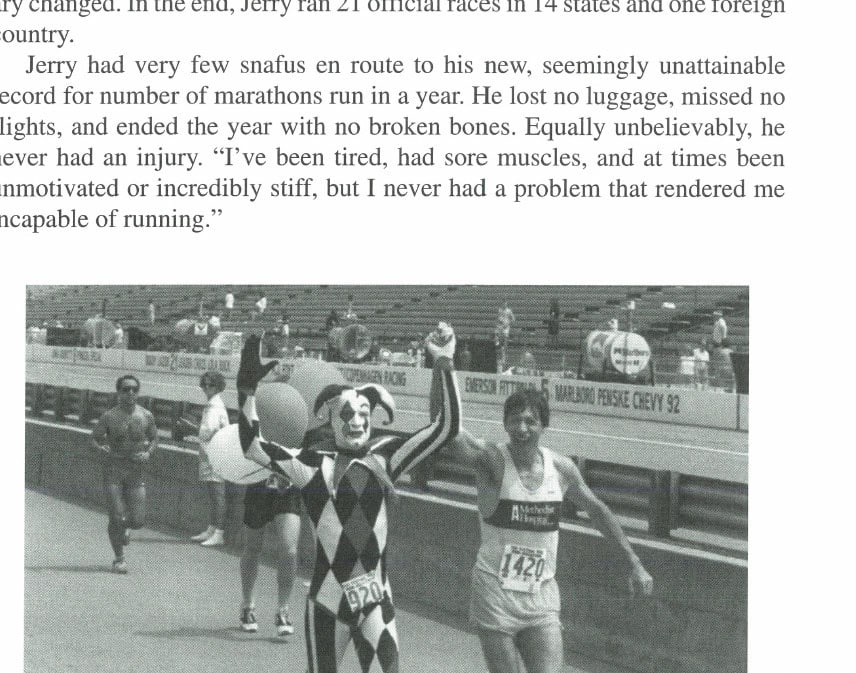
Jerry had very few snafus en route to his new, seemingly unattainable record for number of marathons run in a year. He lost no luggage, missed no flights, and ended the year with no broken bones. Equally unbelievably, he never had an injury. “I’ve been tired, had sore muscles, and at times been unmotivated or incredibly stiff, but I never had a problem that rendered me incapable of running.”
There were times, like day 2 in Los Angeles, when small problems so compounded that Jerry was faced with a potential avalanche of self-doubt. “I’d arrived into L.A. late the night before I was scheduled to start,” he recalls, “instead of giving myself a day of orientation the way I usually did. The first day went terribly because I was tired, and on day 2, I felt a strange pain in my arch. As I walked along by myself, two and a half months into this thing, I realized I had more than nine months to go. I asked myself why I was doing this and tried to think of how I could get out of the commitments I’d made.”
SHIFT TO THE MENTAL
Mental focus is a marvelous thing. Jerry got through the day, made a conscious decision to snap out of it, and had an exceptional, pain-free run on day 3. “I realized early on not to project too far down the road. Thinking about the number of races ahead becomes discouraging when you look at it all at once.”
Like the seasoned ultramarathoner who breaks down hard-to-conceive distances into aid station to aid station-sized chunks, Jerry took the long-range ultimate goal and cut it up into pieces he could easily digest.
This city is only 16 days, and you’re halfway through. Today is just one marathon, focus on that. Get to the next aid station. Take it one mile at a time. Run to that lamppost and take it from there.
This strength of mind over body doesn’t come as any surprise, according to Dr. Larry Tentinger, a physical education specialist from Black Hills University, who advised Jerry on nutrition as he prepared for his Y2K event.
“Jerry is in that 0.5 percent of the population who can conceive of something like this and then actually be capable of pulling it off,” Tetinger says. “It is a physical phenomenon, but it requires a mental, emotional, social, and spiritual focus as well. It takes a balanced, wellness approach.”
When delving into the world of someone like Jerry, the question of balance often comes up. How does someone have such single-minded focus and achieve a balance in life?
With Jerry, you might argue that at least one of his failed marriages resulted from his pursuit of his multimarathon goal. He admits that may be true, but he says that like the mountaineer who seeks the summit of Everest in spite of the risks, he could not give up his high-profile running and remain who he is.
Tentinger, a national powerlifting champion who knows the sacrifice and conflict a person can encounter on the road to seemingly impossible goals, looks at it in terms of priorities. “The way it works to be healthy,” he says, “is that you do not just focus on your goal and forget about everything else. You still give to others so you can receive more yourself. When Jerry would come in here to talk to the students and give us his time, when he shares some of the things that he’s going through on his Web page, when he talks about the joy of pursuing your dreams, when he gives media interviews—you can see in all these things that he’s not just doing this for himself. He’s sharing the message with others because he really cares. If he was just doing this for self-glory, it would have fallen through a long time ago.”
BACK TO THE ROOTS
Jerry reported on his Web site after the Hops Marathon that he ran like the wind . . . wind being a relative term. And yet, despite finishing in 4:05:30—exceeding his own expectations by 10 full minutes—for Jerry, the long anticipated elation of completing number 200 didn’t arrive right away.
“It wasn’t exactly anticlimactic, but it was not nearly as exhilarating as I’d expected,” he says of the finish. “There was no fanfare, which was kind of disappointing. In retrospect, it seems better that way. I mean, this whole thing was kind of a solitary journey that began on a Pacific Coast beach in California, and it seemed appropriate that it ended running alongside the beach in Tampa, not far from where I first started to run when I was a drunk.”
For Elaine, the bladder cancer survivor who jokes about her iliostomy by saying she “runs with a bag under her tights,” the gratification of completing her marathon of marathons was more immediate. “I set myself a challenge every year, and I allow myself the opportunity to appreciate the accomplishment once it is done. My motto is that life is a marathon, so double tie your shoes. I mean there are all sorts of uphills, downhills, speed bumps, and curves, and it can be tough. You have to enjoy the journey and take it one step at a time. It’s a lot more fun when your laces stay tied.”
Before completing 200 in 2000, Jerry became involved with the newly formed Run for Lungs marathon team, a group-training program modeled on the successful Team in Training program. Formed in the fall of 1999 to raise money for the Alliance for Lung Cancer Advocacy, Support, and Education (ALCASE), RFL is designed to bring together people who are determined to do something to expand public awareness of lung cancer, focus on the need for early detection and more treatment options, and show support for people diagnosed with this deadly disease. Even though Jerry and several other “charter members” had raised over $35,000 in donations for RFL by early 2001, July’s Chronicle Marathon in San Francisco was the first time the team appeared at an event.
Besides helping with RFL, writing for several Web sites, and appearing on the new television program “To Tell The Truth,” Jerry spent the first half of 2001 traveling to races all over the country, often accompanied by Elaine. Jerry makes appearances at sponsors’ booths, signs autographs, and gives motivational talks. Elaine runs with her bag at her waist and a smile on her face—and makes sure everyone’s laces are tied.
Don’t limit your challenges; challenge your limits. There’s something in that. And Jerry is right: the words do have a nice ring.
Author’s note: For highlights from 200 in 2000 and more information on Jerry’s endurance running career and to keep track of where Jerry will be turning up next, log on to www.marathonman.org.
| January | 1–16 | San Diego Marathon, Carlsbad, CA |
| February | 17–32 | Las Vegas Marathon, NV |
| March | 33–46 | Los Angeles Intl. Marathon, CA |
| 47, 48 | Back on the San Diego Marathon course | |
| April | 49–65 | Boston Marathon, MA |
| 66–68 | Country Music Marathon, Nashville, TN | |
| May | 69–82 | Flying Pig Marathon, Cincinnati, OH |
| 83 | GutsMuths Rennsteiglauf Marathon, Schmiedefeld, Germany | |
| June | 84–88 | Rock ‘n’ Roll Marathon, San Diego, CA |
| 89–99 | Grandma’s Marathon, Duluth, MN | |
| 100 | Chronicle Marathon, San Francisco, CA | |
| July | 101–109 | Chronicle Marathon, San Francisco, CA |
| 110–118 | Pioneer Marathon, Salt Lake City, UT | |
| August | 119–135 | Cinergy Marathon, Indianapolis, IN |
| September | 136–143 | Bismarck Marathon, Bismarck, ND |
| 144–149 | Air Force Marathon, Dayton, OH | |
| October | 150–157 | Twin Cities Marathon, Minneapolis, MN |
| 158–163 | Spirit of St. Louis Marathon, IL | |
| 164–169 | Chicago Marathon, IL | |
| November | 170–178 | New York City Marathon, NY |
| 179–184 | Ocean State Marathon, Warwick, RI | |
| 185–190 | Philadelphia Marathon, PA | |
| December | 181–200 | Hops Marathon, Tampa, FL |
200 in 2000 Daily Routine
With so much riding on consistency during his pursuit of the 200 marathon goal, Jerry tried to stick to a standard routine. In almost every case, he arrived at his destination two days before he was scheduled to start running so that he was well rested and had a chance to scope out the logistics of getting between his hotel and the course.
| 4:45 A.M. | alarm glass of Green Magma breakfast: fruit, cereal, orange juice, coffee check e-mail; respond if time allows |
| 5:50 A.M. | to start line (coffee en route) |
| 6:00 A.M. | start running, with goal to be done by 11 A.M. make calls on cell phone while running; calls are to Elaine, Larry, sponsors, press food on the run: 4 power gels®, bagel/donut if possible drink on the run: 40–80 oz. water, 12 oz. Endurox R4 Jerry can recite the different food stops for different courses he ran: L.A.: donut at 17 miles (Winchells), banana at 20 miles (grocery store). Boston: banana and donut at 7.3 miles (Getty gas station), cookies and coffee at 24 miles (Beacon St. Gulf) |
| 12:00 P.M. | shower at hotel |
| 12:30 P.M. | lunch in room: tuna, fruit and cottage cheese, salami and cheese, frozen dinner/baked potato |
| 1:00 P.M. | local and USA Today crossword puzzles write daily updates for Web site |
| 6:00 P.M. | dinner: pasta, pizza, fresh vegetables |
| 7:00 P.M. | relaxation, watch TV |
| 8:30 P.M. | lights out |
While he is a meticulous planner and has redefined the meaning of the expression “living out of a gym bag,” Jerry Dunn admits he is not a great keeper of stats. Having said that, following are Jerry’s best guesses at some of the numbers related to his long distance careers:
- Total miles run: 40,000+
- Shoes worn out: 150+ pairs
- Water/electrolyte/recovery drinks: 1000+ gallons
- PowerBars: 3000+
- Power gels®: 600+
- Protein bars: 300+
- Travel miles:
- Plane: 300,000
- Train: 1000
- Car: 100,000
- Hours spent with media: 300+
- Favorite run: Wherever he’s running today
- Major sponsors: Green Foods, Endurox R4, Cosamin DS, Brooks shoes, PowerBar, Sprint PCS, Foster Grant—and always looking for more.
This article originally appeared in Marathon & Beyond, Vol. 5, No. 6 (2001).
← Browse the full M&B ArchiveMore like this
1,000+ stories from 19 years of Marathon & Beyond
The complete archive of the legendary long-distance journal — digitized and free to read.
