

The Tale Of The Pied Piper
Asudden thought occurred to me during a recent sleepless night: it has been 40 years since Frank Shorter’s Olympic marathon win at the 1972 Olympic Games. I reflected on the moment. Those Games were as memorable as any. They included Mark Spitz, Lasse Viren, Steve Prefontaine, Olga Korbut, Dave Wottle, the USA men’s basketball team’s loss to the Soviet Union, and also the Munich massacre—the killing of the Israeli athletes. But for many road runners old enough to have seen it, our most vivid, most enduring memory was that of Shorter’s win.
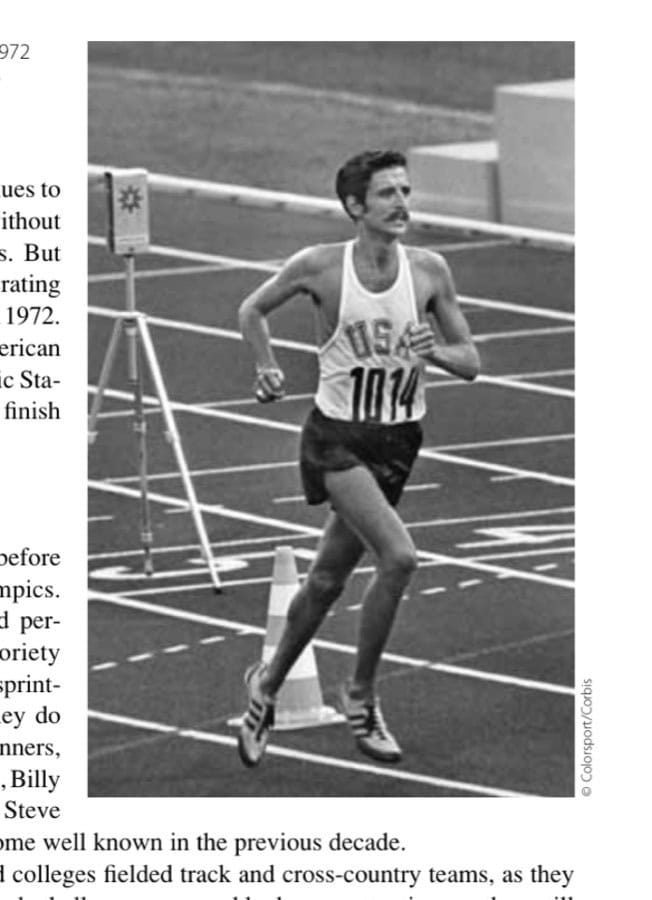
It wasn’t just the fact that no American had won the event since 1908. Here before our eyes, on live television, this seemingly average American man was able to train hard enough to win against the world’s best. For me, the image of Shorter entering the Olympic Stadium ahead of everyone else (except an impostor) will forever be etched in my memory.
Of course, I understand that Shorter is anything but average, but that was the thought at the time. And that’s a large part of the reason that his win marked the start of the running movement. It certainly got me going.
A watershed moment if there ever was one, Shorter’s gold medal sparked running as we know it today. Before the 1972 Olympics, only a few odd, skinny people ran. There were only a handful of marathons and other road races available around the country. After the 1972 Olympics, truly average people began to believe that if they just went out and trained, great things could happen.
Great things did happen. With all the new runners hitting the roads, several big cities inaugurated marathons and other road races to accommodate them. The growth of road racing began to accelerate further; with more road racing in the spotlight, even more people began to run.
▲
Frank Shorter wins the 1972 Olympic Marathon, and the running revolution begins.
And the trend continues to this day, although not without some setbacks and lulls. But now the growth is accelerating to levels unfathomable in 1972. It started with an American guy entering the Olympic Stadium and crossing the finish line 40 years ago.
Yes, there was running before the 1972 Munich Olympics. Track and field enjoyed perhaps a little more notoriety than it does today. US sprinters led the world, as they do now. Among distance runners, Marty Liquori, Jim Ryun, Billy Mills, and most recently Steve Prefontaine had all become well known in the previous decade.
US high schools and colleges fielded track and cross-country teams, as they do now. Football and basketball programs grabbed more attention, as they still do today, but some young athletes dedicated themselves to running.
Two factors limited the future for runners after their college days were completed. First, it was virtually impossible to make a living by running. With amateurism as the rule for the Olympics as well as for most other events, sponsorship opportunities were almost unknown. Professional runners were nearly nonexistent.
The second limiting factor was that there were only a handful of opportunities to compete in road races. The Boston Marathon had a proud tradition, and there were some other marathons and road races of other distances. But these events were so few, and so small, that most runners didn’t bother with them. In fact, most people weren’t aware of road races at all. Most didn’t know what a marathon was. Road running, for most practical purposes, did not exist yet.
Five years before the 1972 Olympic Games, Kathrine Switzer had her famous encounter with Jock Semple at the Boston Marathon. At the time, the Boston
© Colorsport/Corbis
Before Munich
Athletic Association had articulated no policy regarding women runners. Switzer entered the race as “K. V. Switzer.” Partway through the run, B.A.A. race organizer Semple attempted to physically force her out of the race. A boyfriend intervened, and Switzer famously completed the marathon. Photos of the incident demonstrated a truth not generally believed before: women can run long distances. Who knew?
Kathrine Switzer’s original Boston Marathon run in 1967 directly resulted in women (finally) being allowed to officially enter the race in 1972. This simple activity would never be the same, especially for women. It’s notable that the 1972 Olympic Games featured only limited opportunities for female distance runners to compete. The longest event for them that year was 1,500 meters. A couple of more Olympic Games would go by before women would be allowed to compete in longer events.
The 1972 Olympic Games The Games of the XX Olympiad were much anticipated. They were held in Munich, Federal Republic of Germany (West Germany), from August 26 to September 11, 1972. The only other time the Olympic Games were held in Germany was in 1936 in Berlin. Those had come just prior to World War II, and the war was still fresh in the memories of many in 1972. The government of West Germany was intent on showing the country in a positive light.
Cold War tension was nearly at a peak. An undercurrent of the Games would be the competition between East and West. Athletes from the Soviet Union and East Germany were often the ones to beat, from the American perspective.
In the United States, television coverage would be greatly enhanced from that of previous Olympics. The expanded coverage had Americans interested and engaged as never before. On September 5, with six days remaining, an event occurred that would shock the world and change the Games forever. A group of Palestinian terrorists known as Black September broke into the Olympic Village and proceeded to hold 11 Israeli athletes, officials, and coaches hostage. Two of the Israelis were killed early in the ordeal when they tried to overpower their captors. Later, as the terrorists and their hostages were being transferred to an airport, West German authorities attempted a rescue mission. The result was that all of the hostages and several of the terrorists were killed.
The Munich massacre, as it is now called, understandably left the Games in disarray. Olympic events were initially suspended, and then, after 24 hours and a memorial ceremony at Olympic Stadium, they were allowed to continue.
Even after the resumption of the Olympic events, American athletes, as well as many of the others, still wondered whether they ought to compete. Besides the obvious security concerns, the massacre gave them reason to think about whether
it would be respectful to participate. But Olympic officials and American coaches determined that the Games must go on. The athletes ultimately agreed, and the Games did continue. Before and after the massacre, there were many outstanding and memorable athletic events and achievements. Olga Korbut, a young, diminutive, and gifted Soviet gymnast, captured the hearts of everyone watching from around the world. American swimmer Mark Spitz won an unprecedented seven gold medals. The US men’s basketball team lost to the Soviet Union in a controversial game for the gold medal.
Track and field events were just beginning when the massacre occurred. They resumed with even more memorable feats. Popular American runner Steve Prefontaine famously took the lead in the 5,000-meter final before being passed near the finish and coming in fourth. The winner, Lasse Viren of Finland, also won gold at the 10,000, in spite of falling early in that race. In one of the most thrilling 800-meter races ever, American Dave Wottle, who had been running dead last, passed the entire field, including the last runner, a Russian, in the final 200 meters.
In the sprints, American and Soviet runners continued the close competition, with the Soviets winning more than their usual share. East German women appeared to be winning an awful lot as well.
The 1972 Olympic Marathon Frank Shorter was born in Munich in 1947. His father, a US Army officer, had been stationed there. He grew up in Middletown, New York, graduated from Yale University, and was then busy as a law student at the University of Florida. Running the Olympic Marathon in the city of his birth was a dream come true.
Shorter had been successful on the track, winning NCAA and national 10,000-meter titles. He had only recently tried the marathon. But he had already achieved success there as well, winning the event at the Pan American Games in 1971 and tying with Kenny Moore at the US Olympic Marathon trials. What was he thinking leading up to the race? Shorter later recalled, “You can’t be afraid of anything; you can’t let the pressure get to you. After the Israeli massacre at the 1972 Olympics, if the terrorists were going to strike again, the logical event was the marathon. I had to choose to just shut that out of my mind.” And in an NPR commentary, he also stated, “We felt the Israeli athletes would have wanted this. I had a vague feeling that if as a team, we did not try to win our remaining events, the terrorists would somehow win instead . . . I ran the 1972 Olympics Marathon and never once, once, thought about terrorism. I did it that way because I simply had to. We arrived in Munich as innocent athletes and left as the first Olympic athletes to realize competing carries a risk of harm.”
It was the last day of the Games of the XX Olympiad. The marathon start was inside Olympic Stadium, and soon the runners were out on the streets of Munich. Television coverage of the event was better than for past Olympic marathons; there were cameras in the stadium to capture the start and finish, some mobile cameras, and others mounted at various locations to provide a view of the runners as they went by.
Shorter moved into the lead by about the 15-kilometer mark. He was now clearly the best runner in the field, and the cameras displayed his efficient, erect running style as he ran alone through the city of his birth. Continuing on, he maintained his lead and was not challenged for the remainder of the race.
As Shorter was approaching the finish, an impostor ran into the stadium ahead of him. Television announcers Jim McKay and Erich Segal anxiously began screaming and shouting. Segal famously yelled to Shorter (who couldn’t have heard), “It’s a fraud, Frank!”
Initially confused, and with the original roaring ovation that should have been his stolen, Shorter soon understood that he was the true winner. He crossed the line in an outstanding time of 2 hours, 12 minutes, 19 seconds. His American teammates and friends Kenny Moore and Jack Bacheler finished fourth and ninth, respectively. It was the best Olympic Marathon placing by American runners ever.
Shorter appeared to barely grasp what he had accomplished. The Olympic gold medal would be his. But he couldn’t have been aware that a running boom would burgeon following his achievement. I was 19 at the time. Although I had only dabbled a little in track during high school, I had been watching these Olympic Games with great interest. The marathon itself, and especially Shorter’s triumph, was already a great inspiration. I distinctly remember my brother-in-law saying to me (paraphrasing), “Here is this guy, an average American, who simply worked hard and was able to outrun the best runners in the world.” It seemed like anyone could do (nearly) the same, or at least accomplish great things, just by working at it. And running appeared to be the way for many of us.
The first running boom You might say that baby boomers like me were ripe for something. We had just been through the 1960s, and for some of us, that came along with the related sex, drugs, and rock ’n’ roll. The Cold War was still raging, but the Vietnam War was finally winding down. Many of us were living just before, during, or right after our college years. At some point, we would have to (gulp) get a real job and make a living. Would there be more to life than work and family? And what was up with this physical fitness stuff, anyway?
I can’t remember whether I went out for a jog within the next few days after the Olympics. But within a year or two, I was definitely running, and I was doing
Photo courtesy of the Cleveland Marathon
▲ The start of the inaugural Revco Cleveland Marathon in 1978. The author is most likely in there somewhere.
it fairly regularly. A few of my friends were starting as well. It just seemed like the thing to do. The running boom had begun. The New York City Marathon had been inaugurated in 1970, but the early editions consisted of loops around Central Park. In 1976, Fred Lebow redrew the course so as to run through all five boroughs, similar to the way it is today. Boston notwithstanding, the modern urban marathon was born. Road races, including marathons, so few in number before 1972, were now popping up all over the place. Within a couple of years, nearly every big city had to have its own marathon. New road races of various lengths also began to appear on the calendar. Some of the road runners even began making money.
The Complete Book of Running was published in 1977. Written by James Fixx, the work clearly described the benefits and the personal fulfillment that came from running. It became a bestseller. The book further inspired many to get out and run. And for those of us who had already started, it was further reason to keep going.
Nike, Inc. began making running shoes for the masses in 1972. A few other companies did the same. The availability of quality kicks for the rest of us was certainly an enabler to the running boom that was beginning to take place.
Like New York, the Cleveland area had seen some marathons in previous years, but the first one to catch on was the Revco Cleveland Marathon, inaugurated in 1978. A few hundred of my closest friends and I were there. I had trained hard and ran a pretty decent first marathon time, despite almost crawling near the finish. I remember saying to my wife afterward, “Never again!” But I didn’t stick to that promise.
We did not lack for inspiration. Naturally, Frank Shorter’s Olympic win was tops for single events, but Shorter himself continued to motivate, and so did several others. Shorter won other marathons and then went on to win the silver medal at the 1976 Olympic Games in Montreal, Canada. The man who beat him, Waldemar Cierpinski of East Germany, has since been linked to his country’s illegal drug program. This is ironic because by about the time this link was being verified, Shorter had become the first chairman of the new United States AntiDoping Agency.
Bill Rodgers began to excel at road races and achieved instant fame when he won the Boston Marathon in 1975. Although Americans had won the race in the past, Boston Billy’s easy style and grace, contrasted with Shorter’s seemingly more disciplined style, made him another veritable hero to many. Rodgers went on to win Boston three more times, and he also notched a notable four victories at New York.
Steve Prefontaine evidently learned something from his experience at Munich. Although experiencing some ups and downs, he was becoming a better, more complete runner. And he was becoming more of a folk hero than before. Prefontaine had begun training seriously for the Montreal Games when he was tragically killed in an automobile accident. His friend Frank Shorter was the last to see him alive.
Where has it taken us? In 1984, during the Games of the XXIII Olympiad in Los Angeles, Joan Benoit became the first woman to win an Olympic gold medal in the marathon. Every bit as compelling as Shorter’s win, this event further inspired many.
After Kathrine Switzer’s Boston Marathon incident and Shorter’s victory, women also began to participate in running and racing, but not in great numbers. Now, with Benoit, they had something the men had: a champion. Yet for some reason, there was a bit of a lull in the running boom during the late 1980s. People were still running, but the growth leveled off.
Things appeared to accelerate once again in the middle to late 1990s. It seemed that the boom took off even more around about 2005. This time the growth was largely due to women. They were finally now coming out to run in large numbers. Some people call these time frames (the 1990s and 2000s) the second and third
running booms, respectively. Others may refer to them collectively as the second running boom. Whatever you call them, the numbers continue to grow, and the sport continues to flourish and thrive as well as evolve. Although I have friends who have been running as long as I have, most of those I run with are relatively new to the sport. This is a great and wonderful thing. May it never end. And it all began that fateful day in Munich.
Resources Blount, Roy Jr. 1969. “Tallest, Fastest, and Buggiest,” Sports Illustrated, June 16. http://sportsillustrated.cnn.com/vault/article/magazine/ MAG1082518/index.htm Brant, John. 2011. “Frank’s Story,” Runner’s World, August 31. http://www.runnersworld.
com/article/0,7120,s6-239-567–14056-0,00.html Burfoot, Amby. 2007. “Frank Shorter Talks About His Marathon Trials, and This Year’s Too,” Runners World, October 24. http://www.runnersworld.com/cda/microsite/arti
cle/0,8029,s6-239-569–12219-2-1-2,00.html Fixx, James. 1977. The Complete Book of Running. New York: Random House. “Frank Shorter,” Wikipedia, last modified May 19, 2012, http://en.wikipedia.org/wiki/ Frank_Shorter. Frei, Terry. 2008. “Shorter Deserves Applause,” Denver Post, April 3. http://www.denver
post.com/sports/ci_8789432 Shorter, Frank. 2005. Frank Shorter’s Running for Peak Performance. New York: DK Publishing. Shorter, Frank, and Steve Inskeep. 2006. “Attack on 1972 Games Shadows Olympics,”
National Public Radio, February 21. http://www.npr.org/programs/morning/transcripts/2006/feb/060221.shorter.html
© Colorsport/Corbis
▲
Joan Benoit (now Joan Benoit Samuelson) wins the 1984 Olympic Marathon, the first Olympics in which women were allowed to compete in the event.
This article originally appeared in Marathon & Beyond, Vol. 16, No. 5 (2012).
← Browse the full M&B ArchiveMore like this
1,000+ stories from 19 years of Marathon & Beyond
The complete archive of the legendary long-distance journal — digitized and free to read.
