

The Terror Of Tapering
For me, tapering is the most difficult part of training for a marathon. Yes, I find it tougher to spend three weeks resting than I do slogging through a grueling multihour run or pushing myself through a demanding speed workout. In theory, I love tapering; but the truth is that I’m terrible at it. In practice, I don’t relish the license to laze about on the couch; I would rather be running. What is supposed to be a relaxing time to rest and recover is for me a time of intense anxiety. Don’t get me wrong, for a day or two, tapering is great. But as those days stretch into a week, I find myself longing for the thrill of a long run; I can’t stand the torture of not being able to extend a run when I’m feeling great.
But it’s not just the decrease in mileage that irks me during a taper; I hate the malaise of inactivity that overtakes me and the dramatic drop in my appetite. My mind becomes an overproductive worry factory. I become overburdened with fears, and I convince myself that all the sitting around and resting will ruin everything that I have worked so hard to build. I fear my legs will stiffen from lack of use and that by race day they will have forgotten how to run; I worry that my lung capacity will drop dramatically, leaving me breathless and exhausted before the first mile is through. And of course, I worry about the tickle that inevitably appears in my throat. As the tickle progresses into a full-blown sore throat, I panic; how in the world will I be able to finish a marathon with the flu? I mope around work, running every so often to the washroom to note the increasingly deep purple circles under my eyes and the frightening pallor of my face. I’m certain I feel the beginnings of a headache, and I find myself grabbing an extra sweater to ward off the invading chill. “That’s it,” I think to myself, “my marathon is ruined.”
In a last-ditch effort to save my race, I stop at the pharmacy on my way home from work to stock up on flu-fighting essentials. I fill my basket with echinacea, vitamin C, throat lozenges, and cough syrup. At home, I concoct a dinner with as many vegetables, garlic, and onions as I can stand and wash it down with a disgusting brew of boiled grapefruit skin (my brother swears by this as a virusand flu-killing elixir). I pop echinacea and vitamin C pills nearly every hour and crawl beneath a heavy down quilt to hibernate.
Michael Hughes
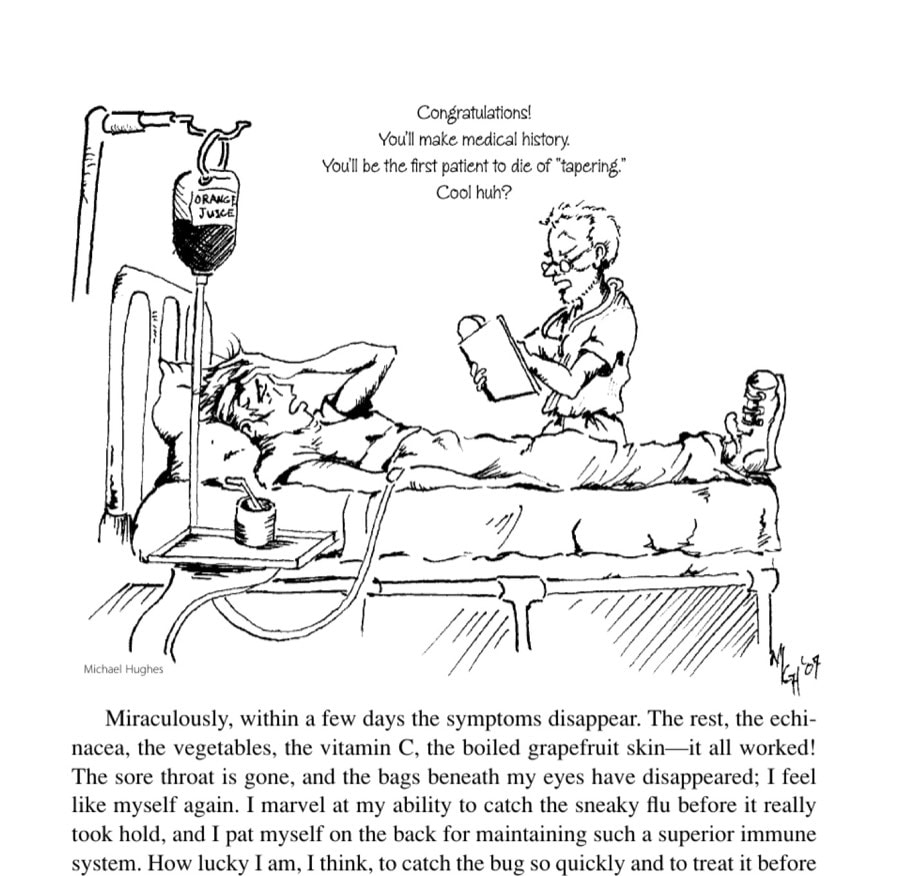
Miraculously, within a few days the symptoms disappear. The rest, the echinacea, the vegetables, the vitamin C, the boiled grapefruit skin—it all worked! The sore throat is gone, and the bags beneath my eyes have disappeared; I feel like myself again. I marvel at my ability to catch the sneaky flu before it really took hold, and I pat myself on the back for maintaining such a superior immune system. How lucky I am, I think, to catch the bug so quickly and to treat it before it got out of control. By the time race day arrives, I feel great. Flu? Ha! What flu? A flu is no match for me!
But I became suspicious when this scenario played itself out before every marathon I ran. Sometimes it started with a headache, other times with a sore throat. No matter what the symptom, every time I settled in for a well-deserved taper, some kind of malady would strike. Whether it was the hint of a cough, the scratch of a sore throat, or an ache in my stomach, I was an illness magnet during my tapers. Perhaps, I reasoned, my immune system was compromised. I realised this was highly unlikely considering that I rarely got sick during the rest of the year. So instead I considered the possibility that I may have some mysterious disorder that predisposes me to prerace illnesses. But after a little research, I’m fairly certain no such disorder exists. Yet I can’t help but feel that the onslaught of flu symptoms before my races is more than a coincidence. You see, the truth is, I’m not just terrible at tapering, I’m
terrified of it. For me, the urge to be active during my taper weeks is overwhelming; I find myself irrationally inspired to take up new sports. I consider signing up for that spinning class I always wanted to take or enrolling in Pilates. I find myself yearning to go out on my inline skates, or to take up mountain climbing, or to try step aerobics.
The last thing I want to do during a taper is to rest. And the only thing that keeps me from lacing up my skates or taking up mountain climbing is the fear of a flu. So when the first flu symptoms hit shortly after the start of taper, adding an extra mile to my run or trying to fit in just one more workout that week is out of the question. The threat of a potential flu lurking somewhere deep inside me is never far from my mind. So I rest and begrudgingly adhere to a schedule of reduced activity. And nothing happens, no cold, no flu, no mysterious stomach malady—nothing.
As real as the symptoms feel to me at the time, it occurs to me that these illnesses could merely be a byproduct of my overactive imagination. Perhaps this is my brain’s way of making sure I get the rest I need before a marathon. Maybe, just maybe, my brain is more clever than I give it credit for.
This article originally appeared in Marathon & Beyond, Vol. 11, No. 3 (2007).
← Browse the full M&B ArchiveMore like this
1,000+ stories from 19 years of Marathon & Beyond
The complete archive of the legendary long-distance journal — digitized and free to read.
