

The Valley Girl
(Editor’s note: At the turn of the millennium, novelist Paul J. Christman visited Deena Drossin in Alamosa, Colorado, where she was living and training. He herein recreates that visit.)
SAll photos by PJC
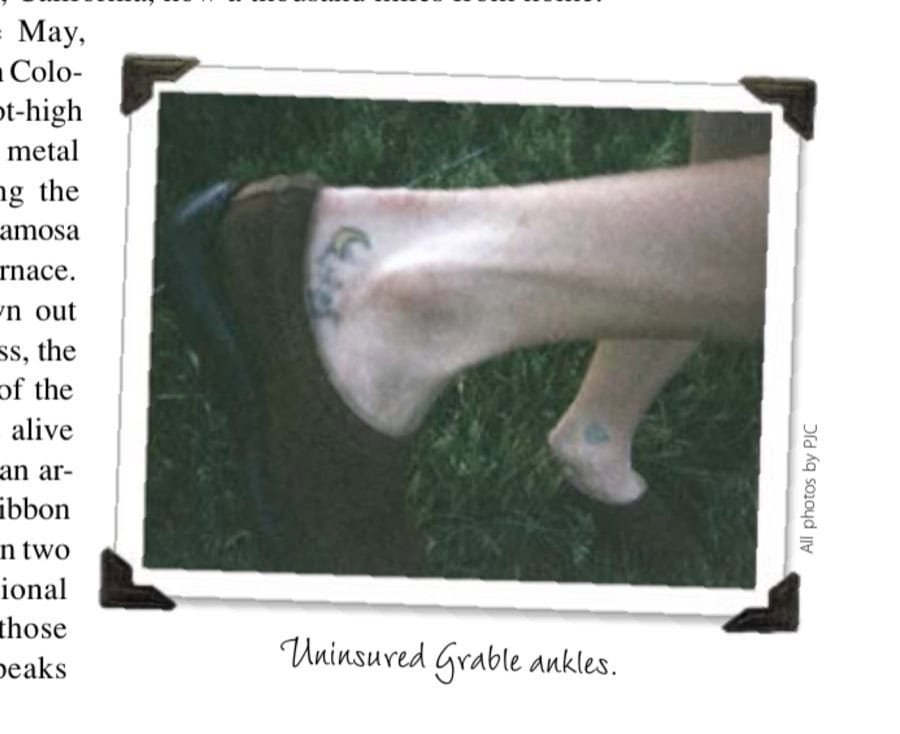
he lives next to a mortuary, is a gourmet cook, has a stout former football player for a mentor, listens to techno-rock groups such as Moby, has the uninsured legs of a Betty Grable featuring a tattoo of a crescent moon and a swimming dolphin on one ankle and a laser-destroyed illustration above the other, and has toenails that are painted black. Her town sits at 7,500 feet of elevation on a somewhat picturesque but desolate plain about as far from any metropolis as the Hawaiian Islands are from other shores. She has pale gray-blue eyes that project a thousand more experiences than those of a 27-year-old. She often consorts with Kenyans and Ethiopians, with mixed success. Her name is Deena Drossin, a Valley girl from Agoura, California, now a thousand miles from home.
Even in late May, motoring through Colorado’s 10,000-foot-high South Park, the metal crate transporting the writer up to her Alamosa aerie is a solar furnace. But coming down out of the Poncha Pass, the baked occupant of the old beater comes alive on Highway 17, an arrowlike 51-mile ribbon threading between two ranges of occasional Rockies 14ers, those snow-streaked peaks
Uninsured Grable ankles.
slowly dripping water to the enormous arid veldt and former sea below. Southwesterly winds buffet the great dry San Luis Valley, bending sagebrush branches and creating a light haze partially obscuring the New Mexican range of the Sangre de Cristo over a hundred miles to the south. Off to the left, the 750-foot dunes of Great Sand Dunes National Monument, even glimpsed at 75 miles per hour and from 20 miles away, look like a beach without any surfers or Coronas. On the dusty odometer, the largest center dune computes to seven miles long. This vista alone, including the sand’s seemingly misplaced juxtaposition with the Humboldt and Crestone Peaks above, make the journey worthwhile.
There are no suburbs in approaching Alamosa, just a few farms, one with Colorado alligators in the middle of nowhere. Then the home of Adams State College suddenly appears, as if by sleight of hand. The town has the same imported deciduous trees, familiar roadside signs, and quaint rustic buildings of a hundred Western outposts the computer age has yet to transform. After a scant two or three blocks one crosses the Rio Grande, hardly the same roaring monster that carved gigantic canyons and now constitutes the southern U.S. border but more a somberly moving creek with slowly undulating underwater grass in the center, yet lacking mallards.
Meeting the mistress of the house Drossin’s street is just as quiet. The only unusual things about the exterior of her one-story house are the two black carriage lanterns on either side of the front door. The screen door is unlocked and stays that way, burglary a little less threatening when the population is about the same size as that of many universities. Drossin appears from a back room, as if greeting an old friend who has known this 5-foot4-inch woman with chopped-and-streaked blonde pageboy hair since birth. The stereo is cranking techno rock with what 25 years earlier Donna Summer might have been happy to have as her disco instrumental background but is turned down in deference to the arrival. Wearing a camisole and shorts, Drossin plops down on a giant leather armchair opposite the writer on the couch, then, noting his burned-out look, offers a glass of cold water and disappears into the kitchen. She has the sort of combustible energy of a young woman who is happy and fit and invariably finds the glass half full, especially if it is of one of her favorite colors—blue or purple. But then any observer has to be reminded that for this prodigious long-distance runner, this first person ever to win two United States national cross-country titles in one weekend, energy is not going to be a problem. Even at 7,500 feet of elevation.
She is popular. Before the tour-de-refurbished rooms can begin, the first of a series of phone calls—as well as stopovers by friends—is fielded on a cordless phone, the tan kind that usually stands up on a plastic battery box and has fingerprints
and peanut butter or dessert stains on it. The call is from her housesitter, Becca, an Alamosa Sheriff’s Department employee-cum-Adams State student, who says she will stop by to pick up a free bike Drossin has rescued from somewhere and put in her garage. After hanging up, the hostess apologizes for the house being a mess, when it’s as tidy as if one’s parents are soon to arrive. The walls are rough plaster painted robin’s-egg blue, the living room separated from the dining room by no more than a minimum arch where a wall perhaps was knocked down during renovation. All the carpeting has been ripped up, and hardwood floors now give the place somewhat of a postmodernist urbane, yet still early-20th-century country manor atmosphere. A Santa Fe style armoire has its steepled, distressed wooden doors open, revealing a stack of de rigueur black stereo equipment as well as a large television and a VCR she has recently inherited from her coach. Just that day Drossin has had cable installed but has yet to couch-potato-out watching Ally McBeal, Martha Stewart, or anything else she might use as a vocal and visual narcotic while resting between lengthy bouts in contact with Mother Earth.
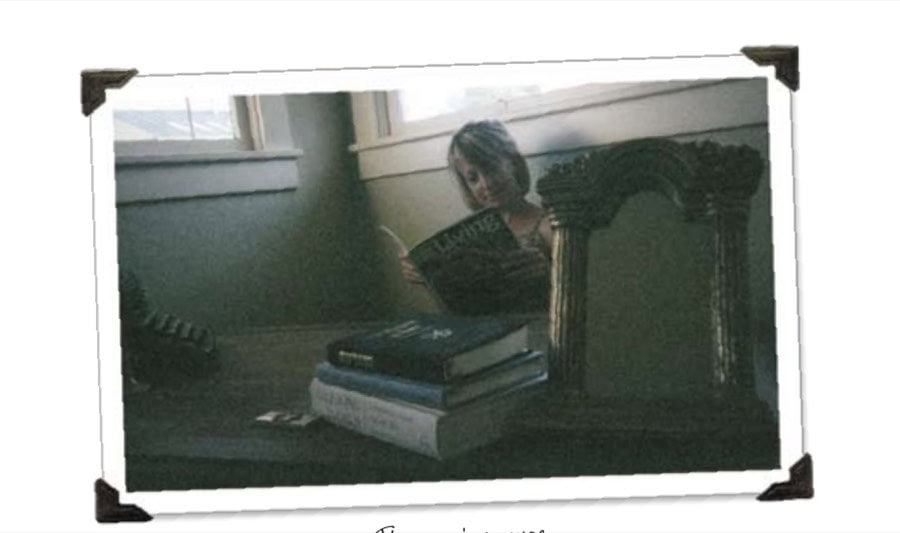
First stop on the household walkabout is her office, which vaguely resembles a converted back porch half-walled on two sides by windows divided into panes for maximum sunlight admission. At one end is a “former sheriff’s desk” with the varnish removed and aged to a gray akin to a desiccated elephant’s hide. On one corner, a stack of three books rests beside an Ionic-columned, bronze-framed mirror facing out; on the other reposes an ancient black typewriter strictly for inspiration rather than keyboard profundities. On a ledge against the wall is a
The running muse.
computer for e-mail correspondence and the usual assortment of household bills, letters, and lists. Drossin likes lists. “I write lists for everything,” she says. “My main to-do lists, and then off of that, today’s, a month, a year, a lifetime.” But when requested to produce one of these handwritten gems, she has to peruse it first to make sure there is nothing too revelatory in it before it is glimpsed by someone who may make certain personal notes or private interests too public. It is printed in longhand, in different sizes, shapes, rough fonts, and positions such as vertically in the margins, and with different pens. But without concerning oneself with the content that is really none of a visitor’s business, it is apparent that things get done in Deena Drossin’s life, and promptly for the most part.
High school hijinks It wasn’t always that way, of course. Fast times at Agoura High in Southern California’s San Fernando Valley weren’t much different than those of Ridgemont High or the Breakfast Club, except that Drossin never used such tropes as “Gag me with a spoon,” or “Oeouuuuuu. . . . ” For instance, there was the time when she and Steve, the captain of the football team, had broken up with their respective steadies and decided to commiserate. “He picked me up in the morning before school so we could drown in our sorrows, and we managed to consume a disgusting amount of Southern Comfort,” Drossin recounted, “polishing off an entire bottle between 90-pound me and 200-pound him. I got kicked out of class that day. The teacher said I could go to the principal’s office or I could go to the nurse’s office, I could take my pick. So I went to the nurse’s office and told her I wasn’t feeling very well—(laughter)—and I went off to sleep off my hangover. Not one of my better moments, of course (laughter).”
At one point Drossin was even close to failing Spanish. But like all those reaching unusual heights, even at an early age she had a talent for creating her own luck. “I was having a little trouble in Spanish class, and my Spanish teacher happened to be the assistant track coach,” she relates. “And so before the 3,000 at Mount SAC [Mount San Antonio College Relays] he told me he’d give me 20 extra-credit points if I ate a hot jalapeño before I warmed up for the 3,000. And in my desperation, I went ahead and did it and burned a hole through my stomach practically, in the race. And at McDonald’s, he also gave me extra credit if I asked for French fries and water in Spanish.”
Yet while she wasn’t particularly adept at language studies and did her share of munching junk food and cruising Ventura Boulevard, she was already showing signs of stellar pedestrianism. For in high school, Drossin won five long-distancerunning track and cross-country state titles. There are 50 states, of course, but only one has over 30 million inhabitants.
Personalities have different states, as well, and as the tour continues into the bathroom, it becomes apparent the things-to-read basket next to the toilet has about 10 Martha Stewart Living magazines for altering one’s mental state while ensconced during those prosaic but necessary times accelerated by countless hours of jarring physical activity. The coiled washcloths in the container on the back of the toilet, as well as the spiral-folded towels in her hall closet, also reveal a will to make each room and component of her habitat exude its own distinct character. The sink stands away from the wall, and its handles are of matching white porcelain. The tiny room’s freestanding bathtub with its circular overhanging curtain is the only anomaly in placing the room in Urban Home & Garden: the tub bottom’s layer of San Luis Valley grit remains a testament to one who often showers twice a day, probably 350 days a year, and during such ablutions has more than light perspiration and household dust to expunge. Even Martha Stewart would find the amount of cleanser and elbow grease required to maintain perennial spotlessness in such a constantly exercised lavatorium challenging. Yet the overall charming ambience is no accident. Drossin willfully admits that Martha Stewart and Madonna are her two biggest idols. “
For their business sense,” she explains. “They both have been entrepreneurs starting from having not very much and building this metropolis for themselves. They both are fabulous women with a vision, and they’ve created such great lives for themselves and made differences in other people’s lives along the way. I think that having that attribute in them just makes them amazing women.”
In view of her admiration for these two powerful media figures, some might easily tend to categorize Drossin as a feminist. Yet she is intent upon following her own course, in a moderate fashion. “I think any extreme groups are always trying to get more, rather than be equal, and so as far as feminists or any harsh groups like that, I’m not into it at all,” she clarifies. “I think, yeah, make a life for yourself and do what you like to do and don’t try to be better than anybody else, but just try to do what makes you feel comfortable.”
A refrigerator very wanting She is decanting this explanation and more when phone call number two comes from a high school boyfriend she hadn’t talked to in nine years before encountering him at one of two weddings she recently attended in California. Drossin is patient with her former beau, all the while ambling toward the kitchen. Soon she has dispensed with this latest caller wishing to reengage in some fashion and is cruising her den of comestible concoctions. One white wall features an alcove loaded with more herbs and spices than an Indian restaurant, while a glass-paned white cabinet above the sink is chock full of blue glassware. The refrigerator interior is well lit but empty, save for six bottles of Guinness, since the country’s preeminent female harrier has just returned from a lengthy trip.
Although the barren fridge with long strings of magnetically composed epigrams on the side and photos on the door doesn’t reflect it, one of Drossin’s passions is cooking. Recently she helped a friend cater an art opening. Included among her culinary creations were 300 scones, 250 pesto pinyon pizzas, 200 each of different types of cookies, 250 miniature cappuccino cheesecakes, 40 rolls of sushi, and 400 chocolate-covered strawberries. It took her two weeks, a significant accomplishment, in that the gesture was but one of many indicating she has yet to lose the common touch. “I love to cook,” she avers with pride. “I cook myself three meals a day, breakfast, lunch, and dinner. I bake. I just love being in the kitchen. I’d rather be cooking than paying bills in my office.” Then there is her famous blender. “Yeah, I make everything in it,” she modestly enthuses. “It’s called a Vita-Mix. And I make anything from marinara sauces for pasta to salsas to hummus . . . margaritas, smoothies.”
While some bridle at the stereotype of women in the kitchen, Drossin has no problem with such traditional pursuits. “Not at all. I’m not barefoot and pregnant yet,” she punctuates with laughter. “But, no, I am a woman and I want to do things that are feminine, and I guess I’m balanced in the masculinity and sweating and gutting it out there on the track day in and day out. But when it’s time for coming home, I like to put on my sundress and get in the garden and do things that are ‘girlie.’ Have slumber parties with my girlfriends and have my girlfriends over for sushi parties on an afternoon, or something . . . so . . . you’ve got to balance yourself.”
Next, out comes the requisite show-and-tell photos-in-glassines book, with lots of thin-clad types in groups in front of arid, flat surroundings, and her darkhaired, dark-eyed sister and parents. The resemblance is almost nonexistent. “I’m adopted,” she finally admits after first joking about the “milkman.” Her fair skin and eyes seem to have an atavistic relation to her half-Irish, half-Swedish derivation. But her fondness for her parents and sister is made apparent by photos in the clothbound keepsake book, as well as those interspersed among the flowers in pitchers, stacks of books, and three-dimensional esoterica tableaus on walls and tables or shelves throughout her abode. “
You can’t see my bedroom right now,” she says. Inasmuch as Drossin has dumped her athletic bags of gear in a jumble and has yet to dispose of the zillions of dirty T-shirts and other brand-spanking-new logoed clothing and shoes she has accumulated during countless miles over varied terrain, the room is off limits for journalistic scrutiny. The next day the room reveals an expansive brass bed with violet velvet bedspread and a profusion of well-placed lacy cream and purple velvet-and-satin pillows.
Although she has just returned from a trip, Drossin’s 23-year-old boyfriend, Andrew, is out of town. But soon through the front door comes another early20s fellow who turns out to be Andrew’s best friend, Chris Holman. He has the
refreshing shyness of a young man who isn’t quite sure if having finished third in the NCAA Division II 1,500 meters is an accomplishment to merit having any peacock feathers over. It is apparent that he looks up to Drossin and is just checking that everything is going all right with the newly arrived male visitor. “Do you want to come over for some pizza?” he asks.
Into the outback Drossin demurs in that she will be stepping out to dinner with the visiting journalist but suggests that he join them. Holman has no sooner departed with his invitation than the hostess is heading out the back door to water the new sod another Adams State College graduate put in to form a back lawn. After carefully placing the sprinkler so that the grass sections don’t turn into burned-out clay, she effuses over a table she has built from some weather-treated cedar her coach gave her. The hostess also expresses her disappointment that she can’t get a service to come over to build a fence separating her backyard from the alley and mortuary beyond. “Do you know what they’re building there?” she asks. “A crematorium. Can you imagine what that will be like when the winds are up?”
It is often breezy in Alamosa, and no sooner has Drossin completed her backyard ministrations in order to continue the indoor tour than the winds bring a tall, blond guy to the front door. It is Kevin Donaldson, who with his wife, Debbie, owns the Cottonwood Bed & Breakfast just down the street. He seems a mildmannered chap, and after the pair chat amicably, it is decided that he will join the trip to Fort Garland the next morning for Drossin’s Wednesday long hill run in the mountains above the Forbes Trinchera Ranch.
Donaldson has just evaporated from the front door when the cordless phone rings again. It is Teddy Mitchell, one of those garrulous characters who never lacks a good story or an opinion or a somewhat risqué anecdote of running lore. Over the phone, he tells Drossin he has made a pilgrimage from Alamosa to Albuquerque to train with marathoner Eddy Hellebuyck but that he will drive back that night in order to do the long run with Drossin the next morning. It is but one more sign that the many males who train with Drossin have great affection for her and will even travel great distances to share some of her magic. Has she ever been a tomboy? “
No. Not at all,” she replies with conviction. “My training partners are men, so I’m with men most of the time.” But not necessarily by choice. “Yeah. When I’m over in Europe, I’m with [5,000-meter runners] Amy Rudolph and Jen Rhines the whole time, so, yeah, it’s whoever I happen to be with. I love being with people. I love my quiet time also, but I just love being able to experience things with other people, which is why I’m ecstatic that my boyfriend Andrew is coming to Europe with me, so that I can share the experience with him.”
She met close companion Andrew Kastor through friends, Sandy and Jason Hubbard. He was their massage therapist, and the pair introduced him to Drossin. There was chemistry from both perspectives, but as is often the case when a male is four years younger than a female, neither did anything about it. They saw each other in passing at parties. Andrew confided to Sandy and Jason of a crush on Drossin. Yet propriety maintained an upper hand—that is, until Drossin mentioned to Sandy that she thought Andrew was “cute.” “
She ended up telling him that I thought he was cute and he ended up stopping by my house on a Saturday night and we sat here for a good four to five hours talking,” Drossin explains. “And it took him five days, he said—which I think was entirely too long—to give me a call back. But after that day, we’ve spent every day together since then.”
Drossin says Kastor has inspired her “in every way.” He was to have moved to Southern California to minister to the stars, while Drossin was to relocate to be near her coach at his future home in Green Valley, Arizona. Now, although Drossin will spend some time with the latter in Arizona, the pair will stay in Alamosa. “He’s had to make compromises for me,” she says of Andrew’s change of plans, “so it’s only fair that I compromise some.”
Staying near Coach Vigil Drossin’s coach, the legendary Joe Vigil, is one of those citizens who helped put Alamosa on the map. For many years he coached at Adams State, his tenure extremely influential in making the college one of those destination schools that talented distance-running types gravitate toward. He was to have made the journey with Drossin for the next day’s mountain run but instead will be off to an East Coast national track writers’ luncheon to deliver one of many talks known for their no-nonsense, motivational qualities. Yet he, too, telephones to say he will be stopping by.
When he does, Vigil, like Drossin, has a reassuringly confident manner of putting anyone at ease. “Avuncular” might be a choice word to describe his demeanor while imparting motivational monologues to those who excel at putting one foot in front of the other. He is a stout man, attired in all black, and walks with a slight limp because of a longstanding knee problem. When questioned, Vigil interlards his methodically mesmerizing speech with elliptical “aah”s as pauses for effect as well as self-deprecating musings such as “We don’t have all the answers.” But his concatenation, whether litany or not, is both engaging and compelling, inviting the listener to remain attentive in devouring the sagacity of whatever this dedicated man is deliberating upon. Nine-time U.S. cross country champion Pat Porter was among those benefiting from his tutelage, and it is no accident that Vigil accepted Drossin as a protégée.
“You’ve got to have a good work ethic, and you know you don’t just luck into a good time,” he explains, conveying to his interrogator of the moment that he is sharing a confidence of value. “The background has to be there. So we take a look at where they’re at when they come in. But Deena will tell you, she established goals four years ago when she first came here. I had her do that. Of what she wanted to do in four years. And she pretty much achieved them in three. So this year’s been frosting on the cake. And it’s been a good, frosted cake for her.”
The cake was not always fresh out of the oven. Although Drossin’s University of Arkansas years—bringing eight All-American titles, including two runner-up finishes at NCAA cross-country and on the track as a sophomore—were a bellwether for a rosy future, extreme variations on team camaraderie caused her to have some dark days. During the period, she even penned about 30 dour poems that remain for her eyes only. “
Every semester at Arkansas was so totally different, whether the guys’ and girls’ teams just got along and were in support of each other and hung out day in and day out after classes, helping each other study, going to the bars,” Drossin reminisces. “Whatever we were doing, it was always doing things together and I loved that . . . I love the town [Fayetteville]. My team was great the first couple of years. . . . And then there was a time when the men’s and women’s teams didn’t get along at all, and even the women’s team didn’t get along. Then the next semester the women’s team was really close: we would cry together, hang out in the locker room together, and it was amazing how easily things changed. That was really odd for me, and finally I just stepped back and began to watch the way that everybody was working together, [or] against each other, and I kind of distanced myself from the whole thing. Very odd. And I have poetry and things that I have written during my last couple years in college. There are dark words in there, and I can’t even believe that it’s the same person because I just feel so in control of my life and so happy with my life ever since I moved to Alamosa.”
Happiness and success equate with a philosophy of life and attitude, not with a destination, Coach Vigil asserts, and these are just two important contributions he has imparted to Drossin. “I don’t care who you are, or who the coach is, or where you’re at,” he relates. “There’s nothing magic about Boulder; there’s nothing magic about Eugene. They don’t go there to train because it’s a utopian environment, they go there because a lot of runners have gathered there and they have a social life. And that’s important to Americans, I guess. Or any other hot spot like Albuquerque or Flagstaff or Palo Alto.” “Or Johnson City, or Gainesville . . . ” the annotator adds.
Having a sense of “place” “Yeah, you’ve been around long enough that you remember all these hot spots. And I think you’ll have to agree with me that the important thing is where you
have a program, someone is running the program where there’s respect in the program, wherever it’s at. It could be in Timbuktu, and it doesn’t necessarily have to be at altitude. I believe in altitude training . . . totally. But I don’t believe that you should be up there for the whole year.”
Vigil has brought a whole bunch of miniature triangular flags on wire stems that look like those that indicate chemicals of some sort have been sprayed on highway medians or lawns subject to ambulatory children. After the two have discussed the next day’s mountain run as well as the series of football-field striders Drossin will do using the flags as markers during his absence, Vigil poses for a front-doorstep photo with his Olympic hopeful and departs.
Attention to detail is part of the successful scheme of things, and Drossin remembers that the front lawn has yet to have sprinkler attention. Just as she is placing this device for defying the dry air and hot sun, up drifts Carl Blackhurst, her lawn man. Another lad in his early 20s, Blackhurst often can be found bounding over barriers, inasmuch as he is an Adams Stater, having placed fifth in the NCAA Division II steeplechase. Just now, however, no leaping and bounding are required, but the more mundane pushing of a power mower. “
You don’t have to cut the lawn now,” Drossin says with sprinkler at the ready. “You can do it later if you want.” She is ever aware that late afternoon is a time for the trials of the miles for many of those in her life, and she wishes to extend such an option to another of her friends sharing the pursuit. Yet Blackhurst indicates that it’s no problem, and soon the lawn is cut and sidewalks swept by leaf rake rather than cacophonous gasoline blower.
Coach Joe Vigil and Drossin—two Alamosa legends.
Dinner out is in an unimposing bar sandwiched among the shops on the main street of town, the frontage of which looks somewhat like the set from the town in Pale Rider minus the elevated wooden sidewalks. A few French pastorals adorn the rough wood-plank walls above the Formica-and-metal-tube tables and chairs barely visible in the neon light from beer signs. Holman and Blackhurst are Drossin’s chaperones for the evening and with their close-cropped hair and white T-shirts and jeans could be cast members of Footloose. All three agree on one of those brewpub beers with names like Burnt Eagle Pale Ale, Roasted Oat Amber, or some such. In a town of strong Hispanic influence, one of the lads orders a burrito and the other a pub burger. Drossin also has a pub burger, but with salad instead of fries.
During dinner it becomes apparent that Drossin relishes trading stories with the lads. Past parties, outlandish incidents, karaoke singing, and mutual-friend gossip are among the themes during which each raconteur tries to match or outdo the previous storyteller. Blackhurst tosses out some particularly salient numbers, one including a desert-bash escape from the police by employing his hares-andhounds skills. “
See these?” Drossin interjects during one daredevil part of the escapade. She is pointing at her arm, and even in the dim light, goose pimples are evident. “I feel that these things are so real, and when people—I guess that’s why I like watching scary stories, even reading great books, because I just put myself into them. So when someone’s telling me a story, I always put myself into that story and try to sense how it might have felt to be there and be a part of some thrilling adventure, a scary story. I just get carried away, I guess. My imagination.”
Many of her thrilling adventures center on races in exotic foreign or stilleducational domestic locations. With regard to scary stories, however, Drossin and the writer arrive back at her well-lit place only to find the front door wide open and the journalist’s bike missing from her dining room. The jaded journalist’s dim-lights, big-city mentality suspects a rip-off, and the old brain suffuses with a mixture of disappointment and annoyance.
The rescue of the wrong bike “Becca must have mistaken it for the bike I told her she could pick up that’s in my garage,” Drossin laughingly reassures the skeptic. “I’m sure she has it. We’ll go over there right now and get it.” Only a few blocks away, a video is dropped off through a slot into a store resembling a pawnshop. Around the corner, a bunch of bikes is leaning against the stucco wall of a duplex. In a big city, they wouldn’t have lasted 10 minutes. One of them belongs to the scribe, and he is relieved. Becca comes outside and sits on the cement steps. She is a large woman and is completely bald, having lost
all of her body hair because of a rare skin disease. Wigs don’t interest her. “When are you going to cook me that dinner?” Drossin’s housesitter asks. “Any night this week. Tomorrow, if you want.” Just around the corner can be seen a pale-white stucco high school building illuminated from below by floodlights. Basking in the glow are four lads sitting like Humpty Dumpties on and banging their legs against a shorter outer retainer wall. From the distance, it looks like a scenario out of American Graffiti, except it is on a quiet street without any lowriders or raked machines cruising by.
Back at Becca’s house, after a conversation updating each other on their week, the inadvertent bicycle thief and the long-distance runner say their good-byes, and Becca exits through a screen door into a brightly lit interior. The bike gets loaded intact into the back of the four-wheel drive, and it’s back to Casa Alamosa for a little more on the life of a migrant runner.
Not many people paid attention when Drossin won the World University Games 10,000 meters in August 1997. But their eyebrows were raised in December of that year when at Portland’s Blue Lake, the kid from Alamosa did the unthinkable: she beat nine-time U.S. cross-country champion Lynn Jennings. It wasn’t just that she beat Jennings but more that she beat her by 35 seconds, an eternity in a cross-country race. The following year, Drossin finished only fourth in the U.S. Cross-Country Trials but that summer improved her 5,000 meter time to 15:07.83 in Stockholm. Then in 1999 she attempted her first U.S. Cross-Country Championship weekend double, beating Jennings by 28 seconds over the long 8K course, but on Valentine’s Day—her 26th birthday—she finished second to pal Amy Rudolph over the shorter 4K distance. In Stockholm that summer, Drossin also pulled her 5,000 meter time down to an internationally competitive 14:56.84.
With the new millennium comes an Olympic year, and Drossin began by winning her first attempt at the half-marathon distance in San Diego in January. But it was in February that came the touchstone performances. Although Adam Goucher would accomplish an equal feat during the same two days, Deena Drossin became the first person ever to win two U.S. cross-country titles on the same weekend.
Reminiscing in Alamosa after her trip out for a burger and salad, however, Drossin relates that something else on that unique turf weekend was just as important to her. Through her friend Billy Mills, the USA’s last gold medalist at 10,000 meters, she met Nicholas Sparks, the author of three of her favorite books: Message in a Bottle, The Notebook, and A Walk to Remember. “The highlight of the Cross-Country Champs was not winning both titles,” she emphasizes, “but was seeing Billy Mills and my favorite author.”
March 2000 was a huge month for the lady from Alamosa, as well. She won the Gate River Run 15K in Jacksonville. Then at the World Cross-Country Championship in Vilamoura, Portugal, Drossin got involved in another of her thrilling adventures by being stung in her throat by a bee in the first hundred meters. She
blacked out during the second lap of the race, took a tumble, got up, and finished a disappointed 12th. Despondency turned to jubilation, however, when afterward she belatedly learned that the USA women’s team had garnered bronze medals.
Good day at Carlsbad It was still in March, however, that another important omen for 2000 occurred, this one in her native California. In front of thousands of Carlsbad 5,000 fans, Drossin set a 15:08 U.S. road record. “
Breaking the American record in Carlsbad was probably one of the highlights of my career as far as races are concerned,” she recounts. “And it would have meant nothing if my family wasn’t there, if the streets weren’t packed with people that were just screaming at the top of their lungs. . . . To have it be done in Southern California, which is where I grew up, and to have friends and family there watching me, and to have running fans all around screaming for me to run a little harder and to push a little harder was just amazing. It was amazing energy that I felt from everybody that was yelling.”
Speaking of amazing energy, in late evening came the question that every athlete in a rising tide of performance-enhancing drug use must face, inasmuch as there are many allegations of EPO [a kidney hormone to increase red blood cell count], steroids, human growth hormone, and other drugs of illegal assistance being swallowed or injected, even in distance running and cycling. Drossin is well aware of such human foibles but is focused on her own pursuit, even if her accomplishments may be diminished by those who may or may not be taking drugs. “
Like being lapped last year [at the World Track and Field Championships 10,000 meters] in Seville (laughs). It was a very humbling experience. I don’t even think about it. I get asked the question a lot as far as athletes and drugs. And, yeah, it bothers me that I know our sport will never be clean because the athletes and doctors are always just a step ahead of drug testing. But [in another sense] it doesn’t bother me at all. If I consider myself one of the top five distance runners in the world, and I get out there and I finish 10th in the Olympic Games because six of the girls that are ahead of me I know I’m skeptical whether they’re clean or not, it just doesn’t matter. In my eyes, I’ve worked hard and I’m getting out of the sport exactly what I’m putting into it. And I’m not cheating in any way, to the extreme that I don’t even take vitamins because I don’t feel like that is a fair advantage. I would rather get it more naturally through foods and more wholesome ways. Like training at altitude to increase my EPO levels rather than getting injections and getting blood sucked out of me and blood pumped back into me and all that. It’s a safer way to do things. Safer and legit. It’s frustrating that there are drugs in our sport, but at the same time it has nothing to do with
me except that it pushes me back as far as placings, and that’s not what I’m in the sport for, anyway.” She’s not in the sport for voice lessons, either. Yet gazing at the front of her stereo as Drossin sits with one leg folded under her on her leather chair does evoke the dinnertime story of her karaoke singing. “We just set up a little stage with a bench right in front of the stereo, plug in the microphone, and put in whatever song anybody wants to sing. We’ve gotten to the point where people are bringing their own CDs and probably practicing during the week,” she relates to laughter from both songstress and scribe. “So I practice in the shower, I admit, but I just pop in any CD and belt out the words, and if I don’t know the words, I just make ’em up (laughter). Anything I remember I keep playing (more laughter). I just remember I had a lot of fun, but I really don’t remember. Because lip karaoke is always with a few margaritas.”
Drossin may be paid to run in circles or on concrete, but as with her karaoke, she is not paid for dancing, either. Yet she and her pal Amy Rudolph lost no time during her March European trip. “We roomed together at the world championships in cross in Vilamoura, Portugal, and we both are into the same type of music. So we set out our Walkmans, our Discmans, and our speakers and listened to our dance music all day. She’s just full of energy, and we just danced around the room together listening to techno music. Our room looked out over the pool area, so
ad
we would go out on the balcony and give ourselves a little MTV dance party out there (laughs heartily). Just the fun things we do on the road, I guess.”
A breakfast for champions The next morning the scribe offers to seek a coffee shop alone, but Drossin indicates that she needs some coffee, too. The shop she has in mind is closed. But next to it is the sort of breakfast place that Pritikin dieters and heart attack victims frown on, faded leather booths and the kind of bacon and eggs and greasy hash browns that stave off hunger for eight hours. The two coffee drinkers lean against the back of the booth and stick their legs out on top of the leather seats. Drossin orders an English muffin. The journalist, recognizing that his attempt to accompany this zephyr of the mountains may well require more than just his usual double shot of caffeine, makes the order two muffins.
Back at Drossin’s house, the departure time for the trip to the mountain run is 8:00 a.m., and by 8:30, Teddy Mitchell has not arrived. Later it will turn out that his car has broken down on the way from Albuquerque. Kevin Donaldson shows up, and the writer’s mountain bike is loaded into a huge four-wheel drive looking as if it could be part of an armored division in Kuwait. “I thought I had a buyer for it,” Drossin says of this huge metal vehicle dwarfing her. “I’ve always had a Jeep, and I want to sell this and get another one.”
The trio are ready for their adventure when Coach Vigil pulls up with his passenger window down. Drossin leans in, and a conversation ensues midstreet that can happen only in a small town where another car comes by maybe once every 15 minutes. Vigil makes sure Drossin has everything under control and understands her training schedule before he departs for the airport.
The air conditioning of the giant oval-treaded beast works, and soon the three of us are making the appropriately prescient 26-mile journey east to Fort Garland. Again the great sand dunes are off in the distance, a predominant diorama preventing anyone from forgetting that the plain they are traversing was once the floor under a far more expansive Rio Grande.
When we reach Fort Garland, it appears very much like one of those tiny windblown crossroads where there is a post office and a gas station/convenience store, a fleeting destination at which the Pony Express will arrive any minute. The size of the town is made even more evident when we park just 150 meters from its center and are on the edge of the mostly barren Forbes Trinchera Ranch.
Drossin and Coach Vigil’s chosen route is a 10.4-mile loop with more grade changes than a roller coaster. “If you make it up the first hill without walking, the next two are easier,” she politely tells the journalist, who will attempt to accompany her on a mountain bike, before they depart. “Sure,” he smirks to himself, confident that this sylphlike gazelle has exaggerated the climbs that he will handily negotiate alongside her.
A dirt road extends east among sagebrush and hills, and soon Drossin and Donaldson are off on the winding flat path to nowhere before the climbs that connote the breakfast of certain Colorado champions. After less than a mile, having already left Donaldson behind, Drossin makes a right-hand turn onto a road climbing initially at about a 5 percent grade. “This is Fontaine Road,” she throws over her shoulder. “That was Prefontaine Road,” she adds, the allusion being to one of America’s most famous and tragically deceased runners, “and later comes Postfontaine Road.”
The road hard traveled Soon there is little more than the rapid but soft methodical sounds of rubberbottomed running shoes crunching through ground-up Colorado clay, basalt, shale, quartz, feldspar, and other indeterminate mineral composites, hunks of which occasionally dot the edges of this stairway to Trinchera heaven. The grade is getting steeper, and the observer on the bike is falling behind. As in the northern-Colorado cycling loop, the Morgul Bismarck, which has its “Hump” and another steady climb to soften riders up before “the Wall,” Drossin’s Trinchera course has the grade increasing steadily until suddenly the road ascends sharply enough that a Monet water-lily canvas might be hung on its surface and viewed from afar. She scampers up it as if chasing a bus for work. The rider finds himself walking his bike partway.
At the top, she is jogging in place, kind enough to wait for a snapshot of the Olympic hopeful with the 14,345-foot Blanca Peak visible to the north. The photo op point isn’t the summit, but merely the crest of the first climb. While the ground-up composite and minerals and earth keep on alternately gaining elevation and leveling underfoot, each stage has another short, steep grade. All grist in the toughening mill for those who pursue such pulse-raising ascents for reaching singular physical and rhetorical heights uncommon to mere mortals, but always in the hearts and minds of prospective Olympians.
Finally, at about 8,300 feet of elevation, Drossin comes to a dusty intersection of dirt roads at which she jogs to a halt. It is no accident that the point comes almost halfway through the run, or at about 4.8 miles. This approximates the distance Drossin will have run in her first of two Olympic Trials events, the 10,000 meters, when the real racing may begin. For the fastest in a long-distance race, success can come in the last 400 or even 200 meters. But for many wishing to leave nothing to Olympic Trials race-end chance, their best shot is to accelerate early—the earlier the better. One or two others may be able to tuck behind and later outkick such an early departure, but in the process the risk-taker often becomes one of three Olympians.
A similar case in point concerns the U.S. Championship in 1999, when Drossin made the World Track and Field Championships 10,000-meter team bound for
Seville but lost her Trials race to two others. She led most of the 25 laps, all the while necessarily expending more energy than those drafting in her wake, and then in the final kilometer was passed by confident kickers Anne Marie Lauck and Libbie Hickman. Now, mid-Trinchera mountain run, Coach Vigil’s protégée is working on attaining the speed required to win as well as to make the Olympic team. “
She’ll run 4.8 or thereabouts, and at that point we have a little downgrade of about 3 percent,” Vigil explained the previous day. “And I know that you know enough about running to understand that it’s hard for anyone to run greater than a hundred percent of their speed on the flat. Because when gravity has something to do with it and you’re running downhill, you can run at 110 or 120 percent of your max. And of course she’s running downhill for 120, 130 meters, or whatever it is, and she concentrates on the lift and arm action and all-out speed. And after she’s done some plyos—some explosive work—she does 15 of these, and then she continues her run and runs the rest of the course, terminating at 10.4. And so she has, oh, maybe a fast mile in there of 120 times 15—whatever that comes to—about 2,000 meters.”
Drossin completes her plyometric “high-knees” and explosive sprint drills without a single whine. It is obvious that her confidence in achieving the impossible, unattainable, or unthinkable has now improved dramatically. Next comes a rocky steep descent on a ledge high above a river audible from the canyon below, a little wider than the trail in Lost Horizon but still dangerous. A fall or a sprawl on foot or off bike would seem an invitation to a triple gainer into the icy waters below. Yet Drossin fearlessly plummets down the rock-strewn trail, the rider, having forgotten his helmet, more circumspect in his descent.
Drossin on top of a mountain— Deena’s Trinchera world.
Along the water-trough canal returning to town, the sweeping panorama of plains and Rockies in the distance is hard to ignore. Yet the footing must constantly be monitored, lest one minor mistake lead to a sprained ankle or other season-ending injury. Drossin’s pace never slackens until the last half mile to the car. The winds are now steady out of the west at about 25 miles per hour, the kind that tatters the edges of flags. Finally, Drossin grinds to a halt a mere 300 meters from the windswept, nearly empty parking lot. It is apparent that this lack of completion has to be balanced with the extreme fatigue she has built up from a mixture of climbing and speed few others could match.
Margaritas interruptus On the ride home the mood is light, and talk turns to Donaldson’s margaritas, which he makes with the special ingredient of Limeade. “Stop by anytime this afternoon and I’ll make some,” he says, wishing to accommodate and reveal his specialty. Drossin makes it apparent that she has enjoyed them at more than one afternoon sitting. But she also knows that possibly her one chance at Olympic immortality is upon her and that the fates wait for no one who misses a step. The margaritas will have to wait until another day.
Donaldson must return to shared duties as the father of two as well as those of caretaker of his bed-and-breakfast. But not before Drossin has offered to barter her services of helping him cater two or three occasions in return for a complimentary night in one of the Cottonwood Inn’s rooms.
After showers to rid themselves of the soil of a thousand steps and pedal strokes, Drossin and the journalist are off to a country club restaurant overlooking a sun-baked fairway. No duffers are in sight, but a variety of weathered characters stop by Drossin’s table to pay their respects. She acknowledges most of them by first name, another nice touch from someone who may be as well known in Alamosa as the mayor.
The woman who ran 12 mountainous miles that morning orders a veggie burger and fries. The journalist expresses his surprise, in that he had been amazed at the previous evening’s restraint when she had ordered a salad instead of fries. “That’s because I don’t like their fries,” she says, an admission of at least a partial belief that when the fire’s hot enough, anything burns. Drossin definitely has a reflective, analytical style, whether her examinations involve something as facile as French fries to her more complex readings varying from Care of the Soul by Thomas Moore to Half Asleep in Frog Pajamas by her favorite, Tom Robbins. “Reading, music, and cooking,” she denotes. “If I could narrow down to just three of my favorite things, those would be the three.”
Her three favorite pursuits may all come into fusion postrunning. When the heat of competition is over and many athletes flounder as their careers slowly
dissipate from having lost a step, Drossin may be holding readings over a meal she has cooked at her own bed-and-breakfast. “I’m just going to let my body and my mind tell me when I’m finished,” she muses aloud. “But I’ll have no problem walking away from it. I have aspirations to open up a bed-and-breakfast, and I have all the plans for it, and it’s going to have a little café on the side. Just a holistic place for people to come to. It’s going to have meditation classes in it, just a wonderful place for people to gather for healthy food and facial massages and . . . everything that’s good for you. I don’t know when it’s going to be or where it’s going to be. But I have the cuisine that I’m going to serve, I have everything . . . décor . . . I think I would like it to be by a lake or by a beach. Either one. It needs to be by water because I think water is very healing.”
Water may have a healing effect, particularly for someone dehydrating herself enough twice a day to drink a tower full of the stuff yearly, but water will play into her second run of the day. Teddy Mitchell finally shows up, and after several anecdotes centering on mutual friends, the shirtless Mitchell joins Drossin on what is designed to be a five-mile recovery run. The pair set out through neighborhood streets and a park but quickly cross over the greatly reduced Rio Grande and commence to amble along the adjacent bike path. On the trot, Mitchell recounts a variety of tales, including one regarding a challenge over the anatomical attributes of several of the USA’s leading distance runners, and also opines on a variety of topics from Boulder’s lack of altitude (it is 5,400 feet) to just who is making progression in the sport and who isn’t. The time passes quickly, even with Drossin’s dropping behind to answer nature’s call among some wetlands as well as slowings to accommodate dog Aspen’s plunges into any fresh water within range. Drossin says little during the run, the diurnal total of 17 mainly fast and arduous miles finally beginning to take their effect.
As the day wanes Back at the house, Drossin goes to the kitchen and then mentions that there is nothing to offer and that it is time for a trip to the supermarket. Mitchell takes his cue and is off, and the journalist can see that after almost 24 hours underfoot, he now risks overextending what has already been a generously shared day in the life of a rare woman who each year runs more miles than many people fly.
The following month, Drossin was going to have to fly on foot as well as by plane. Scheduled were double Olympic Trials by fire in Sacramento, where she hoped to compete in both the 10,000 and 5,000 meters on two successive Fridays. A recurring theme includes the support for such pursuits that she receives from those around her. “I think the most important thing is to be in a positive environment, and it’s hard to be in a positive environment all by yourself,” Drossin stresses. “Because you need a support system, whether it comes from friends who
Aspen, Drossin, and Teddy along the R
io Grande.
are just supportive of what you do, or whether it comes from training partners or family. So much of our self-talk is very negative. I think you need people—not to boost your ego—but just people that you feel good being around, even without saying anything. It doesn’t have to be, ‘Oh, you’re great,’ or ‘You look fabulous,’ or ‘That was an awesome workout.’ . . . I think it is incredibly important to have some type of team, whether a running team, or incorporating friends and family into your team. My dog [Aspen] is part of my team. She makes me feel good . . . So I can’t emphasize enough the importance of people and a good support system in a person’s life. It makes the difference between a mediocre job and a fabulous job in anything. I’m convinced. Whether it’s someone sitting at a desk all day or a housewife. Like I think for the Olympic Trials, right now, between the two weekends, I have between 40 and 60 people from California who are coming up to watch me run. Even some that are flying in from the East Coast to watch. It’s exciting. T-shirts being made up and cowbells being ordered.”
Late in June, with the Olympic Trials still three weeks away, Drossin found herself facing a totally different challenge at one of her favorite alternative training sites, the Arco Olympic Training Center in Chula Vista, California. She was selected to introduce President William Jefferson Clinton to over a thousand athletes, staff, notables, and press assembled for a presidential tour of the facility. U.S. Olympic Committee President Bill Hyble introduced Drossin, and after her speech extolling the virtues of U.S. Olympic development, she in turn introduced Clinton. “This was by far the most humbling experience of my life,” Drossin recounted
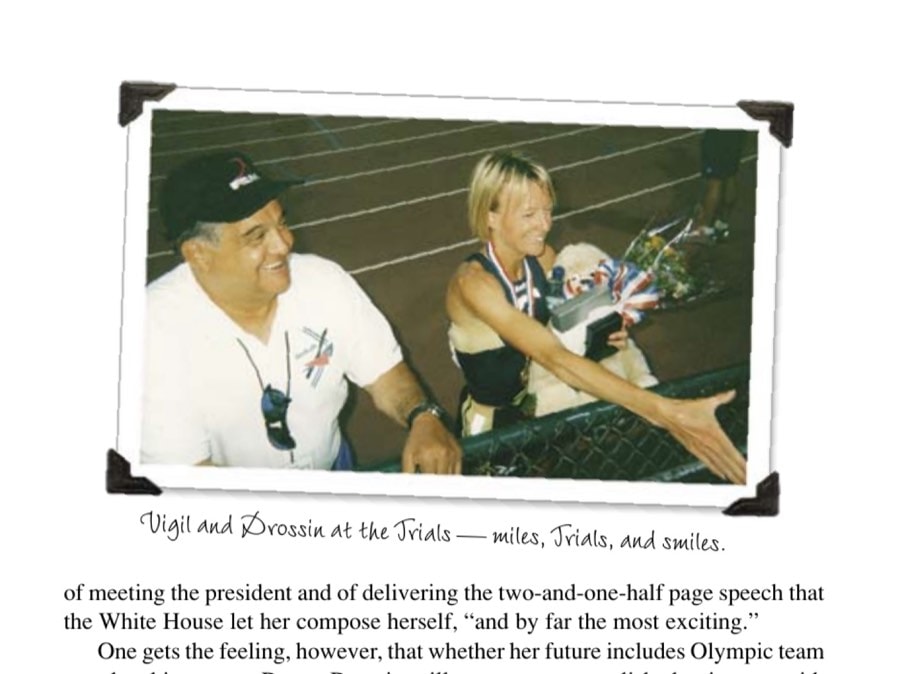
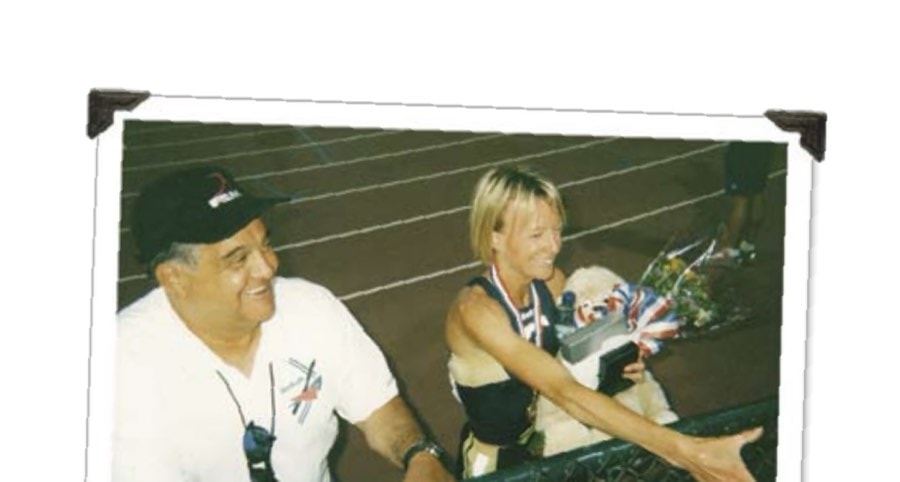
Vigil and Drossin at the Trials—miles, Trials, and smiles. of meeting the president and of delivering the two-and-one-half page speech that the White House let her compose herself, “and by far the most exciting.”
One gets the feeling, however, that whether her future includes Olympic team membership or not, Deena Drossin will carve an accomplished existence with the same aplomb she used to introduce a president. In August, for instance, she plans to take a stab at breaking the U.S. 5,000-meter record at her favorite DN Galan Meeting in Stockholm. Then there looms the possibility of a marathon in her future, for which, she says, the financial rewards already being offered are lucrative. “Next year I’m probably going to focus on a lot longer road races and just being consistent and keeping my volume up,” she hints. “And maybe the year after that I’ll try one. I don’t want to try one in a crucial year. And also, it’s hard to find that kind of time . . . I never thought I wanted to run one—but all of a sudden I feel inspired to do it. I don’t know if it was the Olympic Trials that have inspired me or just seeing so many [great performances].”
A balanced life, plenty of support, and the assurance that hard work brings results would appear to make the compleat Deena Drossin. And for this she is grateful. “I just feel extremely lucky,” she reflects wistfully at the end of another day in her world of simple pleasures. “And I know I work hard for this. But I sit back sometimes when I have a few minutes to think about it, and I can’t believe how it’s come to this. From a scrawny little bag of bones just running around a local track, kickin’ up dirt behind her and eating Abba-Zabas and Snickers bars after a race. To being here and traveling to places like Monte Carlo and Nice, France, Stockholm, Sweden, London—wherever it takes me—Finland, Morocco—exotic places. And then back home again, to this little palace of mine.”
This article originally appeared in Marathon & Beyond, Vol. 13, No. 6 (2009).
← Browse the full M&B ArchiveMore like this
1,000+ stories from 19 years of Marathon & Beyond
The complete archive of the legendary long-distance journal — digitized and free to read.
