

The Art of the Ultramarathoner
The first four installments of Tom Osler’s book appeared in our July/August, September/October, November/December 2001, and January/February 2002 issues, respectively.
CHAPTER 9 RACING FOR SEVERAL DAYS—PART 2
In the previous chapter we examined my own three-day trial at the Human Performance Laboratory in Muncie, Indiana. The three tables on pages 133–134 provide a detailed breakdown and summation of exactly how the time was allocated during this run. In this chapter we will examine the schedules of two men who had vast experience at such events. First we will look at a pre-race schedule written by Edward Payson Weston, prior to an attempt to walk 500 miles in six days. This plan will be contrasted with observations made by a team of doctors who witnessed a similar trial by Weston. Finally, we will review the six day run by Henry “Blower” Brown of England in 1880, which established a new world’s record.
Weston’s Schedule
Two months before becoming the first person to walk 500 miles in six days, Weston tried the same feat unsuccessfully at New York City’s Madison Square Garden, known then as Barnum’s Roman Hippodrome. Before this attempt Weston had printed and circulated his pretrial schedule, a fascinating mix of athletic strategy and self-promotion. He announced a goal of 115 miles on the first day and another 400 miles over the remaining five days. This was to be achieved by starting out with twenty-five miles, resting for five minutes, then falling into a steady rhythm of ten miles walking and five minutes resting until 115 miles were done, which, if all goes according to plan, would be by 11:55 p.m., or just under twenty-four hours after beginning. The second day would add eighty-five miles to the total, the next three days eighty each, and on the sixth day Weston would cover seventy-five miles for his total of 515. The small pamphlet containing this schedule had an introduction which ended as follows:
You will observe that this calculation allows for an extra distance of fifteen miles, which can be dropped on the first day, as walking 100 miles within the first twenty-four hours will, under ordinary circumstances, insure success.
While I am unwilling in any way to prostitute the powers of endurance with which my Maker has endowed me, yet I assure you, on this occasion, I shall use my best efforts to more than meet your most sanguine expectations, and shall ever remain
Faithfully and gratefully yours,
Edward Payson Weston
Weston was never one to “prostitute” his powers of endurance. He managed only 346 miles in this effort.
Table 1 shows a summary of Weston’s approach to the first day. The trial begins at midnight on Monday morning as was the custom. Weston then proposed to walk twenty-five miles without a rest at about five mph. While it’s not shown on this table, the actual schedule shows that the first mile of every walking segment is the slowest. Most often he walked the first mile in thirteen to fifteen minutes, but he would begin as slowly as twenty minutes per mile after rising from a night’s sleep. Most of the miles on the schedule are to be walked in twelve minutes. After the first twenty-five miles, the schedule is simplicity in itself. He simply walks ten miles, then rests for five minutes; walks ten miles, rests five minutes, etc. Notice that no lengthy meals are eaten! An observer of Weston once wrote:
During this walk, Mr. Weston took but few regular meals, a great part of his nourishment being taken while actually walking. In this way he took his beef-essence, soft-boiled eggs, gruel, tea, coffee, and all other drinks.
Also note that no sleeping is planned for the first day.
In Table 2 we see Weston’s second day effort. Notice that he allows for plenty of sleep at the usual sleeping hours. Most rest periods continue to be only five minutes, but now longer periods are allowed for the usual three meals. It appears that Weston is trying to stay close to his daily habits. He walks eighty-five miles on the second day.
Table 3 shows that days three through six are identical except that he stops one hour early at the end of the last day.
E. P. Weston’s Pretrial Schedule
Six Day Solo Walk—Madison Square Garden
October 5–10, 1874
Table 1 The First Day
| Time of Day | Comments |
|---|---|
| 12:05 a.m. | Start |
| 12:05 to 5:00 a.m. | Walk 25 miles |
| 5:00 a.m. | Rest 5 minutes |
| 5:05 to 7:05 a.m. | Walk 10 miles |
| 7:05 a.m. | Rest 5 minutes |
| 7:10 to 9:11 a.m. | Walk 10 miles |
| 9:11 a.m. | Rest 5 minutes |
| 9:16 to 11:17 a.m. | Walk 10 miles |
| 11:17 a.m. | Rest 5 minutes |
| 11:22 a.m. to 1:24 p.m. | Walk 10 miles |
| 1:24 p.m. | Rest 5 minutes |
| 1:29 to 3:30 p.m. | Walk 10 miles |
| 3:30 p.m. | Rest 5 minutes |
| 3:35 to 5:36 p.m. | Walk 10 miles |
| 5:36 p.m. | Rest 5 minutes |
| 5:41 to 7:43 p.m. | Walk 10 miles |
| 7:43 p.m. | Rest 5 minutes |
| 7:48 to 9:49 p.m. | Walk 10 miles |
| 9:49 p.m. | Rest 5 minutes |
| 9:54 to 11:55 p.m. | Walk 10 miles |
| 11:55 p.m. | Retire for sleep |
Table 2 The Second Day
| Time of Day | Comments |
|---|---|
| 11:55 p.m. to 5:15 a.m. | Sleep 5 hours 20 minutes |
| 5:15 to 6:21 a.m. | Walk 5 miles |
| 6:21 to 6:51 a.m. | Breakfast (30 minutes) |
| 6:51 to 9:52 a.m. | Walk 15 miles |
| 9:52 a.m. | Rest 5 minutes |
| 9:57 to 11:58 a.m. | Walk 10 miles |
| 11:58 a.m. to 12:18 p.m. | Lunch (20 minutes) |
| 12:18 to 3:21 p.m. | Walk 15 miles |
| 3:21 p.m. | Rest 5 minutes |
| 3:26 to 5:27 p.m. | Walk 10 miles |
| 5:27 to 5:47 p.m. | Supper (20 minutes) |
| 5:47 to 7:48 p.m. | Walk 10 miles |
| 7:48 p.m. | Rest 5 minutes |
| 7:53 to 9:54 p.m. | Walk 10 miles |
| 9:54 p.m. | Rest 5 minutes |
| 9:59 p.m. to 12:00 a.m. | Walk 10 miles |
| 12:00 a.m. | Retire for sleep. |
Table 3 Days Three Through Six
| Time of Day | Comments |
|---|---|
| 12:00 to 5:55 a.m. | Sleep 6 hours |
| 5:55 to 7:03 a.m. | Walk 5 miles |
| 7:03 to 7:23 a.m. | Breakfast (20 minutes) |
| 7:23 to 10:26 a.m. | Walk 15 miles |
| 10:26 a.m. | Rest 5 minutes |
| 10:31 to 12:34 p.m. | Walk 10 miles |
| 12:34 to 12:54 p.m. | Lunch (20 minutes) |
| 12:54 to 2:57 p.m. | Walk 10 miles |
| 2:57 p.m. | Rest 5 minutes |
| 3:02 to 5:05 p.m. | Walk 10 miles |
| 5:05 p.m. | Rest 5 minutes |
| 5:10 to 7:16 p.m. | Walk 10 miles |
| 7:16 to 7:46 p.m. | Supper (30 minutes) |
| 7:46 to 9:49 p.m. | Walk 10 miles |
| 9:49 p.m. | Rest 5 minutes |
| 9:54 to 11:55 p.m. | Walk 10 miles* |
| 11:55 p.m. | Retire for sleep. |
*On the last day Weston stopped at 10:55, covering only 55 miles.
Over the six day period he allows twenty-nine hours and twenty minutes for sleeping, five hours fifty minutes for meals, and two hours twenty minutes for short rests. His actual traveling time is 105 hours twenty minutes and he averages 12:15 per mile pace.
An Eyewitness Account
We have seen Weston’s proposed schedule. This is Weston in “theory.” What of Weston in “reality”? Fortunately, an extensive eyewitness account of one of Weston’s early performances has been preserved. In 1870 Dr. Austin Flint,
Professor of Physiology at Bellevue Hospital Medical College in New York City, together with a team of assistants, studied Weston for a scientific project. Weston agreed to a fifteen day study. During the first five days he rested, but had his every action observed and recorded. All his food as well as his excrement was weighed and analyzed. During the next five days he gave a pedestrian exhibition during which he attempted to achieve two goals: 400 miles in the five days, and 112 miles on one of the five days. On the final five days, Weston was observed extensively as on the first five days.
Dr. Flint’s work was published in the New York Medical Journal of June, 1871. We will simply relate Dr. Flint’s observations of one of the days during which Weston walked for science.
The walk began on November 21, 1870 in the Empire Skating Rink in New York City. The track was made of boards covered with dirt and shavings and laid out in the form of a rectangle. It measured just over seven laps to the mile.
On the first day Weston managed eighty miles. He felt well and walked with great ease, even though he suffered a little nausea. This, he related, was common on the first day of such an effort. On the second day he managed only forty-eight miles, but he was resting for a big “push” for 112 miles on the third day. Dr. Flint writes:
At 4:05 p.m. he was undressed, and wrapped in a long red flannel gown and a blanket, carried to a vehicle, and driven about five blocks to a private house to sleep. He states that he did not sleep, but dozed and got no rest. About 9:30 p.m. he was brought back to the rink in the same way that he was taken out, ate supper, and began at 10:24 p.m. his first attempt to walk one hundred and twelve miles in twenty-four consecutive hours. He seemed cheerful and confident during the entire day.
The following is Dr. Flint’s detailed account of the third day:
| 12:00 to 6:06 A.M. | 6 h. and 6 m. walking 27-⁴⁄₇ miles, with one stop of 4 m. 30 sec. for rest, and 4 stops for urination, averaging 30-½ sec. each. |
| 6:06 to 6:14 A.M. | 8 minutes’ rest, sitting on the track. |
| 6:14 to 1:31 P.M. | 7 h. and 17 m. walking 33 miles, with 4 stops for urination, averaging 31-¼ sec. each. |
| 1:31 to 1:37 P.M. | 6 minutes’ rest, sitting on the track. |
| 1:37 to 2:24 P.M. | 47 m. walking 3-³⁄₇ miles, with one stop of 34 sec. for urination. |
| 2:24 to 2:31 P.M. | 7 minutes’ rest, sitting on the track. |
| 2:31 to 3:05 P.M. | 34 m. walking 2-¾ miles. |
| 3:05 to 3:32 P.M. | 27 minutes’ rest, sitting on the track. |
| 3:32 to 4:46 P.M. | 1 h. 14 m. walking 5-¼ miles, including 2 stops for urination, averaging 27-½ sec. each. |
| 4:46 to 5:16 P.M. | 30 minutes’ rest, sitting on the track. |
| 5:16 to 5:46 P.M. | 30 m. walking 2 miles, with one stop of 58 sec. for urination. |
| 5:46 to 6:49 P.M. | 1 h. and 3 m. rest in his room (supper). |
| 6:49 to 9:11 P.M. | 2 h. and 22 m. walking 11 miles, with one stop of 30 sec. for urination. |
| 9:11 to 9:21 P.M. | 10 minutes’ rest, sitting on the track. |
| 9:21 to 10:52 P.M. | 1 hr. and 31 m. walking 7 miles, with one stop of 43 sec. for urination. |
| 10:52 to 12:00 A.M. | 1 h and 8 m. rest, continued into November 24th. |
| Walking 92 miles | 20 h. | 8 m. | 43 sec. |
| Urination | 7 m. | 47 sec. | |
| Rest on the track | 1 h. | 32 m. | 30 sec. |
| Rest off the track | 2 h. | 11 m. | |
| 23 h. | 58 m. | 120 sec. = 24 hours |
Thus Weston only managed ninety-two miles on the third day and failed in his push for 112. On the next two days he walked only fifty-seven and forty and one-half miles for a total of 317.5 for the five days. As usual, Weston fell short of his goals.
Upon the conclusion of the walk Dr. Flint observed:
Notwithstanding the immense muscular and nervous strain to which Mr. Weston had subjected himself for the past five days, culminating on the fourth day in complete prostration of the nervous system, he sat up, talked and joked with his friends until 1:40 a.m., November 26th, then went to bed and slept well until 10 a.m. He then got up, feeling splendid, wakening his attendants, who are almost exhausted by the five days’ labor and watching, and called for his breakfast, which he ate at 11:45, with excellent appetite. For the succeeding five days, he felt as well as ever. During these five days, he did absolutely nothing but eat, sleep, and amuse himself, attending to no business. He took no exercise, walking only about two miles a day, though he said he felt as if he could walk one hundred miles any day without difficulty.
Finally, we are told that on the day following the conclusion of the walk, Weston “smoked six cigars during the day.”
“Blower” Brown’s Record
Henry “Blower” Brown was born in Paltham, England and was thirty-seven years old in 1880 when he broke Edward Payson Weston’s year old record of 550 miles for a six day “go as you please” pedestrian match. Brown managed a brilliant 553 miles to become the “champion pedestrian of the world.”
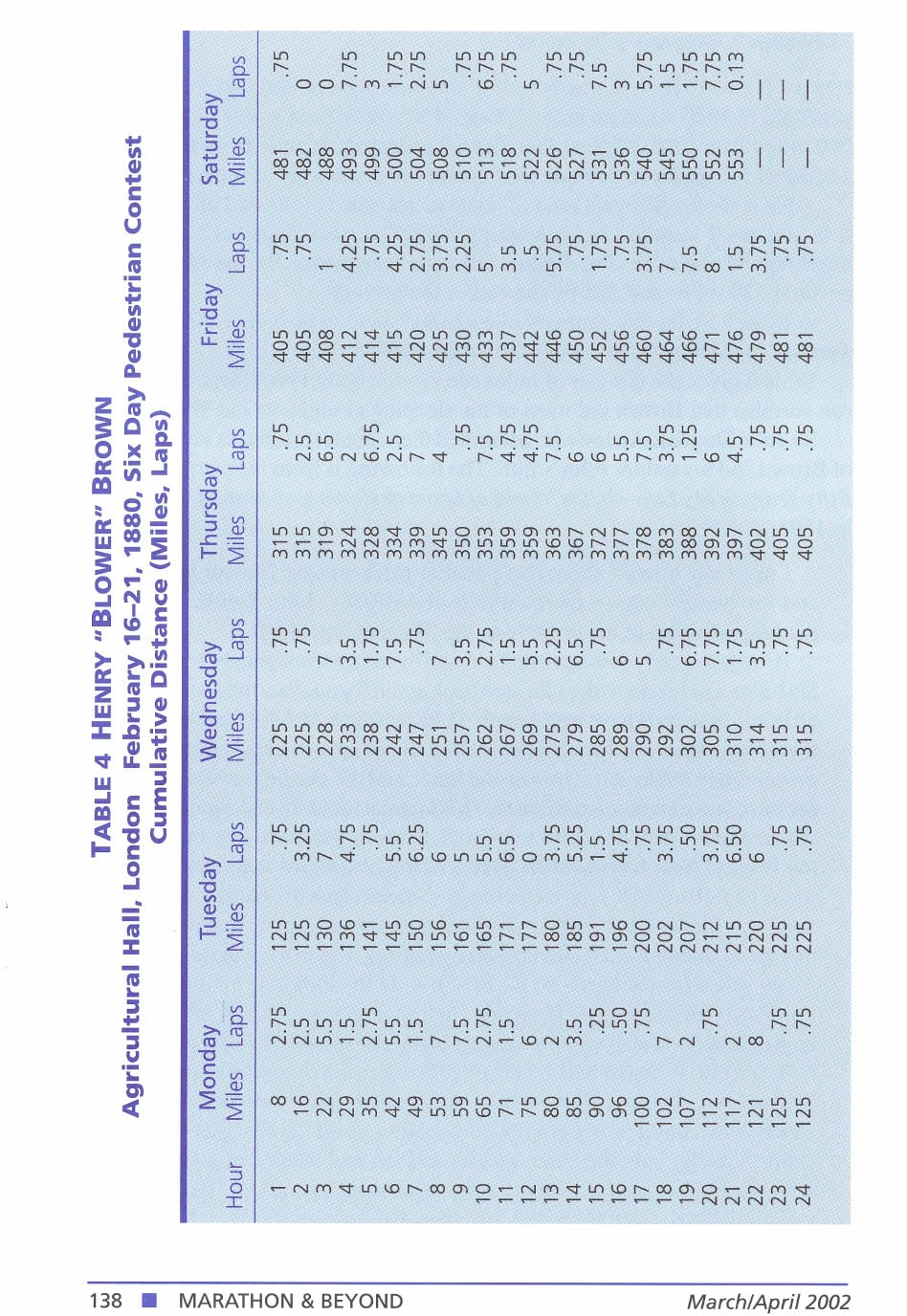
Table 4 shows Brown’s total mileage as recorded at the end of each hour. It is measured in miles and remaining laps. The track apparently measured eight laps to the mile. The figures are truly impressive. In the first day he covered 125 miles and 225 by the end of the second!
In Table 5 we have a summary of each day’s activities. Notice that Brown’s average speed was faster on the sixth than the fifth day.
Table 6 gives the number of miles run in each hour. From these figures we can surmise that Brown did most of his sleeping at night, as did Weston.
Sir John Dugdale Astley who promoted these contests left us a vivid picture of Brown and his trainer John Smith. The following is from his autobiography Fifty Years of My Life—In the World of Sport at Home and Abroad, published in 1894.
I must say a word about that peculiar brick-maker, Blower Brown, and his backer, one of the quaintest of old peds, John Smith, whose soubriquet when in his prime was the “Regent Street Pet.”
Brown had early distinguished himself by the rapid manner he trundled his barrow of bricks to the kiln, and back again for another load, and, like all brick-makers (I have ever heard of), he was wonderfully fond of beer; therefore, when old Jack Smith wished to get an extra spurt out of his protégé, he used to yell at him on the track, and the same exhortation and promise was enumerated whenever his instinct told him encouragement was needed: “Well done, Blower! go it, Blower! you have got ’em beat, my beauty! Yes! Blower shall have a barrel of beer all to himself if he wins; go it, Blower!” One day Blower showed signs of shutting up, and as he was more an animal than an angel, Smith and I agreed that it would be a good thing to wake him up a bit by putting him in a hot bath—quite a new sensation for him—so we took him to my lodgings hard by, and I ordered two chops to be got ready for him, and then put him into a hip bath of real hot water, which livened him up considerably, fairly making him sing out. When he had got him nicely dried, the chops appeared, and whilst I was helping Blower into his running-suit I was horrified to observe old Smith busily employed gobbling up all the best parts of the chops, leaving only the bone, gristle, and fat, and when I expostulated with him on his greediness and cruelty to his man, he replied: “Bless yer, Colonel! Blower has never had the chance of eating the inside, he likes
the outside,” and, sure enough, the brick-maker cleaned up the dish, with the rest that he won first prize, doing 542 miles, a grand performance, and, what is more, his appetite and thirst were in no way impaired.
Four years after setting the world’s record, “Blower” Brown was dead at the age of forty-one. The cause of his death was not reported.
Table 5 Henry “Blower” Brown
Agricultural Hall, London
February 16–21, 1880
Six Day Pedestrian Contest
| Monday | Tuesday | Wednesday | Thursday | Friday | Saturday | |
|---|---|---|---|---|---|---|
| Distance Covered | 125 Miles, 170 Yards | 100M | 90M | 90M | 76M | 72M |
| Time on Track | 20:02:42 | 18:39:26 | 18:07:23 | 18:05:20 | 17:21:43 | 14:57:09 |
| Time Resting | 2:57:18 | 5:20:34 | 5:52:37 | 5:54:40 | 6:38:17 | 6:22:51 |
| Number of Rests | 13 | 11 | 9 | 8 | 8 | 9 |
| Average Pace (mins/mile) | 9:37 | 11:12 | 12:05 | 12:04 | 13:43 | 12:28 |
| Average Speed MPH | 6.24 | 5.36 | 4.97 | 4.98 | 4.38 | 4.82 |
Total Time on Track = 4 days 11 hours 13 minutes 43 seconds.
Total Time Resting = 1 day 9 hours 6 minutes 17 seconds.
Table 6 Henry “Blower” Brown
Agricultural Hall, London
February 16–21, 1880
Six Day Pedestrian Contest
Miles Run Each Hour
| Hour | Monday | Tuesday | Wednesday | Thursday | Friday | Saturday |
|---|---|---|---|---|---|---|
| 1 | 8.34 | 0 | 0 | 0 | 0 | 0 |
| 2 | 7.97 | 0.3 | 0 | .22 | 0 | .91 |
| 3 | 6.38 | 5.47 | 3.78 | 4.5 | 3.03 | 6 |
| 4 | 6.5 | 5.72 | 4.56 | 4.44 | 4.41 | 5.97 |
| 5 | 6.16 | 4.5 | 4.78 | 4.59 | 1.56 | 5.41 |
| 6 | 7.34 | 4.59 | 4.72 | 5.47 | 1.44 | .84 |
| 7 | 6.5 | 5.09 | 4.16 | 5.56 | 4.81 | 4.13 |
| 8 | 4.69 | 5.97 | 4.78 | 5.63 | 5.13 | 4.28 |
| 9 | 6.06 | 4.88 | 5.56 | 4.59 | 4.81 | 1.47 |
| 10 | 5.40 | 4.06 | 4.91 | 3.84 | 3.34 | 3.75 |
| 11 | 5.84 | 6.13 | 4.84 | 5.66 | 3.81 | 4.25 |
| 12 | 4.56 | 5.19 | 2.5 | 0 | 4.63 | 4.53 |
| 13 | 4.5 | 3.47 | 5.59 | 4.34 | 4.66 | 3.47 |
| 14 | 5.19 | 5.19 | 4.53 | 3.81 | 3.38 | 1 |
| 15 | 4.56 | 5.53 | 5.28 | 5 | 2.06 | 4.84 |
| 16 | 6.06 | 5.41 | 4.66 | 4.94 | 3.94 | 4.44 |
| 17 | 4.03 | 3.5 | .88 | 1.25 | 4.31 | 4.34 |
| 18 | 2.79 | 2.38 | 1.47 | 4.53 | 4.47 | 4.47 |
| 19 | 4.38 | 4.59 | 10.75 | 4.69 | 2.06 | 5.03 |
| 20 | 4.84 | 5.40 | 3.13 | 4.59 | 4.44 | 2.75 |
| 21 | 5.16 | 3.34 | 4.25 | 4.81 | 3.81 | .13 |
| 22 | 4.125 | 4.94 | 2.22 | 4.53 | 4.28 | 0 |
| 23 | 3.72 | 4.34 | 2.26 | 3 | 1.63 | 0 |
| 24 | 0 | 0 | 0 | 0 | 0 | 0 |
Chapter 10 Race Organization
Ultramarathon races are not easy to organize and direct. Officials spend long hours counting laps, recording times, giving directions, passing out drinks and monitoring traffic. A fifty mile race usually lasts at least eight hours, and a hundred miler spans twenty hours. The officials can become as exhausted as the contestants, but they get no glory. It’s understandable that so few ultramarathons are scheduled.
In most cases, ultramarathoners themselves are aware of the great sacrifice that is made by directors of these races, and have been very appreciative of their efforts. In short races, it is common to see athletes badgering the race director with trite complaints. By contrast, ultramarathoners have endured numerous kinds of mismanagement of their races with stoicism. Having directed four such races in the past three years myself and having made many errors, I saw that in most cases the runners never complained, but were quick to thank me for at least trying.
Ultramarathoning has been the stepchild of track and road racing. Sponsors have been reluctant to support such races because so few runners have been willing to enter. Now it appears that this situation may change. Races that a few years ago drew ten runners are now run by more than one hundred. In this chapter I will outline my recommendations for successful organization of these events based on my own experience in both racing and directing them.
First I will review guidelines for organization that apply to both road and track races. I will then consider the particular needs of each type of ultramarathon.
General Considerations
A primary requirement for a successful ultramarathon is the availability of competent volunteers to assist in timing, handling and numerous other details. A low-key race can be run with two or three expert officials when the field is small, but a more formal race calls for considerable help.
Once the race director has made arrangements for the necessary assistance he must decide upon the following:
Road or Track?
Track races allow the director to have effective control over the event. Problems of traffic safety, handling stations, toilet facilities and course direction are all trivial on a track. However, on the track the number of runners must be small. There will be so much lapping that the front runners will be seriously hindered if more than thirty contestants are allowed to enter.
On the other hand, road courses allow for very large fields of runners. Lap counting problems are minimal, but traffic is a major concern. Are safe roads available? Can frequent aid stations be manned? Can you obtain official AAU certification that the distance run is accurate?
As a compromise, a road course run over a small loop of two to five miles is often best, because it combines the advantages of both road and track.
Length
If the race is to be run on the road, one of the standard distances—fifty miles, one hundred miles, or one hundred kilometers is best. The shorter the race, the larger the number of entrants will be.
In track races, it is best to organize the race by time rather than distance. Races lasting twelve or twenty-four hours are most common. Why time as opposed to distance? So that all the runners will finish simultaneously.
This allows every contestant to enjoy the approval of the spectators. It allows the spectators to know exactly when the race will end and to arrange their affairs so they can witness the finish. Also, an awards ceremony can be made immediately at the conclusion of the race, and all finishers will be there to enjoy it.
Physical Facilities
Are suitable dressing and showering facilities available? Adequate toilet facilities are a must in ultramarathons at the start and at frequent locations along the course.
Time Limit
In every race a time limit, after which all runners on the course are disqualified, should be set. This enables both runners and officials to know when the race will end, and should be clearly advertised on the entry form with the statement that it will be strictly enforced. A time limit permits the would-be entrant to consider his or her ability to meet your standard before entering.
Age Limitations
Ultramarathoning is a very demanding sport appropriate only for mature, experienced athletes. It is not for children. The young need the protection of those with experience. For this reason I strongly recommend that a minimum age be required for entry. Eighteen probably is a reasonable age, although it could be argued that this is still too young and that twenty-one is better. In any case, the sight of children running in these events harms not only the youngsters but the whole sport as well. In many instances their participation is anything but voluntary, and is due to pressure from an adult. Race directors who permit the entry of children are indirectly participating in child abuse.
Other Qualifications
Frequently race directors require that entrants in ultramarathons provide proof of their fitness to undertake the trial. For entry in a fifty-miler, completion of the marathon in 3:30 is sometimes required. For entry in a 100-miler, completion of a fifty-miler is often required.
Starting Time
Because of their great duration, ultramarathons frequently begin early in the morning. Many fifty-mile races start between 6 a.m. and 9 a.m. The avoidance of extremely warm weather should be a primary consideration in scheduling ultramarathons.
The starting time should also be arranged so that spectators can easily witness the finish. One twelve hour track race in which I competed started at midnight and terminated at noon. A large group of rooters was on hand to enjoy the finish and encourage the runners.
Late Starters
It is very crucial that every effort be made to start the race at exactly the advertised time. Many runners have elaborate pre-race preparations that are easily upset by a delayed start. The race director who starts his event promptly always earns the approval of the entrants.
At times, a runner or two will arrive late through no fault of his or her own. In this case the race director can either forbid them to start, or allow them to start late, with their time recorded as though they started when everyone else left the line. Thus a runner who starts one hour late and actually runs a fifty mile race in 6:10 will have it officially recorded as 7:10, for that is what the watch reads when the runner crosses the finish line. No special mention should be made of this self-imposed handicap. Likewise, his finishing position should not be moved up in any way to compensate for a late start. In addition, to be fair to all contestants, the race director should let all runners know that this particular entrant started late. In head-to-head competition, the runners in front have the right to know who is or is not catching them from the rear.
Timing
Digital watches are now inexpensive and usually more accurate than mechanical ones. At least three such watches should be available with fresh batteries that will last the entire race. In the longest races, I like to synchronize the watches used to time the race with official standard time. The exact time of day can be determined by a simple phone call. For example, the timer might phone one-half hour before the race starts and set his watch accordingly. In this way if the time pieces fail during the race, the exact time can be obtained again by making a simple phone call.
Aid Stations
The race director should make arrangements for numerous aid stations to provide both refreshment and the opportunity to quit and obtain a car ride to the finish. Runners prefer water, fruit juices, soda, and tea with sugar. In hot weather these stations should ideally be one-half mile apart, but certainly no further than two miles apart. In cold weather, they can be three miles apart.
Handlers
All contestants should be encouraged to provide their own handlers. Before the event starts, the race director should speak to the handlers and inform them of their limitations. In particular, they must not hinder traffic by driving alongside their runner continuously. Rather, handlers should drive ahead and park off the road to wait until their runner arrives.
Disqualifying Runners in Distress
On the entry form, and also before the race starts, runners should be told that they will be required to leave the course if they appear to be in severe distress. Runners who ignore an official’s instructions in such cases are automatically disqualified. At times, such runners are semiconscious and must be carried from the road for their own good.
Also, race entrants should be told unmistakably that they are a detriment to the sport if they do not at least appear to be moving well. A runner who begins to stagger down the road is not “heroic,” but is occupying the attention of officials who are concerned for his or her health.
Entry Forms
Entry forms should contain all the important items mentioned above such as time limit, age limit, qualifying requirements, as well as the date, starting time and place, distance and course description, and entry fee if any.
Entry Fee
It is best to obtain a sponsor who can provide all necessary funds for the conduct of the race. Often, such a sponsor is not available and part or all of the director’s expenses must be paid through entry fees.
Pre-Race Information Sheet
The director should send each official entrant detailed instructions to enable runners to provide for personal care. Maps of the course, guidelines for the conduct of handlers, and other relevant details should be explained. In short, all that the runner can expect from the race officials and all that is expected of the runner should be clarified.
Finish Line
As soon after crossing the finish line as possible, each runner should be informed of his position and time. If he has earned a prize, it is best to award it at that time also.
Mailing Race Results
Besides sending the complete results of the race to newspapers and the running press, this information should be sent as soon as possible to each contestant. For most runners this prompt service is valued far more than trophies and medals.
Special Concerns of Road Races
There are several types of road race courses which the race director can consider:
Point-to-Point
Races which start in one city and proceed directly to another city that is fifty or 100 miles away are best if you want to attract the interest of the general
public. The prospect of runners covering on foot a distance that requires hours to travel by car can spark enthusiasm among both contestants and spectators. Unfortunately, these races are the most difficult to direct. Each aid station is used only once by the runners, whereas on a course consisting of ten loops each would be used ten times. Many support vehicles are required to monitor the point-to-point race, and accurate course measurement is very time consuming. In brief, it can be very difficult to find fifty miles of road sufficiently safe for racing.
The two most famous point-to-point ultramarathons are the London to Brighton race and the Comrades Marathon in South Africa. No race director should undertake to organize such a race unless he or she has sufficient manpower and funds to do the job properly.
One Large Loop
A course run over one large loop has all the disadvantages of a point-to-point race except one. Since the start and finish are identical, the dressing facility can be used both before and after the race. However, races run over a large circle do not enjoy one big advantage of point-to-point races, for the general public does not find the idea as captivating.
Out-and-Back Course
Here the runners go straight out for half the distance, make a U-turn, and return over the same route. The out-and-back course is easier to monitor than the single large loop; each aid station is used twice. The course can also be measured with half the effort required for a point-to-point run or a run over one loop.
Repeated Loops
Courses that consist of one small loop that is repeated many times are the easiest to direct and therefore the most commonly used. I prefer running in such a race, for I know that I will not need to rely on others to help me if I get in difficulty. Loops measuring two to five miles are very common. These allow each aid station to be used numerous times. If a runner must retire, he has little difficulty returning to the dressing room. With courses this small, very pleasant parks which permit the runner to compete in a traffic-free environment are frequently used. When timing a race of this type, the officials should take care to record every lap time for every runner. In this way, disputes concerning how many laps a runner actually has completed can usually be resolved easily.
For most races the director should select a course of the small loop type to insure that difficulties are kept to a minimum.
Road Safety
Perhaps the director’s greatest concern is the safety of the competitors. Any race which takes place on the open road has the potential for a tragic automobile accident. Every effort should be made to select a course on which there is no vehicular traffic. For example, Central Park in New York City is closed to vehicular traffic on the week-ends and racing becomes very appropriate there. If traffic cannot be eliminated entirely, a director can ask to have the police block an entire lane of traffic so that runners will have a clear path to themselves. If the authorities will not allow blocking a lane, then the course should be abandoned unless there is very little traffic expected. Many country roads are largely traffic-free and are suitable.
Intersections and railroad crossings are important; dangerous intersections should have authorized traffic directors to allow runners the right of way. No course should cross a railroad track before the director has checked the train schedule.
Road Surface
If the runner must share the road with traffic, then a wide shoulder with a suitable surface for racing should be available. If the road’s shoulder is poor, competitors will be jumping back and forth off the main road onto the shoulder as cars approach. The director should ride over the course being considered with an experienced runner to ascertain how suitable the surface is for racing. The crown of the road should also be checked. Runners do not enjoy traveling fifty or more miles with one foot landing slightly higher than the other. If the road surface is not free of a severe crown, then another route should be selected.
Run Facing Traffic
When the runner must share the road with motor vehicles, he must always face oncoming traffic. In this way he will be able to “jump for his life” should it be necessary.
Course Length Certification
The National AAU and RRCA jointly sponsor a Committee on Course Certification. This committee publishes methods of accurately measuring courses and provides assistance (through the mail) to race directors who cooperate in following these methods. The calibrated bicycle technique is probably the easiest and most accurate way to map out a course, but the calibrated surveyor’s wheel is also recommended. Once the race director has measured his course twice, he files a detailed report of his technique with the Chairman of the AAU-RRCA Committee on Standards. This committee carefully reviews the measuring technique and awards certification to those courses which meet its standards of accuracy. The director can then include on his entry form the statement “AAU Certified Course.” The Standards Committee is very careful in awarding certification. If they have any doubts concerning the accuracy of the measuring technique, the director will be required to remeasure the course. In this way runners have learned to have confidence in courses designated as certified.
No runner wants to complete fifty miles only to wonder whether it was in fact forty-eight or fifty-one. Every effort to obtain AAU Certification of the course length should be made by the director.
Course Directions
All too frequently, courses are complicated and a runner will unknowingly go off the required route. The race director should provide the competitors with maps and the opportunity to see the course before it is run. The route should be clearly marked with arrows painted on the road surface and monitors at each turn to show the runners the proper path.
Special Concerns of Track Races
Another major function of the track race director is the task of counting laps. We will discuss this matter in detail shortly.
Lap Counting for Records
In serious track races in which athletes are attempting to establish records, every effort must be made to insure that lap counting is performed accurately. A track record will not be accepted as “certified” unless each lap time is recorded. This is a very tedious task, but it is the only way to insure that the correct distance was run. If a counter neglects to record a particular lap time, then the runner must lose that lap from his total count. In addition, those who record laps cannot be affiliated in any special way with the runner, in order to avoid any possible suspicion of conspiracy to miscount the laps. When the counters are assigned to individual runners, the assignments should be made at random.
Perhaps electronic lap counting devices will be available soon that will not only detect that a runner has crossed the finish line, but will record that runner’s name and time. Until that time, teams of human volunteers will be necessary.
Note that at least two men should be working in shifts counting laps for a particular runner. When one counter is recording, the other can be resting. When they are fatigued, counters like runners, become more error-prone.
Lap Counting in Low Key Races
While it will not always be possible to secure volunteers to record the times of every lap, this should not discourage promoters from arranging “low key” track races in which a less formal method of lap counting is employed. In this way runners will gain valuable experience in running such races. When no assistance is available for lap counting, runners could count their own laps by carrying a small hand-held counter. They simply click the counter at the conclusion of each lap. At the end of each half-hour period the runners can inform the director of their lap count, and he can record this information. Each runner’s total distance covered can then be posted on a large bulletin board or blackboard for the spectators.
While lap counting by this method remains unsuitable for certified records, the accuracy of the distance covered should be reasonably correct and the performance listed as “uncertified.”
In such cases, a respected AAU or RRCA official should be present to oversee the contest and attest that every effort was made to insure that the counting was accurate under the severe limitations in manpower.
Reversing Direction
When running a very long distance over a track, the fact that the runner is always turning in the same direction can place strain on the ankle and other areas of the runner’s legs. It is simple enough to avoid this difficulty by requiring the runners to reverse direction simultaneously at the end of each half-hour interval. The following procedure can be used to avoid difficulties:
At the conclusion of each half-hour period the race director signals the contestants by blowing a whistle or similar alarm. The runners then proceed to the starting line and reverse the direction in which they had been circling the track. To avoid running into each other, the runner who has not yet reversed assumes the “right of way” and remains on the inside lane. Runners who have just reversed run a bit “wide” until all contestants have reversed.
In the great pedestrian races of the past century, reversing was assumed to be natural, and was always allowed. We have largely forgotten this important technique today, and its use should be encouraged. Reversing is probably not necessary in track races of fifty miles or less; in races of twelve hours or longer reversing is recommended.
Passing Runners
In general, runners should be required to stay on the inside lane whether walking or running; the runner who wishes to pass must move to the outside. In short track races, runners who are being lapped are usually asked to allow
the faster athletes overtaking them to pass on the inside. There is so much lapping in ultramarathon races that this courtesy becomes entirely unreasonable. The runners should simply stay on the inside.
When two runners are moving at the same speed and conversing, they habitually run side by side. This practice should be discouraged in track races for it makes the job of overtaking them even more difficult for faster runners. The director should instruct the contestants to run “single file.”
Editor’s note: This concludes the five-part serialization of Tom Osler’s half of the 1979 book Ultra-Marathoning: The Next Challenge. Tom’s contribution, titled “The Art of the Ultramarathoner,” is a practical approach to taking up and practicing ultrarunning. It complements the other half of the book, Ed Dodd’s “The Great Six-Day Races,” a history of the 19th-century six-day-long “go as you please” races, primarily staged in England and the United Sstates. Ed Dodd’s book was serialized in the first 10 issues of Marathon & Beyond.
In our next issue, we will begin the serialization of Just Call Me Jock by Boston Marathon legend Jock Semple, written with John J. Kelley and Tom Murphy. It was originally published in 1981.
This article originally appeared in Marathon & Beyond, Vol. 6, No. 2 (2002).
← Browse the full M&B ArchiveMore like this
1,000+ stories from 19 years of Marathon & Beyond
The complete archive of the legendary long-distance journal — digitized and free to read.
