

The Last Run
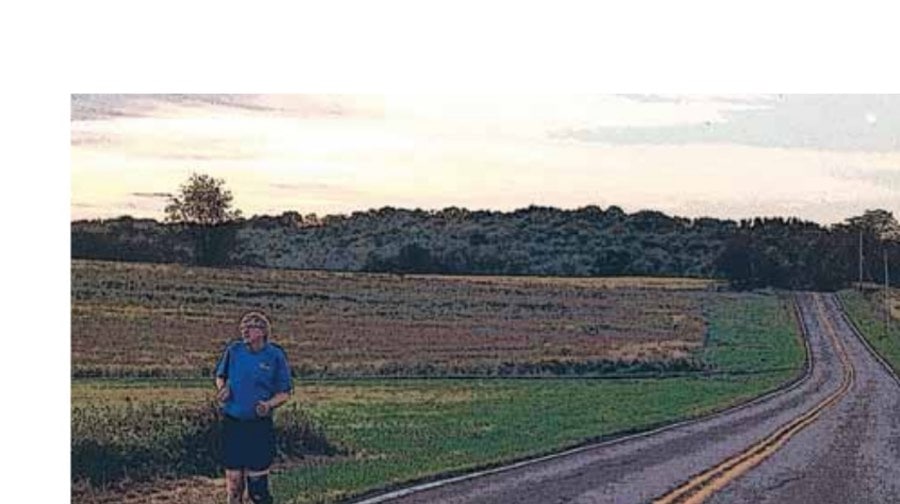
Photo courtesy of Dave Simpson
BY DAVID M. SIMPSON
Thirty days, 30 runs, and then the last run. The last run should look something like this: stepping into the predawn night still alive with the sound of crickets under a sky patterned with stars and a sliver of moon, the air September cool with the promise of fall and a black ribbon of road beckoning, the body moves into a gentle warm-up jog. The pace quickens, the suburban neighborhood is quickly left behind, and the road now descends through a canopy of maple and oak accompanied by the skittering sound of a raccoon seeking cover and, farther on, a crash in the underbrush signals a startled deer.
The first and steepest hill, three-quarters of a mile up the local Boy Scout camp, brings the smell of smoke as someone’s camping breakfast begins. Cresting the hill, night pales to gray, the stars fade, and a gentle glow on the eastern horizon reveals rolling meadows and distant forests.
Four miles out and turning onto the backstretch of a road initially lined with soldierly rows of head-high corn on the right and a wall of pines on the left. Farther on, the rising sun has streaked the sky, the hills, and farmhouse rooftops with coral-tinted gold. The undulating road ahead sinks into a mist-covered valley only to rise out of the veil past a tomato-red barn on the far side. The cricket song has given way to the wake-up calls of birds. Making the turn toward home, the sun is full up, face on, and warming. Coming into the final mile, checking pace, timing, and breathing at the seven-mile marker, it looks just possible to trim maybe a minute off the total time.
It was at this point in my long run several months ago that I saw a woman approaching her mailbox on my left. We exchanged customary good mornings, and then she said, “Lovely morning for a walk, isn’t it?” I knew, of course, that my pace was 15 minutes per mile, but only then was I forced to acknowledge that the world saw me as a walker, not a runner. While I have considered myself not only a runner but a marathon runner for 21 years, now I have to accept the fact that I am no longer a runner by any stretch of anyone’s imagination.
There will someday be a last run Could you imagine that your next run could be your last? One of our “runs” someday will become our last. It may be that we will never be able to run that fast again. Our pace ineluctably slows from a seven-minute mile to a nine-minute mile to 11, or 13, or even to a walking pace, but somewhere along the way we will be forced to reckon with the proper descriptor of what exactly we are doing. And it will not be the difference between jogging and running. In most cases, it will be a matter of tapering off due to the inexorable forces of aging or illness. While there are obviously those who do continue through advanced age to move at a pace universally regarded as running, most runners necessarily do indeed fade away unless brought to an abrupt end by an accident or operation.
In my case, the problem is the left knee: osteoarthritis. X-rays show all too plainly bone on bone: there is absolutely no cushioning left, a condition undoubtedly engendered by having broken that leg skiing 40 years ago and having been placed in a long-legged cast for six months. At least they did not bleed you in those days. My options now are to continue as is through the pain or have a total knee replacement. The first orthopedic diagnosis several months ago was, “I can give you a new knee, but you’ll never run again.” It’s not what I wanted to hear: not after 22 years of never missing a day of putting on the running shoes and hitting the road, not after 25 marathons, not after all that the marathon has given me.
Running started 30 years ago when my wife, Judy, announced that she had had it with jogging in place, which was the final exercise in the Royal Canadian Air Force Exercise Program we had recently been following. At the time, we lived
Photo courtesy of Dave Simpson
in a small housing development on the side of a mountain in the Hudson Valley near West Point. “Why run in place in a basement when it is perfectly gorgeous outdoors?” Judy questioned at the end of one of our sessions. And out she went. She returned a half hour later with the challenge: “You have to try this, and you are going to love it.” She outlined the one-mile loop she had just completed. I accepted the challenge, went outside, and returned home tongue dragging, chest heaving, and spirit soaring. In the next year, the two of us graduated from that one-mile beginning to the 1980 New York City Marathon. At that point in our lives, we had been married for 12 years and had been trying to have a child for four. Due to our mutual medical problems, doctors had advised us that we would never be able to conceive our own child. Thirty days after the NYC Marathon, the doctors pronounced Judy pregnant. As far as we are concerned, our daughter, now 30 and herself a runner, is living proof of the joy of marathoning.
I will not dare to call myself a true streaker as my knee has forced me to limp some days, and not very far at that, but I have not missed a day trying since Memorial Day 1989. In the intervening years, I completed 25 full marathons and was bedridden, feverishly sick, only once, and even that one day, much to Judy’s consternation, I did get out of bed, pull on my running clothes and shoes, and lumber outside for a shuffle around the city block on which we then lived.
An unexpected side trip Several weeks ago, Judy and I were planning for her 50th high school reunion in Boston, but at 2:00 a.m. on the morning of our flight, I was awakened with
severe pain and swelling in that left knee. It looked like I had two knees on that leg. Rather than the airport, we spent the morning in the emergency room of a hospital. The swelling subsided with ice packs, stretching, and walking. And yes, by the end of the day, with the aid of a cane, I was able to lace on the shoes and go out for a continuation of some kind, but continuing to “run” on the knee through the pain did not seem reasonable.
At that point, it seemed clear that the real choice was between just being able to walk or, in the end, not walking at all. So in 30 days I will miss my first day of “running” when I go in for the knee replacement, but here is what I have learned from the marathon. The marathon has taught me to think about the long view, set a goal, and plan how to reach that goal. The long view for me is to be able at the very least to walk unassisted. My specific goal now is to work my way back to being able to cover those familiar eight country miles at any pace possible, moving on my own power. I just want to be able to step into that cloak of night, see the stars above me, and walk, if not run, the sun up.
At the 1991 Columbus Marathon, the race director cheered the assembled throng of runners with, “The training is over. Let the marathon begin.” My marathon days are over, but let the training begin anew.

This article originally appeared in Marathon & Beyond, Vol. 17, No. 1 (2013).
← Browse the full M&B ArchiveMore like this
1,000+ stories from 19 years of Marathon & Beyond
The complete archive of the legendary long-distance journal — digitized and free to read.
