

To the Peak
JUST AS Mother Nature is the dominant force in the natural world, the Peak Busters has been a major force behind women moving not only forward in the running world but also upward to the peak of marathon competition in a tough long-distance course: Pikes Peak. For the past quarter century, Peak Busters has encouraged women to take the challenge of running to the peak of central Colorado’s Pikes Peak (14,110 feet) and back down again.
Ironically, the groundbreaking women’s group has a man to blame for its existence. He was a very unlikely, very much politically incorrect man, but Peak Busters glories in its long-running association with one of running’s most famous iconoclasts, Walter Stack.
The group has been taking on the challenge for 25 years and continues to do so. In August 2001, 107 members of Peak Busters met in Manitou Springs, Colorado, to participate in what had gradually become a weekend of celebration that went above and beyond Pikes Peak itself. The whole weekend served as a celebration of just how far, and how high, women’s running had come. Forty-one of the Peak Busters were first-time Pikes Peak aspirants, brought to the group by friends or relatives (mothers, aunts, grandmothers) who are Peak Busters themselves or by the lure of the promotional material that Peak Busters sends to each female Pikes Peak entrant. They come from all over the country to experience the support, camaraderie, and success of women who have used running, and especially the challenge of the Pikes Peak Ascent or the “round trip” marathon, to overcome smoking addictions, the deadly dull routine of small-town flatland life, and medical, health, and weight problems. They also come to compete with themselves for a personal record at Pikes Peak and to compete with the field in general. Regardless of individual motives, Peak Busters, true to its founding mission, provides unity, identity, and unconditional support along with an unspoken expectation for success.
THE UNLIKELY ORIGINS OF THE PEAK BUSTERS
As with the secret identities of any comic book superhero, whether it’s Batman or Wonder Woman, who throws off street clothes to become an overachiever, the origin of the Peak Busters comes from unlikely origins.
One of the intriguing aspects of this all-woman band of superheroines is that the group was founded by (egad!) a man.
Of course, the founding of such a long-running and energetic women’s group wasn’t left to just any man. Mere mortals need not apply. The man who founded this group was the legendary Walter Stack of San Francisco.
Stack, a gnarly, barechested, tattooed hod carrier with a sailor’s vocabulary was about as politically incorrect as any man could be in the second half of the 20th century. He was also a man who felt running should be all-inclusive, that it should include every nationality, every age, and certainly both sexes. [See Walt Stack profile in this issue beginning on page 53.]
As president of the Dolphin South End Runners from 1966 to 1986 (Walt was born in 1907 and died in 1995), Walt cajoled, coached, encouraged, nudged, and lured 10 San Francisco Bay Area women into running the 1975 Pikes Peak Marathon. Walt, who used to go up to complete strangers on the street and encourage them to jog along with him on a Sunday morning DSE “race,” persuaded these sea-level pioneer trail runners to run up the side of a mountain that was 1,500 miles away from Baghdad by the Bay. Walt’s passion for running was legendary, as was his ability to persuade anybody to do just about anything, no matter how far-fetched it seemed at the time.
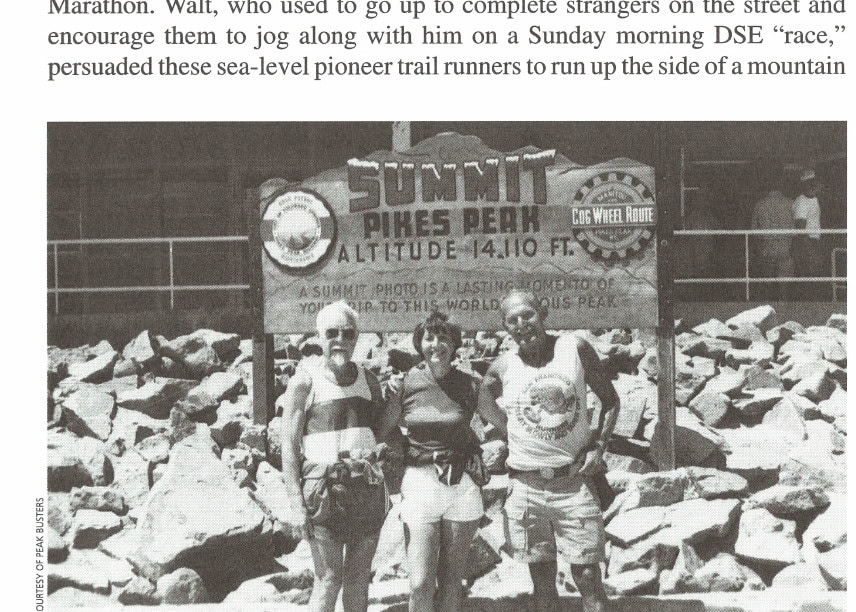
Walt’s approach to running was “mellow.” It was he who originated the DSE motto of “Start slowly and taper off.” He once said, “I’ve been running 8:30 miles so long that if I fell out of an airplane I’d drop at an 8:30 pace.”
The Pikes Peak Marathon and Walt’s women were a perfect match. Pikes Peak was the first marathon to allow female entrants, which it has since its second running in 1957.
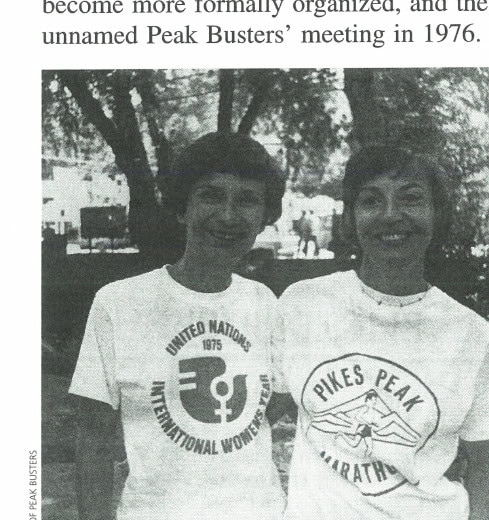
Walt’s “everybody’s welcome” attitude ensured a good showing for his women in 1975. His encouragement to just take it easy and you’ll make it was augmented by the fact that he had arranged for some rewards for his charges, who ranged all the way up to 83-year-old Brenda Ueland. His first group of 10 Peak Busters received Dolphin South End trophies, United Nations International Women’s Year T-shirts, the first edition of the Peak Busters’ T-shirts (picturing a male runner), and a feminist button. Walt also made it plain that he was authorized by the power vested in him to perform marriages at the top of Pikes Peak, a service he performed several times.
Inspired and motivated, as well as rewarded, by Walt’s initial expedition to Pikes Peak, Annabel Marsh and Kay Atkinson decided that the women should become more formally organized, and they decided to host the first as-yet-unnamed Peak Busters’ meeting in 1976. From the start, the Peak Busters’ meeting was held before the race itself, and in a unique approach to running, trophies and T-shirts were presented to the first-timers (13 of them in 1976) before the race.
SPACE FOR ANNUAL MEETINGS
The meeting venues have varied from Manitou Springs City Hall to the longest-lasting location, the Manitou Springs Community Congregational Church Fellowship Hall, to a big outdoor race expo tent in Memorial Park at the race-start location.
Members of Peak Busters are accepted by each other unconditionally. All are welcome. Women who, because of health and fitness conditions, have to walk, hike, or jog up the mountain and who are not successful on their first attempts are treated with the same acceptance and expectations for future success as are champion, experienced, multiple finishers of the Pikes Peak challenge. There are also no age limits. The spread goes from teenage girls to great grandmothers. The “Golden Girl” category (60 years and older) accounts for 25 percent of the group’s membership.
Bess James was one of those Golden Girls. Bess set a 75-79 age-group record in 1988 before the six-hour cutoff was established in 1993 by completing the ascent in 8:10. Her record still stands.
Then there’s 78-year-old Po Adams, from California, who began running in 1979 when she was 55. She claims that she began her running career out of vanity. She wanted the perfect figure. She waited until 1995 when she was 71 to run her first Pikes Peak Marathon and found it more relaxing than merely doing the ascent. Since then she has graduated to ultradistance races. At the 2001 Peak Busters’ dinner, Po told the group that she is proud to be a woman
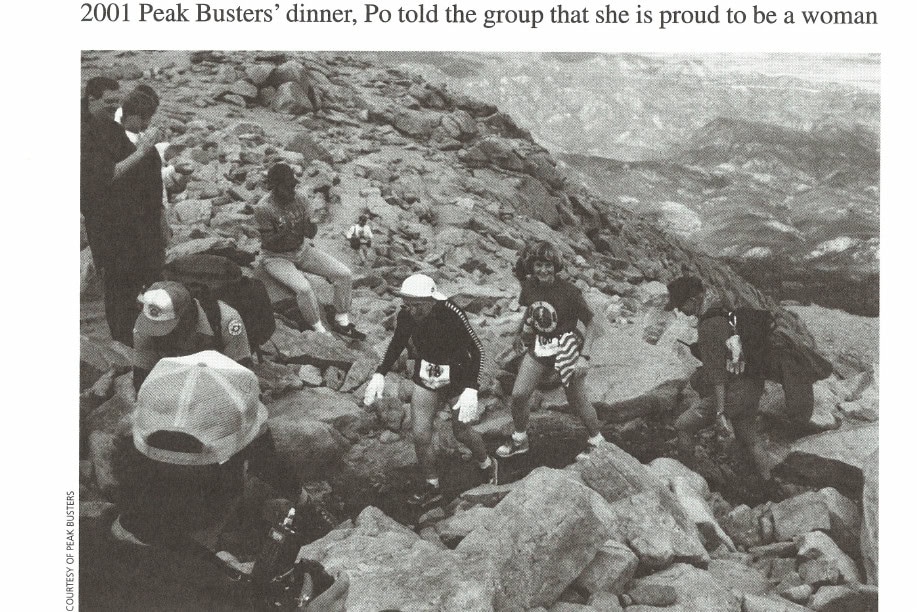
and that her involvement with the group has built her confidence that “you can do almost anything in your life.”
Another sizeable segment of the Peak Busters is the first-timers.
First-timer Lisa Dorn, from the lowlands of Minnesota, came to Pikes Peak through the ultrarunning and trail-running achievements of her father and her Peak Busters’ stepmother. After recovering from a prerace training climb up another of Colorado’s 14ers (peaks above 14,000 feet) that left her suffering from altitude sickness, she was excited to receive her first-timer award and the expectation of success that goes along with it. She lived up to the Peak Busters’ expectation and thrilled herself with her accomplishment by completing her first Pikes Peak Ascent in 5:47.
Race champions and age-group record holders also fill the ranks of Peak Busters, providing inspiration and role models.
Visiting VIPs make it a point to recognize and support the mission of the Peak Busters. Perhaps to assure himself of good weather by getting some good vibes transmitted to Mother Nature from the Peak Busters’ contingent, former race director Dave Zehrer made annual visits to the Peak Busters’ awards dinner. Matt Carpenter, multiple champion and course record holder for both the ascent and the full marathon, occasionally makes visits to the Peak Busters’ dinner so that he can provide tips that might help them succeed on the mountain he knows so intimately.
SISTER MARION SPEAKS; RUNNERS LISTEN
At the Peak Busters’ 2000 dinner, legendary Sister Marion Irvine, a Peak Buster since the 1980s and the oldest woman ever to qualify for the U.S. Olympic Marathon Trials, was the main speaker and gave this bit of advice on how to get up the mountain. “Take the foot that is behind and move it to the front. Repeat this as many times as necessary until you get to the top.” (Sounds like she studied at the feet of Walt Stack.) When runners make use of Sister Marion’s advice and make it to the summit, more often than not she’s waiting there to welcome them into a very special sorority with a sweaty, heartfelt hug.
Margie Loyd-Allison, who lives and trains in Colorado Springs and hence has something of a home-course advantage, has won the Pikes Peak Marathon twice, in 1983 and 1986. Her winning times are impressive but not her fastest. She surpassed her 4:39 (1983) and 4:54 (1986) winning times by running 4:36 in 1982 when she placed second, 11 minutes behind the winner. She started running in 1980 and by 1984 was good enough to qualify for the first U.S. Women’s Olympic Marathon Trials. Margie ended her 15-year marathon career when she ran her 15th Pikes Peak Marathon, which was also her 50th marathon overall.
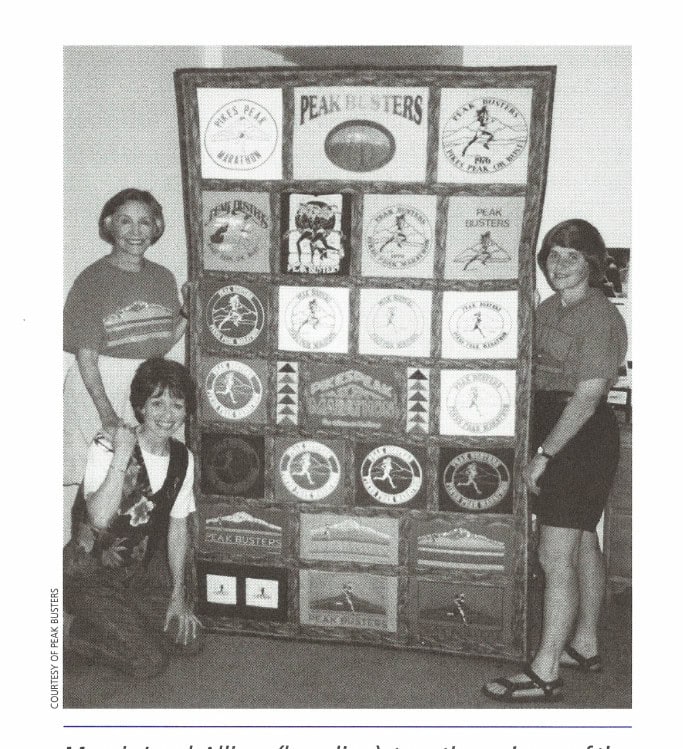
Margie’s most memorable Pikes Peak race is what she referred to as the August “blizzard of 1981,” when Mother Nature once again showed her pique. These days Margie supports the Peak Busters by displaying the quilt she created from her collection of Peak Busters T-shirts. For the first 1975 Peak Busters’ T-shirt, mentor Walt Stack pulled one of his usual politically incorrect moves and pictured a male runner silhouetted against a mountain background. Annabel Marsh and Kay Atkinson, the ladies who got the organization onto its feet, corrected that slight indiscretion by displaying a female runner against a mountain backdrop for 1976. They ordered a mere 35 T-shirts in 1976, wildly underestimating the popularity of the first “novelty” running T-shirt with a female runner on it.
Margie also works the sign-in table at the annual dinner and offered racing advice for attendees in 2001. Her advice includes the admonition to go “minimalist” by wearing very light running clothes and using only three miniature safety pins to attach bib numbers. She also observed that the only reason women tend to pack so much gear (such as jackets tied around themselves, fanny packs, and “stuff hanging from everywhere”) is that their donkey dies under the weight of carrying all that gear to the start line.
NO LIMITS, NO BOUNDARIES
For a running group that is focused solely on the achievement of running the Pikes Peak Ascent and Marathon, the Peak Busters’ membership is a group with very diverse running accomplishments.
At the 2001 banquet, it was discovered that members have run at the Everest base camp, they’ve run marathons in each of the 50 states, and they’ve even run a marathon around the steel deck of a boat anchored off Antarctica.
The greatest encouragement for the group comes from the senior members and from those who have overcome tremendous difficulties.
Some members find inspiration in the achievement of President Emerita Annabel Marsh, who in 1984 ran 3,261 miles in crossing the United States. The journey took four months and ate up 30 miles of American countryside per day. Annabel was accompanied by Caroline Merrill, current Peak Busters president. Their effort was documented by the Guinness Book of World Records as the first transcontinental run by women.
Peggy Plonka, of New Castle, Pennsylvania, had been running since 1979 when in 1993 she decided to act upon the Pikes Peak tales she had been hearing from two male runners in her local running club and entered the race. She immediately joined Peak Busters as much for the unique all-women’s aspect as the fact that it was dedicated to one single objective: to race on Pikes Peak. She continued to return to run the Pikes Peak Ascent each year and in 1995 PR’d with a 5:37.
But Peggy’s joy was diminished in 1996 when she was diagnosed with multiple sclerosis. She went back to Pikes Peak to wait at the summit to cheer on her fellow Peak Busters, but that wasn’t enough for her. Multiple sclerosis or not, she was determined to again accept the mountain’s challenge, and in 1999 she was back. She reached the top of the mountain and declared that “it was a gift from God.”
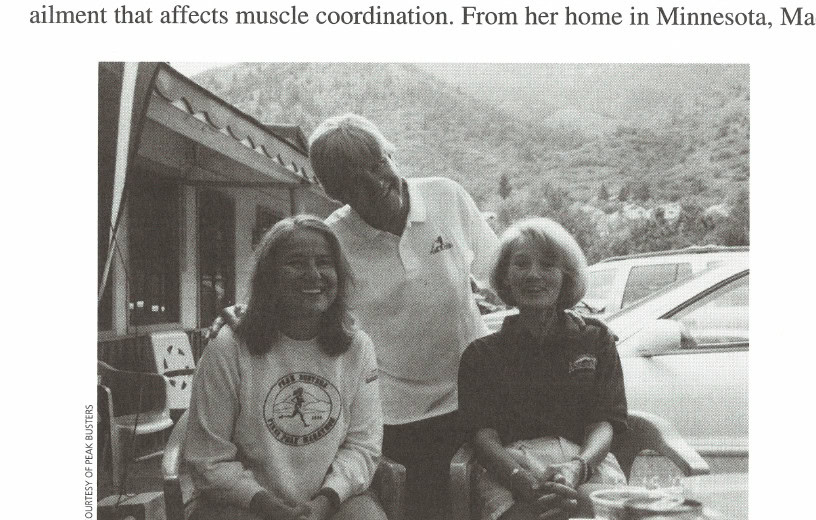
It is a fact of life that we all age, and as we age our performances deteriorate. In recognition of that fact, each year at the banquet there is a “sick call” to recognize Peak Busters who can no longer make the trek up the mountain. At the 2001 banquet, Mae Horns was recognized; the 67-year-old mother of U.S. Olympic Marathon Trials winner and ultrarunning legend Janice Klecker, Mae now suffered from Lou Gehrig’s disease, a progressive neurodegenerative ailment that affects muscle coordination. From her home in Minnesota, Mae
speaks of the memories that she has of her “Peak Buster sisters, of the courage it took to climb the mountain, of the beauty all around while running, and the determination to do the final steps to the finish line. I still have two legs and although I can’t run anymore, I’m still a runner at heart,” she says. “Once a Peak Buster, always a Peak Buster.”
NOT FOR WOMEN ONLY
In spite of their pioneer status as a “feminist” vanguard of women runners, the Peak Busters have a special place in their hearts, and in their programs, for men. After all, it was legendary manly man Walt Stack who first brought the female Pikes Peak aspirants together and who entertained them on their long bus trek to Manitou Springs, Colorado. Walt was named an honorary Peak Buster and wore his title proudly until his death at 87 in 1995.
Although Walt basked in being the only male member of the Peak Busters, his status was shaken in 1980 when he was joined by Ivor Welch of Pacifica, California, a dapper elderly gentleman whose carefully trimmed goatee made him look much like Colonel Sanders of finger-lickin’ chicken fame. Ivor set a Pikes Peak age-group record at age 85 that still stands. Ivor decided not to die until age 99, and the Peak Busters feel he set a high standard for them to emulate.
But the Peak Busters do not limit their association with men only to those who run. In the early 1980s an auxiliary to Peak Busters (called Peak Cocks) was established to provide a social group for male runners and nonrunners whose significant others were Peak Busters. Concurrent with the Peak Busters’ annual Thursday evening banquet, Bill Harvey, of Fort Myers, Florida, convenes the Peak Cocks’ dinner at Mike Milar’s Keg establishment in Manitou Springs. Peak Busters join the male festivities when their own dinner is over.
ENDURANCE FOR MORE THAN MERE RUNNING
Peak Busters’ officers and past presidents are as committed to their group as they are to their sport. Perhaps it is the energy, youthfulness, vitality, and graceful expectations that the Peak Busters exude, but members sign on for the long haul.
President Emerita Annabel Marsh, at age 79, has guided the Peak Busters since its inception and continues to provide historical perspective. Annabel’s founding partner, Kay Atkinson, supported and inspired the Peak Busters until her death in 1984. The newsletter editor, Cheryl Willis, has been performing her duties for 16 years.
Longevity seems to come with a Peak Buster membership. Now at retirement age, Caroline Merrill has been president since 1986. She toyed with the idea of using her presidential clout to establish a Fountain of Youth of sorts. In 2001, as her 60th birthday loomed, she contemplated increasing the age for admission in the elite Golden Girls division from 60 to 70 just so she could put off that honor for another decade. She thought better of it, and proudly joined the Golden Girls.
In looking back on the group’s history, Annabel Marsh puts it simply. “When we began Peak Busters we didn’t know that it was going to grow to be so successful and include such a broad spectrum of women.”
Perhaps it’s the honorary male Peak Busters who have set a precedent for longevity in life and in running. To celebrate their birthdays in 1987, Walt Stack (who was 80) and Ivor Welsh (at 92) participated in runs in support of the Peak Busters.
Ivor’s death at 99 set a high bar for Peak Busters to aspire to. Certainly, the group welcomes such challenges. And with Mother Nature as the unofficial metaphor for Peak Busters, the ladies will be an ongoing inspiration for each other for a long time to come.
This article originally appeared in Marathon & Beyond, Vol. 6, No. 5 (2002).
← Browse the full M&B ArchiveMore like this
1,000+ stories from 19 years of Marathon & Beyond
The complete archive of the legendary long-distance journal — digitized and free to read.
