

A Record Blown Away in the Windy City
SIX HOURS. That was my goal for The LaSalle Bank Chicago Marathon on Sunday, October 7, 2001. As a below-knee amputee whose recent street marathons have averaged roughly 6:30, speeding up a half hour or more posed a significant but attainable challenge. I had two reasons to finish by 1:30 P.M. I wanted to meet the official cutoff for clock times and medals, and new airport delays could make it difficult to catch my 4:55 P.M. return flight to Miami (which I had scheduled months before).
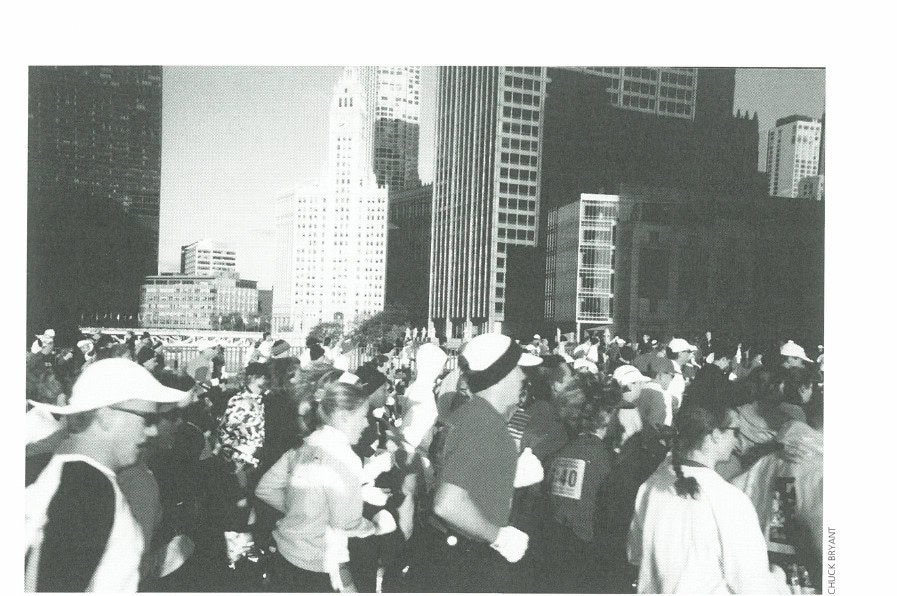
I was up at 4:30 A.M., gone from my Evanston hotel by 5:00, and parking the car at the Rosemont train station by 5:30. I caught a train for downtown at 5:45 and arrived by 6:30. After checking my gear bag and finding an overlooked group of portapotties, by 6:45 I was ready to stroll around, warm up, and take it all in.
In its preceding 23 years, Chicago’s fall marathon has faced a manic-depressive range of weather, from 12-degree wind to sweltering 80s, snow to sleet to rain, and whatever else comes, it’s the Windy City. Saturday night’s predictions of morning freeze and frost got my attention; I was glad to find that they applied farther inland. At the 6:55 A.M. sunrise in Grant Park beside Lake Michigan, the temperature hung in the high 30s. Ideal.
Executive race director Carey Pinkowski had brought together a great staff to make sure that this major event was meticulously organized, to the point of details such as announcing, “Five minutes (and three, two, one) to a moment of silence in memory of the events of September 11.” “Profound” hardly begins to describe that quietness from the crowd of nearly 32,000 participants, plus spectators. The “Star-Spangled Banner” followed that reverent moment, and we cheered the 14 wheelchair racers on their way at 7:25.
With five minutes to the start, runners removed and discarded extra gear they had worn for warmth. A peculiar storm of sweatshirts, trash bags, toques, and scarves began flying out from the race crowd toward the spectators lining the street.
From the starting horn’s blast at 7:30 A.M. sharp, I walked for almost 3 1/2 minutes before crossing the starting line. I usually walk my first mile or two at a 14-minute pace or even 14:30, but today I jogged from the start. After we crossed the Chicago River, I found I had done my first mile in 11:25. (Remember, this is from an amputee carrying 260 pounds of caloric reserves.)
Had I already slightly overextended myself? Would I pay for this in the last few miles? And as we headed south on State and crossed the river again, I did feel a little tightness in my hamstrings. I usually don’t feel that until perhaps miles eight or nine. Well, I would gut it out if I had to. I had a plane to catch.
A MOBILE MESSAGE
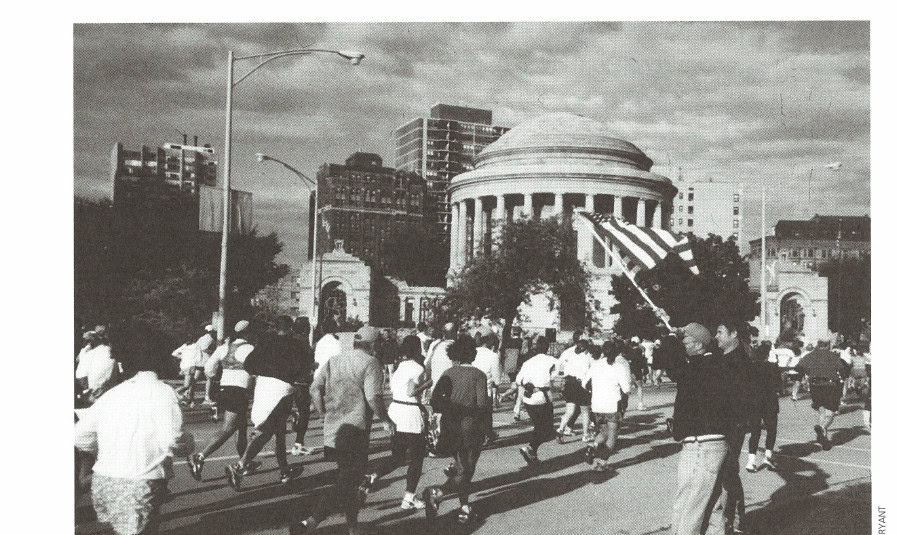
North on LaSalle a blues/rock trio on the sidewalk pumped us up. Just after the third river crossing I took a photo of three girls running side by side, each with one word of “God Bless America” on the back of her shirt. That drew my attention to how many flags were being waved, worn, and carried by both spectators and participants.
Meanwhile (as I would later find while watching four hours of taped TV coverage), celebrity commentators Frank Shorter, Joan Benoit Samuelson, and Mark Coogan agreed that the leaders weren’t showing much effort for any sort of record (Joanie has held the American women’s marathon record since 1985 with her 2:21:21, set here). Pacers were hitting their marks on time, but a gap was slowly growing between them and the competitors. The panelists sounded increasingly anxious as they kept repeating: once you get too far behind, you can’t make it up.
That didn’t apply to 23-year-old hired-gun pacer Ben Kimondiu. Near the halfway mark, he was deliberately slowing, per Pinkowski’s instructions, to let the men’s pack catch up. His fellow Kenyan, track and cross-country champion Paul Tergat, made use of the opportunity. They began a runner’s duet that would evolve into a duel.
Catherine Ndereba, also of Kenya, pulled away in the same general area. As Ndereba had won 12 of her 13 races so far that year, it wasn’t surprising that she also left behind a male runner assigned to accompany her (for “protection,” not pacing). The commentators admired her evident effortlessness. It’s true; on video she is liquid strength, flowing down the streets.
By now the commentators had given up speculating on records and were focusing on the likelihood of who would win. Ndereba seemed a done deal in the women’s race, barring an injury (and anything can happen in a marathon). For the men, the consensus was that Tergat’s proven strength would give him a vicious kick against anyone who might be unfortunate enough to be near him in the final stretch. Who that might be, if anyone, was unknown at this point. For now Tergat stayed with Kimondiu, but his pacing work would be done at mile 18 and he would be free to leave the course and collect his rabbit feed of $5,000.
Kimondiu would eventually leave the course but not at mile 18.
Not that I had any clue of any such drama emerging. I was back in miles five and six, jogging past other male runners as they opted for express lane service at Lincoln Park’s ad hoc tree urinals.
As we headed south on Broadway into the tremendously enthusiastic Lakeview crowd, the Pom Pom Boys cheered us from the east; a few blocks later drag queens choreographed “YMCA” to the west. More conventional cheers greeted us politely in Old Town and River North. On Wells an Elvis impersonator sang to us just before spectators cheered us from the L station above. The course turned right at the Sears Tower and headed west on Adams through Greek Town.
A RABBIT WITH HEART
While I jogged and walked this stretch, commentators were wondering why Kimondiu had decided to stay on the course after mile 18. They also thought it odd that Tergat hadn’t passed him, especially when the two made mile 22 the race’s slowest segment. One announcer riding alongside the race insisted at about mile 24, “Paul Tergat, barring disaster, has got this race sewn up. . . . He can blow [Kimondiu’s] doors off.”
“Disaster” has rarely presented itself so calmly, quietly, and gracefully as it did today. With less than a mile to go, Kimondiu simply pulled away as he turned north up the ramp along Lake Shore. Tergat followed closely, but Kimondiu was in the zone, dude. Stress? Tension? Fatigue? None of them was evident as he cruised across the finish line in 2:08:52. In the Chicago Tribune photo, his face appeared as blissful as a Zen master floating in a pool of Gatorade. Tergat followed four seconds later.
Kimondiu left the course 8.2 miles farther along than he was required to go. He collected $75,000 for first place and $15,000 as a time bonus. Having finished almost seven minutes better than his only previous marathon, the much warmer LA Marathon, he remarked pragmatically in an interview, “It was not as difficult as I thought.”
One commentator reminded us that Kimondiu deliberately slowed up at midrace. “Mmmmm,” the others astutely replied. What might have happened
if he had simply kept on, with that extra lead? No one knows. What we do know is that Kimondiu’s decisions decisively set him high in the world-class status.
With comparable elegance, Catherine Ndereba simply continued gliding through Chicago’s neighborhoods. Several excellent male runners had their egos slightly injured by the windburn when she sailed past them.
Japan’s Naoko Takahashi had just set a new women’s world marathon record one week earlier in Berlin (2:19:46). That still-warm record fell at about 11 minutes before 10 o’clock this morning. Breaking into marathon history, Ndereba blew a minute off it, dashing across the Chicago line in 2:18:47!
Her closest competitor, Elfenesh Alemu, took second place more than six minutes later. Over the second half, Ndereba had no challengers anywhere near visible to urge her on. She was a self-propelled vial of mercury running a one-woman race.
For her determination, discipline, and magnificent achievement, she received $75,000 for first place plus a $100,000 bonus for breaking 2:20. (No one anticipated the women’s field breaking 2:19!)
Though my chances for victory were now clearly shattered (I had yet to cross the halfway mark, while Kimondiu and Ndereba pondered the tax ramifications of their morning’s work), I persevered. At the halfway mark I checked my pace band and was encouraged to find that I was 11 or 12 minutes ahead of the mark corresponding to a six-hour pace. Though I was jogging more consistently than I have in previous marathons, my thighs still felt OK, and my hamstrings weren’t significantly tighter, or at least not painfully so.
Two left turns sent us back toward downtown on Jackson. On Halsted we passed the University of Illinois at Chicago and again went west. Weather held steady. The Windy City tossed us only the occasional light breeze.
RECALCULATING MY FINISH
The colorful Pilsen neighborhood brought out the mostly Latino residents. The mariachi band had stopped performing when I passed through at mile 15, but a group of sidewalk musicians helped me trudge through mile 18. Tiring but not fatigued, I calculated that, even if I were to lose 5 to 10 seconds per mile for the rest of the race, I could still smile for a finish line photo by 1:30 P.M. That margin of safety actually gave me a little more freedom to push myself just a bit more vigorously.
An aid station in an industrial area offered PowerGel (tangerine flavor has double caffeine!) before I reached Chinatown. Near Comiskey Park, as an old lady and a younger guy passed me, the guy yelled back to us, “C’mon, are you all gonna let an 80-year-old nun kick your ass?” I’m not sure that she had asked him to say that, but the nun certainly was doing well after 20 miles of running. Maybe it was penance for past sins.
A half mile later, one runner started up a military call-and-response along the lines of “When my grandmother was 91, she ran marathons just for fun; when my grandmother was 92, she ran marathons faster than you.” It was a pleasant diversion for a couple of minutes. At this point I appreciated every laugh offered.
Some marathoners hit “The Wall” at about this point. I move so slowly that I’ve never hit The Wall. Occasionally I’ve perhaps bumped into The Wall, but it’s just a slow-motion dull thud. With a few grunts I simply crawl over it and keep moving.
The clear day had warmed to the 50s when I crossed over I-90/94 and turned north toward several tall public housing buildings. Eyeing a few of downtown’s skyscrapers in the distance, I was still eight or nine minutes safely ahead of the six-hour pace. East on 33rd took me toward some scattered but wonderfully supportive crowds in The Gap. African percussion briefly revived my running rhythm on Martin Luther King Jr. Drive.
The marathon was down to a 5K with an attitude.
A right turn on 31st led straight to Lake Michigan. I felt as if I could run faster and farther, but that was overridden by the knowledge that a steady brisk walk would safely bring me in under six hours. Even 5:59:59 would be my best time in a few years. I was ready to set it on cruise control and coast on in.
Once I made the turn onto Ft. Dearborn Drive, though, with the sunlit lake to my right, I got a little kick in the butt from the Adrenaline Fairy. At the 24-mile sign I began what might loosely be called a rally. All right, a rallyette. A little faster, a little farther, and still I felt pretty good. Yeah, this is why I’m here.
MUSIC DRAWS US ONWARD
As I entered the tunnel under McCormick Place, the distant echo of the stereo blaring “Eye of the Tiger” sounded a little surreal. It segued into “Start Me Up” by the time I exited into daylight to see downtown just over a mile away. I trotted past the polka band (nice touch!) and passed underneath the interstate before the final turn northward taunted me with the first of two inclines, each maybe 100 to 150 feet long. (This was where Kimondiu began to pull away from Tergat, some three and one-half freakin’ hours earlier.) That slight climb drained a bit of my resolve, but I managed to jog maybe half of this last section, off and on.
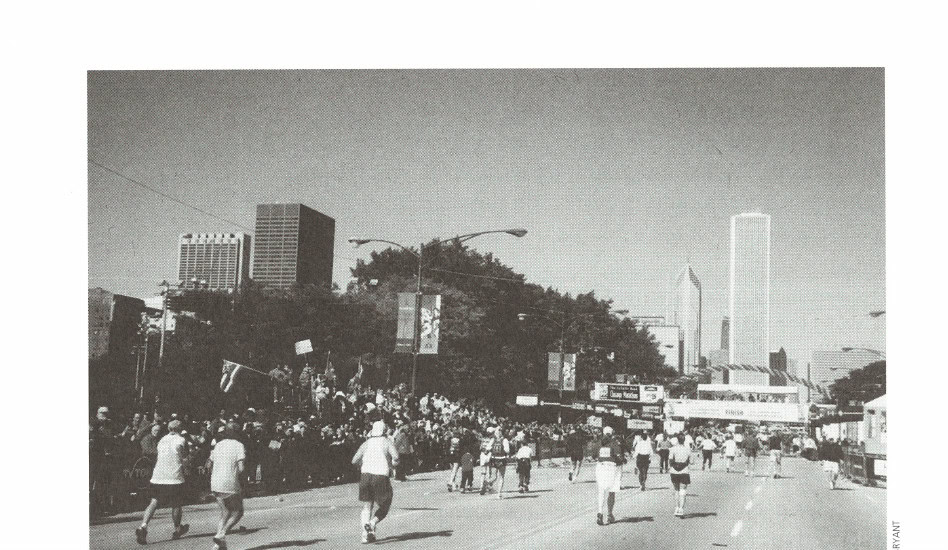
As I neared Roosevelt and mile 26 at the top of the second Death Ramp, Grant Park came into view. I heard the angelic chorus! I saw visions! I smelled Gatorade! Firing up my last few ultra-slow-twitch fibers and a half dozen remaining brain cells for a valiant push over the final two-tenths, I hit my best time since 1997 at 5:49:20, seizing the highly coveted 27,597th place of 28,585 finishers. This was my 29th marathon in 22 states since 1992.
After turning in my Champion Chip, I stocked up on the ample refreshments, including Tropicana, a bag of chocolate-covered peanuts (the fitness-enhancing variety), bananas, water, PowerBars, and whatever else they offered.
And, oh yeah, my medal.
I had no time to savor the moment, to relax and swap stories, to scrounge trash cans for leftover morphine-enhanced GU packets. I had to get to the airport before I turned into a pumpkin at 4:55. As I made my 15-minute Parade of Triumphant Stiffness to the train station, I found the city sidewalks much steeper than they had been when I arrived that morning.
The train zipped along toward O’Hare. I congratulated myself on my travel strategy as I watched highway traffic constipated at maybe 20 to 30 miles per hour, sometimes stalling. After checking in and clearing security, I had just enough time to treat myself to lasagna, after which I made an increasingly rigor-mortified shuffle to Gate 18. I left Chicago very, very satisfied.
This article originally appeared in Marathon & Beyond, Vol. 6, No. 5 (2002).
← Browse the full M&B ArchiveMore like this
1,000+ stories from 19 years of Marathon & Beyond
The complete archive of the legendary long-distance journal — digitized and free to read.
