

Training For The Long Haul
Runners know that no important goal comes without hard work. We like hard work—thrive on it, in fact. But we can also be amazingly shortsighted. Somehow, we think that if we work really, really hard we can have everything we dream of, immediately.
Sure, most of us know that for a beginner, “Ten weeks from couch potato to 10K” might be a prescription for disaster. But we’re not beginners. And that can make it even easier to be seduced into thinking solely in terms of instantgratification goals. “Americans have difficulty thinking in the long term,” says Bob Williams, assistant coach at Concordia University (Portland). “We’re all short-term thinkers.”
Consider Alberto Salazar. In his often-candid memoir, 14 Minutes: A Running Legend’s Life and Death and Life, he describes his reaction to his first marathon, the 1980 New York City Marathon, which he won in 2:09:41, at the time only 68 seconds slower than the world record. He should have been on top of the world. He should have taken at least a couple of weeks off from training, then slowly rebuilt. Instead, he immediately ramped up his training in the hope of snagging the world record only six weeks later, at Fukuoka. “
Luckily,” he wrote, “my body rebelled before I could do serious damage. I contracted a raging case of bronchitis that forced me to shut down.” But that didn’t save him for long. In 1984 he finished only 15th in the Olympic Marathon, his last marathon effort on the world scene. From initial flash of brilliance to fade-out, Salazar’s marathon career had lasted less than four years.
Now widely regarded as one of America’s top coaches, he has made it one of his goals to make sure his runners don’t follow similar fast-burning careers. When Galen Rupp sprinted to Olympic 10K silver last summer, he was 26 years old—two years older than Salazar was for his final marathon win. And barring disaster, Rupp may have quite a few more good years ahead.
Michael Lebowitz/Long Run Pictures
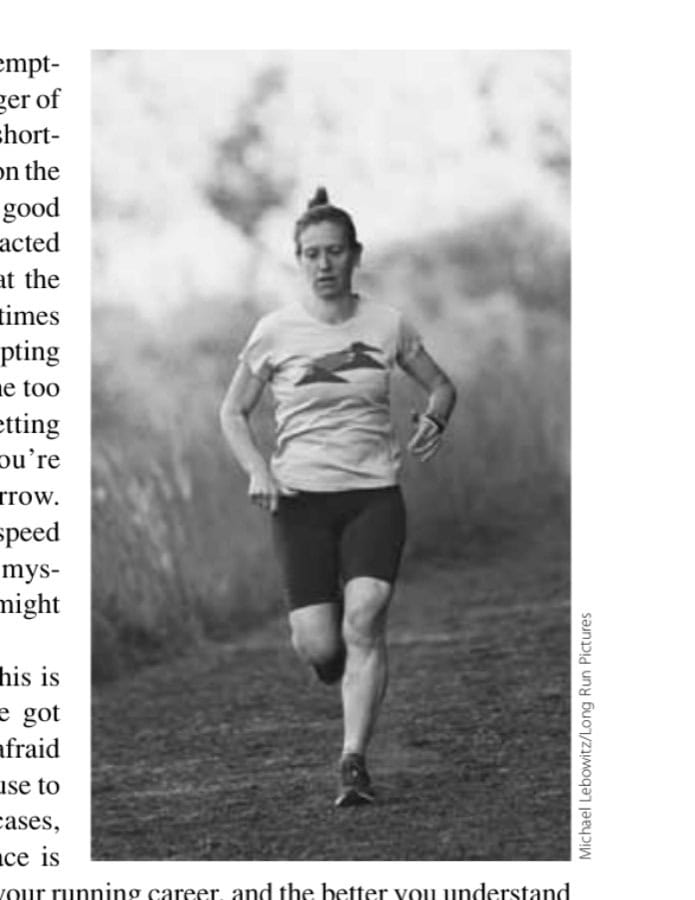
When my own runners are tempted to try too much or are in danger of being diverted into going for shortterm glory, our mantra is “eyes on the prize.” It’s a cliché, but it’s also a good mnemonic for not getting distracted into chasing short-term goals at the expense of the big ones. Sometimes it means saying “no” to a tempting “tune-up” race that might be one too many. Sometimes it means letting a rival win today because you’re after something bigger tomorrow. Sometimes it means forgoing a speed workout because you’ve got a mysterious twinge that might, or might not, make speed unwise.
Another way I like to put this is by reminding runners, “We’ve got lots of time.” Some people are afraid that thinking this way is an excuse to wimp out. But it isn’t. In most cases, it’s simple reality. The next race is rarely the be-all and end-all of your running career, and the better you understand this, the better you will be . . . in the long run.
Of course, this means that you have to know the prize that you’re trying to keep an eye on. For a lucky few, it’s the Olympics, or even the Olympic Trials. For others it might be to break 3:00, 4:00, or whatever. For still others, it might be to finish your first marathon or run marathons in all 50 states. What matters is that you don’t infuse your goal with too much sense of urgency. That feeling of I need this now because I might never get another chance is not only dangerous, it’s simply not the way our bodies usually work.
Masters runner John Keston, at one time the oldest man to run a sub-3:00 marathon, took up running when he was 55. That’s an age when most of us are starting to decline, and one might think he would soon have done the same. But he kept improving until age 62. The reason was that even as he was aging, he was building training base and gaining experience. “[Even] runners who take up running later in life need about seven or eight years to reach their peak performances,” he wrote in his 2010 memoir, Expressions of Aging.
If that applies to older runners fighting the aging clock, it applies even more strongly to young ones. “It takes about six to eight years to develop a runner,” says
Heike McNeil, head coach of Northwest Christian University, Eugene, Oregon. “I get athletes all the time who want to run 80 miles a week, and I’m like, ‘No, you’re not. The maximum increase is about 10 miles a week per year, and you’re not going to do any more than that.’”
If that sounds conservative, that’s the whole point. The Internet is full of programs for faster progression . . . and the world is full of injured or burned-out runners. The strongest training benefits, says Williams, come not from intense training bouts but simply from staying healthy, year after year after year. “I think if people learned to train a little less intensely, they would stay healthier longer,” he says.
Amy Begley, a 10,000-meter Olympian turned coach, agrees. “The question to ask,” she says, “[is] would you rather be ‘90 percent’ and healthy at the start of the race—or injured on the sidelines?”
Twenty-four months The first step is simply to get out of the short-term mindset. “Most recreational athletes should be thinking at least one to two years out,” says Williams. “Why do we want to get so fast, so soon? Why not think long term, over the course of your life?”
Other coaches agree. “A two-year plan gives you time to train, experiment with techniques, and adjust along the way,” says Begley, who is now women’s cross-country head coach at the University of Connecticut. “It also gives the sense that each race or workout is a steppingstone.”
This is particularly helpful for beginning runners, but the lessons are ones from which we all can benefit. “In high school,” she says, “the first two years for most athletes are about building a base, learning to race . . . and learning how to train.”
Retired college coach Jack Daniels, author of Daniels’ Running Formula, adds: “I always encouraged college runners to think in terms of about a 10 percent improvement during their four years at college.”
Begley’s husband and coaching partner, Andrew, puts it even more strongly. “The number of high-school phenoms who are never heard from in college is staggering,” he says. And don’t think that just because your school years are long behind you, this can’t apply to you. “Recreational runners need to think about where they want to be with their running five years, 10 years, and even 20 years down the road,” Andrew Begley advises.
Not that this means you should be writing out training schedules years in advance. What matters is letting go of the sense of urgency and understanding where you want your overall plan to be heading, not just in the next few races, but in the ones after that.
Be yourself Also important, says Paul Greer, coach of the San Diego Track Club, is not to pay too much attention to what other runners are doing. “Don’t compare yourself to the Joneses,” he says. “Don’t try to run mileage just because your friend or neighbor [or training partner] is doing more mileage.” You can’t expect to train like Meb Keflezighi or Ryan Hall if you’re on your feet all day at work. You have to find what works for you.”
If family and work don’t allow you to train as much as you would like, there is no point pretending otherwise. “Later you may have more time,” says Chicagobased coach Brendan Cournane. The same don’t-compare advice also goes for participation in training groups. Yes, it’s often said that the best way to get faster is to run with faster people. But that applies only if you also use common sense. “The worst type of condition someone can get—worse than a stress fracture—is being overtrained,” says Greer. “It’s very important that one basically knows their limitations.” “
Keep control of your own training,” adds Charlotte Richardson, coach at Lincoln High School in Portland, Oregon, who in her youth was one of the pioneers of women’s distance running (Joan Benoit Samuelson cites her as an inspiration). “Some people don’t realize just how competitive they are and get ahead of themselves. You have to learn how not to do that.”
Another aspect of long-term thinking is understanding the physiology of what you’re doing. Intense speed work gives the quickest short-term bang for the buck—“but that’s not going to make good runners in the long term,” says Jason Karp, PhD, author of Running for Women. “To raise performance to a higher level, it must come from increasing the base of the training pyramid with more aerobic work.” I myself have seen promising marathoners soar . . . then implode when their coaches overloaded them
Michael Lebowitz/Long Run Pictures
Don’t forget the base
with excessive speed work that produced exactly the effect Karp describes. If you want to be a flash in the pan—amazing your friends, then fighting to regain your early glory—all speed and little base is the way to go. Amy Begley adds that avoiding this temptation is yet another reason to have a long-term plan to help you be patient while building the base needed to achieve your eventual goals.
But like so many things, you can also err by doing all base and no speed. That can be a problem with experienced adult runners who may simply pile on the miles and try to accomplish everything that way, says Andrew Begley. Rebalancing such programs to include a better mix of speed, base, and long-term planning can pay substantial dividends. “Most adults that I coach are able to get bigger PRs with less time spent running,” he adds, noting that while speed work poses short-term injury risk, reducing your mileage can reduce the long-term risk, extending your competitive career.
Set realistic goals As children, many of us were probably chastised for having eyes bigger than our stomachs—heaping our plates with more goodies than we could possibly eat. Adult runners are often much the same way: striving for the 3:10 marathon, for example, before we’ve broken 3:20. Such runners often say they don’t want to settle for overly easy goals. But if you’ve been plateaued at a 3:20 marathon for the last several races, a more reasonable goal might be to break 3:15. It helps to realize that for most of us, the quick gains are in the past. “It’s a lot easier to go from a 4:30 marathon to a 3:30 than to go from 3:30 to 3:15,” says Cournane.
Setting a reasonable goal, though, can be tricky. When new people come to the track where I coach, one of the first questions I ask is their 5K pace. I’m shocked at the number who don’t know. Many have run a few marathons and maybe a couple of half-marathons, and now they want to step it up, perhaps to qualify for Boston, perhaps to break some magic number. I often have no clue if it’s a reasonable goal. There is simply not enough information to go on.
Amy Begley describes goal setting in terms of a staircase, where the top step is the ultimate goal and the bottom one is where you are now. In between are intermediate goals, each forming the basis for the next. She uses this as a method for long-term planning, but something similar applies to the initial process of goal setting, especially in a race as demanding as the marathon.
For me, that process begins by running a short race, preferably a 5K. You might want to run two or three, a few weeks apart, because if you’re not used to the distance, you’re not likely to pace it properly the first time. (And the nice thing about 5Ks is that they don’t require large amounts of recovery time.)
Once you’ve done that, you can make a reasonable guess at your 10K time, based on online calculators such as McMillan’s. Then you can step up to the half, and from there you can set a marathon goal.
Michael Lebowitz/Long Run Pictures
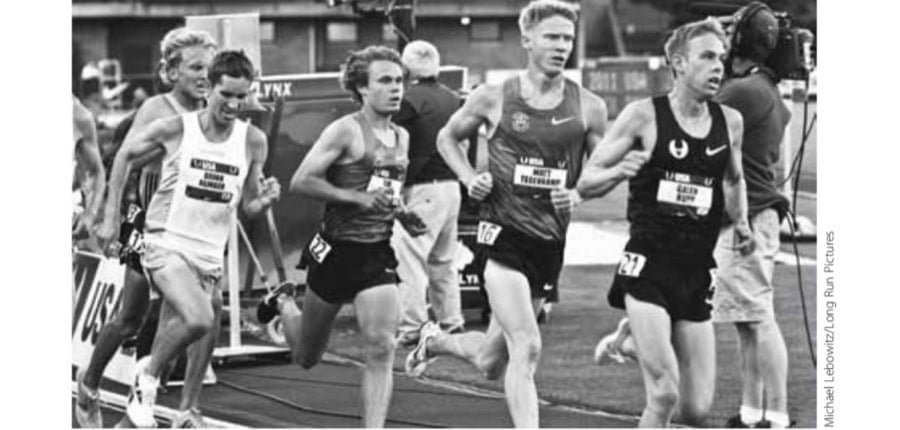
When a big race comes around, you can also set several tiers of goals. I think of them as the “A,” “B,” “C,” and sometimes even “D” goals. The “A” goal is the dream, not the best day of your life ever, perhaps, but a darn good one. The “B” is more modest but still good enough to make for a satisfying day, given race conditions and your present state of training. If you set B goals correctly, you ought to hit them more often than not. The “C” is a backup. OK, it wasn’t a great day, but that sometimes happens. The “D” is a red flag. If you don’t do at least that well—and there isn’t an obvious explanation, like a giant head wind or a course that all the Garmins are showing as long—you might want to get a blood check for low iron, review your training log for signs of overtraining, or otherwise reassess.
The point isn’t to set goals that make you feel bad if you don’t hit them but ones that give you information related to your long-term plan, whether that information is “Wow, hurrah!” or “Yow, something’s wrong and I need to figure out what it is.” Part of long-term planning is to view races not as measures of your worth as a person but as information—knowledge that can be folded into future planning.
Time out Every fall, Bernard Lagat takes a five-week break. “Rest is a good thing,” he told The Wall Street Journal last year. During that period, he added, he typically gains about 8 pounds—no problem, because he trains them off again before he reaches peak racing shape, anyway. Other (smart) athletes force themselves to take shorter rest breaks twice a year, even though it defies that ingrained voice that’s scared of getting out of shape.
If you don’t do this occasionally, you’ll stagnate, says Greer. “You can’t just go from one thing to the next to the next, or 10 years later you’ll be burned out.” I tell my own runners to take a minimum of two weeks totally off after a marathon . . . and then a minimum of two more to building back to base-level training. The first time I told an elite marathoner to do that, I thought she would rebel. But she didn’t, and seven weeks later she clipped two minutes off her halfmarathon PR. Trust that when you come back from the break, you really will still be the runner you were before . . . but rested and ready to go. “Time off resets the body,” says Andrew Begley.
Amy Begley adds that even the weight gain during a rest break can be a good thing. “This goes against a lot of people’s thought processes,” she says. “However, especially for women who tend to be very lean and become amenorrheic, the weight gain can help restart the hormones and give the bones a boost of protection.”
Rest can even turn a minor setback into a blessing. As an example, Greer cites Gerry Lindgren, who in the 1960s “was training like a madman,” trying to break the world record for six miles. He ran so hard, Greer says, that he wound up in the hospital. “He was sidelined for a week. Then he gets out and breaks the record.”
Technically, he tied the record with Billy Mills, who was in the same race and beat him on the lean (while clocking the identical time). But the point is clear. “He probably wouldn’t have done it if he’d continued on the path he was on,” Greer says.
Stay the course One of the main benefits of long-term goal setting is immunizing yourself from day-to-day emotional swings. “Stay patient,” says Greer. “It’s not going to come right away. If you’re under a good coach or a good program, it’s going to work for you eventually.”
Cournane says much the same. “Just like a marathon is a long-term endurance event,” he points out, “improved performance is often a long-term event. Most runners don’t really learn how to run the marathon until their fourth or fifth.”
Amy Begley adds that Andrew’s college coach used to tell his athletes that it takes a year in a new program to start seeing the results. “The point [is] not to think of how much better you want to get this year,” says Daniels. “Sometimes things come around more slowly than you would like.”
Be versatile This one comes hard for marathoners, who tend to disdain shorter distances. But in 2008, Kara Goucher won the indoor mile at the Millrose Games—one of the best indoor-track competitions in the nation.
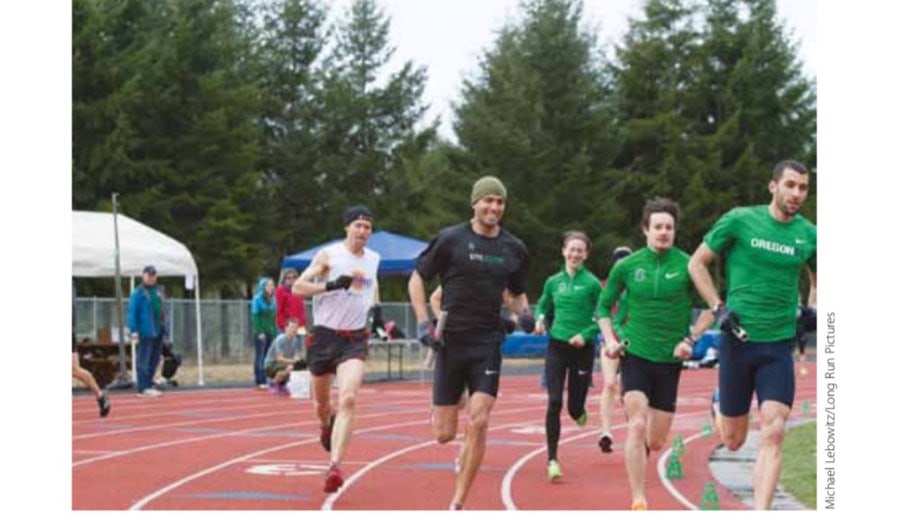
“Find a variety of races,” says Greer. “Get on the track. Maybe do some crosscountry. It’s no accident that some of the best runners can do a lot. They can be competitive on the track, and in cross-country, and on the roads.” Andrew Begley agrees. “Mix it up,” he says. “Even if [you] are focused on marathons and halves, doing a season of shorter races will allow [you] to improve [your] economy at faster paces. This will carry over to the longer races. Too many runners plateau because they never change up their training and racing.”
Michael Lebowitz/Long Run Pictures
Keep it fun
Very few of us do this for a career. For most of us, running is a hobby—a means of self-expression. “If you’re constantly pushed and told to go harder, you don’t love it anymore,” says college-coach McNeil. “My job as coach should be mostly to hold them back.”
And it’s not just collegians who can wind up with what she calls “a weird love/hate thing” with running. Recreational runners are quite capable of becoming their own Little League parents. Nor should you ever forget the things that give you joy. “Go watch a middleschool or high-school race and remember why you started running,” says Amy Begley. “Their energy can motivate you.”
Or find a favorite run and come back to it for periodic renewal. “Mine is above the cliffs in Del Mar,” says Greer. “It’s just so beautiful it invigorates me.”
This article originally appeared in Marathon & Beyond, Vol. 17, No. 6 (2013).
← Browse the full M&B ArchiveMore like this
1,000+ stories from 19 years of Marathon & Beyond
The complete archive of the legendary long-distance journal — digitized and free to read.
