

Trial By Fire
“C
ould it be any hotter?” I asked myself, sitting at the Friday afternoon race orientation for the 2011 edition of the Rio Del Lago 100 Mile Endurance Run. I had dressed for the weather in a light T-shirt and baggy shorts. I had also found the shadiest spot on the patio of the community building at Beal’s Point on the shore of Folsom Lake near Sacramento, California. But I was still sweating like a pig.
The race director, Molly Sheridan of Desert Sky Adventures, meanwhile was all joy and light talking about the next day: “Awesome aid stations . . . hoping for a record number of finishers . . . great weather . . . fantastic course.” I looked down past an expanse of green grass at the lakeshore where a swim team was doing laps around a set of orange buoys and mothers were watching their kids splash in the water. A ferocious, glaring sun sizzled above in the sky. So tomorrow I was going to run 100 miles. Just crossing the parking lot to get to the orientation had seemed like an endurance event to me.
A bunch of scantily clad teenagers paraded by, laughing, their hair wet and dripping, teasing each other, young, carefree, and cool in the heat and the sun. Watching them, I felt ancient at age 58, like an old man swept up in the Crusades, marching in the sand, clad in hot leather, outside the gates of Jerusalem on a misguided quest. Run 100 miles in this heat, at my age: am I crazy?
Race day began at three the next morning. I armored up with sunblock, skin lubricant, bug spray, Band-Aids, and hydration pack and stepped out of my airconditioned hotel room into what should have been a comforting morning chill. Instead I felt a warm envelope of sticky air seal shut around me.
The race began in the dark with a little out-and-back on a bike path to kill a couple of awkward miles. I made my first mistake when I dumped my flashlight passing back through the start. It stayed dark an hour more, which I spent creeping out other runners by snuggling up close to them to piggyback off their lights. With the dawn, I could relax, stop stepping on everyone’s heels, and enjoy the beguiling parklands next to Folsom Lake, where we were running. The farther we went, the more rugged and picturesque the lakeshore became. The trail rose
and fell and curved in and out through the canyons above the water. We passed Horseshoe Bar and then Rattlesnake Bar. Some thin but strategically placed clouds dampened the sun’s early-morning fire. I managed to get up the switchbacks of Cardiac Hill and on into Auburn Dam Overlook at mile 25 feeling pretty human. At that point hope sprang eternal.
Too Auburn Dam hot
© Robert Josephs
But leaving Auburn Dam Overlook and dropping down into the canyon toward No Hands Bridge of Western States fame, I could feel the angry heat taking hold. Soon I was reduced to a walk as I tried to keep my core temperature from rising and blowing all my valves. At just that moment, my iPod shuffled randomly onto an old Cole Porter classic, “It’s Too Darn Hot.” Gee, that helps, I thought grimly. The heat persisted as I crossed No Hands and struggled up K-2, a steep and broken road with several false summits that toyed with me as a maniacal cat might toy with a desiccated mouse.
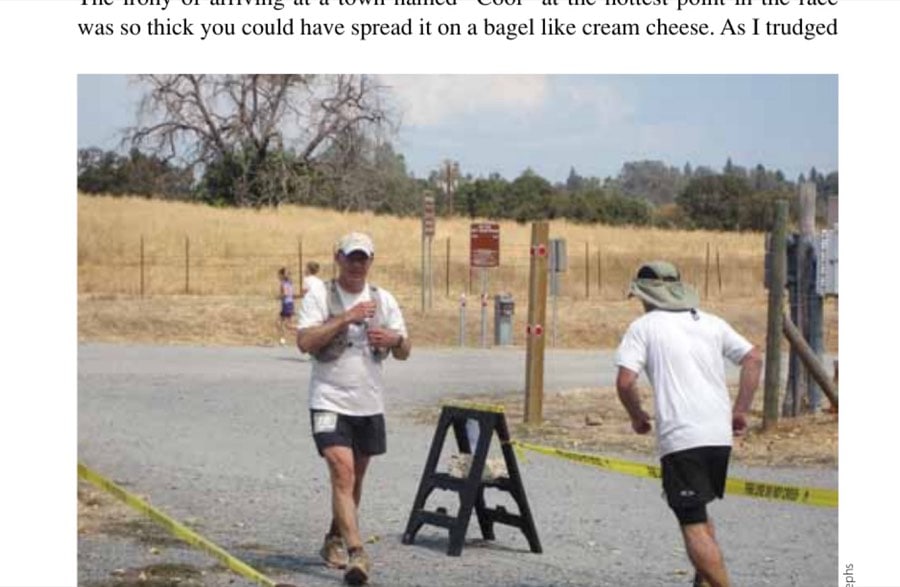
Next came a largely exposed seven-mile loop beyond the Cool Fire Station. The irony of arriving at a town named “Cool” at the hottest point in the race was so thick you could have spread it on a bagel like cream cheese. As I trudged
▲ The author still looking pretty cool arriving in Cool.
© Robert Josephs
around the endless loop, I came to the spot where a woman on horseback had stopped next to me a couple of years before when I was running a 100-kilometer race there on another very hot day. She had asked how long the race was, and I had told her it was 60 miles. She laughed and said, “Well, you picked the hottest day of the year to run that far.” It was not lost on me that today I was running even farther on a hotter day.
Back at the aid station at the firehouse I dropped into a chair. The two guys who were crewing for me huddled around looking concerned. It was midafternoon and 40 miles into the race. I should have been wolfing down sandwiches to stoke up my energy reserves for later, but my stomach had gone south and the nausea made me uninterested in food. It was all I could do to choke down a little banana and a few chips. I waved off the peanut butter and jelly sandwich and the hot soup they offered, thinking that when the sun went down my appetite would return and I would catch back up with the eating.
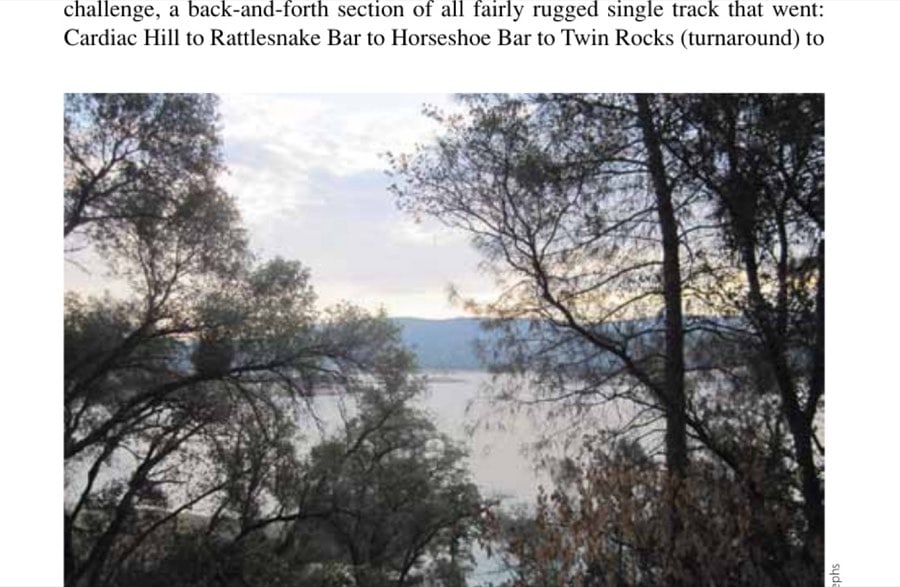
I tore myself out of the chair and crept along a section of heat-radiating blacktop road to the Maidu aid station and then down to the aid station at the bottom of Cardiac Hill to reach 50 miles. Here the course offered up a mind-numbing challenge, a back-and-forth section of all fairly rugged single track that went: Cardiac Hill to Rattlesnake Bar to Horseshoe Bar to Twin Rocks (turnaround) to
▲ Lake Natoma seen through the trees.
© Robert Josephs
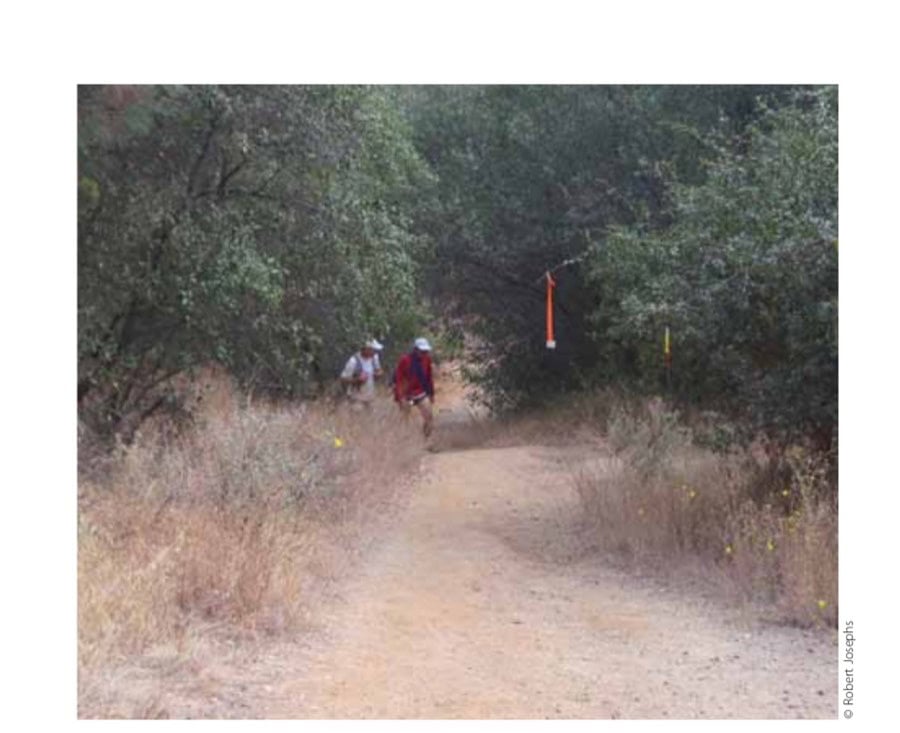
▲ Going back and forth in the “Meat Grinder.”
Horseshoe Bar to Rattlesnake Bar to Cardiac Hill (turnaround) to Rattlesnake Bar to Horseshoe Bar to Twin Rocks, and only then to the finish. Runners tenderly referred to this part of the run as the “Meat Grinder.”
Luckily, far down below us, pleasure boats were cruising up and down in the blue waters of Lake Natoma. The people on board were stretched out in the late-afternoon sunshine like sleepy cats, quite oblivious of the drama playing out on the dusty trails above them. Oh, wait. That just made it worse. The full day of megaheat had chiseled me down to a nub. I was barely negotiating the uphill sections of the course. On the flats, I was into a survivor’s shuffle. On the downhills, gravity was all I had going for me. My stomach was not coming around so I was falling way behind on replacing my energy stores. When the darkness finally closed in around me, the night air was warmish and offered no relief.
Thank god for blisters OK, I thought, things don’t look too good, but I have some clean socks in my drop bag at Rattlesnake Bar so I can do something about my feet. Gritty dust had been
seeping into my shoes and socks all day, combining with the heat to create, basically, sandpaper against the soles of my feet. On a positive note, the pain from the resulting blisters was keeping my mind off my sour stomach. When I got to my drop bag at Rattlesnake, there were no socks. I realized they must be in my bag at Horseshoe Bar.
By the time I got to Horseshoe Bar at mile 60, my mind was in an uproar. Everything hurt, not just my feet. My stomach was a mess. I was getting sleepy and exhausted. I had eaten hardly a thing all day. I managed to get my hydration pack filled. I fumbled through my drop bag for electrolyte tabs and energy gel, and I left forgetting about the socks. Idiot! I thought, as, about a half mile from the aid station, I realized what I had done. I consoled myself knowing that I could get socks from my drop bag at Twin Rocks. Six miles and an eternity later, I arrived at Twin Rocks and discovered I didn’t have a drop bag there: no bag, no socks, no nothing. This was discouraging.
I was also up against a decision. I was 65 miles into the run and faced turning around and going back along the course 15 miles to Cardiac Hill before I could turn for home. Or I could quit. I could get a ride to the finish and be back in my hotel room and bed in about half an hour. I would be off my feet. I could lie down and close my eyes. It was about eleven o’clock so I could get a full night’s sleep. My stomach wouldn’t matter. No more gagging on energy gel. No more forcing myself to drink. No more hills or rock staircases. No more night. No more sandpaper against my feet. I didn’t care a whit about getting a finisher’s buckle. I sat for a long time. Then I got up and pulled on my hydration pack. I don’t know why, but I headed back toward Horseshoe Bar, back into the Meat Grinder.
Sometime after midnight, my stomach had had enough and took charge. I heaved three times in a row before I could wobble off down the trail. I tried to make the best of it and convinced myself that I was now a lot better off. I could start over with the food, the liquids, the energy gels, and the salt tabs and maybe get to a better place. And at Horseshoe Bar, my pacer was going to join me and I could get my feet fixed up. I could still make it. I just had to keep going all night.
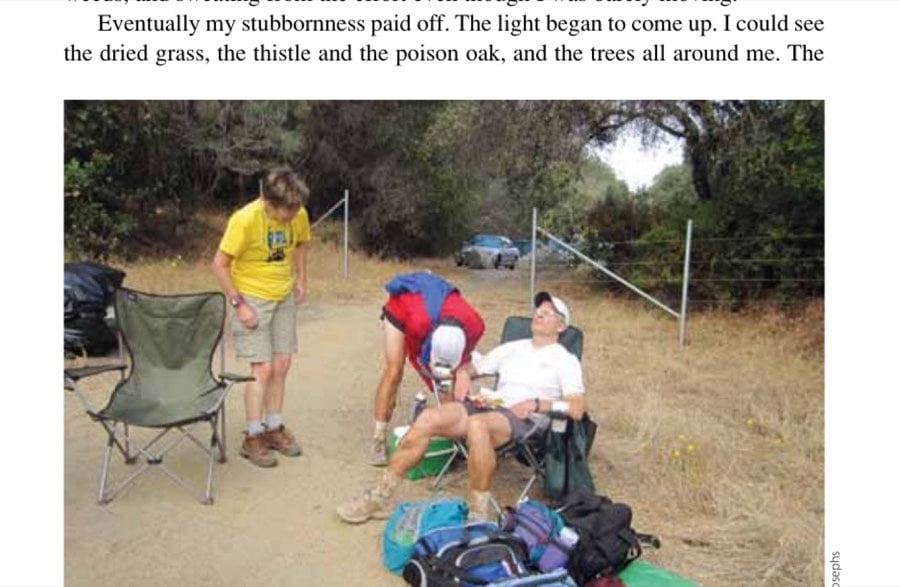
The curious onlookers gathered around my blistered feet at Horseshoe Bar were clearly impressed with the damage to my feet. They shook their heads. They said, “Wow.” They all agreed that nothing could be done. “They’ve already popped,” the guy holding my foot explained. “I’ll just clean them up and you can put on the clean socks. Nothing else I can do.” I stared dully at the top of the guy’s head; he was telling me I was going to run 10 more hours on painful feet. My pacer, David Nakashima, handed me a sandwich, which I gnawed on listlessly. I was back to maybe quitting. I had counted on some kind of miracle with my feet, and that wasn’t happening. David shrugged. “Just give it some time,” he said when I told him I might drop.
Breaking away from the chair
© Robert Josephs
I sipped soup, ate the sandwich, and stared into a campfire. After 15 minutes, David said, “We better get moving.” From pure instinct, I got to my feet and left the chair of defeat behind. We walked a few steps out of sight of the aid station and I threw up behind some bushes. David patted me on the back until I straightened up, and we moved on.
Ever so slowly we made our way back to Rattlesnake and then on to Cardiac Hill. At each aid station, I would collapse at once into a chair and doze for 15 or 20 minutes while David waited and timed me. I kept drinking and eating, thinking that finally I would be able to keep something down, but invariably as soon as I was up and moving, I would start retching again. It got so ridiculously bad that it started to seem funny. I would straighten up and smile at David as if to share the joke. How frickin’ pathetic is this? I kept thinking. At the bottom of every uphill, I would have to stop, bend over, and rest my hands on my knees while I steeled myself for the effort of climbing onto a rock or up a slope with absolutely zero energy to draw on. I was tripping on every bump in the trail, weaving into the weeds, and sweating from the effort even though I was barely moving.
Eventually my stubbornness paid off. The light began to come up. I could see the dried grass, the thistle and the poison oak, and the trees all around me. The
▲ The author taking a final nap at Twin Rocks before tackling the last five miles to the finish.
sky brightened, and there was the water off to my left. David pushed me along until we got to Twin Rocks, the last aid station, and I had only five more miles to go. We worked out the time remaining before the final cutoff at the finish, and it looked good. As long as I kept moving, I would make it. My second pacer,
Robert Josephs, picked me up there. Robert and I had a long history of helping each other at 100-mile races, but for whatever reason most of those races had ended in DNFs. Today would be different, and we both gloried in the feeling of at last succeeding. I was still unable to eat, but somehow I found energy and strength in knowing that the last aid station was behind me and only the finish line remained. Each step remained painful, but now the last step was not so far off.
Finally—a finish with Robert Slowly we completed the final stretch of trail and came to the dirt road that skirts Folsom Lake. The road rose and fell and I trotted down the backside of the hills just to show myself that I could still run. Then we were on the causeway crossing over Folsom Dam, and in the distance I could see a big red arch marking the finish line. A couple on bikes saw my race number and asked what we were doing. When I said I was finishing a 100-mile run, they just stood with their mouths open. They fell in behind me. I didn’t hurry. I could have run the last half mile, but I just walked and savored the moment. Robert and I talked about other races where we had not finished and had not had this experience of approaching the end of the race with the finish deliciously in hand but not quite there.
I jogged the last few steps and passed under the finish banner. I was the next-to-last runner to complete the course under the time limit. It had taken 31 hours and 20 minutes. More than half of the starters had succumbed to the heat and quit. For just a few moments, I was buoyed by the tremendous thrill of being done. Buckle in hand, I posed for a few photos with my crew in front of the big race banner. The next thing I knew, I was sprawled out on a patch of grass. I could feel the earth pressing up against me, supporting my back, my arms, my legs. After struggling for so long, now at last I could exist with no effort. David and Robert went to pick up a car that had been left at an aid station. When they returned, I was all alone. Everyone else had packed up and left. You would have never known that an event had taken place there.
Back at the hotel, I watched from my bed as Robert did all the packing, loaded up the car, and checked us out of the room. All I had to do was get up, walk out to the car, and fall into the back seat. Robert would drive us home. But there was just one more thing I had to take care of. On my way out to the car, I stopped by the bathroom and completed my Rio Del Lago adventure. I threw up.
This article originally appeared in Marathon & Beyond, Vol. 17, No. 6 (2013).
← Browse the full M&B ArchiveMore like this
1,000+ stories from 19 years of Marathon & Beyond
The complete archive of the legendary long-distance journal — digitized and free to read.
