

Zzzs For Speed
“B
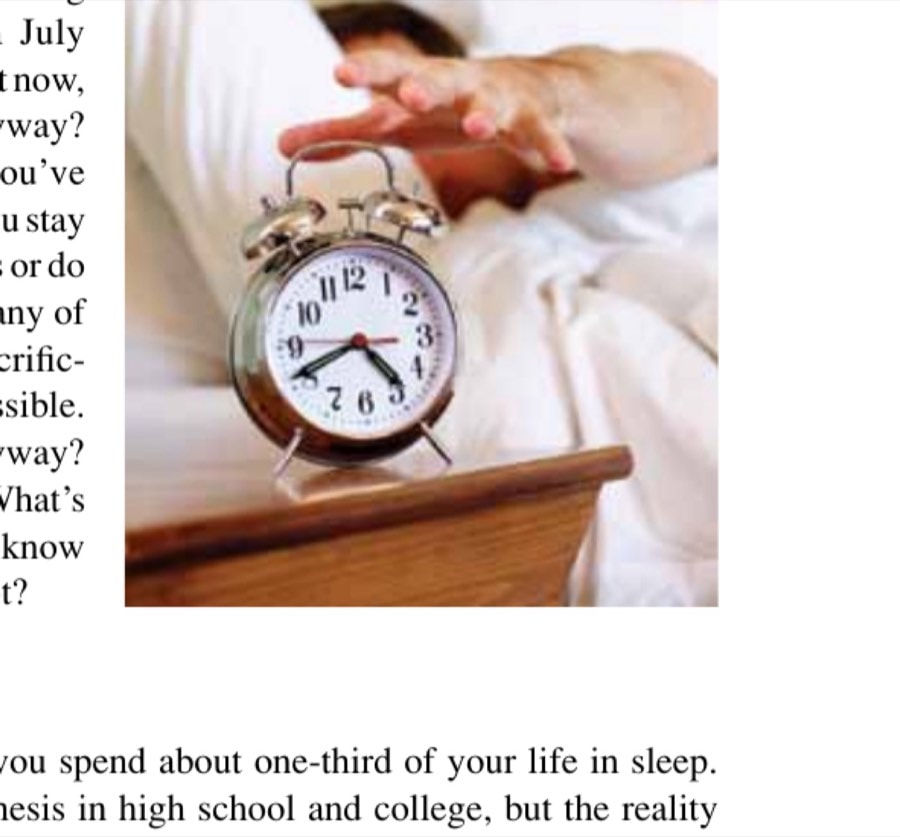
eep, beep, beep.” Oh, no . . . “Beep, beep, beep.” Aargh! It’s 5:00 a.m. The sheets are warm and cozy, and the road outside is cold, dark, and wet. That training program you came up with in July doesn’t seem quite so perfect right now, does it? Whose idea was this, anyway? If you are like most runners, you’ve faced this quandary before. Do you stay wrapped in the arms of Morpheus or do you get in that six-miler? For many of us, fitting in the miles without sacrificing the “zzzs” doesn’t seem possible. But what’s the story on sleep, anyway? Does sleep affect your running? What’s the right amount, and how do you know if you are hitting your sweet spot?
The need Your body needs sleep. In fact you spend about one-third of your life in sleep. Sure, you tried to debunk this thesis in high school and college, but the reality can’t be denied. You need to sleep for your body to function well. Early studies showed that forcing people to stay awake for a few days without sleep would result in severe mental breakdown similar to schizophrenia (West et al. 1962). More recent studies demonstrate that chronic, inadequate sleep may increase the risk of high blood pressure (Gangwisch et al. 2006), depression (Tsuno, Besset, and Ritchie 2005), certain cancers (Verkasalo et al. 2005), diabetes (Yaggi,
Araujo, and McKinlay 2006), and other chronic conditions. Inadequate sleep can also impair performance and reaction time on par with the effects of a few beers. As if that isn’t bad enough, shortened sleep also increases the production of an appetite-stimulating hormone called ghrelin (Spiegel et al. 2004). This could explain why those who sleep less have a greater battle with the bulge than their well-rested counterparts. To understand why all this badness happens, you have to understand the real purpose of sleep.
Never wasted Sleep is intended as a period of restoration to reset your central computer. It is a time when your body can focus all of its energy on healing, growth, and preservation. During the day, you use vast quantities of energy moving, typing, sitting, eating, worrying, calculating, remembering, and on and on. During sleep, your body uses its energy to increase immune function; accelerate healing of muscles, bones and skin; increase growth; and carry out other key physiologic processes. Your body takes care of “you” during sleep, not just all the things you think you have to do. Although sleep feels like a passive process for us, it is actually a very busy time of adaptation and healing. It is easy to think I don’t have time to sleep. However, regular sleep may just deserve more attention in your calendar book then mapping your training runs and your periodization patterns.
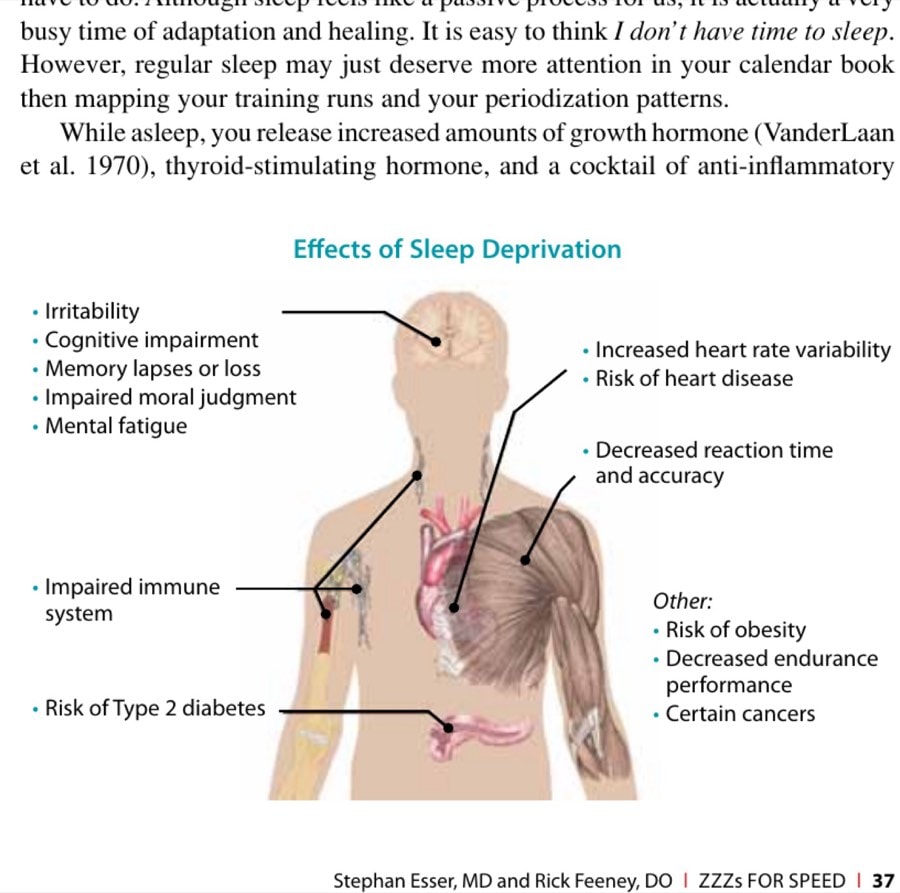
While asleep, you release increased amounts of growth hormone (VanderLaan et al. 1970), thyroid-stimulating hormone, and a cocktail of anti-inflammatory Effects of Sleep Deprivation • Irritability • Cognitive impairment • Memory lapses or loss • Impaired moral judgment • Mental fatigue
• Impaired immune system
• Risk of Type 2 diabetes
• Increased heart rate variability • Risk of heart disease • Decreased reaction time and accuracy
Other: • Risk of obesity • Decreased endurance performance • Certain cancers
molecules that help put out the fires of daily living. There are many molecules released you may never have heard of and others like melatonin that you hear a lot about. Melatonin is a neurohormone released from the pineal gland. This small, pea-shaped gland sits in the back of the brain, where it releases melatonin in response to innate circadian rhythms and the onset of darkness. Melatonin not only helps promote sleep, but it is also a powerful antioxidant and anti-inflammatory (Pieri et al. 1994). So people who lose out on regular sleep also reduce the benefits that come with adequate melatonin release. Cyclical release can also be altered by flying to new time zones and by prolonged periods of wakefulness. This is just one of many examples of the powerful chemistry that goes on as we sleep. When you get inadequate sleep, your body doesn’t produce enough of these molecules, it has insufficient time for healing, and dysfunction sets in.
All hands on deck Daily living takes energy, but when you throw on the running shorts and slip into your racing flats, your body is about to go from two cylinders to eight. Running requires all hands on deck as your cardiovascular, musculoskeletal, and neurologic systems kick into gear and allow you to maximize your performance. Some research suggests as much as seven to 15 times your normal metabolic activity occurs during prolonged running (Cheetham et al. 1986).
As you increase activity, your muscles also increase the production of waste products like carbon dioxide, hydrogen, and lactic acid. These molecules build up in the tissues where they can decrease muscle efficiency, accelerate the onset of muscle soreness, and cause unwelcome postworkout symptoms. These metabolic wastes can also alter the normal cellular efficiency as you move into your long runs. Along with adequate hydration and good nutrition, sufficient sleep is key to shortening or preventing these symptoms and the reduced performance they induce. If you get insufficient rest the night before a big run, your body has incompletely compensated for the stressors of the previous day, and you add to the cellular wastes present in the muscle tissue and further impair their efficiency.
Of course, you are also altering the function of the central and peripheral nervous systems in ways we do not fully understand, but we do know that it results in increased fatigue and decreased function. The healing and regeneration that occur during sleep are essential to help you perform your best during training and on race day.
Sleep and sugar Your body needs sugar—no, not necessarily the kind that comes in Pixy Stix and candy bars (sorry)—but sugar or glucose is the essential energy source of the body.
Practically every cell in the body needs sugar to do its job. Just as a house needs electricity for fixtures to work, your body needs sugar to function. Hair cells, skin cells, muscle cells, and brain cells all need sugar. After a big meal, extra glucose is stored in the muscles and liver as glycogen, a complex, branched-storage sugar. When you start a run, you initially burn up the glucose circulating in your bloodstream, and as you extend your run, the stored glycogen is mobilized from the muscles, converted to glucose, and used for fuel.
Shortening your sleep impairs glucose metabolism and makes the muscles less efficient. In fact, a study published in the Lancet in 1999 found that by reducing sleep by as little as four hours, young, healthy men had “profound alterations in glucose metabolism, in some situations resembling patients with type-2 diabetes” (Spiegel et al. 1999). In such a state, the body is unable to withdraw the stored sugar for use in an efficient manner. It’s as though you can’t get your money out of the bank when you really need it to make a big purchase. The “money” (sugar) is just stuck in the muscles, and your body is unable to access it efficiently. As a result, your muscles don’t get the fuel they need, so they feel exhausted and can’t perform at their peak. Is it any wonder you feel sluggish and fatigued after a night without restful sleep? That is why many people reach for the easy simple carbohydrates to flood the bloodstream with glucose. While this can boost your performance when you are in a bind, it is not an ideal way to compensate for lack of sleep. You are really just artificially stimulating the system with simple sugars and not giving the body the tools it really needs so it can use its own stored sugars.
When rubber meets the road So you know sleep is very important for the little things, such as reducing your risk of diabetes, obesity, and high blood pressure, and it seems to help your muscles improve efficiency. But does it affect the important things, such as your performance on race day? According to the present state of the science, it does on many levels.
To begin with, adequate sleep appears to inversely correlate with injury rates. Of course, training consistently, over time, far outweighs an individual effort for any given workout. That’s why staying injury free is paramount. Adequate sleep allows you to dodge both the acute and chronic injuries, spending more time on the roads and trails. An interesting retrospective study in 2008 showed that Israeli infantry recruits in basic training sustained 62 percent fewer stress fractures after implementing reduced cumulative marching measures and a minimum requirement of six hours of sleep per night (Finestone and Milgrom 2008). But why would sleep make a difference? It is hypothesized that because of the constant bone remodeling that occurs daily and through various phases of our lives, the time we sleep is essential for maintaining bone balance. In the study mentioned, markers
of bone resorption, or the breakdown phase in bone remodeling, were increased by 170 percent in sleep-deprived recruits (Finestone and Milgrom 2008). Yes, but you’re not an army recruit. You’re an endurance athlete, and sleep is just not a high priority. Consider this: a German study this year examined a cyclist competing in the Race Across America, a grueling, nonstop 4,800-kilometer course. The conventional approach to this race held that minimizing sleep and maximizing time riding produced faster times. However, this cyclist finished in the top 10, averaging almost twice as much sleep as his competitors. He spent less time in the saddle but covered the same distance (Schumacher et al. 2011). Sleep equals speed. In previous studies, researchers found that after just one night of decreased sleep, participants had
decreased endurance performance while running and perceived the work to be harder (Martin 1981). One night without sleep shortened the time to exhaustion during exercise by an average of 11 percent in another classic study (Oliver et al. 2009). There was a spread of between 5 percent and 40 percent more-rapid exhaustion in different subjects, suggesting that some of us may be more susceptible than others. So the next time your running buddies brag that they can stay out all night before a big race and still post a PR, tell them to give their parents a call and say thanks for the genetics. Then let them go out and party while you get your zzzs.
Mind over matter As any seasoned runner knows, what’s between the ears can trump the number of miles logged. Just one night of sleep deprivation increases perceived effort in endurance athletes while having negligible effects on heart rate and metabolic rate (Martin 1981). Muscle recovery and performance suffer over time with accumulated sleep debt, but mental fatigue affects performance immediately. As it turns out, our performance, the power produced in our musculoskeletal system, is highly dependent upon the drive from above. Scientific literature use ultramarathon races as prime examples of how sleep deprivation, or mental fatigue, may diminish this “central drive” (Millet 2011). Our muscles may not feel the negative effects of fatigue after a few late nights, but our minds do. And guess who tells your muscles what to do?
So inadequate sleep decreases endurance performance and makes the running that is completed seem harder. That is definitely not what you want to feel the day of a race after weeks of diligent training. Regular and adequate sleep will give you the time to heal from tough workouts, improve the metabolic efficiency of your body to both digest food and use stored carbohydrate, and enhance your mood and self-efficacy. Adequate sleep is a win-win situation and may just be the most powerful thing you can do to improve your running.
According to Dr. Michael Fredericson, MD, FACSM (the medical director of Stanford’s track and field program and a national expert on running-injury prevention), “Adequate sleep is clearly underappreciated. It can do more for an athlete’s running performance than the proposed benefits of any vitamins, minerals, or supplements.” We wholeheartedly agree with his strong and scientifically based perspective.
What’s your number? Now that you know how important sleep is to your running health and function, the next question is how much do you need? The classic answer is at least eight hours a night, but the truth is that every person’s sweet spot is different. We do know a few things for sure. There is a definite global trend in industrialized cultures to limit time spent in sleep.
Over the last 20 years, the average American adult has transitioned from sleeping eight to nine hours per night to seven hours (Gallup Organization 1995), and more than 30 percent of the population reports sleeping fewer than six hours per night (National Center for Health Statistics 2005). This graduated decline in sleep duration has coincided with an increase in many of the metabolic diseases we described earlier in the article for many of the reasons we have already reviewed.
Of course, duration in bed does not always correlate with quality and depth of sleep. Many people spend extended periods of time in bed but little of it sleeping.
Habits of prolonged reading or late-night television-watching while in bed frequently disrupt sleep habits and can easily lead to inadequate sleep. On average, it appears that six to eight hours of uninterrupted sleep is necessary for most people to function in a healthy state. But you are not an average— you are a person, so it is essential that you listen to your body and identify how many hours of sleep you need to awaken refreshed and ready to go. Don’t fool yourself, though; if you need a few cups of coffee and some doughnuts before you feel fully awake every day, then it may just mean that you are not achieving your sweet spot. If you feel exhausted and need a nap by 11:00 a.m., then maybe you will have to TiVo your favorite late-night shows and watch them the next day. Experiment and evaluate how you feel after a few days of increased sleep. Do you think a little clearer? How do your muscles feel? Do you bounce back from the long runs a little sooner? If so, then perhaps it’s time to move your bedtime to a little earlier in the evening.
Wrapping it up Let’s put it all together. There is a growing body of evidence showing that adequate sleep is needed for your body to function at its best. When you catalog your long runs, you are placing significant loads on the anatomic and physiologic functions of the body, and during sleep, your body is able to restore and heal. Inadequate sleep will slow down your performance on race day and also increase your risk for a plethora of diseases during the race of life.
If you are anything like most Americans, your life is getting busier and busier, with more responsibilities and what seems like less time to recharge and reboot. You are probably cutting corners when it comes to your sleep habits and getting less-than-ideal amounts. Now that you know how crucial the zzzs are, what can you do to get those precious zzzs and turn things around? Follow these four tips. #
1: Log it. Most runners are great at logging data whether it’s your PR, the number of calories you eat prior to a run, or the number of miles you run per week. Well, it’s time to add the number of hours you sleep into your little black book. Before you even consider changing something, you want to know what you are doing right now. So track your sleep habits for a few weeks and see what you average. Also rate how rested you feel so you can compare the results of any changes you may make. We are doctors, so we like to objectify things as much as possible. We recommend that you try using a number system that uses zero for “exhausted” and 10 for “perfectly rested.” See where you land on the average morning. It will be interesting to see how it correlates with your running speed and your sense of energy. #
2: Be aware. Once you know the average number of hours you sleep per night and how rested you feel when you awaken, identify whether there are any
modifiables that are keeping you from hitting your sweet spot and waking up a 10 every day. Do you stay up late watching TV, do you procrastinate and work on tasks right before bed, or do you start up finance conversations with your spouse before you hit the hay? Can you make your breakfast oatmeal or pack your clothes the night before to reduce your morning chores and give you a little more time at rest? Find out where you can make changes. #
3: Plan. Once you know the sleep you need and what limits or facilitates regular and restful sleep, make a plan to meet your needs. Be especially aware as you approach race day and make sleep a priority. You want to get extra sleep a few days in advance in case butterflies the night before keep you up. #
4: Reevaluate. No plan is ever perfect, so after every few races, reevaluate your sleep habits and start back at #1. Your body’s needs may also slightly change over time, so stay in tune and modify accordingly!
As Momma said After reading our article, we hope you are convinced that your mom really was right: you do need a good night’s sleep. Although you might not suddenly wake up running a 4:15 mile tomorrow, it may just be the most powerful thing you can do to consolidate your training and keep you setting PRs for years to come. Seek health!
ad
References Centers for Disease Control and Prevention. 2005. QuickStats: Percentage of adults who reported an average of 6 hours of sleep per 24-hour period, by sex and age group—United States, 1985 and 2004. Morbidity and Mortality Weekly
Report 54(37):933. Cheetham, M., et al. 1986. Human muscle metabolism during sprint running. Journal of Applied Physiology 61(1):54-60. Finestone, A., and C. Milgrom. 2008. How stress fracture incidence was lowered
in the Israeli army: A 25-yr struggle. Medicine & Science in Sports & Exercise 40(11):S623-S629. Gallup Organization. 1995. Sleep in America. Gallup Organization. Princeton, NJ. Gangwisch, J., et al. 2006. Short sleep duration as a risk factor for hypertension:
Analyses of the first national health and nutrition examination survey. Hypertension (47):833-839. Martin, B. 1981. Effect of sleep deprivation on tolerance of prolonged exercise. European Journal of Applied Physiology and Occupational Physiology 47(4):345354. Millet, G. 2011. Can neuromuscular fatigue explain running strategies and performance
in ultra-marathons? The flush model. Sports Medicine 41(6):489-506. Oliver, S., et al. 2009. One night of sleep deprivation decreases treadmill endurance performance. European Journal of Applied Physiology 107(2):155-61. Pieri, C., et al. 1994. Melatonin: A peroxyl radical scavenger more effective than
vitamin E. Life Sciences 55(15):PL271-276. Spiegel, K., et al. 1999. Impact of sleep debt on metabolic and endocrine function. The Lancet 354(9188):1435-1439. Spiegel, K., et al. 2004. Brief communication: Sleep curtailment in healthy young men
is associated with decreased leptin levels, elevated ghrelin levels, and increased hunger and appetite. Annals of Internal Medicine 141(11):846-50. Schumacher, Y., et al. 2011. Physiology, power output, and racing strategy of a race
across America finisher. Medicine & Science in Sports & Exercise 43(5):885889. Tsuno, N., A. Besset, and K. Ritchie. 2005. Sleep and depression. The Journal of Clinical Psychiatry 66(10):1254-1269. VanderLaan, W., et al. 1970. Implications of growth hormone release in sleep. Me
tabolism 19(10):891-897. Verkasalo, P., et al. 2005. Sleep duration and breast cancer: A prospective cohort study. Cancer Research 65:9595-9600. West, L., et al. 1962. The psychosis of sleep deprivation. Annals of the New York
Academy of Sciences 96(1):66-70. Yaggi, H., A. Araujo, and J. McKinlay. 2006. Sleep duration as a risk factor for the development of type 2 diabetes. Diabetes Care 29(3):657-661.
This article originally appeared in Marathon & Beyond, Vol. 16, No. 2 (2012).
← Browse the full M&B ArchiveMore like this
1,000+ stories from 19 years of Marathon & Beyond
The complete archive of the legendary long-distance journal — digitized and free to read.
