


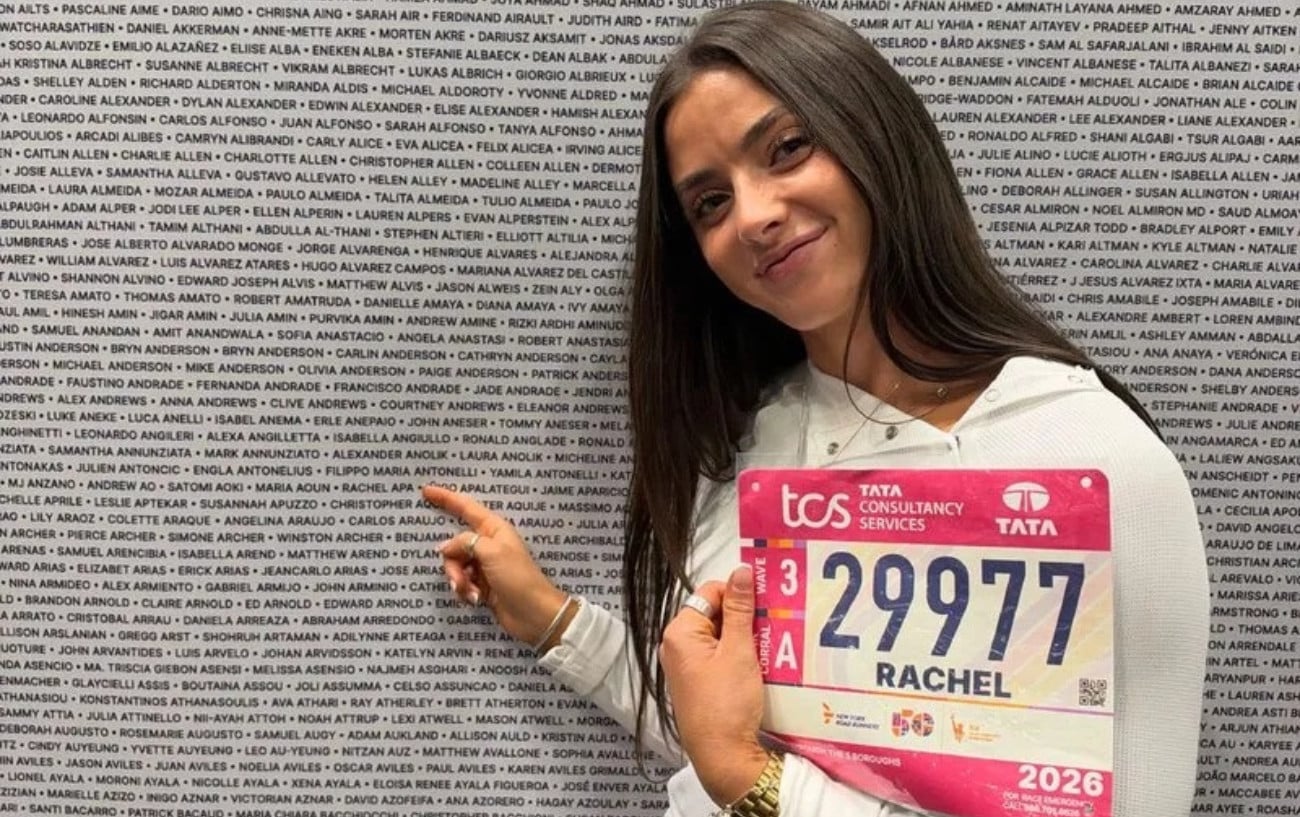
Rachel Apa was a little more than two miles from the end of her first marathon when she collapsed in Central Park on Sunday afternoon. The 24-year-old from Lewisberry, Pa., was taken to Mount Sinai, where doctors worked on her for about six hours before she was declared dead at around 9:40 p.m. Her father, Steve Apa, said she died of rhabdomyolysis, a condition in which damaged muscle breaks down and releases its contents into the bloodstream faster than the kidneys can clear them.
He gave the family’s account to the New York Times, which first reported her death on Monday. “It’s unfathomable,” he told the paper. “Perfect health, perfect shape, 24 years old.” He had been following her from home on the race app and sending her messages as she went, and she wrote back only twice after the halfway point, at Miles 18 and 19, to tell him she was hurting. Her mother, Michelle, was waiting for her farther along the course and went looking for her when the tracker showed she had stopped moving.
Spectators near 85th Street got to her first and started CPR, and the race’s medical staff used a defibrillator on her before an ambulance took her to the hospital. New York Road Runners, which organizes the New York City Marathon, said in a statement that it was “deeply saddened by the death of one of our runners following yesterday’s race.” According to NYRR, the last time a runner died after a medical incident at the marathon was in 2024.
Apa played as a forward on Bucknell’s Division I field hockey team, starting every game of her senior season in 2023, when the university named her to the Academic All-Patriot League team. She had since gone to work as a product manager for an electrical component company and had just started an MBA at Charleston Southern University.
She ran Sunday for the Parkinson’s Foundation’s Champions team, in memory of a grandfather who had Parkinson’s disease and died in 2022. “My grandfather was one of my role models growing up,” she wrote on LinkedIn. “He taught me to stay active, push my limits, and embrace challenges.” That made her one of the thousands of charity runners who had pushed the race’s fundraising past $100 million before the start.
Rhabdomyolysis at the New York City Marathon
Crush injuries, severe dehydration, some medications and inherited muscle disorders can all cause rhabdomyolysis, and so can hard exercise. The Cleveland Clinic puts the number of cases in the U.S. at about 26,000 a year and counts endurance athletes among the people most at risk, mostly when they push harder than their bodies are prepared for. Up to half of patients develop acute kidney injury, and the condition can be life-threatening without quick treatment. Everything known so far about the cause of Apa’s death comes from her family.
Physicians from Mount Sinai, where Apa was treated, and Lenox Hill Hospital looked at this race specifically in a paper published in Nephron in April. They counted 24 runners treated for rhabdomyolysis after the 2022 New York City Marathon, when temperatures peaked at 75 F with humidity near 80 percent. Across the 2017, 2018, 2019, 2021 and 2023 races combined, they counted 15. Nearly all of the 2022 patients had acute kidney injury and one needed dialysis, but the paper reports no deaths. Sunday was much cooler, with AccuWeather forecasting about 50 F for the early waves and a high near 60 F.
A study in JAMA last year counted 176 cardiac arrests among more than 29 million U.S. marathon and half-marathon participants between 2010 and 2023, and found the death rate had fallen by about half from the decade before, with bystander CPR and on-course defibrillators credited for much of the improvement. Apa’s death follows those of three other runners in their mid-20s at big races this fall: two 25-year-old men at the Great North Run in September, and Trey Lara, a 24-year-old pastor who went into cardiac arrest at the Portland Marathon in October.
Her fundraising page for the Parkinson’s Foundation was still open on Tuesday, and had raised more than $5,400 against a goal of $4,000.
RunClub
Get more running stories — join RunClub
Daily running news, a community of 300,000+ runners, free training plans for every distance, and a daily running game. Free to join — no card.
Already a member? Log in →






Start the conversation