


For the second time in four months, a machine has claimed a distance running mark off a Beijing start line. In April, a robot built by the smartphone company Honor covered a half-marathon in 50:26. On Saturday, as the World Humanoid Robot Games opened in Beijing, a robot named Tien Kung Ultra ran 100m in 9.39, 0.19 faster than any human has run the distance.
That human is Usain Bolt, whose 9.58 has stood since Berlin on Aug. 16, 2009, according to World Athletics. The sprint figure comes from Xinhua, which carried the organizer’s account of the opening session, and the Associated Press places the robot with X-Humanoid, a Beijing developer. The games are at the National Speed Skating Oval, a 2022 Winter Olympics venue, and Xinhua puts the field at 2,056 machines from 666 teams across 51 events.

A second and faster number is circulating, and it belongs in a different category. Honor said before the games that its robot Lightning, which stands 169cm, had covered 100m in 9.32 in a trial, reaching a peak of 14.5 meters per second, Reuters reported from footage aired by the state broadcaster CCTV. That run was not a competition result. Bolt’s own peak was 12.42 m/s (27.33 mph), reached between 60m and 80m.
Neither figure was ratified by anyone outside the industry that produced it. Saturday’s time was announced by the games organizer and the robot’s maker, and the body that sanctions the competition, the World Humanoid Robot Sports Federation, came out of the inaugural edition in 2025. Athletics settles the same question through ratification, and it has recently used that process against a human performance. Jacob Kiplimo ran 56:42 for the half-marathon in Barcelona in February 2025, and World Athletics rejected the record after finding that the pace vehicle had sheltered him from the wind. The mark on the books is the 57:20 he ran in Lisbon on March 8, 2026, 38 seconds slower.
Equipment is governed on the same principle, which is that the limit is set before the performance. World Athletics caps sole thickness at 20mm across track and field, in force since Nov. 1, 2024, and USATF applies 40mm on the roads. Rajpaul Pannu crossed the line first at the 2025 national 100-mile championships and lost the title in post-race review when his shoes measured 48mm at the heel. Honor lengthened Lightning’s legs from 95cm to 1.05m between events. The same question has been asked of super shoes in human running; no equivalent accounting exists for a machine whose proportions can be changed between competitions.
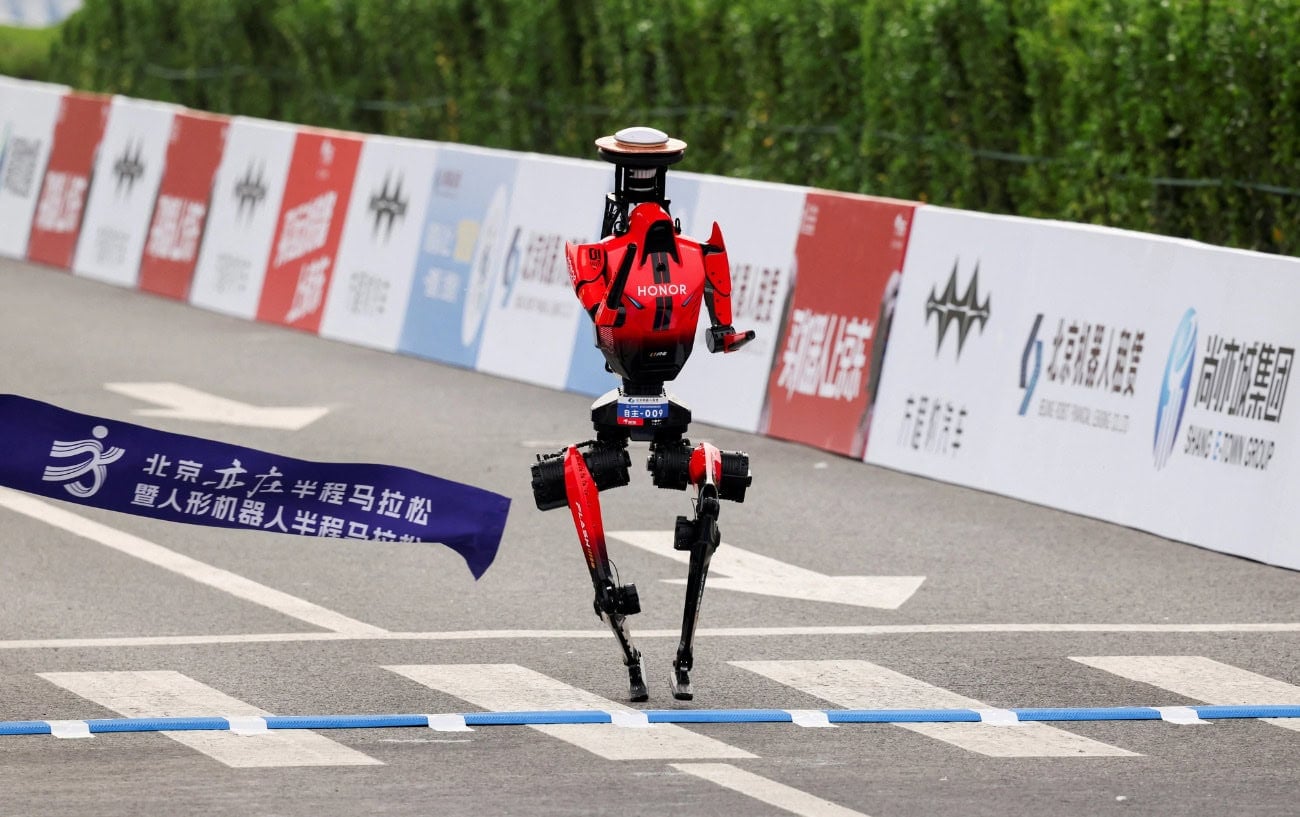
The opening day also showed what that performance costs. Robots that completed the sprint stopped by running into a padded barrier and going down, then were carried off, CBS News reported. Others came apart or caught fire in other events. Guo Yijie, technical lead of Tien Kung Ultra, told Xinhua: “The real challenge lies in turning peak performance into consistent reliability, while high-speed, long-distance running will expose structural fatigue, joint cooling, and drivetrain durability issues that must be addressed for long-term deployment.”
Sixteen months ago, the winner of Beijing’s first robot half-marathon needed about two hours and 40 minutes to finish and changed batteries three times along the way. The games run through Wednesday, with weightlifting and tug-of-war still on the schedule.
RunClub
Get more running stories — join RunClub
Daily running news, a community of 300,000+ runners, free training plans for every distance, and a daily running game. Free to join — no card.
Already a member? Log in →









Start the conversation