


Every April, the same script gets written. The previews roll in, the same two or three names get stacked at the top of every power ranking, and the narrative hardens into conventional wisdom before anyone’s tied their laces on Hopkinton Common.
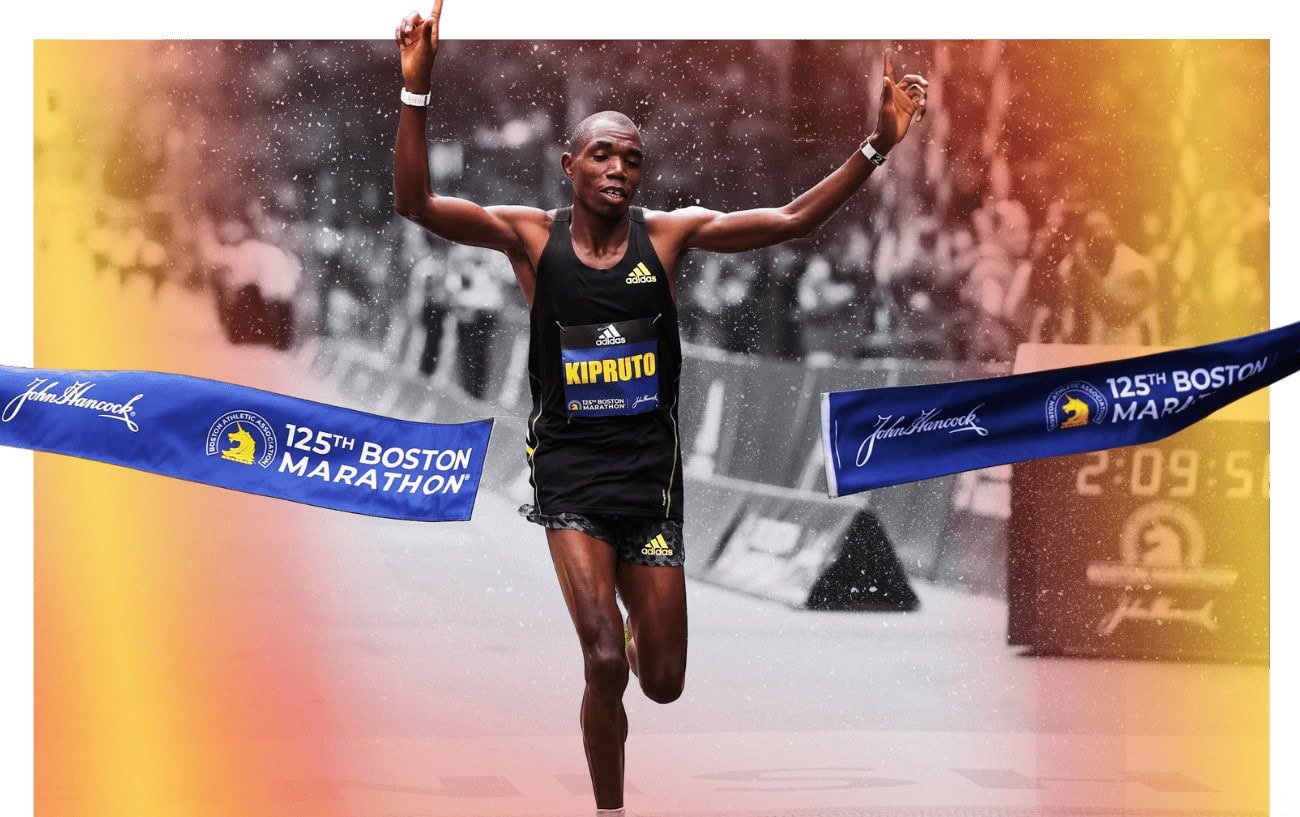
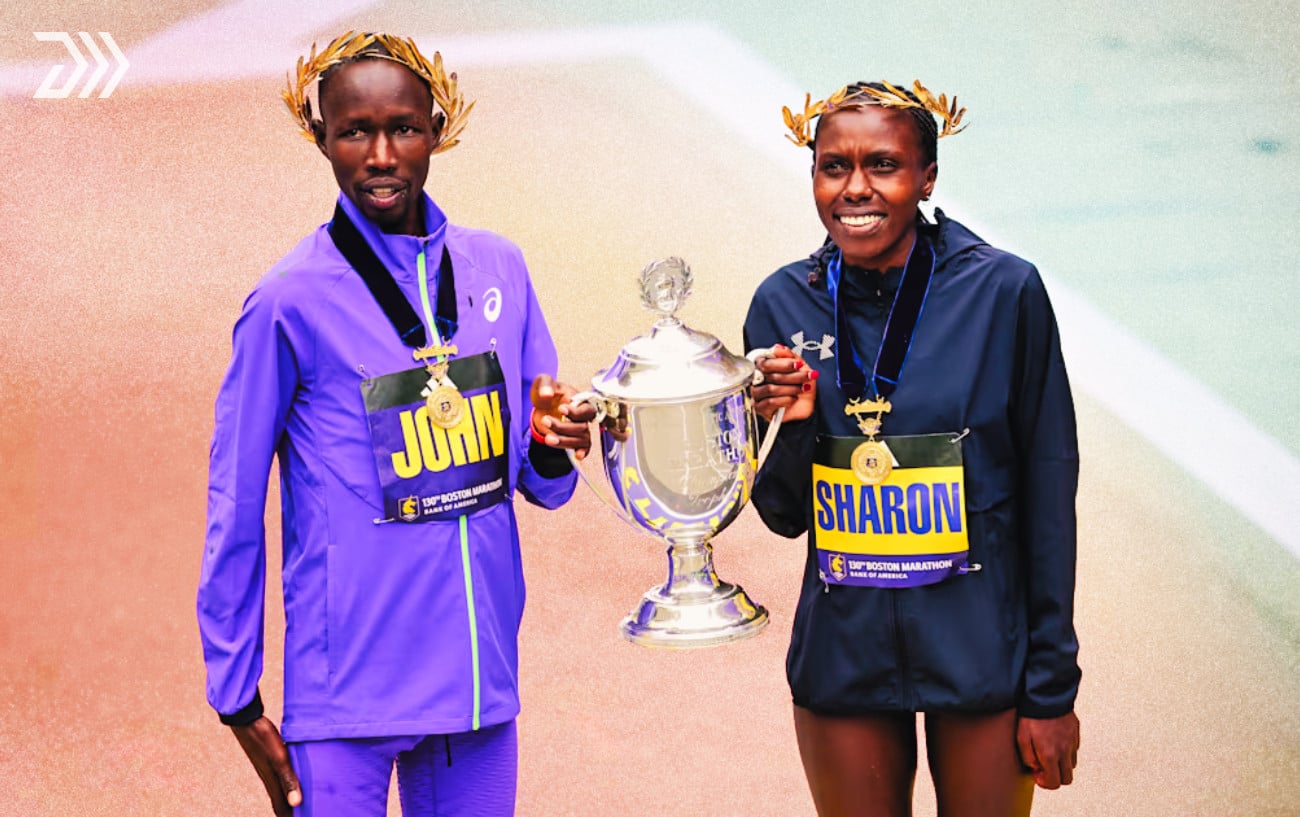
This year, the men’s story is Benson Kipruto — the man with the fastest PB in the field at 2:02:16 — versus defending champion John Korir. On the women’s side, the dominant question being asked is whether the American contingent can challenge Sharon Lokedi’s grip on the course record. Fine. Those are reasonable takes. But Boston has a way of making reasonable takes look foolish by Boylston Street.
Here are the names we think deserve a lot more attention — and the data to back it up.
Men’s Field
Alphonce Simbu: The Reigning World Champion
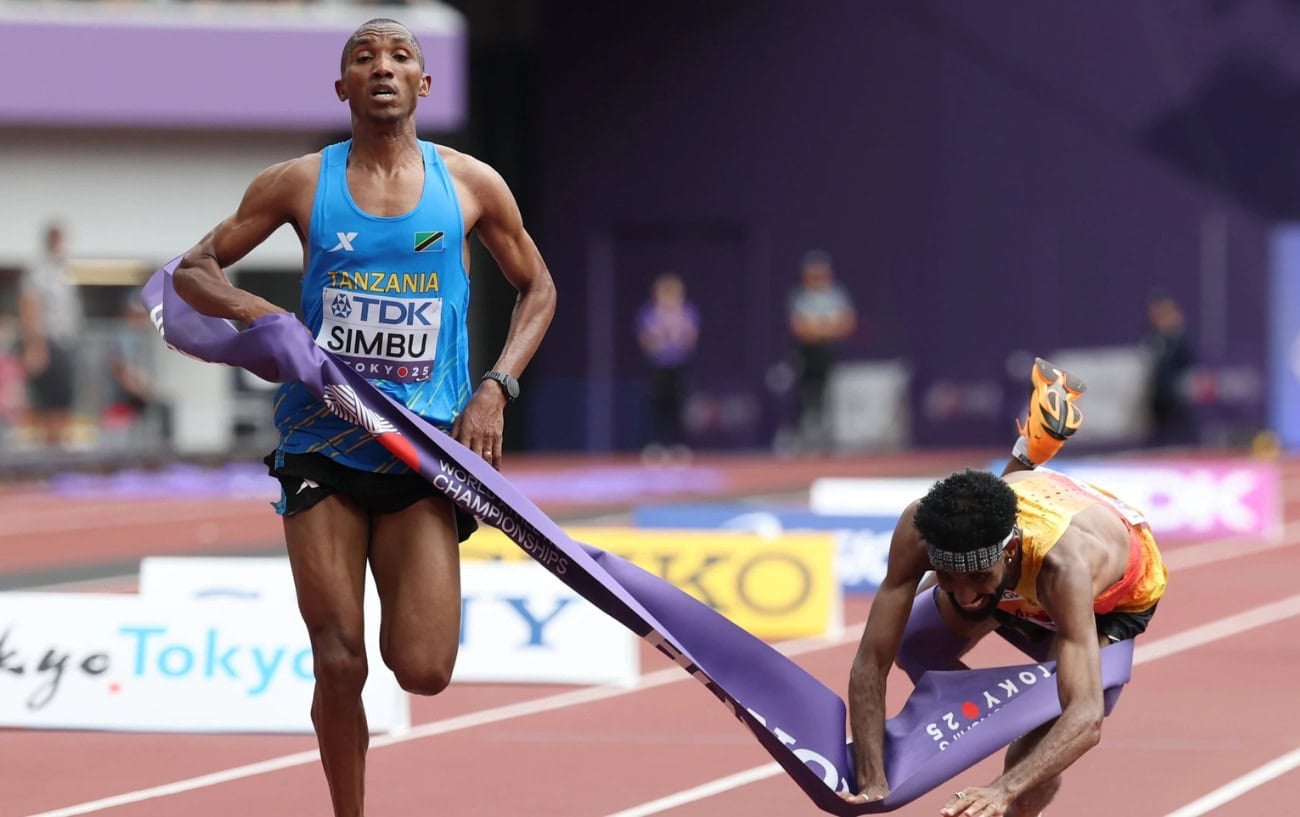
The consensus preview frames Alphonce Simbu as a great narrative: Tanzania’s first-ever global marathon champion, the 0.03-second photo finish in Tokyo last September. It’s a compelling story. What that framing misses is that Simbu is also one of the two or three most dangerous men in this field.
Look at his time progression over the past three years:
- 2022: 2:06:20 (Daegu)
- 2023: 2:06:19 (Osaka)
- 2024: 2:07:55 (Daegu), then 2:04:38 PB (Valencia, December)
- 2025: 2:05:04 (Boston, 2nd place), 2:09:48 (World Championship gold, Tokyo)
That Valencia 2:04:38 wasn’t a blip — it unlocked a new level. Six months later, Simbu finished second at last year’s Boston in 2:05:04. Three months after that, he won the World Championship in a sprint finish by three hundredths of a second. This is what a peaked athlete in championship form looks like.
The key question for Boston is always how a runner performs in tactical, competitive races rather than time-trial conditions. Simbu’s record says he thrives when the race comes down to the wire. He’s proven he can run 2:04:38 on a fast day, and he’s proven he can out-kick anyone alive on a hard day. Kipruto has the fastest PB in the field. Simbu has the deepest recent race record.
Abdi Nageeye: The Most Undervalued Runner in This Field
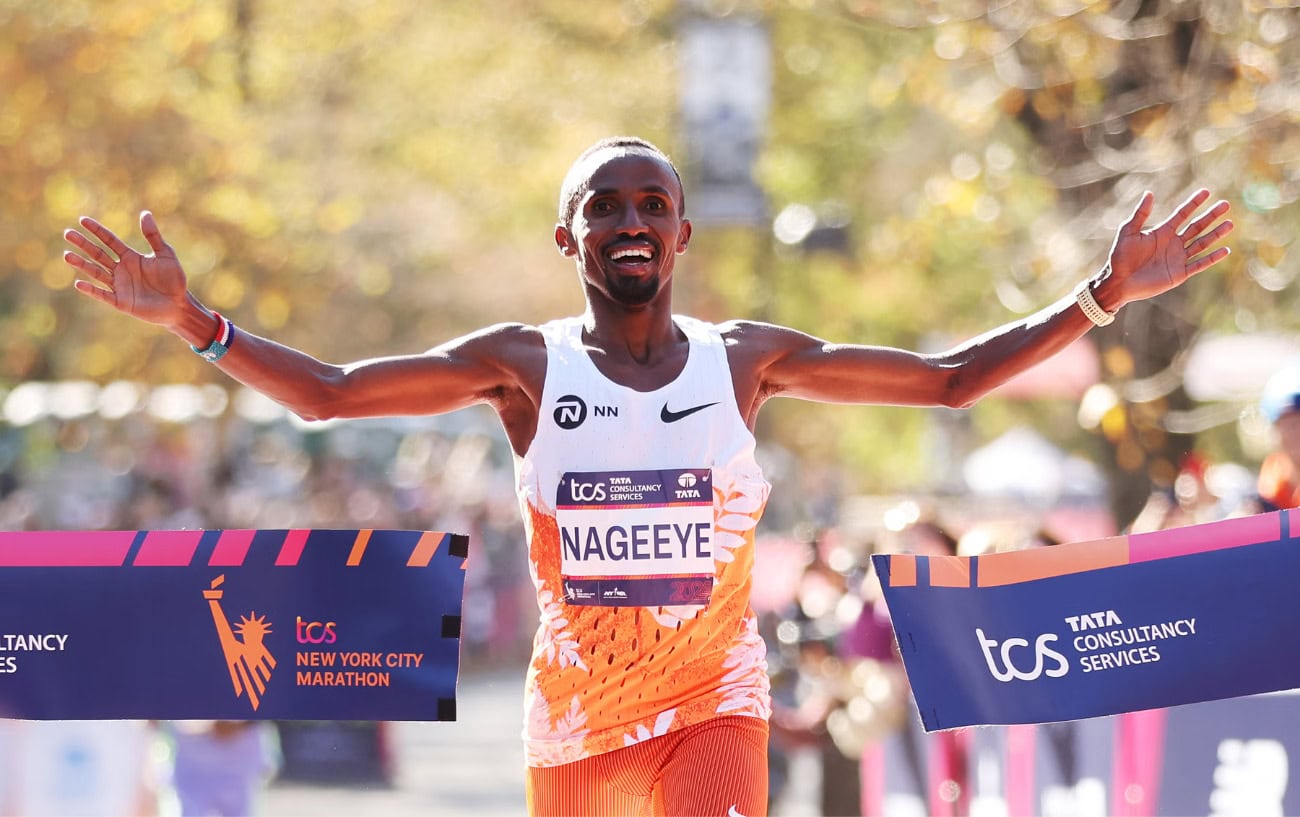
If there is one man in this entire field whose name is appearing in fewer previews than his resume warrants, it is Abdi Nageeye.
His marathon progression tells a story of an athlete who just keeps raising his ceiling:
- 2022: 2:04:56 (Rotterdam, WIN — first Dutchman ever to win Rotterdam, Dutch record at the time)
- 2024: 2:04:45 (Rotterdam, WIN — new Dutch record), then 2:07:39 (New York City, WIN — first Dutchman ever to win NYC, his first World Marathon Major victory at age 35)
- 2025: 2:04:20 (London, 4th — new Dutch record), 59:44 (NYC Half, Dutch record)
That is not a resume of a fading runner squeezing out one more result. That is the trajectory of an athlete who keeps improving at an age and pace that shouldn’t be possible. Nageeye’s 2:04:20 at last spring’s London Marathon is the fastest time in his career, run at 36 years old, 11 months after winning New York for the first time.
He is an Olympic silver medalist who races tactically and finishes fast. He has a Dutch national record in the half marathon. He has won the most recent marathon he entered. And he is coming to Boston — a course that rewards patient, tactical runners who know how to accelerate through suffering — for what may be the best shot of his career.
Zouhair Talbi: The Houston Momentum Is Undeniable
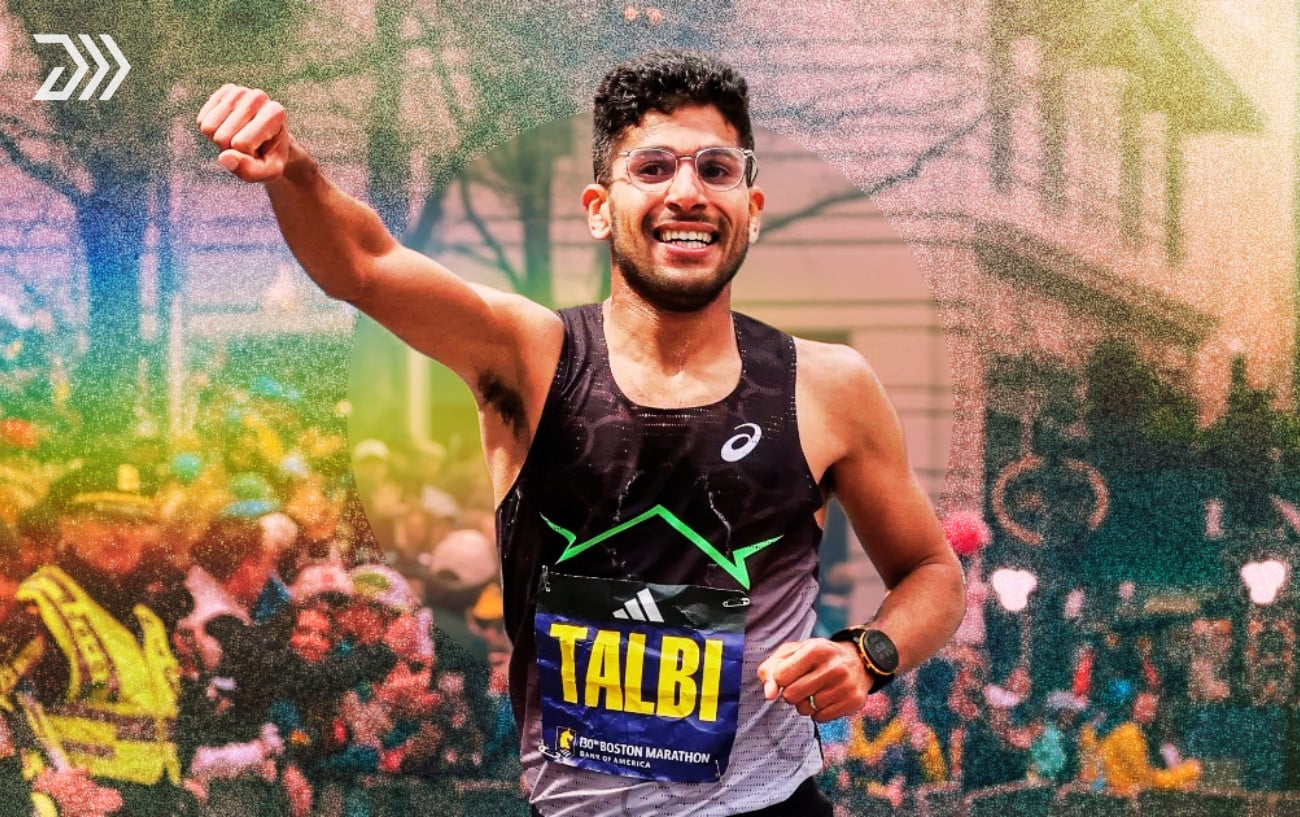
Zouhair Talbi’s story is one of steady, verifiable escalation — and the most recent data point demands attention.
- 2023: 2:08:35 (Boston, 5th — on this exact course)
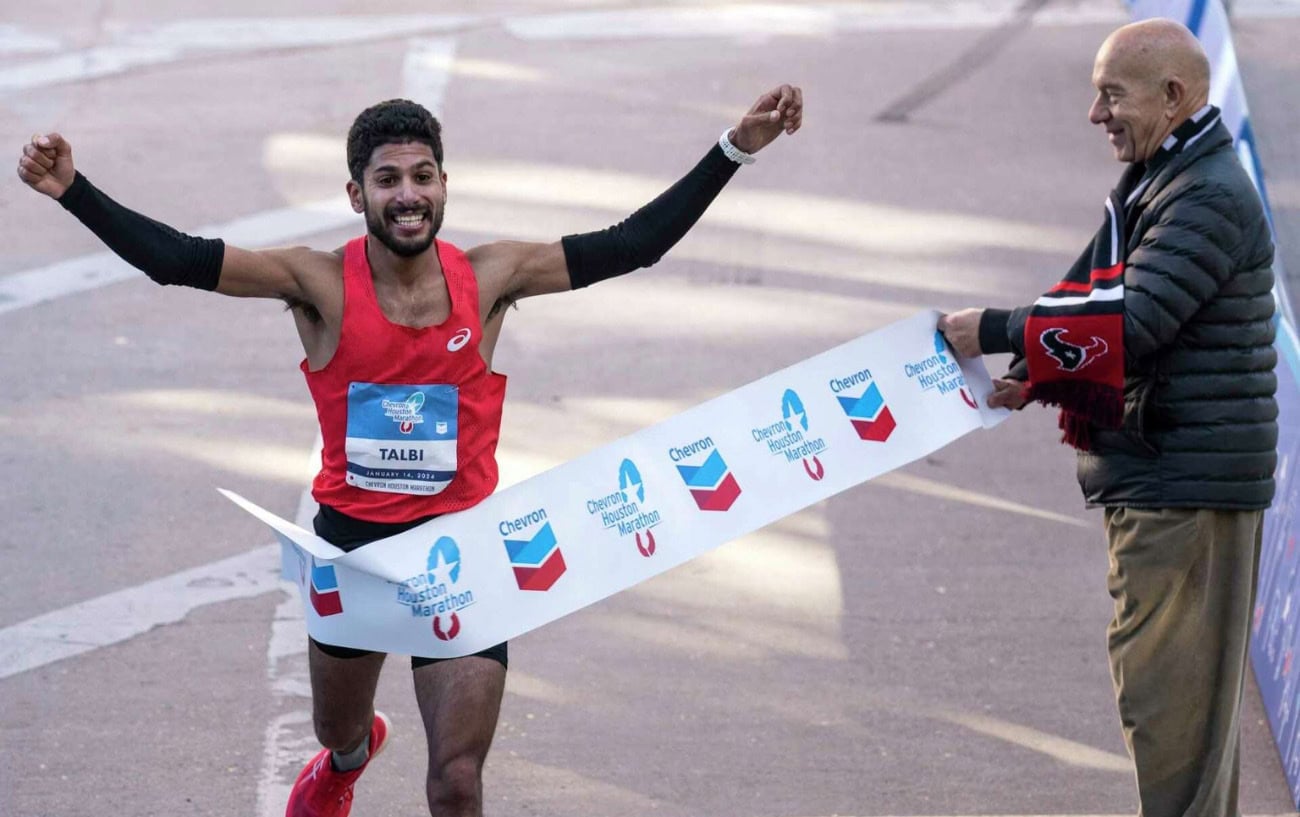
- 2024: 2:06:39 (Houston, WIN — course record)
- 2026: 2:05:45 (Houston, WIN — 4th fastest time ever by an American)
Back those up with a 59:41 half marathon at the NYC Half in March — where he finished second against an elite field — and you have a clear pattern: Talbi enters every race faster than he left the last one.
The knock coming in will be that he’s never converted his road speed into a top-three finish at a World Marathon Major. At 2023 Boston he ran 2:08:35 for fifth. But 2:08:35 and 2:05:45 are not the same runner.
The man who won Houston in January — on a fast course, in a competitive field, three minutes ahead of his 2023 Boston time — has had three months to build on that form. The fact that his only Boston start produced a fifth-place finish on the same course he’s about to race matters. He knows these roads.
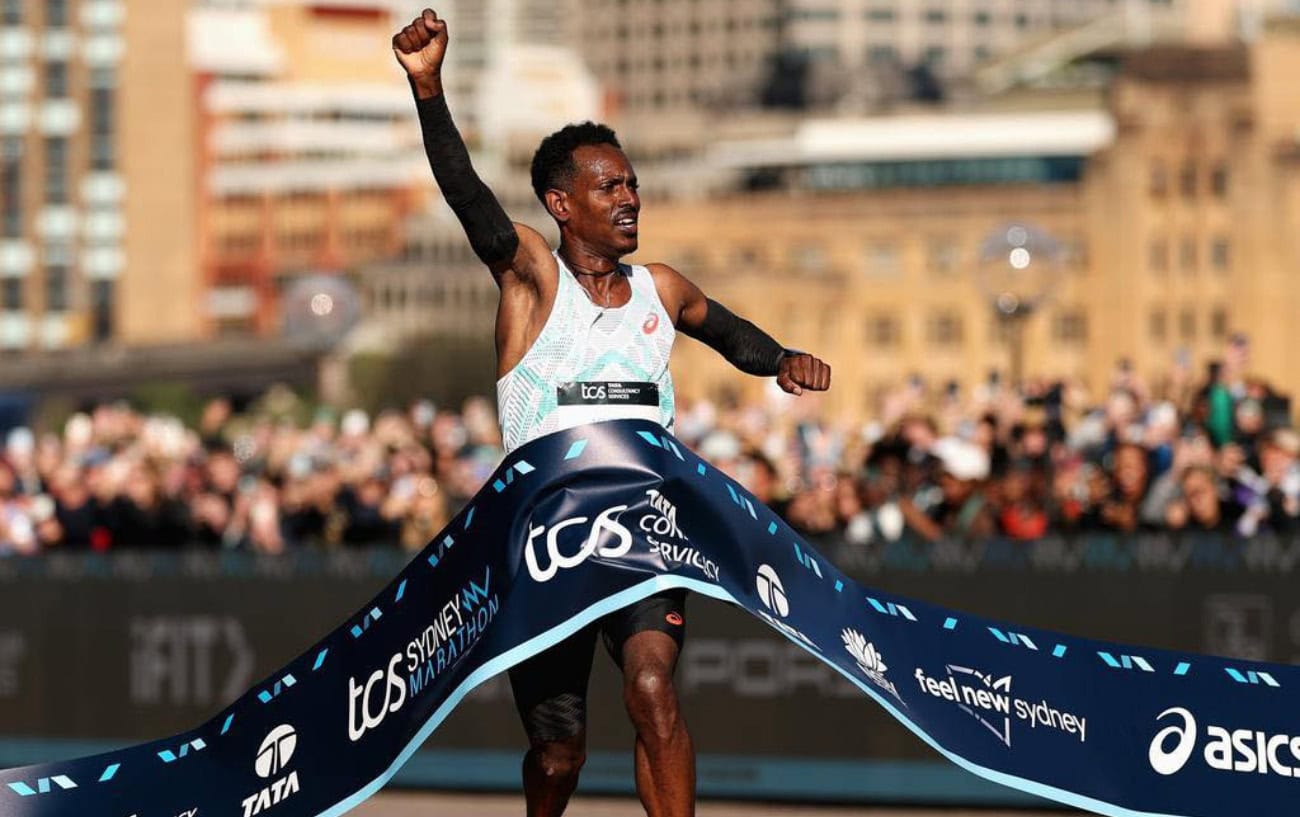
Hailemaryam Kiros: Sydney Was the Signal, Boston Is the Opportunity
Ethiopia’s Hailemaryam Kiros, 28, enters this race without the profile of a Simbu or a Nageeye, and that may be exactly the point.
His results through 2024 showed an athlete capable of running with the very best men in the world — 4th at Tokyo, 5th at Berlin — but not yet converting that presence into a win. His PB entering 2025 was 2:04:35, top-20 all-time, earned in a loaded Berlin field. Then came Sydney.
At the inaugural Abbott World Marathon Major in Sydney last August, Kiros won in 2:06:06, setting the course record and beating a quality international field by 10 seconds. It was his first WMM victory, and it came after two consecutive near-misses at the top of the hardest races on the circuit.
The pattern here is recognizable: an athlete with elite-level fitness who has been learning how to win. The Tokyo 4th and Berlin 5th were not results of weakness — they were results of going up against some of the best marathon fields in history in his first years at that level. Sydney was the payoff. The Boston course, with its patient first half and punishing Newton Hills, is tailor-made for an athlete who runs efficiently under pressure and has the fitness to go sub-2:05 on his best day. Kiros will enter with no pressure and a lot of horse.
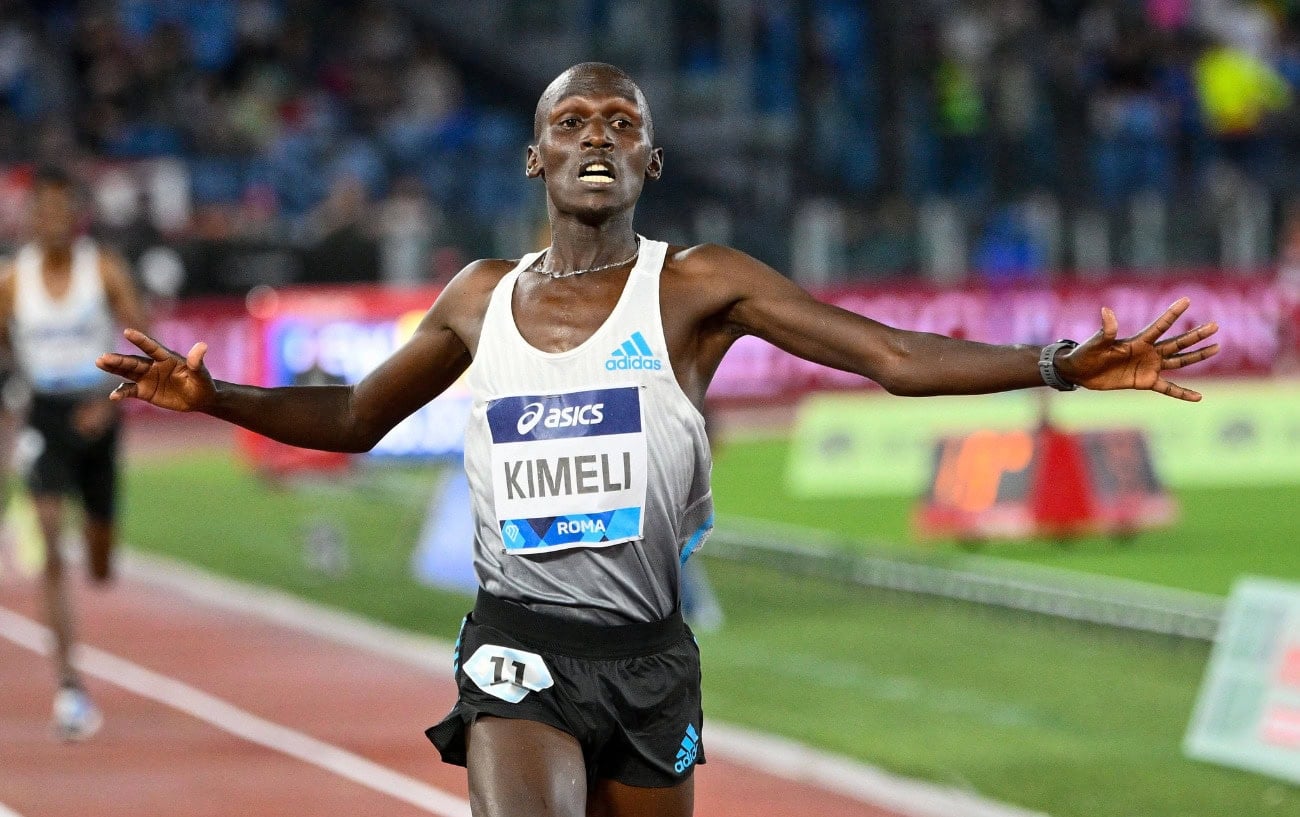
Nicholas Kipkorir: A Marathon Debutant To Keep Your Eyes On
There is a number that needs to be put in front of you before anything else is said about Nicholas Kipkorir: 58:08.
That is his half marathon personal best, run in March 2026. It is one of the top 25 half marathon times ever recorded. The theoretical marathon equivalent is 2:01:12 — which would not only win this race by several minutes, it would come within 37 seconds of the world record.
Kipkorir is 27 years old, currently ranked #4 in the world in men’s road running, and he has never run a marathon. Boston on April 20 will be his debut.
The case for him is almost embarrassingly straightforward on paper. He is a Diamond League Final winner, a three-time top-8 finisher at the World Championships, an Olympic finalist, and a Commonwealth Games silver medalist. His 5000m PB of 12:46 tells you his aerobic engine is built at the track level, not just the road. The 58:08 half suggests that engine has now been fully converted to road speed. There is no obvious ceiling.
The case against is the one that follows every debutant into Hopkinton: the Boston Marathon course is not a time trial. The net downhill opening miles punish runners who go out too fast. The Newton Hills arrive at exactly the point — miles 16 to 21 — where an athlete who has never been through 26.2 miles of race-day fatigue is most vulnerable. Kipkorir has the fitness to run 2:01. Whether he has the experience to manage the back half of Boston is an entirely different question.
But here’s the thing: the two most likely outcomes for a debutant of this calibre are either a spectacular implosion or a spectacular win. There is very little middle ground when the raw material is this good. If his team has done the preparation correctly — conservative early pacing, respect for the hills, patience through mile 18 — there is a legitimate argument that Nicholas Kipkorir is the most dangerous man in this field.
Women’s Field

Emily Sisson: One Of The Most Interesting Boston Debut in Years
Emily Sisson is making her Boston Marathon debut. She is 34 years old. She holds a personal best of 2:18:29. If that sentence doesn’t make you stop, re-read it.
Here’s the fuller picture:
- 2019: 2:23:08 London debut (2nd fastest American marathon debut at the time)
- 2022: 2:18:29 Chicago (American record, 2nd overall behind Ruth Chepngetich)
- 2023: 2:22:09 Chicago (7th, 1st American)
- 2024: 2:29:53 Paris Olympics (23rd, on a brutal course in brutal conditions); then relocated, took a lengthy break
- 2025: 2:25:05 NYC (8th, 3rd American — her return race after nearly a year away from racing)
That NYC return result is the most interesting number in her recent log. After a difficult Olympic year and a full reset, Sisson came back at New York and ran 2:25:05 — enough to lead the American women in one of the strongest NYC women’s fields in history. That’s not a runner grinding through a comeback. That’s a runner who took time to reset and came back running.
The 2:18:29 PB is the ceiling. The 2025 NYC result is the floor. Boston debuts are unpredictable, but first-timers who bring Sisson’s experience, tactical intelligence, and raw speed don’t stay in the dark for long.

Calli Hauger-Thackery: Back-to-Back-to-Back Wins
Calli Hauger-Thackery only ran her first marathon in 2023. By 2026, she is Britain’s second-fastest women’s marathoner ever. The speed of that progression is hard to overstate.
- 2023: 2:22:17 (debut, WIN — McKirdy Micro Marathon)
- 2024: 2:21:24 (Berlin), 2:24:28 (California International Marathon, WIN — course record)
- 2025: 2:22:38 (Boston, 6th), DNF Chicago (attributed to travel fatigue), WIN Honolulu (December)
- 2026: WIN Houston (2:24:17, January)
Since December 2025, Hauger-Thackery has not lost a marathon she’s finished. She won Honolulu. She won Houston. She comes back to Boston — a course where she already has a top-ten finish and intimate knowledge of the Newton Hills — in the best shape of her life, off two wins in 90 days.
The narrative around her will note the Chicago DNF and perhaps the fact that 2:21:24 doesn’t lead this field’s PB list. But that misses the point. Form isn’t a PB from 18 months ago. Form is what she just did in January and what she did in December. No woman in this field is entering Boston on a hotter streak. If her progression continues at even half its current pace, she has a 2:20 or faster in her relatively near future — possibly in this race.

Jess McClain: She’s Already Proved She Can Run This Course
There’s no mystery about what Jess McClain can do at Boston. She’s already done it.
Her improvement over four years is as linear a progression as you’ll find anywhere in the women’s field:
- 2022: 2:33:35 (Mesa Marathon, debut, WIN)
- 2023: 2:29:25 (Grandma’s Marathon)
- 2024: 2:25:46 (US Olympic Trials, 4th — missed the Paris team by 15 seconds), then 2:27:19 (NYC, 8th)
- 2025: 2:22:43 (Boston, 7th overall, 1st American — a 3+ minute PB on a course not known for fast times)
That 2025 Boston result is the one to focus on. A 3-minute personal best, set on this specific course, on this specific day, in a competitive field. Boston doesn’t give away fast times. The Newton Hills make sure of that. For McClain to drop from 2:25:46 to 2:22:43 between her Olympic Trials run and her 2025 Boston race — not at a flat, wind-aided course, but here — suggests she runs this course well.
In a deep American women’s field where attention consolidates around a few names, McClain risks being the runner everyone respects on paper but doesn’t fully account for. That’s exactly where you want to be in a field this size.
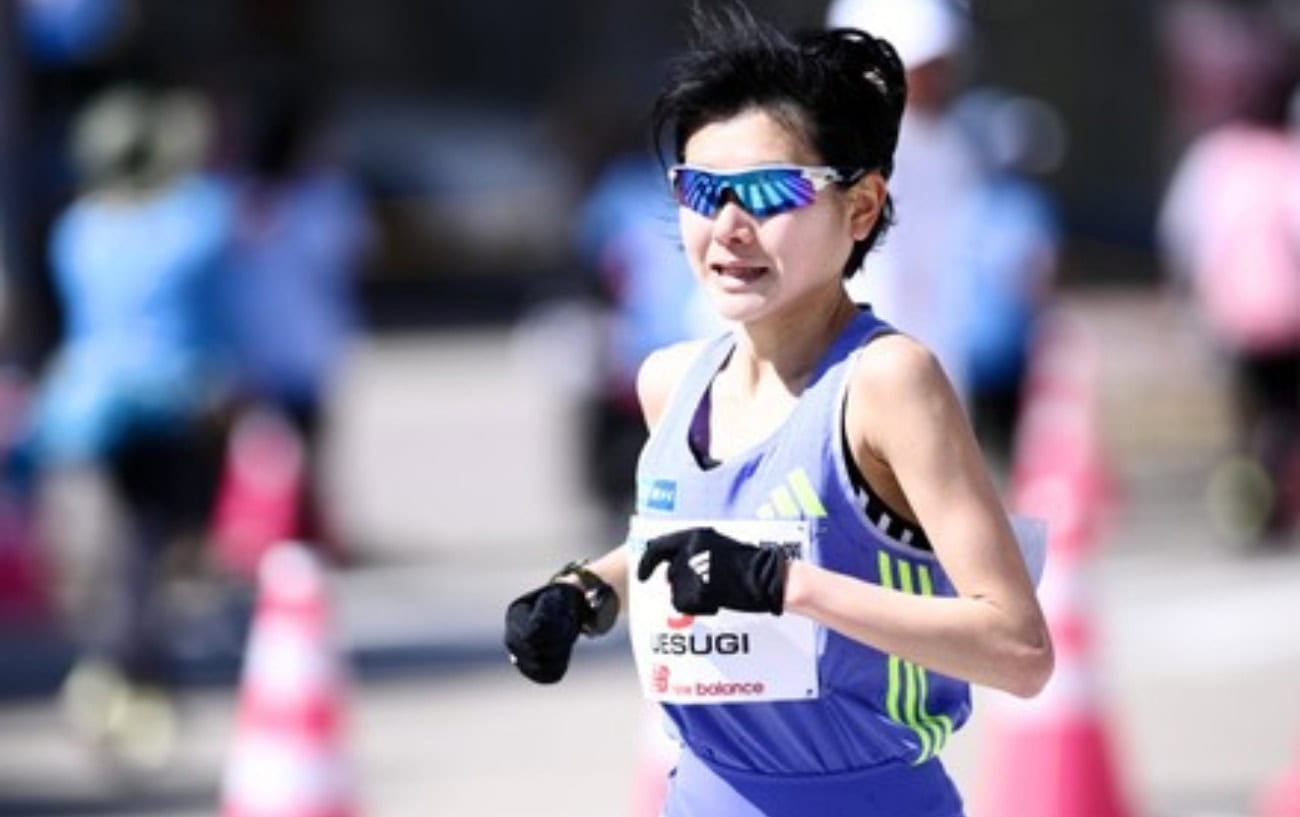
Mao Uesugi: The Japanese Long Game
Mao Uesugi’s personal best of 2:22:11, set at Nagoya in March 2025, puts her right in the mix with the American pack. That’s the easy read. The harder read is what it means in context.
- 2023: 2:25:18 (Osaka, 4th)
- 2025: 2:22:11 (Nagoya, PB)
That’s a three-minute improvement over roughly two years, still on an upward curve, on courses specifically suited to fast times. Boston is not Nagoya. The question is whether Uesugi’s improvements translate to a point-to-point course with a challenging second half — and history offers a useful frame here.
Japanese women marathon runners, trained methodically for decades inside one of the world’s most sophisticated marathon development systems, have a strong record of outperforming their seed at major international marathons.
They tend to run even or negative splits, stay disciplined when the early pace tests the field, and arrive at the hills in better shape than many faster athletes on paper. The Newton stretch — miles 16 through 21 — historically reveals who has been running within themselves. Watch for Uesugi to be quietly in contention when the race gets real, past mile 21.
RunClub
Get more running stories — join RunClub
Daily running news, a community of 300,000+ runners, free training plans for every distance, and a daily running game. Free to join — no card.
Already a member? Log in →







Start the conversation