


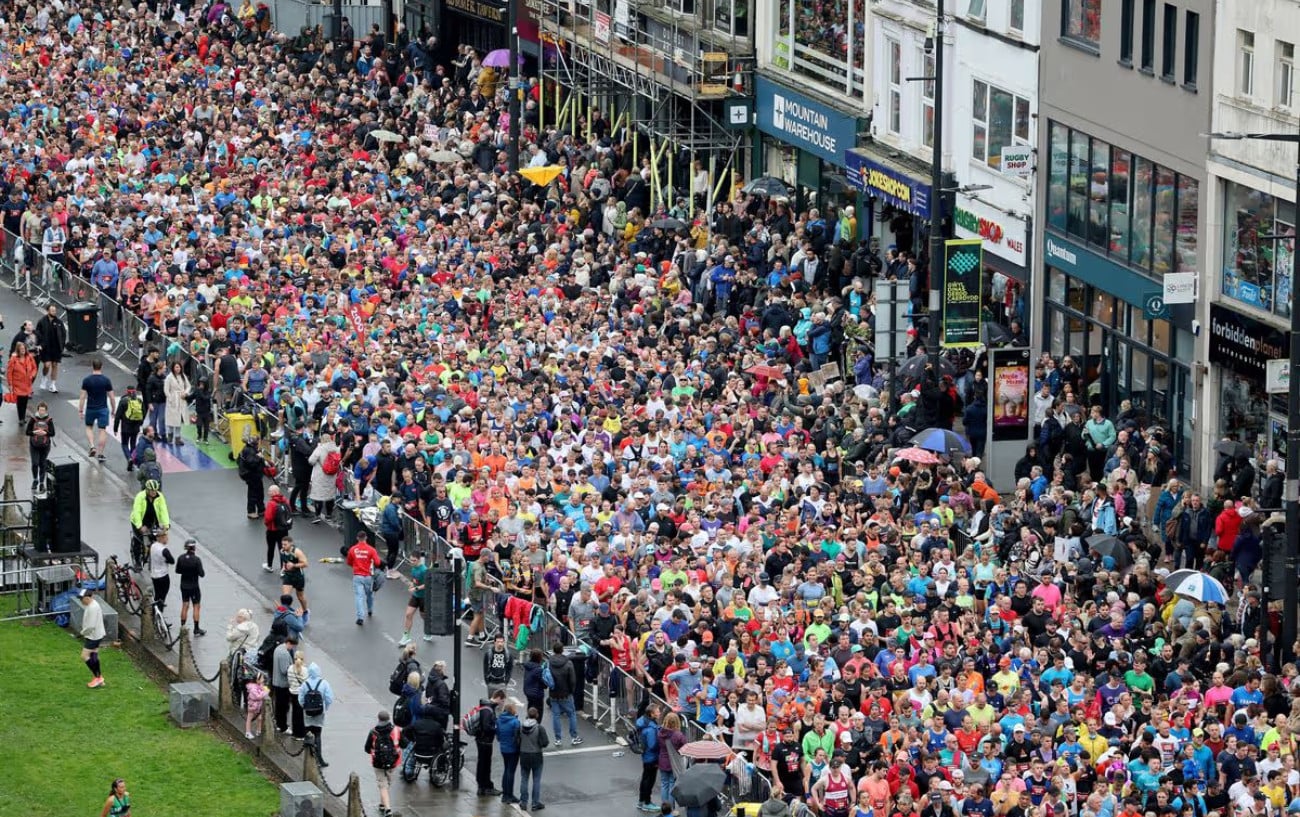
On Sunday, May 24, roughly 27,000 runners will fan out from Green Point for the 17th edition of the Sanlam Cape Town Marathon. The 26.2-mile loop that follows is the second-most consequential morning the course has ever hosted, the first being the 2025 edition, which was called off ninety minutes before the gun when overnight gusts ran past 60 km/h.
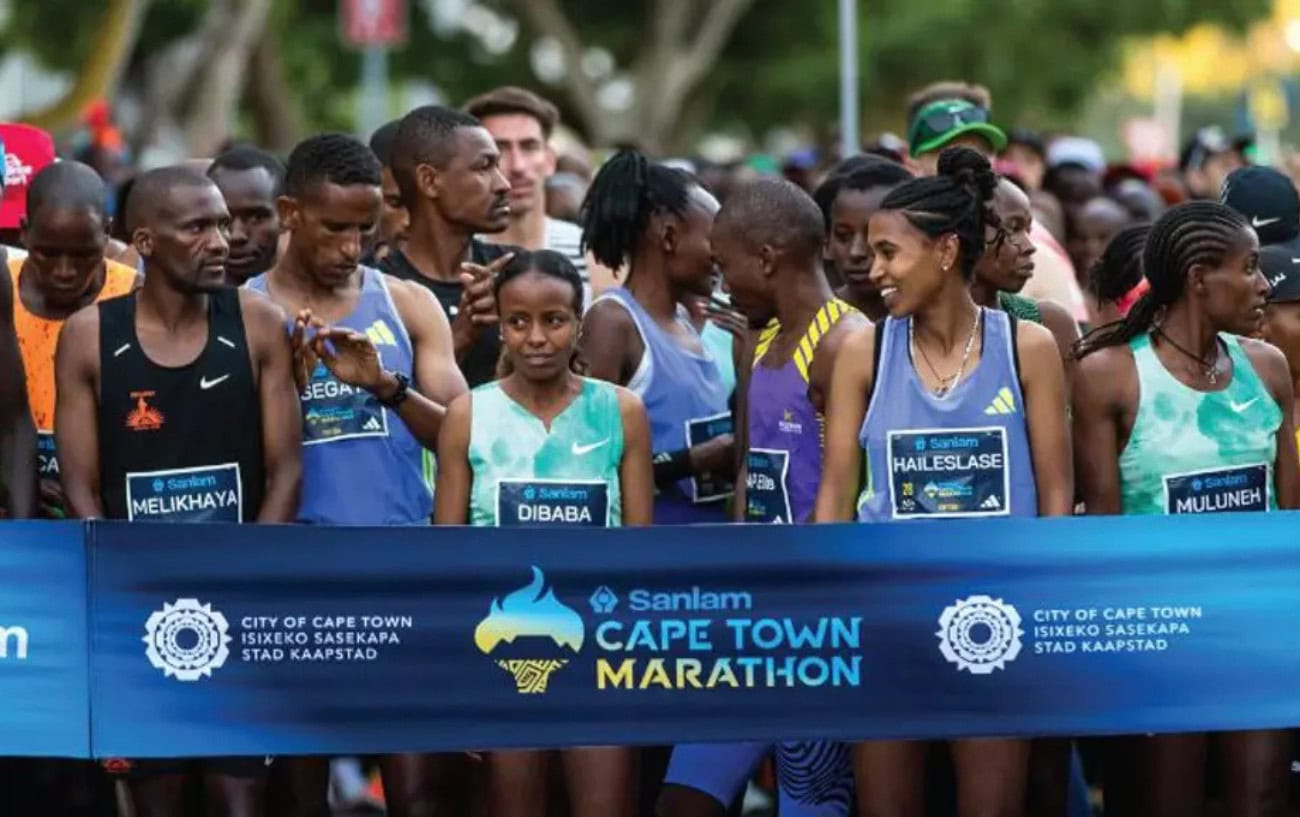
The race shifted to May to escape Cape Town’s spring winds, and the field that arrives on Sunday is the deepest in the marathon’s history. Eliud Kipchoge runs his first African marathon here. The two-time Olympic champion is the headline name in a men’s field that includes 14 sub-2:08 athletes, alongside a women’s race featuring nine women under 2:22.
The other reason the race matters: this is the second of two Abbott World Marathon Majors candidacy assessments. If Cape Town passes, it becomes the seventh Major from 2027. All 2026 finishers receive a provisional Abbott star that converts retrospectively if the candidacy clears. For everything else worth knowing about the race itself, see our everything-you-need-to-know guide to the 2026 Cape Town Marathon.
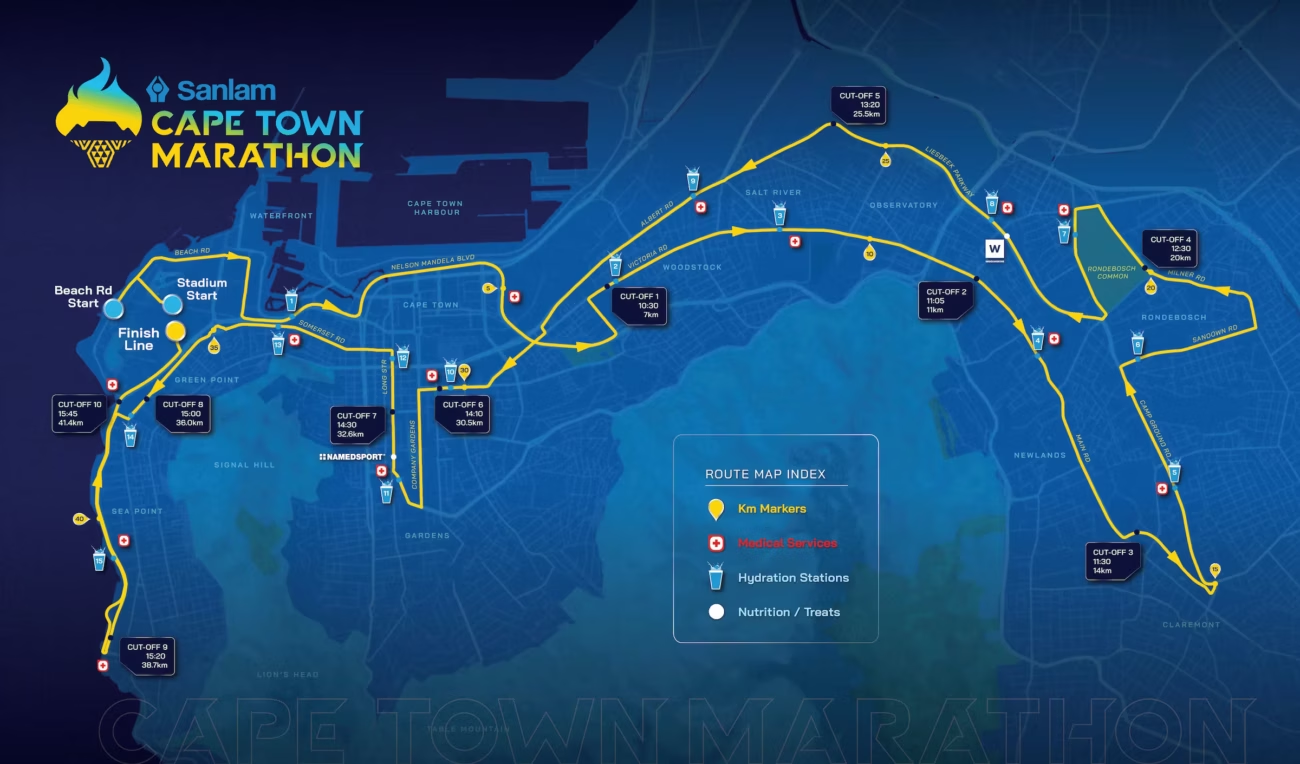
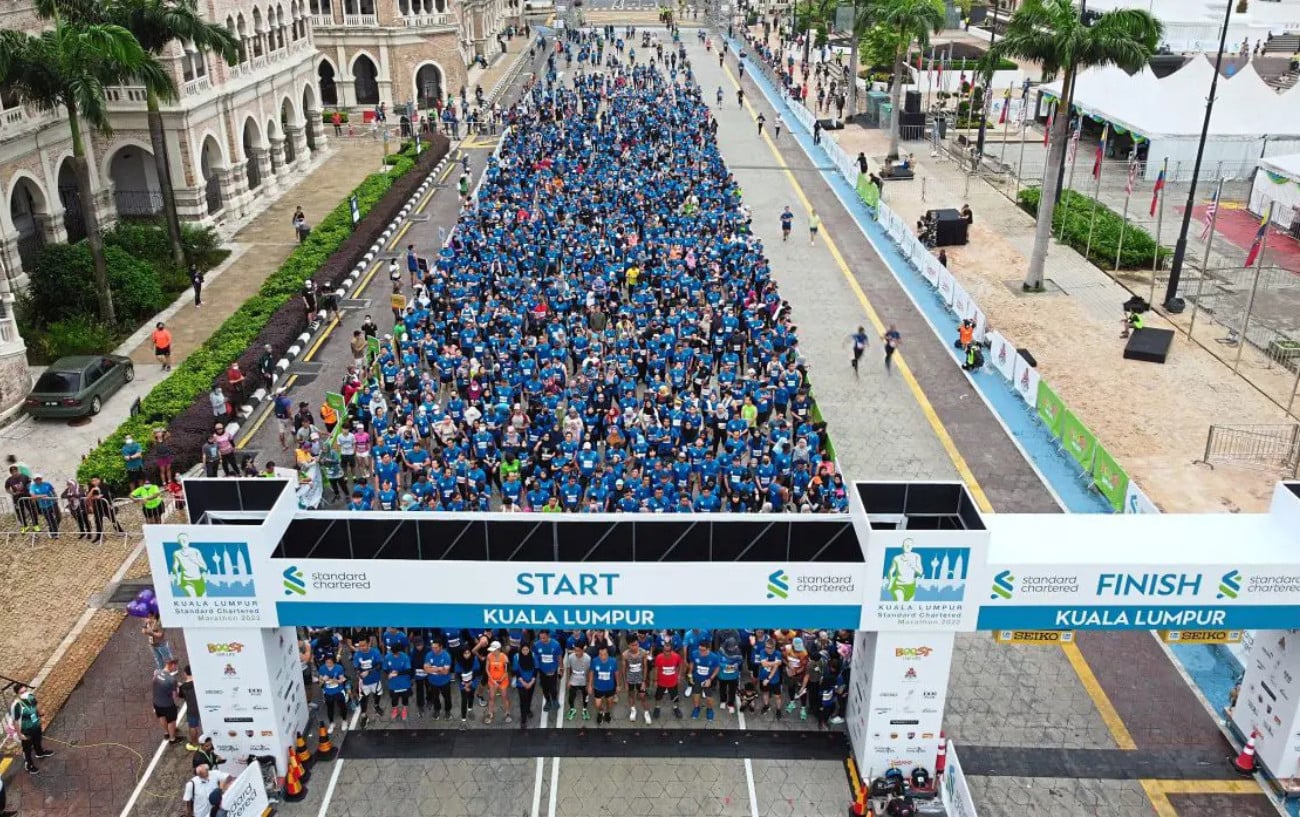
The course uses two start lines in 2026 for the first time. The Stadium Start, on Fritz Sonnenberg Road alongside DHL Stadium, hosts the elite field and the Yellow Wave. The Beach Road Start, an eight-minute walk away in Mouille Point, takes the Pink and Red Waves. The two routes merge inside the first kilometer, and the entire field is together by Mile 1.
The first few miles
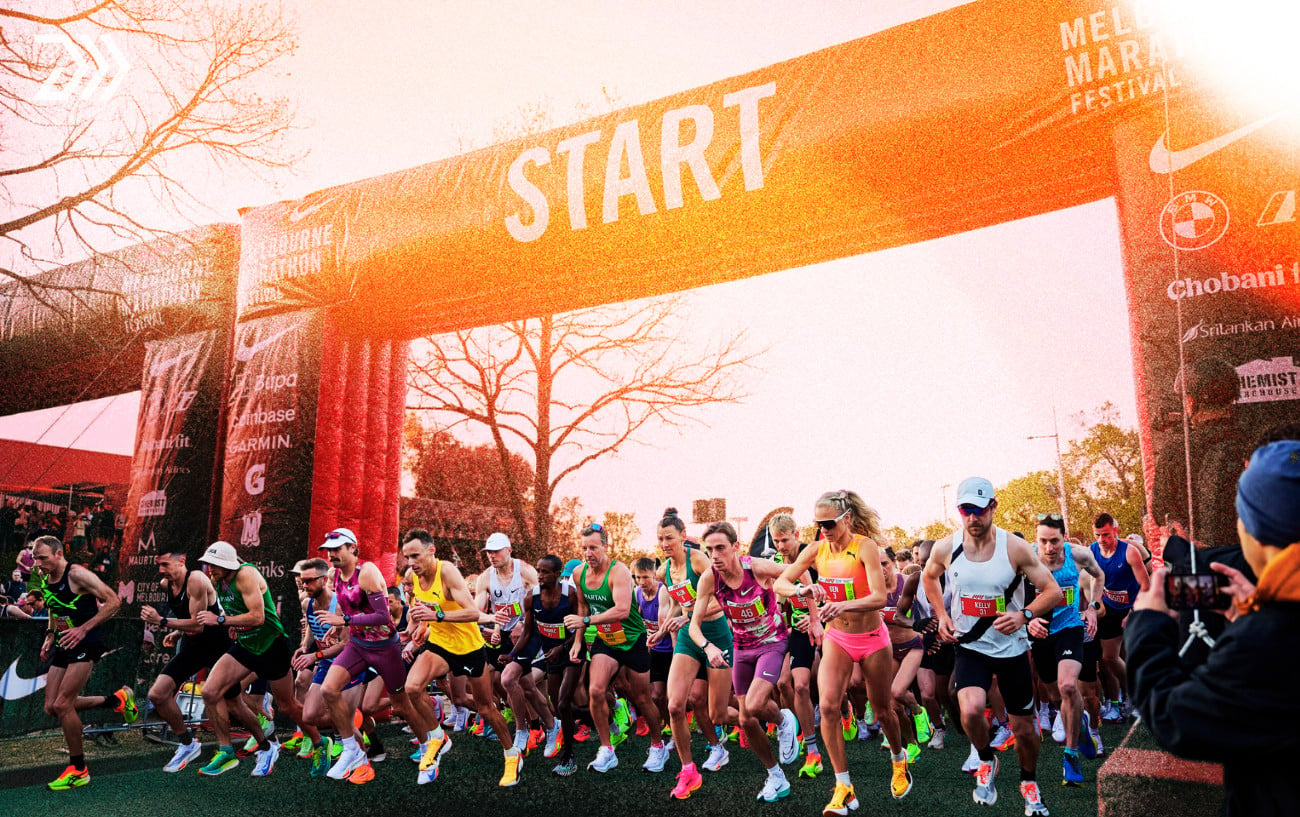
The wheelchair race goes off at 7:50 a.m. The elite men and elite women break at 8:00 a.m. Mass waves follow at 8:10, 8:40 and 9:06.
Out of Green Point, the road tilts gently down toward the Foreshore. The opening 5 miles are the easiest section of the course, with wide tarmac, mild downhill bias, and a steady tailwind on most morning forecasts. The temptation here is to bank time. Don’t. Cape Town has a sustained climb in the back half that most first-timers underestimate, and a surge in the opening 5K is one of the more reliably punished mistakes in the dataset.
By Mile 2, the field is on Nelson Mandela Boulevard, heading into central Cape Town. The first water station appears at the 2K marker and reappears at roughly two-and-a-half-kilometer intervals through to the finish, the standard South African road-race rhythm. Water comes in sachets, not bottles. Tear the corner with your teeth, drink, discard. Powerade is poured at every station alongside the water. Coca-Cola is added from kilometer 25 to the finish, unusual on the global Majors circuit, common in South Africa, and worth practicing with before race day if you are traveling in from abroad.
There are no on-course gels. Carry your own. Our complete guide to running with gels covers the timing and our guide to how many gels you actually need is worth a read in the taper.
City centre, City Hall and the Castle
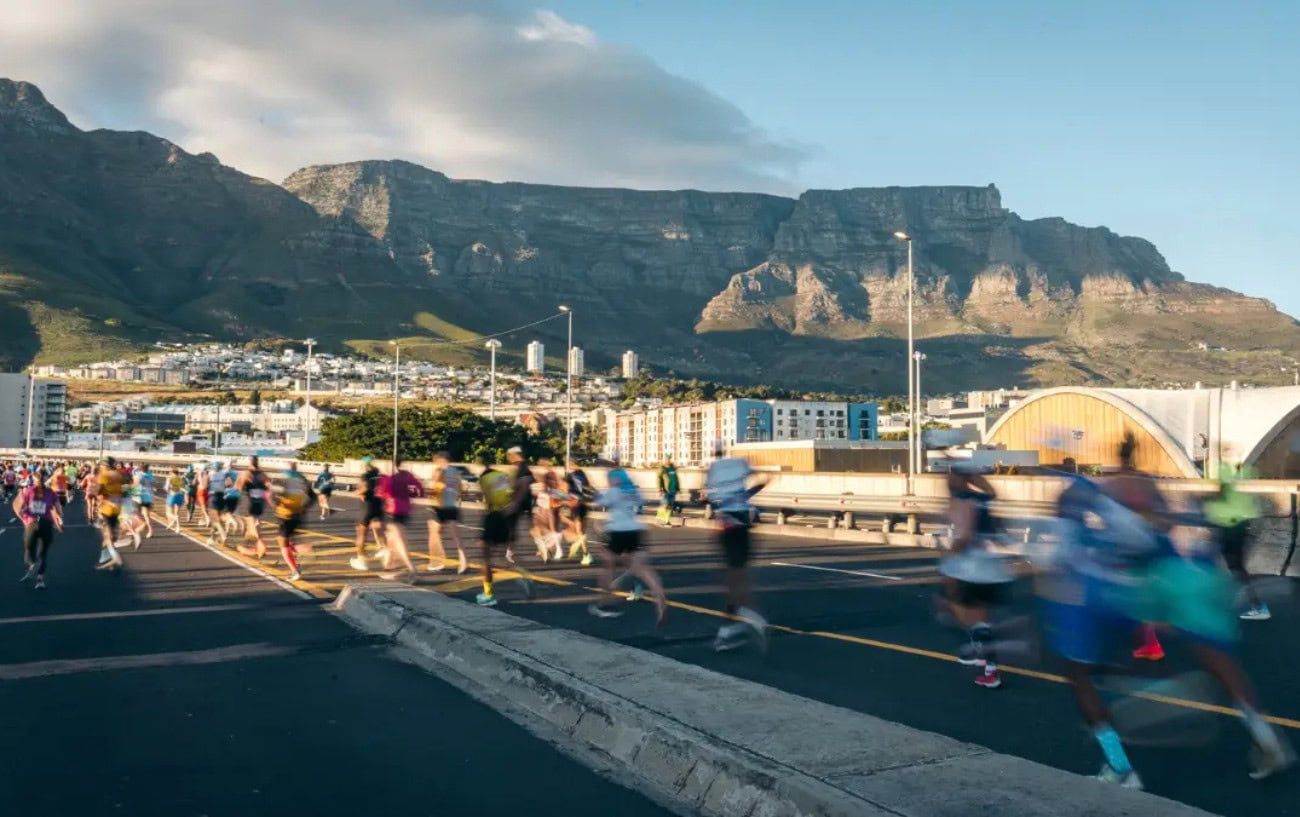
The V&A Waterfront crowds catch the runners just before Mile 2. This is the first dense crowd block of the day, and the noise off the water is louder than the road’s width suggests it should be. From there, the course peels south, picks up the city center proper, and runs past Cape Town City Hall and the Castle of Good Hope at around Mile 3 to 4.
The road is wide. The gradient is gentle. The City Hall section has a slightly tighter road than the Foreshore, and the crowds compress accordingly. This is the section that television will linger on for the early elite shots, the Castle in the background, Table Mountain framing the runners from the right.
Most of the local Cape Town spectators set up here, in the V&A area, or on the seafront in the closing miles. The City Hall section is the easiest of the three to reach on foot from central accommodation.
Into the southern suburbs
From Mile 4 onwards, the route turns south through Woodstock and Salt River, two neighborhoods that bring louder, noisier crowd support than elite marathon racing typically gets. Local clubs run impromptu cheer stations on the corners. House music drifts out of front yards. The atmosphere shifts from a city-center marathon to a community road race over about a kilometer.
By Mile 7, the field is in Mowbray. By Mile 9, it is climbing gently, but unmistakably, toward Rondebosch Common. The rise here is the first time the course has asked anything of the legs. Marathon Handbook’s own analysis of South African road-race splits shows that recreational runners fade more sharply between Mile 8 and Mile 11 at Cape Town than they do at the equivalent point on any other Comrades-qualifier marathon, mostly because the climb is gradual enough that it doesn’t register as a hill but steep enough that it adds up.
Rondebosch Common at Mile 11 is where the elite race tends to break apart on the men’s side. The lead pack thins from sixteen to eight here, year after year. On the women’s side, it is where the four- to six-runner lead group historically forms.
Halfway sits just past the Newlands cricket and rugby grounds at roughly Mile 13.1. The course flattens briefly. Settle in. The hard part is next.

The climbing section
From halfway, the course swings north-west and back toward the coast. This is the section Cape Town locals know to respect, and the section international visitors most often run badly because the elevation profile makes it look manageable on paper.
There is a sustained climb from Mile 15 through Mile 17. It isn’t steep. It isn’t long enough to break anyone outright. But it lasts long enough to feel disproportionate in marathon legs at that point in the race, and it is followed by an uneven downhill that confuses pacing and shreds quads if it is attacked too hard.
GPS watches sometimes drift around the higher-elevation buildings on this stretch, particularly through the University of Cape Town corridor. Trust the mile markers. The lap-pace screen is going to lie to you for the next twenty minutes.
The crowds thin meaningfully here. This is the quietest part of the course. If you are pacing a friend, Mile 17 is the place to stand. They will need it.
The coastal return
The Atlantic Ocean appears off the right shoulder somewhere around Mile 18. The course settles into the seafront return, and the visual centerpiece of the race opens up. Sea Point promenade. The Atlantic on the right. Lion’s Head and Table Mountain frames the back of the course on the left. The road is flat. The wind, off the ocean, is the only meaningful obstacle.
The Sea Point crowds are the deepest of the day. Sunday-brunch tables turn into cheer stations. Café terraces line both sides of the road. Runners who paced the climb correctly tend to negative-split this section. Runners who didn’t pace it through gritted teeth.
The closing miles run a long, gentle bend along the seafront, Mile 22, Mile 23, Mile 24, with the finish line a constant presence in the distance. The course turns inland through Mouille Point at Mile 25, drops onto Vlei Road, and finishes on the lawns alongside DHL Stadium with Signal Hill rising directly above the line.
The final 385 yards are flat. The crowd is thick. You will not need the watch.
Advice for first-timers
Toilets are spaced every aid station from kilometer 2 onwards. Cape Town’s aid stations are large by international standards, partly a function of the long South African road-race tradition, and partly a function of the WMM candidacy push, which places heavy emphasis on on-course operations.
The course markers are in kilometers, not miles. Mile markers are also painted on the road as a courtesy to international runners, but the primary signage is in metric units. If you have only trained with mile splits on a Garmin, set up a second screen with kilometer splits before race morning.
The weather forecast at the time of writing is close to ideal: a high of 20°C (68°F), a low of 12 °C (54°F), and light south-easterly morning winds. That is the kind of forecast that puts the course records, 2:08:15 for men, 2:22:22 for women, both set in 2024, into play.
Cape Town’s post-race village runs until 4:00 p.m. on the Vlei Road and DHL Stadium lawns. The Family Meeting Area is alphabetical by surname, organised on the lawn immediately past the finish chute. The race-day party schedule continues into Sunday evening, with live music on the stadium lawns and dense bookings at V&A Waterfront restaurants. If you have plans for Sunday dinner, you should already have a reservation.
A few practical reminders, none of them about pace. Wear sunscreen regardless of the forecast — the Cape Town sun reflects off the Atlantic and the late miles are exposed. Practise with Coca-Cola in your long runs if you plan to use the on-course supply after Mile 16. And stop on the promenade for ten seconds, sometime between Mile 22 and Mile 24, and look up. This is the view that puts Cape Town on every serious runner’s bucket list of marathons.
For runners debuting the marathon distance at Cape Town, our strategies for your first marathon cover the basics that the EYNTK guide doesn’t.
The finish line opens to spectators by 10:00 a.m. The elite men should be through somewhere between 10:08 and 10:15. The first mass-wave finishers follow about 50 minutes later. By 12:30 p.m. the lawn is full.
RunClub
Get more running stories — join RunClub
Daily running news, a community of 300,000+ runners, free training plans for every distance, and a daily running game. Free to join — no card.
Already a member? Log in →


Start the conversation