


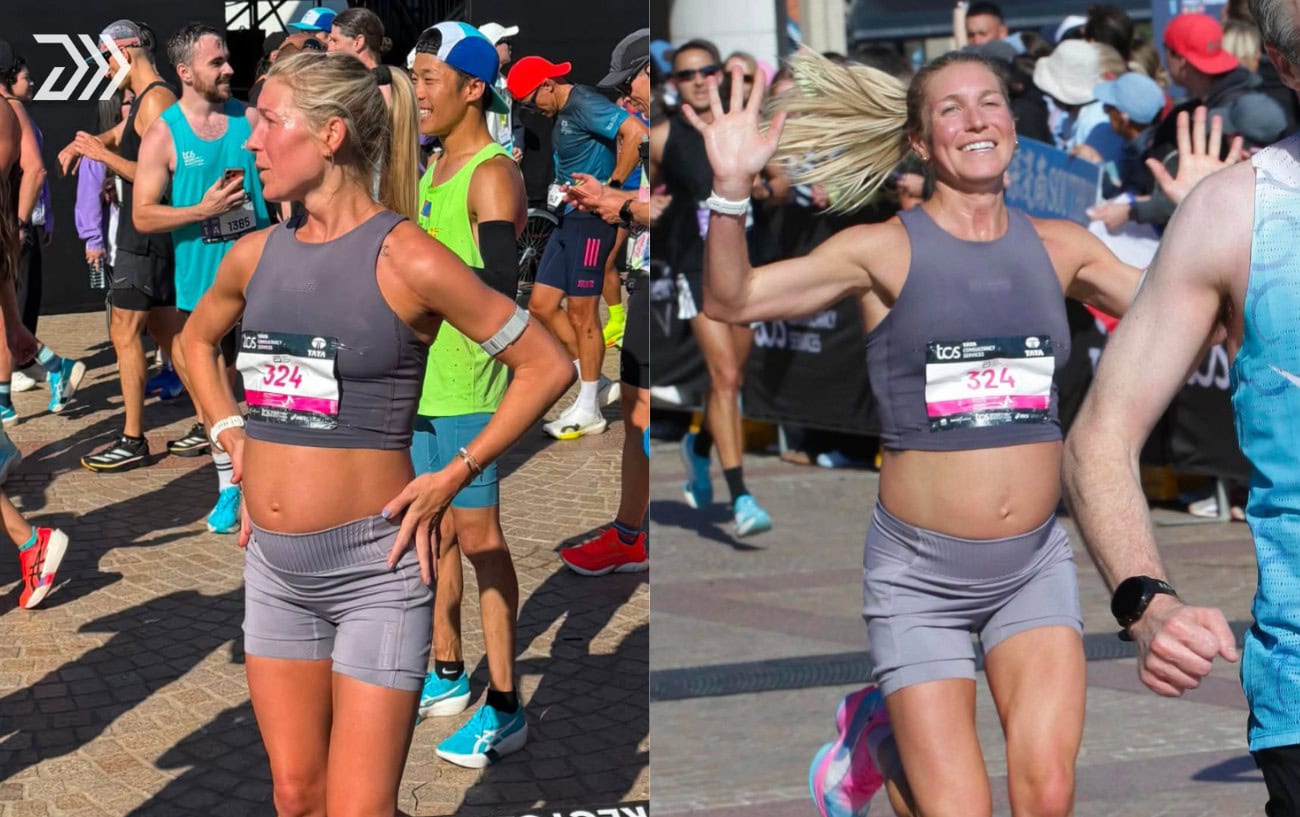
Ali Anderson ran 2:59:43 at the Sydney Marathon on Sunday, a time that puts her inside the roughly 1 percent of women who break three hours for the distance, and she ran it 32 weeks into her first pregnancy.
Anderson, 29, had entered Sydney before she learned she was pregnant. She told News24 Australia she saw no reason to give up the start, and she was one of a record 40,000 entrants who ran from North Sydney to the Opera House. It counted as her fourth World Marathon Major, her seventh marathon overall, and the second she has run pregnant. At Boston in April, at 13 weeks, she ran 2:41:58 for her personal best, and announced the pregnancy afterward.
Boston took an average of 6:11 per mile. Sydney took 6:52, roughly 41 seconds per mile slower across 26.2 miles (42.2K), and 17 seconds inside three hours. A sub-3 marathon requires 6:51 per mile, so Anderson held the pace she needed and little more. Sydney drops off the Harbour Bridge early, then rolls through the eastern suburbs. “I’m obviously heavier, so the hills were a little bit more intense. But I felt really good, and I wasn’t pushing too hard,” she told Yahoo Lifestyle. She gave Yahoo the time as 2:59:43; News24 reported it one second quicker.
What she had to plan around was bathroom stops. “The challenges were mostly just the potty stops and factoring that into my time,” she told News24. Walking afterward was harder than running, she said.
Anderson put the question to her doctor early on, and recounted the answer to Yahoo Lifestyle: “There’s no reason to stop what you’re doing. You’re obviously not going for a personal record or anything, so it’s safe for you to keep going.” Her pregnancy was uncomplicated, she said. Conditions such as preeclampsia and placenta previa rule running out.
The evidence behind that advice comes from studies of exercise rather than studies of racing. A 2019 systematic review in BMC Pregnancy and Childbirth pooled 15 studies covering more than 32,000 pregnancies and found that vigorous exercise continued into the third trimester made no meaningful difference to birthweight, a mean difference of 8 grams, added about 0.21 weeks to gestation, and carried a lower risk of preterm birth. Its authors concluded that “vigorous intensity exercise completed into the third trimester appears to be safe for most healthy pregnancies.” The one qualification sits close to what Anderson did. Among the studies reviewed, one on elite athletes recorded fetal bradycardia, a slowing of the fetal heart rate, once exercise intensity passed 90 percent of maximum heart rate.
Anderson described managing exactly that. “When you run as much as I do, you get to know your body and what feels too much, so I was really in tune with not going at my maximum capacity,” she said.
A 2018 cohort study in BMJ Open Sport & Exercise Medicine surveyed 1,293 women recruited through parkrun and found that 208 of them, 16 percent, kept running into the third trimester. Their gestational age at delivery and their babies’ birthweight centiles were indistinguishable from the women who did not run, at any weekly distance, although assisted vaginal deliveries were more common among runners, 27 percent against 22 percent. None of that describes racing 26.2 miles at close to threshold effort, and guidance on running while pregnant generally has runners moving to a walk-jog by the third trimester, with many walking only from weeks 32 to 36 and returning to running on a graded plan after birth.
Sydney’s rules gave Anderson a way to defer, and she did not use it. The race’s 2026 pregnancy and postpartum policy let a pregnant entrant move her place to 2027, 2028 or 2029 on a letter from a doctor, registered midwife or obstetrician naming an anticipated due date, with a deadline of 5 p.m. AEST on Aug. 14. The policy governs deferral, and carries no guidance on running while pregnant.
Sydney was Anderson’s last marathon before the birth. “I have put her through two marathons now and that is enough for her,” she told News24. She had a third marathon booked for December and had planned an attempt at the U.S. Olympic Marathon Trials standard, which USATF has set at 2:37:00 for women in 2028, with the marathon qualifying window open since Sept. 1, 2025. Her Boston time sits 4 minutes and 58 seconds outside it.
RunClub
Get more running stories — join RunClub
Daily running news, a community of 300,000+ runners, free training plans for every distance, and a daily running game. Free to join — no card.
Already a member? Log in →








Start the conversation