


No marathon has produced more world records than Berlin, which has now seen 13 of them, and the reason is not complicated. The road is wide and smooth, the corners are few and shallow, and across the full 26.2 miles (42.2K) the course climbs about 240 feet (73 m) and gives back about 260, on figures compiled by findmymarathon, which over that distance amounts to nothing you can feel. Organizers call it the flattest course in the World Marathon Majors and nobody has bothered to argue.
It is worth being precise about what that flatness actually buys you, because it is not an easy race. What Berlin removes is every excuse. There is no hill to blame, no long exposed drag to plan around, nothing to survive. Whatever happens to you after mile 18 happened because of how you ran the first 18, and that is a harder thing to get right than a course profile makes it look.
Here is the road as you will meet it, from the pens on Straße des 17. Juni to a finish line about 300 m past the Brandenburg Gate.
Miles 1 to 3 (0 to 5K): Tiergarten and the Long Straight West
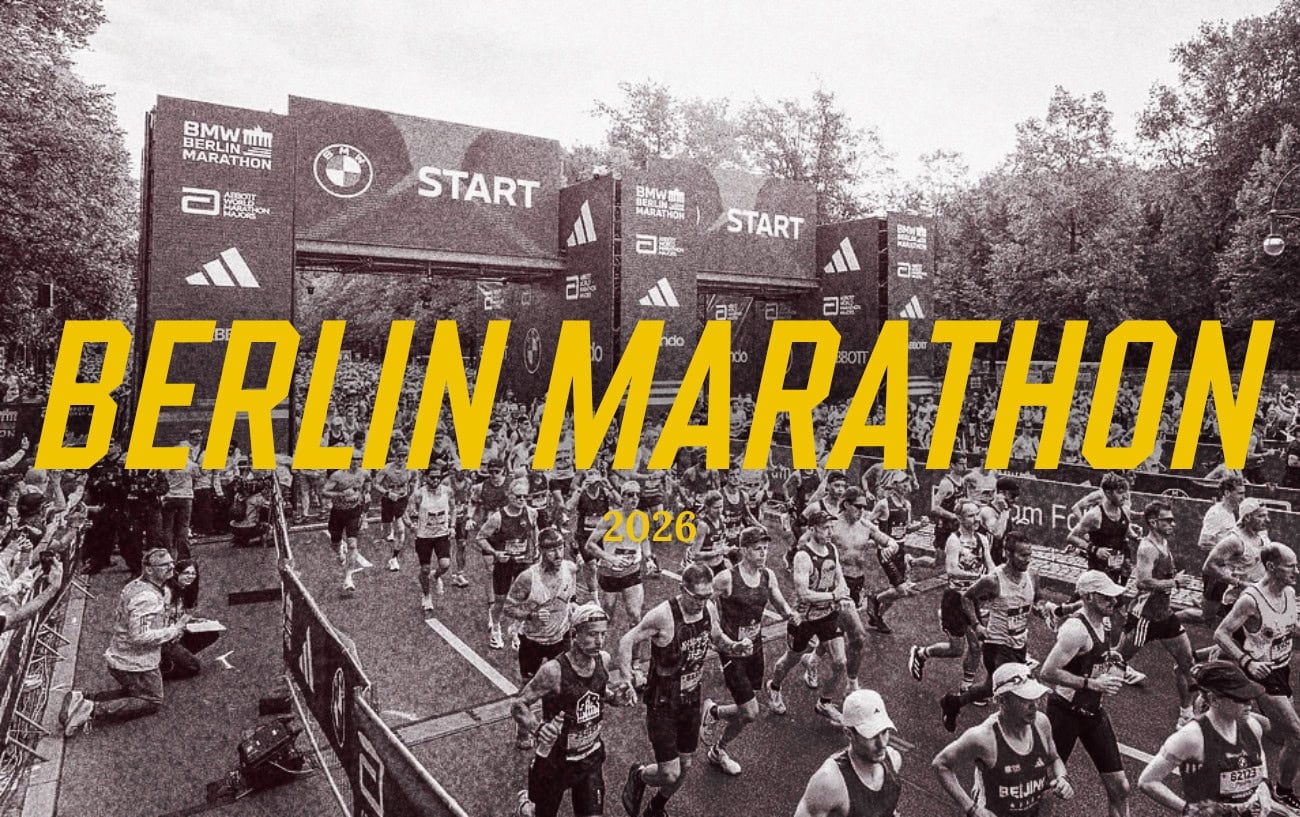
More than 56,000 runners are expected on the start line in 2026, and for the first mile and a half it feels like most of them are within reach of your elbow. Six waves go from 8:45 a.m. onto a road built wide enough for military parades, and it still is not wide enough. The Victory Column arrives inside the first kilometer and the Charlottenburg Gate shortly after, though most people spend this stretch watching the back of someone’s head rather than the monuments.
Run the opening mile 10 to 20 seconds slow and let it go. Clawing it back in mile two, in that traffic, costs far more than the time is worth.
Two things to sort out before you get here. Berlin paints a blue line on the road marking the exact 42.195K, the ideal line to the finish, and on a course with this many gentle bends it is worth following wherever the traffic allows. And every kilometer marker carries a clock, which is the only timing you will get: there is not one mile marker anywhere on this course. If you think in miles, convert your splits and write them down before race morning, because nobody does arithmetic well at threshold. The first water station, water only, is at 5K.
Miles 3 to 6 (5 to 10K): Moabit and the Government Quarter
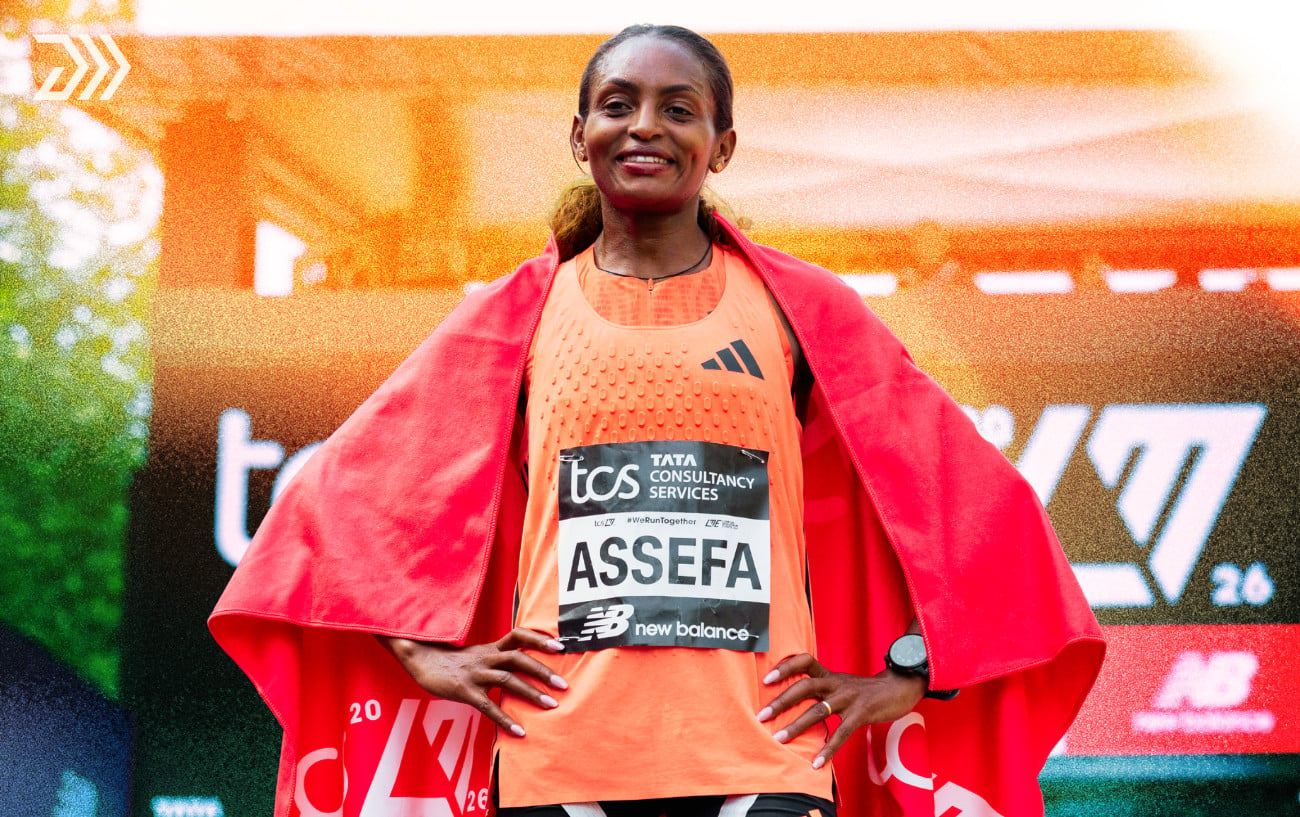
Then it goes quiet. The course turns north and east through Charlottenburg into Moabit along Alt-Moabit, and the crowds thin for the first time, which is a relief for about a mile and then is not. The Reichstag and the Spree come up on the right along Otto-von-Bismarck-Allee and Reinhardtstraße. The first proper aid station, with water, fruit, tea and Maurten Drink Mix 160, is at 9K.
This is where the field finally strings out and a pace stops being a guess. It is also the first place people overspend, because the legs are fresh, the road is flat, and there is a clock at every kilometer inviting you to do the math on a finishing time you have not earned yet.
Miles 6 to 10 (10 to 16K): Mitte, Alexanderplatz, and Karl-Marx-Allee
Torstraße carries the course east through Mitte past Rosenthaler Platz, and somewhere along it the television tower turns up as a shape at the end of the road. It keeps reappearing for the rest of the morning from angles that make no sense. Then Karl-Liebknecht-Straße, Alexanderplatz and the World Clock, then Alexanderstraße and the turn onto Karl-Marx-Allee toward Strausberger Platz. Water at 12K, a full station at 15K.
Karl-Marx-Allee is 90 m across, built in the 1950s as a showpiece boulevard for East Berlin, and it is the loudest place on the course. It is lined on both sides and the noise comes off the buildings and stays there. It also arrives at about mile nine, which is the precise point in a marathon at which a person feels indestructible.
This is the most expensive mile on the course. Whatever pace Karl-Marx-Allee talks you into, you will be holding it for another 16 miles in a much quieter part of town.
Miles 10 to 14 (16 to 22.5K): Kreuzberg, Neukölln, and Halfway
South down Lichtenberger Straße and Heinrich-Heine-Straße, through Moritzplatz, into Kreuzberg at Kottbusser Tor, then down Kottbusser Damm to Hermannplatz. Halfway falls somewhere in here.
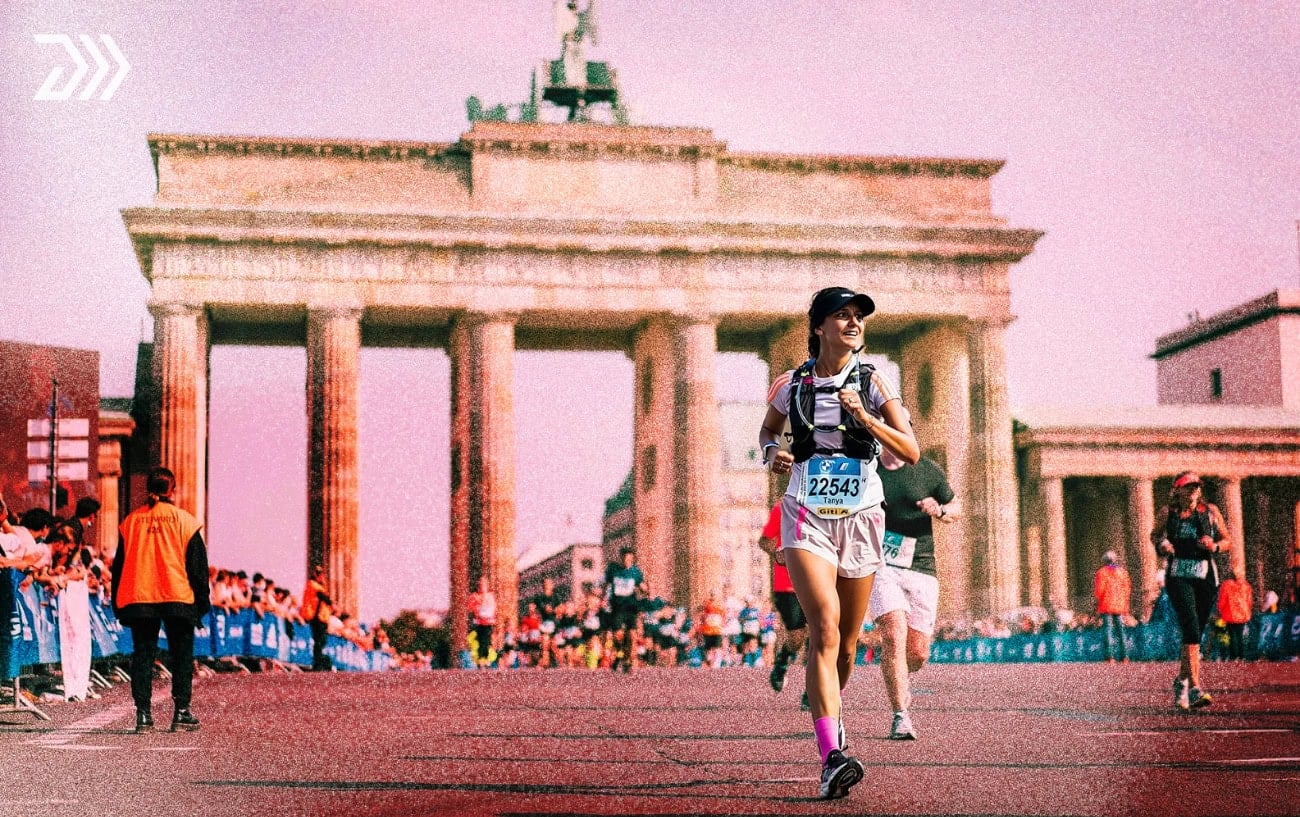
Kreuzberg and Neukölln are the reason Berlin has a reputation for sound systems rather than cowbells. The support is unofficial, loud and right on top of the road, and the road itself is narrower than anything since the start, so for the first time the line you run genuinely matters. Water at 17.5K, a full station at 20K.
Carry two numbers through this section. Eliud Kipchoge passed halfway in 59:51 on the way to 2:01:09 in 2022 and came home in 1:01:18. Sabastian Sawe went through in 1:00:16 in 2025 and came home in 1:02:00 for 2:02:16. Those are two of the fastest marathons ever run, on the flattest major course in the world, and neither man got back quicker than he went out. Negative splitting Berlin is a good deal rarer than the elevation profile says it ought to be.
Miles 14 to 18 (22.5 to 29K): Hasenheide to Schöneberg
More turns are packed into these four miles than into the whole rest of the race. West along Hasenheide, through Gneisenaustraße and Mehringdamm, then onto Yorckstraße and west into Schöneberg by way of Grunewaldstraße and Martin-Luther-Straße. Not one of them is sharp. Each costs a little rhythm, and rhythm is most of what you have left by this stage.
The crowd changes character out here too. Southwest Berlin is residential, and after Kreuzberg the support turns steady and polite. If you feed off noise, know that it thins out at exactly the point you will start needing it, which is a decent argument for having the last of your gels planned rather than improvised. Water at 22.5K, the full spread at 25K, then 27.5K, which carries water and the only gel handout on the course, Maurten Gel 100.
Miles 18 to 21 (29 to 34K): Friedenau, Schmargendorf, and the High Ground
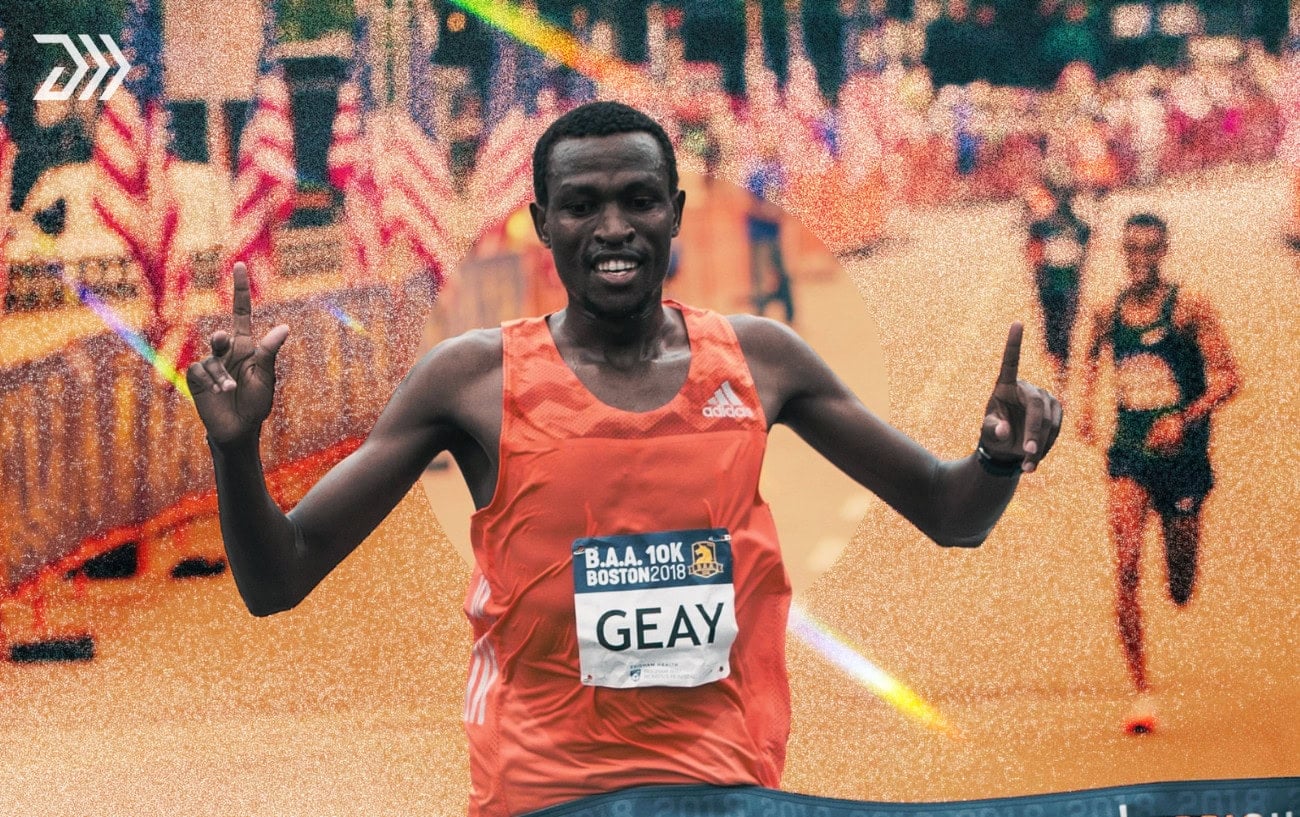
The least photogenic stretch of the Berlin course is the one every pacing guide circles, and the elite splits back them up.
Past Rathaus Schöneberg, where Kennedy gave the “Ich bin ein Berliner” speech, then out through Friedenau and Schmargendorf and onto Hohenzollerndamm toward Fehrbelliner Platz. It is the far corner of the loop and the highest ground on it. The high point of the course sits about 165 ft (50 m) above sea level and the low point is 91 ft (27 m), with the whole of that difference smeared across miles instead of stacked into anything you could point at. There is no hill to see. What is left is a drag so slight that the only evidence of it is the pace on your watch, and it arrives at the exact stage of a marathon when a drag that slight is plenty.
Kipchoge’s slowest 5K segment of his world record, 14:43, came between 35K and 40K, only 29 seconds off his opening one, on ground where he could see nothing wrong. The course does not do anything to you out here. It simply stops helping, and the wall turns up on schedule regardless of how flat the road is. A full station at 30K, water at 32.5K, then Konstanzer Straße drops you onto Kurfürstendamm with an extra water point just past 33K at Olivaer Platz.
Miles 21 to 24 (34 to 38.5K): Kurfürstendamm and Wittenbergplatz
Everything changes at once on the Ku’damm: shops, traffic lanes, people standing four deep. It runs straight, broad and very slightly downhill back toward the center, past the Memorial Church, then Tauentzienstraße past KaDeWe, then Wittenbergplatz.
That shallow descent is the second trap on the course and a much better disguised one than Karl-Marx-Allee. It is genuinely faster ground, it arrives with a little under six miles (9K) left, and it feels like payment for the six that came before it. The runners who handle this section best let the gradient do the work and do not add to it. Water at 34.5K, a full station at 36K, water again at 38K.
Miles 24 to 26.2 (38.5 to 42.2K): Potsdamer Platz, Unter den Linden, and the Gate
Kleiststraße to Nollendorfplatz, along Bülowstraße, then north up Potsdamer Straße to Potsdamer Platz at about 38K. From there the last four kilometers run east along Leipziger Straße before the course turns north past Gendarmenmarkt and swings west onto Unter den Linden. Last water at 40K.
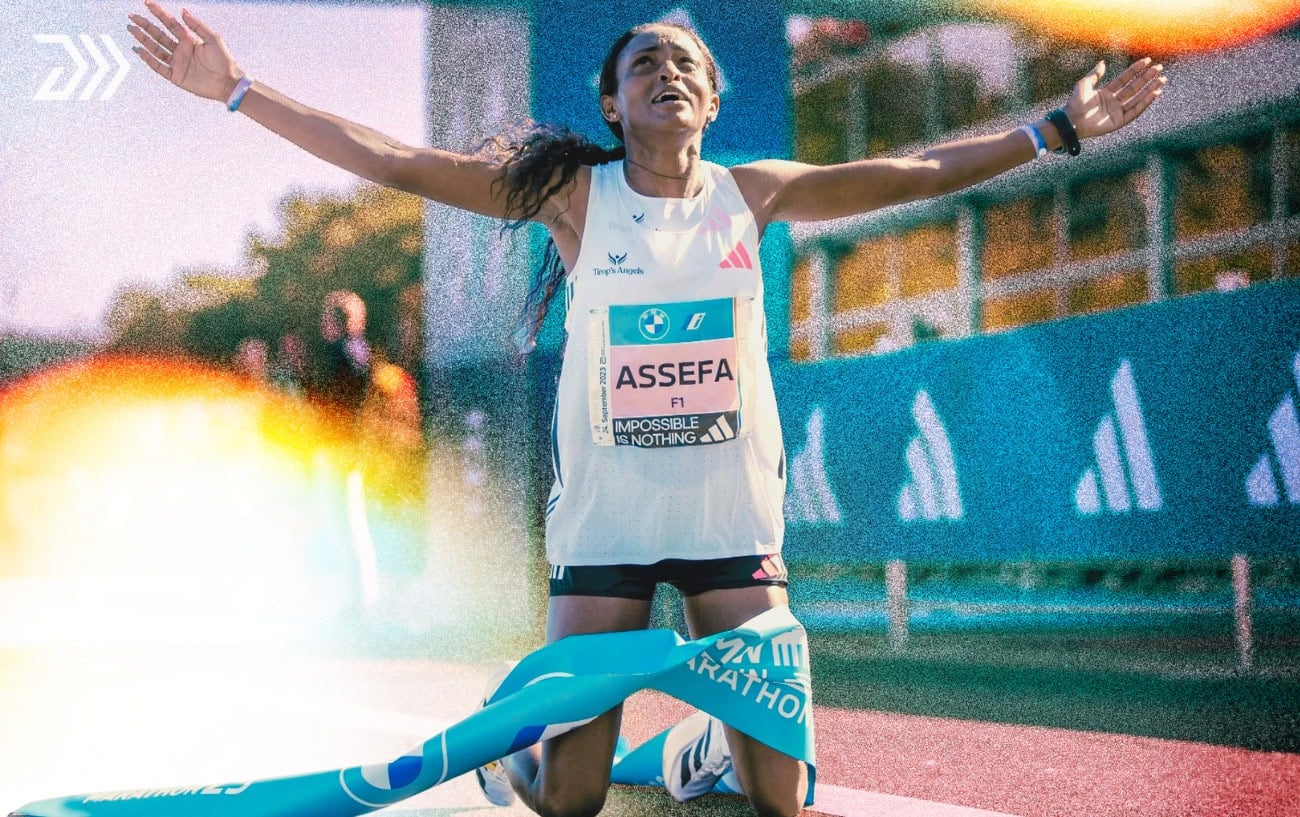
Unter den Linden is flat, straight and lined with trees, and the Brandenburg Gate sits at the end of it in plain view for much longer than anyone wants. It is an odd thing to run toward. For a good half mile it refuses to get any closer, and then it does, all at once.
Through the arch, the finish is about 300 m further on, back on Straße des 17. Juni near Yitzhak-Rabin-Straße. The Gate is where the photographs happen, the mat is past it, and every year a fair number of people ease up at the arch and hand back seconds they spent five months earning.
The 2026 race goes off on Sunday, Sept. 27, without defending champion Sabastian Sawe, who withdrew in late August with a tibial stress fracture, four months after running 1:59:30 in London. Tigst Assefa is back on the course where she ran 2:11:53 in 2023, still the Berlin course record. The race has finished at the Brandenburg Gate only since 2003. Before that it ended out on Kurfürstendamm, and runners first came through the arch at all in 1990, the year after the wall opened.
Every Aid Station on the Berlin Marathon Course
| Distance | What is there |
|---|---|
| 5K | Water |
| 9K | Water, fruit, tea, Maurten Drink Mix 160 |
| 12K | Water |
| 15K | Water, fruit, tea, Maurten Drink Mix 160 |
| 17.5K | Water |
| 20K | Water, fruit, tea, Maurten Drink Mix 160 |
| 22.5K | Water |
| 25K | Water, fruit, tea, Maurten Drink Mix 160 |
| 27.5K | Water and Maurten Gel 100 (the only gel on the course) |
| 30K | Water, fruit, tea, Maurten Drink Mix 160 |
| 32.5K | Water |
| 33K (Olivaer Platz) | Water |
| 34.5K | Water |
| 36K | Water, fruit, tea, Maurten Drink Mix 160 |
| 38K | Water |
| 40K | Water |
RunClub
Get more running stories — join RunClub
Daily running news, a community of 300,000+ runners, free training plans for every distance, and a daily running game. Free to join — no card.
Already a member? Log in →


Start the conversation